Before we go any further here, has it ever occurred to any of you that all this is simply one grand misunderstanding? Since you’re not here to learn anything, but to be taught so you can pass these tests, knowledge has to be organized so it can be taught, and it has to be reduced to information so it can be organized do you follow that? In other words this leads you to assume that organization is an inherent property of the knowledge itself, and that disorder and chaos are simply irrelevant forces that threaten it from the outside. In fact it’s the opposite. Order is simply a thin, perilous condition we try to impose on the basic reality of chaos . . .
Because the soul is progressive, it never quite repeats itself, but in every act attempts the production of a new and fairer whole. This appears in works both of the useful and the fine arts, if we employ the popular distinction of works according to their aim either at use or beauty. Thus in our fine arts, not imitation but creation is the aim. In landscapes the painter should give the suggestion of a fairer creation than we know. The details, the prose of nature he should omit and give us only the spirit and splendor. He should know that the landscape has beauty for his eye because it expresses a thought which is to him good; and this because the same power which sees through his eyes is seen in that spectacle; and he will come to value the expression of nature and not nature itself, and so exalt in his copy the features that please him. He will give the gloom of gloom and the sunshine of sunshine. In a portrait he must inscribe the character and not the features, and must esteem the man who sits to him as himself only an imperfect picture or likeness of the aspiring original within.
What is that abridgment and selection we observe in all spiritual activity, but itself the creative impulse? for it is the inlet of that higher illumination which teaches to convey a larger sense by simpler symbols. What is a man but nature’s finer success in self-explication? What is a man but a finer and compacter landscape than the horizon figures,—nature’s eclecticism? and what is his speech, his love of painting, love of nature, but a still finer success,—all the weary miles and tons of space and bulk left out, and the spirit or moral of it contracted into a musical word, or the most cunning stroke of the pencil?
But the artist must employ the symbols in use in his day and nation to convey his enlarged sense to his fellow-men. Thus the new in art is always formed out of the old. The Genius of the Hour sets his ineffaceable seal on the work and gives it an inexpressible charm for the imagination. As far as the spiritual character of the period overpowers the artist and finds expression in his work, so far it will retain a certain grandeur, and will represent to future beholders the Unknown, the Inevitable, the Divine. No man can quite exclude this element of Necessity from his labor. No man can quite emancipate himself from his age and country, or produce a model in which the education, the religion, the politics, usages and arts of his times shall have no share. Though he were never so original, never so wilful and fantastic, he cannot wipe out of his work every trace of the thoughts amidst which it grew. The very avoidance betrays the usage he avoids. Above his will and out of his sight he is necessitated by the air he breathes and the idea on which he and his contemporaries live and toil, to share the manner of his times, without knowing what that manner is. Now that which is inevitable in the work has a higher charm than individual talent can ever give, inasmuch as the artist’s pen or chisel seems to have been held and guided by a gigantic hand to inscribe a line in the history of the human race. This circumstance gives a value to the Egyptian hieroglyphics, to the Indian, Chinese and Mexican idols, however gross and shapeless. They denote the height of the human soul in that hour, and were not fantastic, but sprung from a necessity as deep as the world. Shall I now add that the whole extant product of the plastic arts has herein its highest value, as history; as a stroke drawn in the portrait of that fate, perfect and beautiful, according to whose ordinations all beings advance to their beatitude? Continue reading ““Art” — Ralph Waldo Emerson”→
1. I’ve been rewatching David Simon’s Baltimore epic The Wire, generally regarded as one of the best if not the best, TV series ever. I’ve been watching with my wife, who’s never seen the show before. I’m going to riff on a few of the themes of season four of The Wire here, and there will be spoilers.
If you’ve never seen The Wire and you think that some day you want to see it (it’s as good as everyone says it is, so you should want to see it) you shouldn’t read this post because of the spoilers.
2. Season four of The Wire takes education as its central subject. Specifically, it examines the different ways in which personal circumstance and chance (and maybe fate) intersect with institutions. The simplest example of one of these institutions might be Edward J. Tilghman Middle School, but there are other institutions too—the city’s political core, including the Mayor and his advisers, the police and their various detention centers, and even the criminal organizations that foster their own trainees.
3. Season four gives us four eighth graders to care about. The first episode of the season, “The Boys of Summer,” establishes these characters as they prepare to head from childhood into a more complex—and violent—world:
Childish joy and youthful agitation mixes with real territorial violence here; everything that follows in the season shades this scene with a bleak irony.
4. Season four presents a series of possible mentor relationships, wherein various principal characters contend to steward, foster, educate, or otherwise help these four kids turn into four men.
Roland Pryzbylewski, one-time detective-cum-fuck-up, becomes the teacher Mr. Presbo. He idealistically tries to help the four kids, who all take his class together. Parallel to Pryzbylewski’s efforts in the classroom are Dennis “Cutty” Wise’s efforts in the boxing gym; he hopes to take these kids off the corners as well. Initially, Presbo fosters Randy and Dukie while Cutty tries to make headway with Namond and Michael.
As the season develops, different mentors present themselves for each of the kids. Almost all fail.
Cutty loses whatever inroads he had on mentoring Michael, who comes under the tutelage of the dark assassin Chris. Tellingly, Michael enlists Chris in killing off his brother Bug’s father; the assassination is Oedipal.
Mr. Presbo helps Dukie in real and meaningful ways, making sure that the indigent child has clean clothes and a place to shower, but also showing him a kind of loving respect wholly absent in his relationship with “his people,” hopeless, horrible drug addicts. However, after Dukie is promoted to high school early, Mr. Presbo realizes that he will have to limit his involvement with the boy. He sees that there will always be another Dukie to come along, and that he can’t “keep” the boy—only steward him for a year or two.
After a series of institutional bungles, Carver tries to protect Randy, but loses him to a group home. The last time we see Randy he receives a savage beating at the hands of his roommates.
5. (I should now bring up Sherrod, a dim bulb of maybe 15 who seems to have dropped out of school years ago. Homeless, he’s “schooled” by Bubbles, who first tries to make him return to Tilghman, and then, seeing the boy won’t go, tries to teach him some basic survival skills. Sherrod ends up dead though, and Bubbles, feeling that the death is his fault (which it is in part), attempts suicide. Another failed mentor.
We can also bring up Bodie, whom McNulty attempts to help, albeit the relationship here is hardly on the mentor/avuncular (which is to say, displaced father/son) axis that the other five boys experience. Still, McNulty tries to steer Bodie to a path that would help absolve the young man’s conscience. The path leads to the young man’s murder).
6. And Namond?
Namond is perhaps the most fascinating figure in season four, at least for me. He’s a spoiled brat, hood rich, the son of infamous Barksdale enforcer Wee-Bey Brice who is doing life for multiple murders. Namond is petulant and mean and immature. He bullies Dukie, yet he doesn’t have the “heart” (in the series’s parlance) to manage selling drugs on his corner, a weakness that comes to harsh light when a child of no more than eight steals his package of drugs. Namond is a mama’s boy, but bullied by an overbearing mother, a woman who encourages him to drop out of school to sell drugs for her own material comfort. He is not made of the same stuff as his father.
Namond is also creative, funny, charismatic, individualistic, and intelligent. Bunny Colvin sees these qualities and sees an opportunity to help—to really help—one person. And here is the moment of consolation in season four. It’s a consolation for Colvin, who has experimented twice now with programs that bucked the institutional path (Hamsterdam in season three; the corner kids project in season four), and perhaps it’s a consolation for Cutty, who is instrumental in connecting Colvin with Wee-Bey. But it’s also a consolation for the audience, who perhaps will concede that one out of four ain’t bad. (Although clearly, three out of four children are left behind).
7. The Wire’s emphasis on Baltimore locations, specific regional dialects, and its use of local, semi-professional actors afforded the show a strong sense of realism. Straightforward shots and short scenes added to this realism. What I perhaps like most about The Wire’s realism is its near-complete lack of musical cues: other than the opening song and closing credits soundtrack, the only music that appears in any scene in The Wire is internal to the scene, i.e., we only hear music if the characters are hearing it (in their cars, on their stereos, etc. — a la rule two of Dogme 95).
The Wire breaks from these formal realistic conventions at the end of each season, using a montage—a device it almost always avoids—overlaid with a song. Here’s the montage from the end of season four:
8. I include the montage as a means to return to point 6, Namond. The images unfold, giving a sense of where our characters (those who survive season four) will go next (the universe of The Wire is never static; our characters are always in motion). The montage settles (about 4:40 in the video above) to rest on Namond, working on his homework, clearly more comfortable if not at ease in his new life with the Colvins. A family embraces on the porch of the house behind the Colvin house, signaling that Namond has finally arrived in an institution that can protect and foster and nourish him—a loving family. A reminder of his old life as a corner boy enters the scene as the young car thief Donut pulls up, smiling; there’s an implicit offer to return to the corner life here. Then Donut blazes through a stop sign, almost causing a wreck. Namond’s troubled face signals that he’s learned something, but it also twists into a small grin. The shot lingers on the crossroads: open possibility, but also the burden of choice.
9. (Parenthetical personal anecdote that illustrates why season four is, for me, easily the most emotionally affecting entry in The Wire:
For seven years I taught at an inner city high school that was plagued by low test scores, low student interest, and violence. The school’s population was about 95% black, with most students receiving free or reduced lunch. I was still working at this school when I first saw The Wire’s Edward J. Tilghman Middle School, and although the depiction was hyperbolic in places, the general tone of chaos and apathy was not at all unfamiliar to me. There were fights at my school. Brawls. Gang violence. Murders even—student-on-student murders that still haunt me today (these didn’t happen on campus, but they were still our students). I recall one day leaving early—I had fourth period planning and my principal allowed me to leave once a week to attend a graduate school course—and being stunned to see two swat trucks pull up around the school and unload teams of militarized police.
Most of our students were good people trying to get a good education despite very difficult circumstances that were beyond their own control—poverty, unstable family environments, severe deficits in basic skills like reading and math. And most of our teachers were good people trying to help these students as best as they knew how in spite of a draconian, top-heavy management structure that emphasized the Florida Comprehensive Assessment Test (FCAT) as the end-all be-all of education.
I’m tempted here to rant about tests like the FCAT and legislation like the No Child Left Behind Act, rant about how they drain schools of resources, rob children of a true education, and limit teachers’ and schools’ ability to differentiate instruction—but that’s not the point of this riff.
Probably more productive to let The Wire illustrate. I’ve sat in meetings like this one (I imagine many educators have):
The primary goal of the institution is always to maintain the institution, no matter what the mission statement might be.
What I’m trying to say here is that The Wire’s Edward J. Tilghman Middle School strikes me as very, very real).
10. I’ll conclude by returning to Namond and Colvin and suggest that this is the closest thing to a happy ending that The Wire could possibly produce. The Wire perhaps boils down to the evils of institutionalism (of any kind); Colvin (and, to be fair, Cutty and Wee-Bey to a certain extent) must take an individualistic response to bypass institutional evils. (In season five, McNulty will carry out an individualistic response to institutional apathy—which is to say practical evil—on a whole new level).
The Wire plainly shows us that life costs, that all decisions cost, and that decisions cost in ways that we cannot calculate or measure or foresee. Namond’s future comes at the cost, perhaps, of Michael, Dukie, and Randy, the children who are left behind. And here is the real evil of a mantra like “no child left behind”—its sheer meaningless as a philosophy inheres in its essentially paradoxical nature, whereby if no single child can be left behind then all children can be left behind—the institution simply redefines or “jukes” what “behind” means. Colvin’s solution, on one hand, is to pragmatically assess the costs and payoffs of managing his interest in education, in being “a teacher of sorts” (as he calls it). (This pragmatic side echoes his Hamsterdam experiment in season three). Colvin’s pragmatism is successful though not only because he realizes his limitations—he cannot help just any child, and certainly not every child—it is also successful because it is tempered in love.
Steve Kemper’s Labyrinth of Kingdom looks pretty cool. Here’s publisher Norton’s write up:
In 1849 Heinrich Barth joined a small British expedition into unexplored regions of Islamic North and Central Africa. One by one his companions died, but he carried on alone, eventually reaching the fabled city of gold, Timbuktu. His five-and-a-half-year, 10,000-mile adventure ranks among the greatest journeys in the annals of exploration, and his discoveries are considered indispensable by modern scholars of Africa.
Yet because of shifting politics, European preconceptions about Africa, and his own thorny personality, Barth has been almost forgotten. The general public has never heard of him, his epic journey, or his still-pertinent observations about Africa and Islam; and his monumental five-volume Travels and Discoveries in North and Central Africa is rare even in libraries. Though he made his journey for the British government, he has never had a biography in English. Barth and his achievements have fallen through a crack in history.
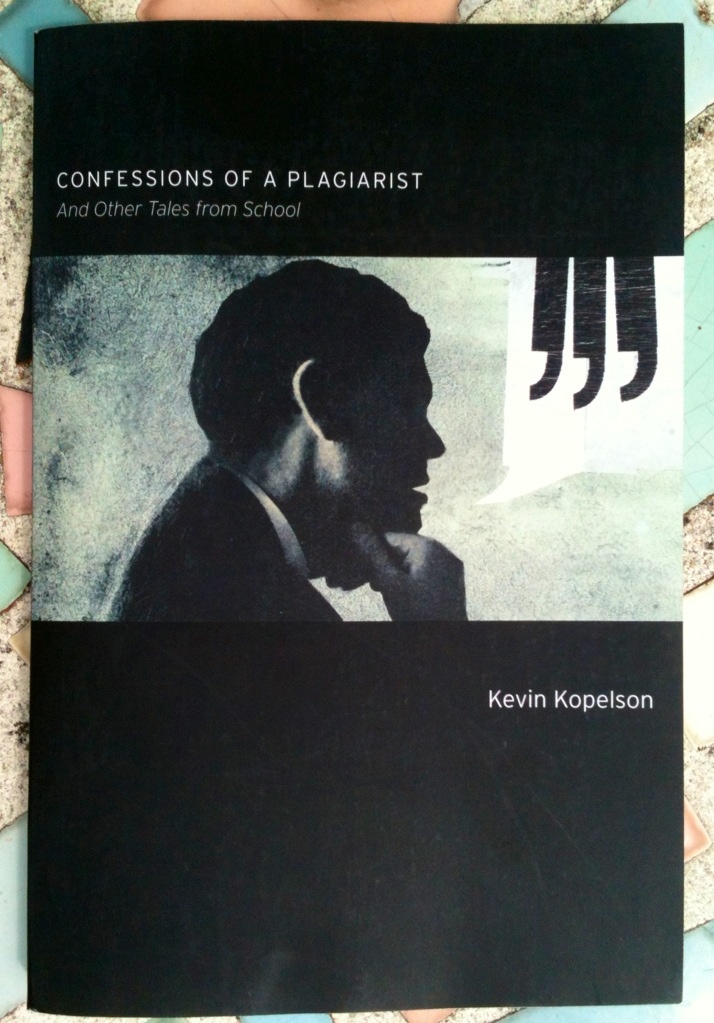
Kevin Kopelson’s Confessions of a Plagiarist—not really sure what to make of this one. Publisher Counterpath’s blurb:
In college, Kevin Kopelson passed off a paper by his older brother Robert as his own. In graduate school, he plagiarized nearly an entire article from a respected scholar, and then later, having met her and been asked if he would send something for her to read, sent that essay he had plagiarized from her work. This is not to mention the many instances in which he quoted others extensively, not passing their work off as his own, but substituting it for his own words when his words were what were called for. Until recently, such plagiarisms and thefts had been his most shameful secret, shared only with a trusted few. But then Kopelson—now an English professor and the author of a number of respected books, most recently 2007’s Sedaris—wrote an essay entitled “My Cortez,” which was published in the London Review of Books in 2008. It was a satirical literary confession, an exploration of Kopelson’s personal and professional life via his various acts of plagiarism. From that jumping off point and exploring also his other vices, Confessions of a Plagiarist is the compelling and clever retelling (not to mention renovation) of Kopelson’s life, one transgression at a time.
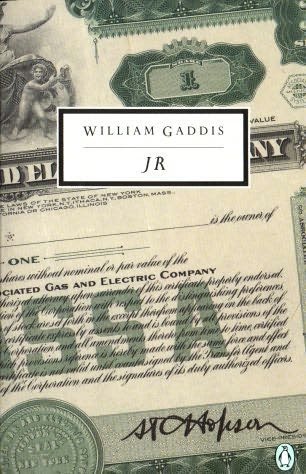
Near the beginning of William Gaddis’s sprawling novelJ R, erstwhile protagonist Jack Gibbs rants about knowledge to his students:
Before we go any further here, has it ever occurred to any of you that all this is simply one grand misunderstanding? Since you’re not here to learn anything, but to be taught so you can pass these tests, knowledge has to be organized so it can be taught, and it has to be reduced to information so it can be organized do you follow that? In other words this leads you to assume that organization is an inherent property of the knowledge itself, and that disorder and chaos are simply irrelevant forces that threaten it from the outside. In fact it’s the opposite. Order is simply a thin, perilous condition we try to impose on the basic reality of chaos . . .
1. I want to write about William Gaddis’s novel J R, which I am about half way through now.
2. I’ve been listening to the audiobook version, read with operatic aplomb by Nick Sullivan. I’ve also been rereading bits here and there in my trade paperback copy.
3. What is J R about? Money. Capitalism. Art. Education. Desperate people. America.
4. The question posed in #3 is a fair question, but probably not the right question, or at least not the right first question about J R. Instead—What is the form of J R—How is J R?
5. A simple answer is that the novel is almost entirely dialog, usually unattributed (although made clear once one learns the reading rules for J R). These episodes of dialogue are couched in brief, pristine, precise, concrete—yet poetic—descriptions of setting. Otherwise, no exposition. Reminiscent of a movie script, almost.
6. A more complex answer: J R, overstuffed with voices, characters (shadows and doubles), and motifs, is an opera, or a riff on an opera, at least.
7. A few of the motifs in J R: paper, shoes, opera, T.V. equipment, entropy, chaos, novels, failure, frustration, mechanization, noise, hunting, war, music, commercials, trains, eruptions of nonconformity, advertising, the rotten shallowness of modern life . . .
8. Okay, so maybe that list of motifs dipped into themes. It’s certainly incomplete (but my reading of J R is incomplete, so . . .)
9. Well hang on so what’s it about? What happens?—This is a hard question to answer even though there are plenty of concrete answers. A little more riffage then—
10. Our eponymous hero, snot-nosed JR (of the sixth grade) amasses a paper fortune by trading cheap stocks. He does this from a payphone (that he engineers to have installed!) in school.
11. JR’s unwilling agent—his emissary into the adult world—is Edward Bast, a struggling young composer who is fired from his teaching position at JR’s school after going (quite literally) off script during a lesson.
12. Echoes of Bast: Thomas Eigen, struggling writer. Jack Gibbs, struggling writer human. Gibbs, a frustrated, exasperated, alcoholic intellectual is perhaps the soul of the book. (Or at least my favorite character).
13. Characters in J R tend to be frustrated or oblivious. The oblivious characters tend to be rich and powerful; the frustrated tend to be artistic and intellectual.
14. Hence, satire: J R is very, very funny.
15. J R was published over 35 years ago, but its take on Wall Street, greed, the mechanization of education, the marginalization of art in society, and the increasing anti-intellectualism in America is more relevant than ever.
16. So, even when J R is funny, it’s also deeply sad.
17. Occasionally, there’s a histrionic pitch to Gaddis’s dialog: his frustrated people, in their frustrated marriages and frustrated jobs, explode. But J R is an opera, I suppose, and we might come to accept histrionics in an opera.
18. Young JR is a fascinating study, an innocent of sorts who attempts to navigate the ridiculous rules of his society. He is immature; he lacks human experience (he’s only 11, after all), and, like most young children, lacks empathy or foresight. He’s the perfect predatory capitalist.
19. All the love (whether familial or romantic or sexual) in J R (thus far, anyway) is frustrated, blocked, barred, delayed, interrupted . . .
20. I’m particularly fascinated by the scenes in JR’s school, particularly the ones involving Principal Whiteback, who, in addition to his educational duties, is also president of a local bank. Whiteback is a consummate yes man; he babbles out in an unending stammer of doubletalk; he’s a fount of delicious ironic humor. Sadly though, he’s also absolutely real, the kind of educational administrator who thinks a school should be run like a corporation.
21. The middlebrow novelist Jonathan Franzen, who has the unlikely and undeserved reputation of being a literary genius, famously called Gaddis “Mr. Difficult” (in an essay of the same name).
22. Franzen’s essay is interesting and instructive though flawed (he couldn’t make it through the second half of J R). From the essay:
“J R” is written for the active reader. You’re well advised to carry a pencil with which to flag plot points and draw flow charts on the inside back cover. The novel is a welter of dozens of interconnecting scams, deals, seductions, extortions, and betrayals. Between scenes, when the dialogue yields briefly to run-on sentences whose effect is like a blurry handheld video or a speeded-up movie, the images that flash by are of denatured, commercialized landscapes — trees being felled, fields paved over, roads widened — that recall to the modern reader how aesthetically shocking postwar automotive America must have been, how dismaying and portentous the first strip malls, the first five-acre parking lots.
23. Franzen, of course, is not heir to Gaddis. If there is one (and there doesn’t need to be, but still), it’s David Foster Wallace. Reading J R I am constantly reminded of Wallace’s work.
24. But also Joyce. J R is thoroughly Joycean, at least in its formal aspects: that friction between the deteriorated language of commerce and the high aims of art; the sense and sound and rhythms of the street. (Is there a character more frustrated in Western literature than Stephen Dedalus? Surely he finds some heirs in Gibbs, Bast, and Eigen . . .)
25. Gaddis denied (or at least deflected) a Joycean influence. Better to say then that they were both writing the 20th century, only from different ends of said century.
26. And then a question for navel-gazing lit major types, a question of little import, perhaps a meaningless question (certainly a dull one for most decent folks): Is J R late modernism or postmodernism? Late-late modernism?
27. Gaddis shows a touch of the nameyphilia that we see (out of control) in Pynchon: Hence, Miss Flesch, Father Haight, the diCephalis family, Nurse Waddams, Stella Angel, Major Hyde, etc.
28. To return to the plot, or the non-plot, of J R: As I’ve said, I’m only half way through the thing, but I can’t see its shape. That sentence might need a “yet” at the end; or, J R might be so much chaos.
29. In any case, I will report again at the end, if not sooner.
National Teacher Appreciation Week winds down today. Have you thanked that special teacher in your life? Or at least thought about him or her? No? Maybe your teachers scarred you. Or ruined you. It’s possible. But probably not all of them. I’m sure at least one of them was really important to you, right?
Although Biblioklept World Wide Industries brings in the kind of moolah that allows me to literally swim in cash à la Scrooge McDuck, I retain my day job as a teacher of literature in the English language; I do this because, you know, I care. So me waxing heavy on why teachers matter and blah blah blah is sort of like waitresses overtipping other waitresses because, you know, they know. So I’ll just say that teachers are generally overworked, underpaid, and perhaps undervalued in our society, and I appreciate all of you–all of you who taught me and shaped me and mentored me and shared your wisdom with me, and all of you who I’ve worked with over the years who’ve inspired me to do better and be better. Thanks.
So well anyway, I’ve been skimming again through Nietzsche’s highly-aphoristic volume Human, All Too Human for the past week, and came across this passage, section 200, Caution in writing and teaching. Quoting in full:
Whoever has once begun to write and felt the passion of writing in himself, learns from almost everything he does or experiences only what is communicable for a writer. He no longer thinks of himself but rather of the writer and his public. He wants insight, but not for his own use. Whoever is a teacher is usually incapable of doing anything of his own for his own good. He always thinks of the good of his pupils, and all new knowledge gladdens him only to the extent that he can teach it. Ultimately he regards himself as a thoroughfare of learning, and in general as a tool, so that he has lost seriousness about himself.
Ouch! Did Nietzsche just call me a tool? I think his words are actually quite insightful–teachers do think of themselves as instruments through which they may better their pupils. But I don’t think that that is the only end for knowledge as far as teachers are concerned, and I don’t think that that makes teachers unserious about knowledge. Knowledge-as-enlightenment and self-improvement is great of course, but knowledge-as-transcendence–that is, knowledge as wisdom and experience that can be passed from person to person, shared, communicated–that’s what’s really meaningful in life.
Formless Content is is unaware of the container. Definite Content embraces the container as a canvas. Formless content is usually only text. Definite content usually has some visual elements along with text. Much of what we consume happens to be Formless. The bulk of printed matter — novels and non-fiction — is Formless.
Mod argues that the rise of e-readers like the Kindle and (presumably) the iPad are harbingers of a new age in reading, where both formless and, now, definite content might be readily (and easily) displayed. He makes a brash judgment:
The convenience of digital text — on demand, lightweight (in file size and physicality), searchable — already far trumps that of traditional printed matter.
Really? On demand? For whom? “On demand” here presupposes a number of conditions, first and foremost, that each person who wishes to enjoy this new medium has the economic means to do so. The projected retail cost of the iPad is currently $500, a price that does not include monthly ISP fees, let alone the prices of e-books and other e-texts. The Kindle retails now for about half the price of the iPad. Although these prices will certainly fall over time, it is difficult to imagine that the “convenience of digital text” will trump equitable access to “traditional printed matter” — particularly for families with multiple children (at least any time soon).
Mod makes some good points about the future of printed, physical books in the age of e-readers (or, the iPad, a device he seems to think will normalize the medium):
I propose the following to be considered whenever we think of printing a book:
The Books We Make embrace their physicality — working in concert with the content to illuminate the narrative.
The Books We Make are confident in form and usage of material.
The Books We Make exploit the advantages of print.
The Books We Make are built to last.
The result of this is:
The Books We Make will feel whole and solid in the hands.
The Books We Make will smell like now forgotten, far away libraries.
The Books We Make will be something of which even our children — who have fully embraced all things digital — will understand the worth.
The Books We Make will always remind people that the printed book can be a sculpture for thoughts and ideas.
Anything less than this will be stepped over and promptly forgotten in the digital march forward.
Goodbye disposable books.
Hello new canvases.
Books as aesthetic, durable objects — great idea. But books as relics, as things to recall the smell of “now forgotten, far away libraries”? Really? Libraries function as an important space in communities that transcend the mediums of information in those libraries. It’s almost downright scary to posit some kind of project-utopia where a library becomes “digitized.” Also — and again, much of what Mod suggests here is great — but also, who are “our children” who “have fully embraced all things digital”? In the current geopolitical climate, Mod’s line of thinking can only realistically apply to “First World” countries. Even in our own beloved United States, first among the “First World,” we have difficulty feeding all of our children or funding their educations. E-readers like the iPad or Kindle could presumably do much to ameliorate the burgeoning education gap, but recent effortshaven’t gainedmuch momentum or praise.
It’s not that I disagree with (what I perceive to be) Mod’s overall thesis — that the iPad and successive e-readers will revolutionize how we read, access, and store information. I do, however, think that his rosy-toned enthusiasm has led to a number of blind spots in his article. Why should e-readers eliminate libraries? What, exactly, are “disposable books”? Who will have access to these “new canvases,” and in what capacity? Why the implicit presumption that digital storage of media is fail safe, easier than current methods, and more permanent?
Finally, my biggest problem with the piece is the simple assumption that any e-reader could be more comfortable than a paperback book. Mod addresses arguments like mine:
When people lament the loss of the printed book, this — comfort — is usually what they’re talking about. My eyes tire more easily, they say. The batteries run out, the screen is tough to read in sunlight. It doesn’t like bath tubs.
Mod responds to these arguments:
Important to note is that these aren’t complaints about the text losing meaning. Books don’t become harder to understand, or confusing just because they’re digital. It’s mainly issues concerning quality. One inevitable property of the quality argument is that technology is closing the gap (through advancements in screens and batteries) and because of additional features (note taking, bookmarking, searching), will inevitably surpass the comfort level of reading on paper.
While Mod’s point of meaning vs. quality (what I’d refer to as readability) is certainly right, his assumption that technology “will inevitably surpass the comfort level of reading on paper” is wholly unfounded and unsupported. It’s exactly the kind of teleological claim we see too often about technology — that technology always progresses to an inevitable, good, and superior end point. Still, Apple can feel free to send me an iPad and I’ll be sure to test my own assumptions on the issue, and redress them here if need be.
I teach at an inner-city school, and I’ve witnessed first hand just how awful NCLB has been: it basically aims to make zombies out of kids. Here’s a personal anecdote that best sums up how NCLB’s rigid testing processes work to attack the fostering of free thought: I was administering an FCAT practice test, and a young lady of about 15 years or so raised her hand for my assistance. Her problem was that the answer box for a short response question was far too small to accommodate her answer (her handwriting was also large). We are teaching kids to literally “think inside the box”; we are also mandating that there is always only “one right” answer to problems, which is plainly false.
Please take a few seconds to sign the online petition to abolish this heinous crime against our young people.
Claim: Annual standardized testing is the key to bringing school improvement and accountability to all schools. “For too long,” says the Department of Education, “America’s education system has not been accountable for results, and too many children have been locked in underachieving schools and left behind. … Testing will raise expectations for all students and ensure that no child slips through the cracks.”
Reality: A huge increase in federally mandated testing will not provide the services and strategies our schools and students need to improve. Most states and local districts have dramatically increased the use of standardized tests over the past two decades, but this did not solve the problems of poor schools. Some estimate that the new federal law will require states to give more than 200 additional tests at a cost of more than $7 billion.
Many studies show that standardized testing does not lead to lasting increases in student achievement and may in fact reduce it. Researchers at Arizona State University recently completed the largest study ever done on the issue. They concluded that “rigorous testing that decides whether students graduate, teachers win bonuses and schools are shuttered, an approach already in place in more than half the nation, does little to improve achievement and may actually worsen academic performance and dropout rates.” (New York Times, 12/28/02)
I found this on the floor of my classroom; I’m assuming it’s a student’s response to a prompt given by the social studies teacher who has my classroom while I’m on my planning period. I don’t know the student. What follows is the student’s response, verbatim:
“I think the US should blow up Iraq because Iraq is hating on the US and they would do whatever it takes to blow up us and we all are beefin.”
Clearly, this kid is savvy enough to work for the Bush administration.
I came of age (as the hackneyed phrase goes) in the nineties, a magical time when the Chicago Bulls ruled the world and Michael Jordan was the king of the universe. As a young kid, I didn’t really care about sports: I wasn’t very good at them and I didn’t really grow up in America, so my exposure and interest were limited on two fronts. But by 1991, my family had moved back to the States and I was suddenly aware of something very, very cool: there were these guys, the Bulls, who played like the best orchestra in the world. They were all awesome individually–Michael Jordan was basically God in Nikes, and there was this guy Scottie Pippen who was a star in his own right–but they also played as a real team. By the time the Bulls were going for their “threepeat” in the ’92 NBA season I–and just about every other kid in America–loved the Bulls. I didn’t really even care about basketball, to be honest–I liked it all right I guess, but what I really loved was to watch Jordan play. By the time I was headed to college, the Bulls were finishing up their second “threepeat,” and I knew for certain that I didn’t really care about basketball at all–just the Bulls and Jordan. I also knew that this was somehow lame or shameful, and it was also kind of sad. I only cared about seeing something really, really good. But who could blame me–especially after Jordan decided to come back after giving minor league baseball a shot, especially after game five of the ’97 championship, when Jordan, running a fever of over one hundred degrees, scored 38 points including a game-deciding three-pointer in the last minute. That’s pure magic; that’s divine spirit channeled. But why am I going on about this? You were probably there too, and if you weren’t, you know the mythology.
The point is that we love winners in America. We love to see someone excel at something, to do something better than anyone else, and do it harder, faster, longer, more, more, more. We don’t just want excellence, we want spectacular excellence (and conversely, devastating, soul-crushing failure). And we want excellence we can measure: points made, times beaten, wins racked up, championship victories accrued. We want to know for sure who won: we don’t like ties (soccer will never really take off in America). We want objective evidence to point to, so we can say plainly what is good and what is great and what is excellent and what is not: see, the numbers are right there.
This need for winners is, of course, not confined to the world of sports. Americans now seem to want to know who the winners in education are: they want test scores and school grades that objectively determine what a student knows or does not know. But the ability to think critically, rationally, logically, and creatively cannot truly be determined objectively. Education isn’t a basketball game, with points, and winners, and losers. When a basketball team is good, we know that they’re good because there is a system of rules that make the game a game (without the rules, there is no game). However, education is not a game, and treating it as such is unfair to young people in schools.
I am not making an argument that all kinds of testing be done away with, or that objective testing can’t provide a clear idea of the strengths and weaknesses of students and schools. The right kind of tests help assess deficiencies that can then be remedied. However, America is doing little right now to educate their children. Our educational model in this country goes back to the Industrial Revolution; we are behind the rest of the world in science education; we have abandoned the idea of teaching civic responsibility and bought in to the myth that to be American is to be a cannibal capitalist. There is clearly a gap between public expectations of public education and public support of public education. I don’t think that the average American comprehends the genuine literacy crisis that this country is faced with right now, but it’s real, it’s happening, and the results will be objectively measurable in the ever-growing gap between the rich and the poor in this country.
I’m on a rant now; sorry. I’ll try to be clearer: standardized tests like the Florida Comprehensive Assessment Test (FCAT) are a big waste of taxpayer money. They prove nothing and divert resources–money and educators’ time and energy–away from meaningful instruction and real learning. I’m not arguing that the test is too difficult–it’s not, and you certainly should be able to master such material in order to graduate high school–but the amount of stock the state has put into this test is ridiculous. It delimits creative and complex thought, limiting students to bubbling answers without recourse to explanation or rationale. Even the written response sections don’ t allow for real analytical assessment–students must literally think inside a tiny little box, and if their answer goes outside of the box, it will not be considered for grading. We need to abandon these types of tests and replace them with a meaningful, real-world based curriculum. We need to teach kids word processing, website design, standard office programs. Institute new hands-on science programs. Bring back shop, home ec, etc. But that’s not what’s happening: instead of curricula based on real-world needs, Florida continues to ask for objective data in place of real thinking, test scores instead of laboratories and practicums.
We all knew that Michael Jordan was great; we didn’t need the scoreboard to tell us. We didn’t need the MVP awards and National Championships and thousands of points he made to tell us. You could see it in his jump, in his tongue, in his eyes. It came out of the TV and you could feel it. MJ’s excellence was truly excellent because it transcended objective data: even a nerd like me could recognize it and honor it and hope to reach something close to it in some unknown way. We loved MJ because he represented an unquantifiable, nearly ineffable excellence; I believe that this excellence has a potential analog in the mind of any student in this country. But when we get hung up on things like points, scores, and grades, we not only send the wrong message, we also squander and misspend that potential.




 Biblioklept
