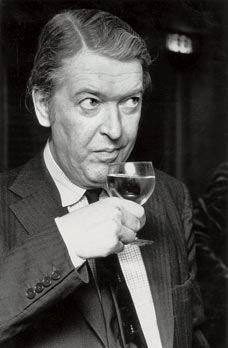
In his 1983 book Everyday Drinking, Kingsley Amis shares the recipe for his signature cocktail, the Lucky Jim — 12 to 15 parts vodka to one part vermouth with two parts cucumber juice. Yikes. More here and here.
Here’s a recently unearthed photo of the famously reclusive author J.D. Salinger putting on his socks. Earth shattering! Now if we could only get a peek of Thomas Pynchon adjusting his bolo . . . (More info here).


In Hilary Mantel’s 2005 novel Beyond Black, a fat psychic named Alison endures the harrowing torment of a collective of ghosts she calls the Fiends, the spirits of cruel men from her childhood. When a young, aimless woman named Colette comes into Alison’s life and assumes managerial duties for her career, Alison’s bilious past comes to a head. Colette engineers more and better gigs for Alison (the death of Princess Diana causes a huge spike in business), who, despite her genuine psychic talents, must nonetheless run the kind of scam the “punters” in her audience crave. Colette and Alison soon move in together, buying a new house in a quiet, boring suburb outside of London; their prefab homestead is drawn in sharp contrast to the slums of Aldershot where Alison grew up–the novel’s second setting. As Beyond Black progresses, contemporary suburban Britain increasingly crumbles into Alison’s grim, greasy past in Aldershot. Alison’s chief tormentor is, ironically, her “spirit guide,” a mean little man named Morris, a one-time frequent customer for Alison’s prostitute mother. Alison, like many victims, has suppressed much of her grotesque childhood, but it’s hard to black out everything with psychic baggage like Morris weighing her down. In time, more and more of the Fiends reemerge, forcing Alison to confront her mother and the abuse they both suffered at the hands of those awful men. As the book lurches to its chilling climax, Alison asserts independence, casting out her metaphysical and psychological demons.
At its core, Beyond Black asks what it means to be haunted and how one might survive an abusive past whole and intact. A slim specter of a character named Gloria floats through the book. The Fiends, whose vile antics are sometimes compared to a gypsy circus, have dismembered Gloria with the old saw trick. In Alison’s memory, pieces of Gloria are scattered around her childhood home, parceled out, fed to dogs, transported in boxes at midnight, hidden. Alison’s awful mother frequently alludes to Alison herself being “sawed up,” a metaphor that dances on the literal as we come to realize that the old drunk has pimped out her daughter repeatedly. Mantel’s novel investigates the return of the repressed, and although she gives us something like a happy ending, the book’s central thesis seems to be that pain cannot be abandoned or hidden, but only mitigated through direct confrontation.
The book’s humor does nothing to lighten its grim subject–if anything it exacerbates and confounds the darkness at the heart of Beyond Black. Mantel’s gift for dialogue fleshes out her characters (even the spectral ones), and while the book aims for a satirical tone at times, its characters are too richly drawn to be mere cutouts in a stage production. Mantel’s satire of contemporary English life is sharp and bleak; you laugh a little and then feel bad for laughing and a page later you’re horrified. It’s a successful book in that respect. It’s one real weakness is in the character of Colette, whose voice gives way to Alison’s past by the book’s end. This is actually no problem, as Colette’s narrative life is not nearly as interesting as Alison’s psychic traumas; Colette is, however, catalyst for the changes in Alison’s life. It would’ve been nice to see more resolution here, but I suppose Beyond Black hews closer to real life here, with all its messy loose ends.
I chose to read Beyond Black because I enjoyed Mantel’s recent Booker Prize winner Wolf Hall so much. The books have little in common other than being well-written and tightly paced, and I think that anyone who wanted more Mantel after an introduction via Wolf Hall would do right to pick up Beyond Black. Recommended. Beyond Black is available in trade paperback from Picador.
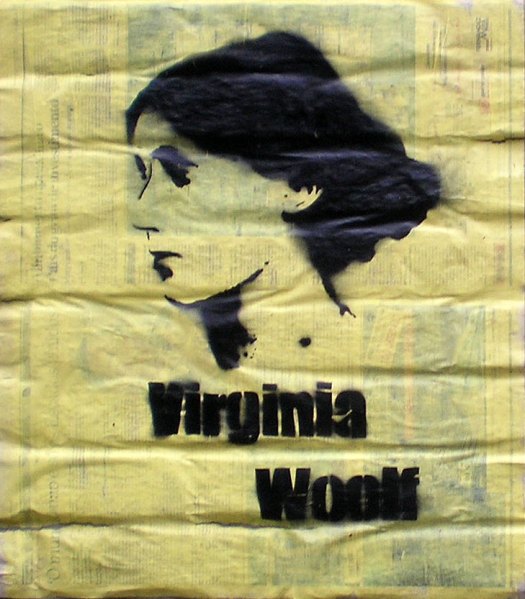 James Wood, writing about Virginia Woolf in his essay “Virginia Woolf’s Mysticism” (collected in The Broken Estate)–
Woolf, I think, became a great critic, not simply a “great reviewer.” The Collected Essays, which are still being edited, is the most substantial body of criticism in English this century. They belong in the tradition of Johnson, Coleridge, Arnold, and Henry James. This is the tradition of poet-critics, until the modern era, when novelists like Woolf and James join it. That is, her essays and reviews are a writer’s criticism, written in the language of art, which is the language of metaphor. The writer-critic, or poet-critic, has a competitive proximity to the writers she discusses. The competition is registered verbally. The writer-critic is always showing a little plumage to the writer under discussion. If the writer-critic appears to generalize, it is because literature is what she does, and one is always generalizing about oneself.
Wood’s description of Woolf is really Wood’s description of Wood.
Today’s New York Times profiles one our favorite bizarros, China Miéville. Read the article here. Topics include embarrassing apocalypses, Star Trek, and his new book Kraken. From the article:
Mr. Miéville says what attracts him to the genre, as a reader and a writer, is the importance of the imagination — “that sense of the world blown apart, that sense of a crack in reality, that visionary sense, that ecstatic sense,” as he described it.
“At a certain stage some people end up not trusting their own imagination,” Mr. Miéville said. “You get this kind of baleful set of voices in your head that tell you, ‘That’s silly; you’re being silly.’
“But I think most people have more ideas in their heads than they think they do. It’s just that those of us in the fantastic fields — either we don’t listen to our own filters, or we have a much higher ridiculousness threshold.”
Great essay today at The Guardian from Tom McCarthy, author of Remainder and the the forthcoming, highly-anticipated C. McCarthy discusses technology, modernity, and literature, mulling over writers like Blake, Cervantes, Shelley, Joyce, and Ballard. He also talks about some of the research that went into C. From his essay:
C takes place, specifically, between 1898 and 1922. The dates aren’t accidental: they mark the period between Marconi’s early short-distance radio experiments and the founding of that centralised state broadcaster of entertainment, news and propaganda that we still know as the BBC. In 1922, Britain was erecting, in its colonial territory Egypt, the first long-distance pylons of its proposed imperial wireless chain – and as it went about this, it lost Egypt, which gained independence in February of that year. For ancient Egyptians, “pylons” were gateways to the underworld: these modern ones came to symbolise bereavement on a national scale. In November, also in Egypt, Howard Carter disinterred what would become the most famous family crypt of all time. 1922 was also modernism’s annus mirabilis, seeing the publication of The Waste Land, in which voices, dialogues and even weather reports drift in and out of audibility as its author-operator fiddles with his literary dial – and Ulysses, a huge textual switchboard in which the themes of death and media are plugged into each other time and again.
Look for our full review of C sometime next week.

Things that happen in director Nicolas Winding Refn’s new film Valhalla Rising:
A one-eyed warrior (let’s just call him One Eye) gets revenge against the dudes who have enslaved him (they’ve been making him fight chained-to-a-pole gladiator-style for kicks).
(This is, by the way, likely set in some Scandinavian country during the Middle Ages, in case you need some context).
One Eye blood-eagles a dude.
One Eye does not kill the slave boy who brought him food when he was chained up. The boy becomes One Eye’s mouthpiece, because One Eye never talks. The boy names One Eye “One Eye.” In the film’s only moment of humor, the boy says “You need a name. And you do have only one eye.”
For some unclear reason, One Eye and the boy team up with a band of Christian Vikings who are planning to invade the Holy Land. Maybe they join the Christian Vikings because the bastards who enslaved them were pagans? No. I don’t think that’s it.
The Viking ship gets lost in an existential mist. Despair ensues.
They arrive somewhere. Are they in the Holy Land? They’re somewhere.
There’s no food. Some Vikings dissent. People are flipping out. They want to go home. Some Lord of the Flies-type craziness kicks in.
Valhalla Rising rumbles to an intense, surreal climax, which I will not spoil here.
Things that don’t happen in director Nicolas Winding Refn’s new film Valhalla Rising:
Lots of talking.
Any appearance by a woman.
Explicit context or exposition with respect to setting, plot, or character motivation.
Coherent or unproblematic resolution, clear and defined conflict, epiphanies, or other moments of transformation. (Hang on, maybe there is an epiphany, but it’s likely the viewer’s, not a character’s).
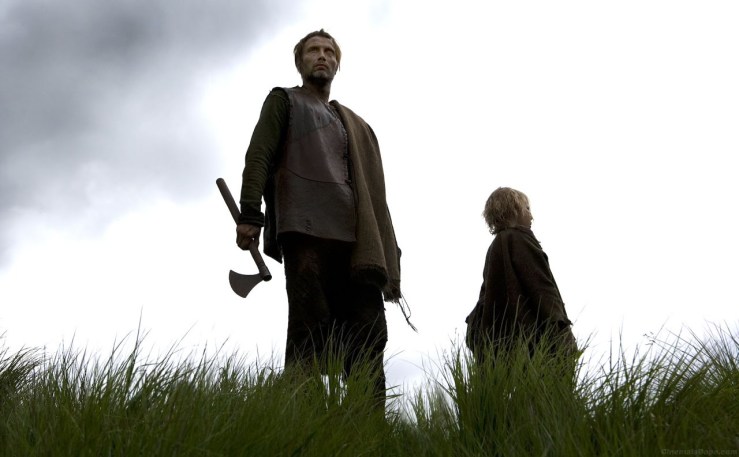
Some more thoughts on Valhalla Rising, in a non-list form:
Valhalla Rising begins with a quotation asserting that before the introduction of monotheism, there’s just man and nature in the world. The film then goes about showing how cruel this relationship is and how the apparently assuaging claims of Christianity have no purchase on the world’s intrinsic, bloody Darwinism. There is no social contract in Valhalla Rising, only brain busting with axes, confounding weather, and a lack of easily available food. If there’s a religious commentary that links the fact that the Norse god Odin only had one eye to One Eye tenuously throwing in his lot with Christian marauders, I can’t find it. The film plays out like a version of King Lear where all sense of family, philosophy, and art has been stripped away, leaving only the cruel heath (and maybe the eye-gouging scene). Valhalla Rising may actually be closer to Ran, Akira Kurosawa’s version of Lear, with its unrelenting silence punctuated by moments of warrior violence. But hang on, Lear is a bad comparison altogether, isn’t it? Maybe better to say Valhalla Rising recalls Werner Herzog’s jungles and madmen, or Terrence Malick’s lonely vistas. But if Refn’s film recalls those greats, it also has a strong whiff of Jason Statham all over it. Not that its violence is cartoonish or that it’s a mere actioner, but it is a violent film that refuses to reflect on its violence, that posits violence not just as a necessity but as normal, as constituent of existence itself. In some ways the film recalls Cormac McCarthy’s novel The Road, only more meandering and aimless. One Eye and the slave boy are not “carrying the fire.”
Valhalla Rising was shot in the gorgeous highlands of Scotland, and director of photography Morten Soborg evokes expressionist depth in this landscape, balancing the natural deep browns, verdant greens, and grays of the setting with rich blues and bursts of fireblood red. Peter Peter and Peter Kyed’s soundtrack sounds at times like an arty death metal band’s extended druggy tune up, but when it starts chugging, it really works. Mads Mikkelsen’s silent performance as One Eye will likely strike a cultish cord for those who like their badassery served up cold and mean. It’s more nuanced than it has a right to be in a film that is, like the aforementioned Herzog and Malick’s films (as well as maybe Wong Kar Wai), more of a mood than a narrative. Valhalla Rising is not a film for everyone; those who want the swelling moral clarity of say, Braveheart, need not apply, and even though I’ve name dropped Herzog and Malick in this review, Refn’s film is something else. Whatever it is, I enjoyed it very much.
More images from Luigi Serafini’s surreal cryptoencyclopedia, Codex Seraphinianus. Learn more by reading Justin Taylor’s essay from the May 2007 issue of The Believer.


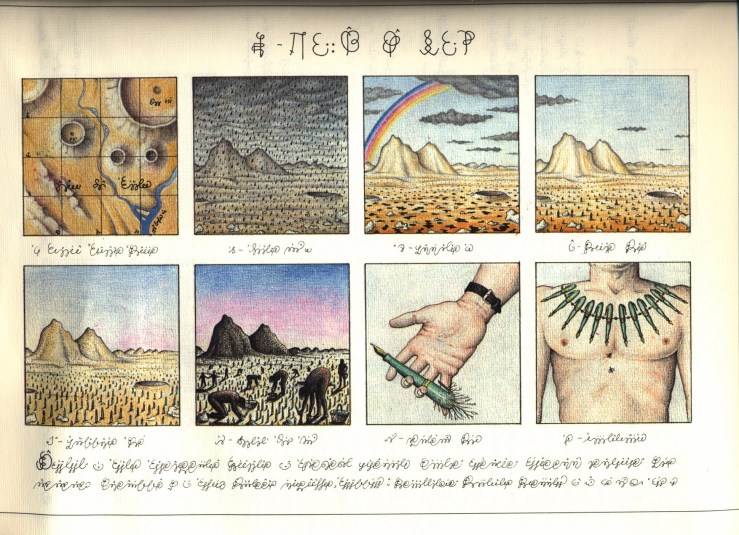
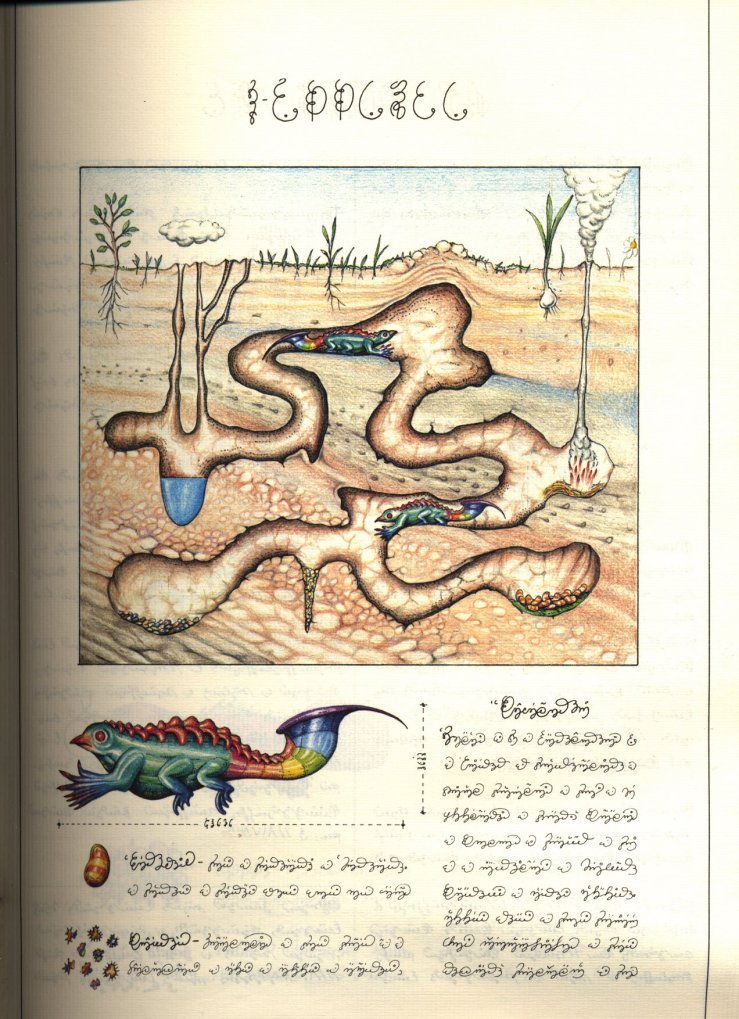
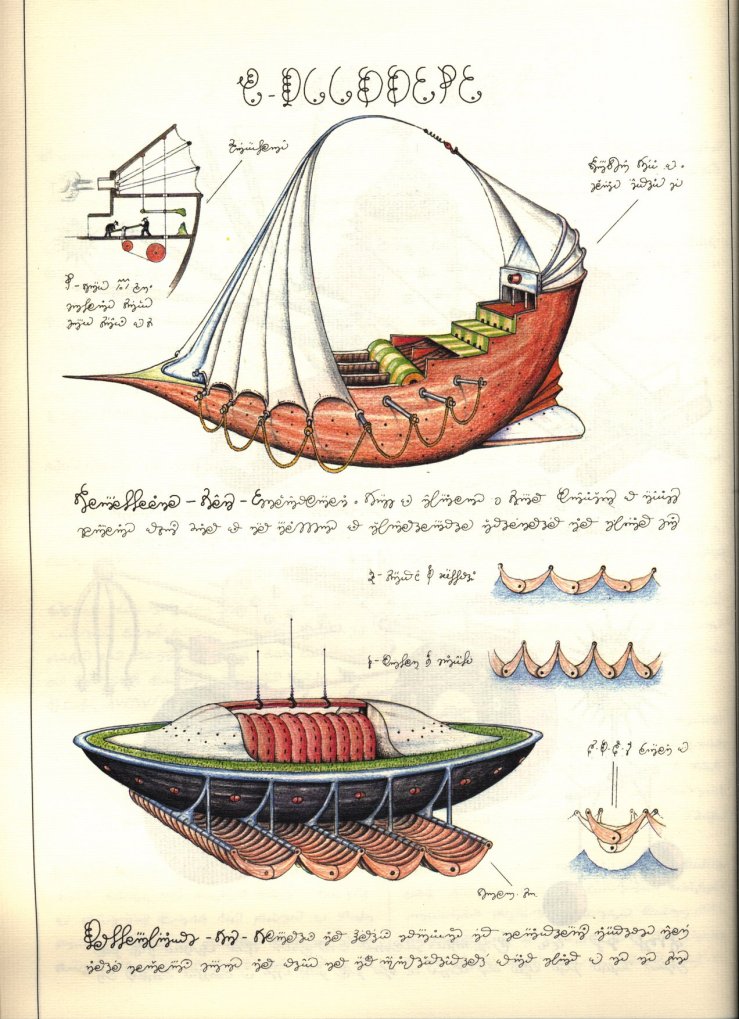
Vanity Fair interviews David Mitchell about his new book The Thousand Autumns of Jacob de Zoet. The interviewer mistakenly (I believe, anyway) thinks James Wood is joking in his New Yorker review when he wonders if the book is “post-postmodernist.” Mitchell’s answer sounds about right.
VF: James Wood in the New Yorker was describing your books and he jokingly came up with the phrase post-postmodernism. If there were such a thing as post-postmodern literature, what do you think that might be?
DM: Oddly enough, I’m not sure if novelists are the best people to ask whither-the-novel questions. For me, it’s a little like I’m a duckbilled platypus and I’m being asked a question about taxonomy. You won’t get much of an answer out of a platypus because they’re busy going about their business digging tunnels, catching fish, and having sex. You really have to ask a critic, or a taxonomist. I feel like I should have a pithy answer because I’m a novelist and you’re asking a question about the future of the novel, but the biggest question I ever get to is, “How can I make this damned book work?” I rarely ever put my head above the rampart and see where this big lumbering behemoth called global literature is going.
(Thanks to the Bored Bookseller for the tip).

Woody Allen talks to The New York Times about recording audiobook versions of his anthologies Getting Even, Without Feathers, Mere Anarchy, and Side Effects. Here’s Woody, from the interview, emitting his usual positive vibes:
I imagined it would be quite easy for me, and, in fact, it turned out to be monstrously hard. I hated every second of it, regretted that I had agreed to it, and after reading one or two stories each day, found myself exhausted. The discovery I made was that any number of stories are really meant to work, and only work, in the mind’s ear and hearing them out loud diminishes their effectiveness. Some of course hold up amusingly, but it’s no fun hearing a story that’s really meant to be read, which brings me to your next question, and that is that there is no substitute for reading, and there never will be. Hearing something aloud is its own experience, but it’s hard to beat sitting in bed or in a comfortable chair turning the pages of a book, putting it down, and eagerly awaiting the chance to get back to it.
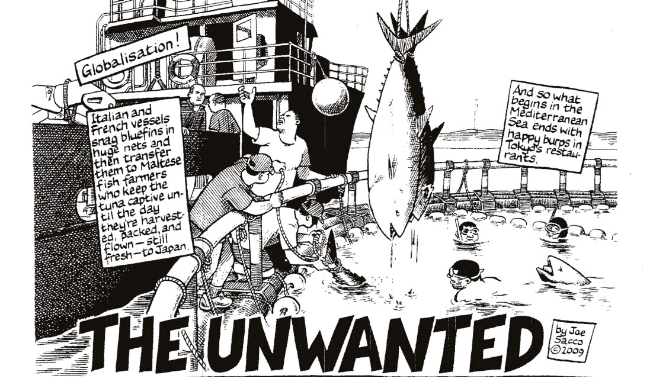
Read Joe Sacco’s comic “The Unwanted” at The Guardian. As usual, Sacco approaches a complex problem at the human level in his story about African immigration to Malta. Go here for more on Joe Sacco, his journalism, and his fantastic books, Safe Area Goražde and Palestine.
Hear the whole interview here.
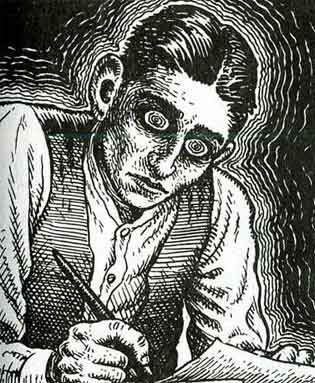
Yesterday, lawyers in Zurich opened four anonymous safety deposit boxes supposedly containing original manuscripts, letters, and drawings by Franz Kafka. The question of who owns the literary cache has turned into something of an international debacle, with lawyers and judges jostling for control.
In appreciation of Kafka (and this whole cosmically-ironic fiasco), we direct you to audio clips of the PEN fellowship’s March 26, 1998 tribute, which featured, among others, E.L. Doctorow, Susan Sontag, Cynthia Ozick, and Paul Auster, reading from their own essays on Kafka, or the Czech’s work. The highlight is David Foster Wallace’s essay “A Series of Remarks on Kafka’s Funniness from Which Not Enough Has Been Removed.”
You can stream the tracks here. True biblioklepts can download them directly from here.
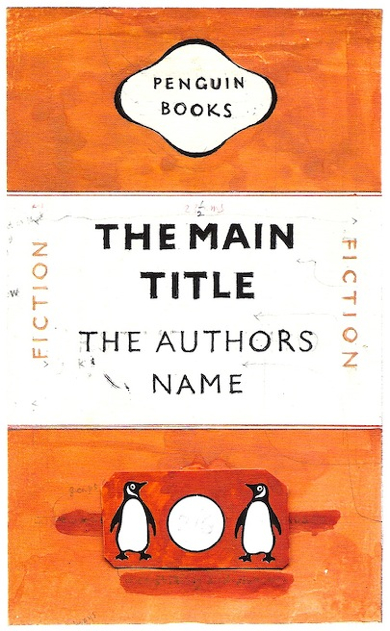 Penguin Books turns 75 today. Happy birthday! More
  Biblioklept