15. Battle Royale, Kinji Fukasaku (2000)
I actually rewatched Battle Royale just the other week. In retrospect, it’s difficult to assess the film against the influence it’s had, especially on video games. In his 2008 New Cult Canon entry, Scott Tobias described the film as “Lord Of The Flies meets The Most Dangerous Game meets perhaps the cruelest year of teenage life.” I think what many of us remember about Battle Royale is first the concept, so widely imitated, and then the violence—but it’s actually a gentler film, with hints of Rebel without a Cause (Nicholas Ray, 1955). It’s also kinda goofy and disjointed.
6/10
Alternate: I don’t think they’re widely available as legal streams, but you could track down Kinji Fukasaku’s early 1970’s crime films, the Battles without Honor or Humanity series.
Alternate alternate: 10 minutes of Friedkin on Fukasaku:
16. Dead Man, Jim Jarmusch (1995)
A perfect film, one that seems better every time I see it. Gary Farmington is amazing as William Blake’s spiritual guide (“Stupid fucking white man” is a sublime line reading), and Jarmusch has a loaded bench to bounce pretty boy Depp off of (Iggy Pop is particularly scary, but Robert Mitchum seems an embodiment of evil from a truly different time—magnificent).
10/10
Alternate: El Topo, Alejandro Jodorowsky (1970)
17. Wet Hot American Summer, David Wain (2001)
I have no idea if Wet Hot American Summer holds up well—I think I was always part of its intended audience, part of the tail end of the “Reagan-era latchkey kids who grew up watching” the kind of films Wain’s movie is—satirizing?—on television. I watched Wet Hot American Summer approximately 100 times in 2003; it was one of a handful of DVDs on repeat at my best friend’s childhood house, where my unemployed unstructured ass spent a few nights a week crashing. His folks were in the beginning of a (permanent) separation, and the house seemed to have been ceded to a loose configuration of a dozen or so of us. We’d drink tallboys on the beach, stumble in, and fall asleep to The Royal Tenenbaums (Wes Anderson, 2001) or Reign of Fire (Rob Bowman, 2002) or Human Nature (Michel Gondry, 2001) or Wet Hot American Summer. There were probably others, but those are the ones I remember.
10/10
Alternate: Porky’s, Roy Clark (1981)
18. The Boondock Saints, Troy Duffy (1999)
The Boondock Saints is a truly awful film. It is relentlessly stupid and when it is funny, it is funny by accident—except when Willem Dafoe’s charm takes over one of the scenes he’s chewing up. The viewer can almost sense Dafoe rewriting Duffy’s sketchy, shoddy, nonsensical script in real time. For all its retrograde bluster (and poor filmmaking), The Boondock Saints actually has a viewpoint.
3/10
Alternate: Payback, Brian Helgeland (1999)
19. Punch-Drunk Love, Paul Thomas Anderson (2002)
Another perfect film. In his original New Cult Canon, Tobias suggested that,
Punch-Drunk Love marked the moment when Anderson threw away the stylistic
crutches of forbears like Martin Scorsese and Robert Altman, and came into his
own as an original filmmaker. That doesn’t mean he’s discarded these and other
influences altogether, which isn’t something he could or would want to do. But Punch-Drunk
Love has a unique texture that’s unmistakably Anderson’s, marked by a wired, coked-up
intensity and a yen for discord. It’s a film that sets viewers on edge from the
start, almost daring you not to like it.
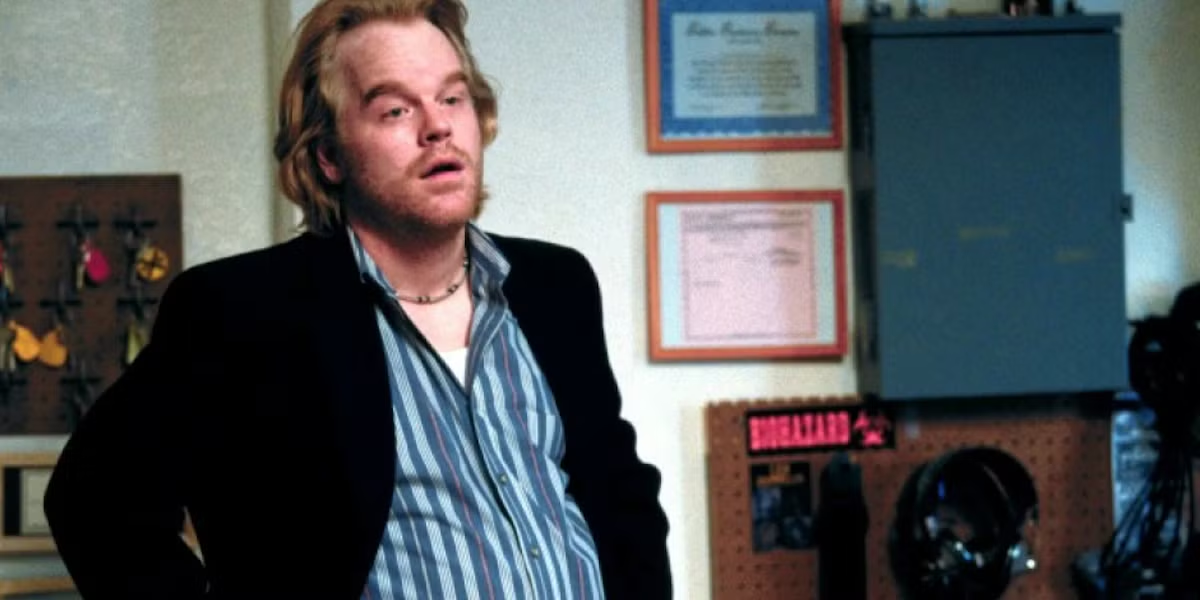
Philip Seymour Hoffman might have stolen the film from Sandler, had he been in it more than the few minutes he’s actually on screen (he’s looming larger in our memory, as always).
10/10
Alternate: Popeye, Robert Altman (1980)
20. Wild Things, John McNaughton (1998)
This is another film that I watched because Tobias wrote about it. I had actually seen McNaughton’s film Henry: Portrait of a Serial Killer entirely by mistake at a “party”; this probably happened around the same time that Wild Things released to theaters. But I never would have connected the two. I thought Wild Things was a different kind of trash than the trash it actually is. Tobias’s write-up makes an argument for Wild Things as high camp, a film told entirely within a set of quotation marks. I think he’s a bit too generous in his admiration for McNaughton’s film, but I ultimately enjoyed it.
6/10
Alternate: Bad Lieutenant: Port of Call New Orleans, Werner Herzog (2009)
 Biblioklept