New York City
4 January 1955
Dear Doctor Oppenheimer.
I have already taken a greater liberty than this, asking your attention to my letter, in having called Harcourt, Brace & Co., who are publishing a long novel I have written, to ask that they send you a copy. You must receive mail of all sorts, crank notes and fan letters of every description, but few I should think of half a million words. And since I can also well imagine that you seldom if ever read novels, if only for not having the time, it is an added imposition to have sent you such a bulky one.
But for having read your recent address at Columbia’s anniversary, I should never have presumed to do so. But I was so stricken by the succinctness, and the use of the language, with which you stated the problems which it has taken me seven years to assemble and almost a thousand pages to present, that my first thought was to send you a copy. And I do submit this book to you with deepest respect. Because I believe that The Recognitions was written about “the massive character of the dissolution and corruption of authority, in belief, in ritual and in temporal order, . . .” about our histories and traditions as “both bonds and barriers among us,” and our art which “brings us together and sets us apart.” And if I may go on presuming to use your words, it is a novel in which I tried my prolonged best to show “the integrity of the intimate, the detailed, the true art, the integrity of craftsmanship and preservation of the familiar, of the humorous and the beautiful” standing in “massive contrast to the vastness of life, the greatness of the globe, the otherness of people, the otherness of ways, and the all-encompassing dark.”
The book is a novel about forgery. I know that if you do get into it, you will find boring passages, offensive incidents, and some pretty painful sophomorics, all these in my attempts to present “the evils of superficiality and the terrors of fatigue” as I have seen them: I tried to present the shadowy struggle of a man surrounded by those who have “dissolved in a universal confusion,” those who “know nothing and love nothing.”
However you feel about the book, please allow my most humble congratulations on your address which provoked my taking the liberty of sending it to you, and in expression of my deepest admiration for men like yourself in the world you described.
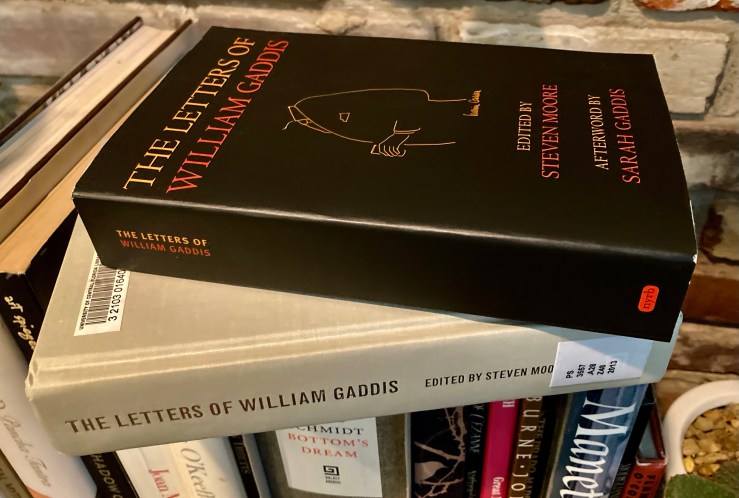
From The Letters of William Gaddis; ed. Steve Moore. Moore adds the following note: [American physicist (1904–67), known for his work on the atomic bomb. On 26 December 1954 he gave a lecture entitled “Prospects in the Arts and Sciences” at Columbia University’s bicentennial anniversary celebration, reprinted in his book The Open Mind (1955). The following letter is a corrected draft.]
You can read a version of “Prospects in the Arts and Sciences” here.

 Biblioklept