
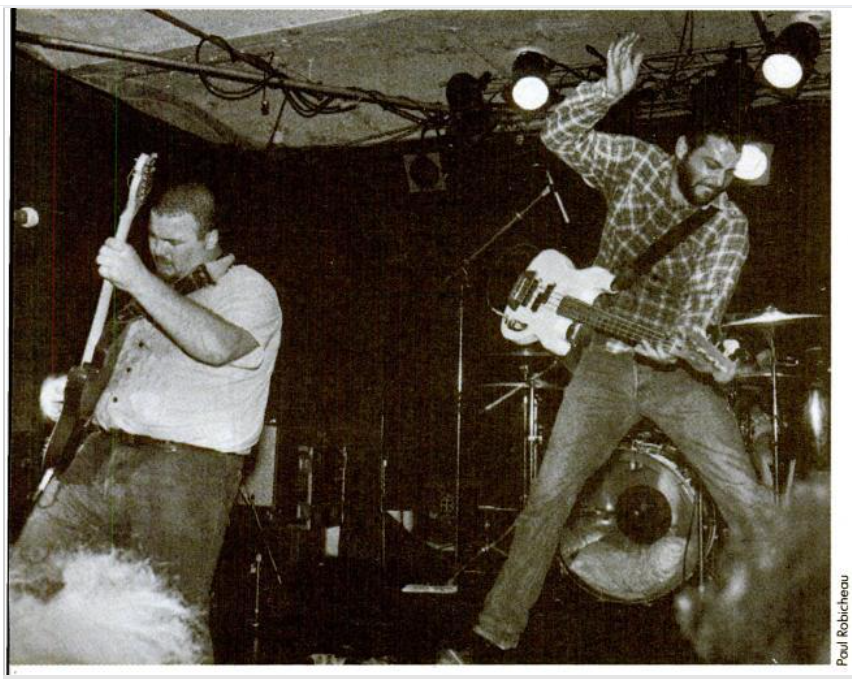
I was looking for something else when I found this brief profile of the Minutemen in the December 1985 issue of SPIN (I didn’t find the thing I was looking for). The article, by Forced Exposure stalwart Byron Coley, focuses on the Minutemen’s attempt to “sell out” with their record 3-Way Tie (For Last). The record, like the issue of SPIN, was released in December 1985.
3-Way Tie ended up being the last studio album by the Minutemen. Singer/guitarist D. Boon died tragically right after its release. From Michael Azerrad’s Our Band Could Be Your Life:
[Mike] Watt’s phone rang early the following morning: December 23, 1985. It was D. Boon’s dad. Boon’s girlfriend had been driving the band’s tour van, her sister in the passenger seat and a feverish Boon sleeping in the back. At around four in the morning, Boon’s girlfriend fell asleep at the wheel. The van crashed and flipped; Boon was thrown out the back door and broke his neck. He died instantly.
I looked through the next two issues of SPIN to see if there was any mention of Boon’s passing but didn’t find anything (there was a feature on Mötley Crüe in the Jan. 1986 issue tastelessly titled “Asleep at the Wheel” and a long profile on crack (the drug) in the Feb. ’86 issue).
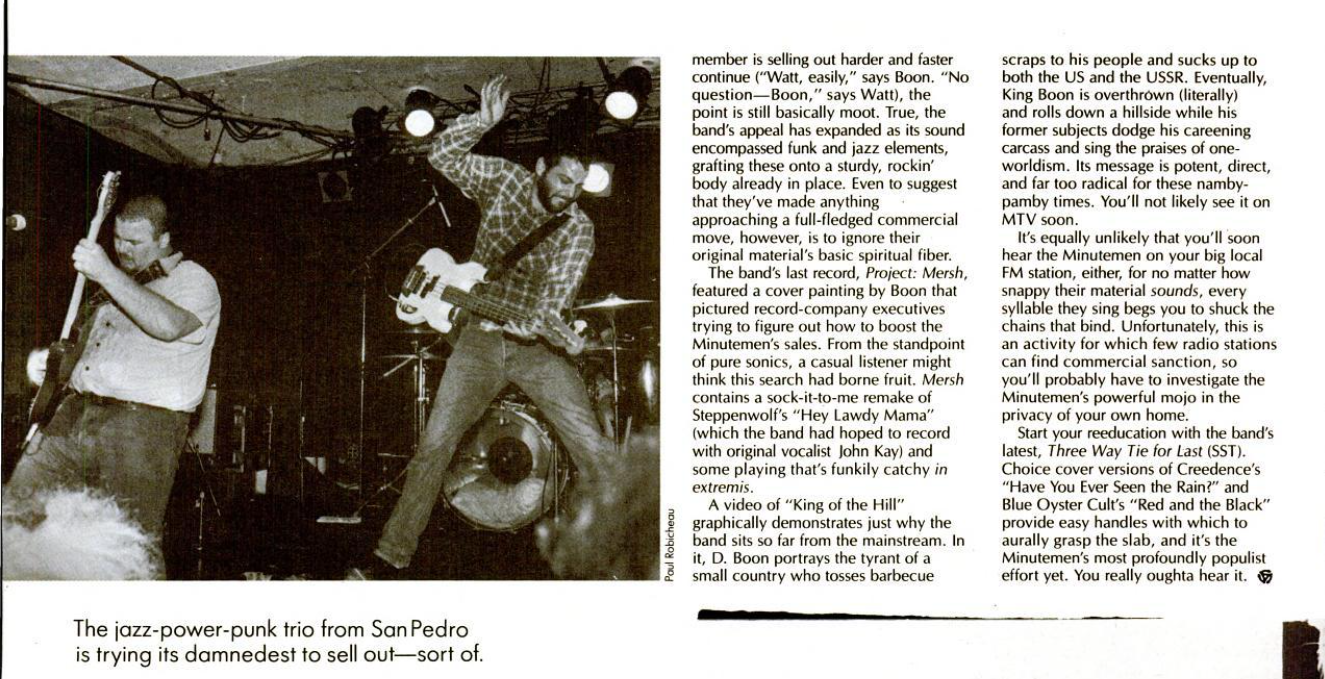
Here is the article (followed by a transcription):
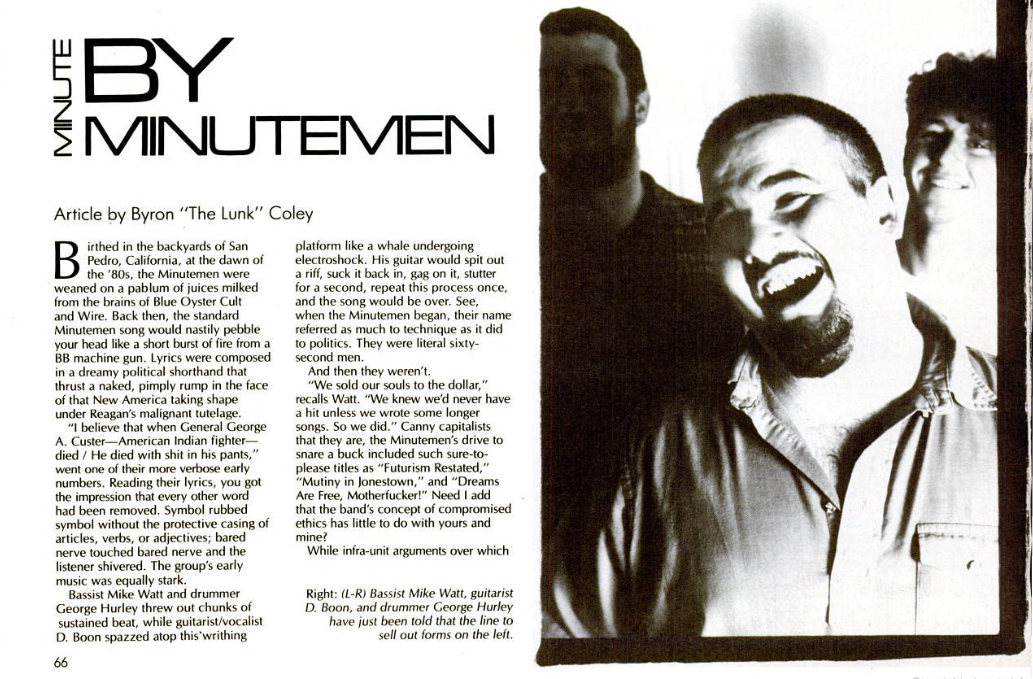
“Minute by Minutemen”
Article by Byron “The Lunk” Coley
Born in the backyards of San Pedro, California, at the dawn of the ’80s, the Minutemen were weaned on a pabulum of juices milked from the brains of Blue Öyster Cult and Wire. Back then, the standard Minutemen song would nastily pebble your head like a short burst of fire from a BB machine gun. Lyrics were composed in a dreamy political shorthand that thrust a naked, pimply rump in the face of that New America taking shape under Reagan’s malignant tutelage.
“I believe that when General George A. Custer—American Indian fighter—died / He died with shit in his pants,” went one of their most verbose early numbers. Reading their lyrics, you got the impression that every other word had been removed. Symbol rubbed symbol without the protective casing of articles, verbs, or adjectives; bared nerve touched bared nerve and the listener shivered. The group’s early music was equally stark.
Bassist Mike Watt and drummer George Hurley threw out chunks of sustained beat, while guitarist/vocalist D. Boon spazzed atop this writhing platform like a whale undergoing electroshock. His guitar would spit out a riff, suck it back in, gag on it, stutter for a second, repeat this process once, and the song would be over. See, when the Minutemen began, their name referred as much to technique as it did to politics. They were literal sixty-second men.
And then they weren’t.
“We sold our souls to the dollar,” recalls Watt. “We knew we’d never have a hit unless we wrote some longer songs. So we did.” Canny capitalists that they are, the Minutemen’s drive to snare a buck included such sure-to-please titles as “Futurism Restated,” “Mutiny in Jonestown,” and “Dreams Are Free, Motherfucker.” Need I add that the band’s concept of compromised ethics has little to do with yours and mine?
While infra-unit arguments over which member is selling out harder and faster continue (“Watt, easily,” says Boon. “No question—Boon,” says Watt), the point is still basically moot. True, the band’s appeal has expanded as its sound encompassed funk and jazz elements, grafting these onto a sturdy, rockin’ body already in place. Even to suggest that they’ve made anything approaching a full-fledged commercial move, however, is to ignore their original material’s basic spiritual fiber.
The band’s last record, Project: Mersh, featured a cover painting by Boon that pictured record-company executives trying to figure out how to boost the Minutemen’s sales. From the standpoint of pure sonics, a casual listener might think this search had borne fruit. Mersh contains a sock-it-to-me remake of Steppenwolf’s “Hey Lawdy Mama” (which the band had hoped to record with original vocalist John Kay) and some playing that’s funkily catchy in extremis.
A video of “King of the Hill” graphically demonstrates just why the band sits so far from the mainstream. In it, D. Boon portrays the tyrant of a small country who tosses barbecue scraps to his people and sucks up to both the US and the USSR. Eventually, King Boon is overthrown (literally) and rolls down a hillside while his former subjects dodge his careening carcass and sing the praises of one-worldism. Its message is potent, direct, and far too radical for these namby-pamby times. You’ll not likely see it on MTV soon.
It’s equally unlikely that you’ll soon hear the Minutemen on your big local FM station, either, for no matter how snappy their material sounds, every syllable they sing begs you to shuck the chains that bind. Unfortunately, this is an activity for which few radio stations can find commercial sanction, so you’ll probably have to investigate the Minutemen’s powerful mojo in the privacy of your own home.
Start your reeducation with the band’s latest, Three Way Tie for Last (SST). Choice cover versions of Creedence’s “Have You Ever Seen the Rain?” and Blue Öyster Cult’s “Red and the Black” provide easy handles with which to aurally grasp the slab, and it’s the Minutemen’s most profoundly populist effort yet. You really oughta hear it.

 Biblioklept