Previously:
Not-really-the-rules recap:
I will focus primarily on novels here, or books of a novelistic/artistic scope.
I will include books published in English in 1976, including translations published in English for the first time.
The New York Times Best Seller list for fiction in 1976 was dominated by Agatha Christie, Gore Vidal, and Leon Uris. Christie’s 1975 novel Curtain ruled winter and early spring, with her posthumous 1976 novel Sleeping Murder topping the charts in November and December. Vidal’s historical novel 1876 and Uris’s Trinity split the rest of the year. While Alex Haley’s Roots topped the nonfiction Best Seller list for only a few weeks in 1976, it’s the bestseller title of the year with the most cultural staying power. Bob Woodward and Carl Bernstein’s The Final Days, their follow up to 1974’s All the President’s Men was a bestseller in the spring and summer (and one of many, many Watergate books of this era). Gail Sheehy’s “road map to adult life” Passages was popular in the fall.
But sales charts ain’t literature.
Better to regard the New York Times Book Review’s end-of-year round up, “1976: A Selection of Noteworthy Titles.” It begins with a heavy dose of literary biographies, memoirs, autobiographies, and collections of letters. These include Christopher Isherwood’s Christopher and His Kind, Lucille Clifton’s memoir Generations, Patrick McCarthy’s bio Celine, Charles Higham’s The Adventures of Conan Doyle, and Lillian Hellman’s third memoir Scoundrel Time.
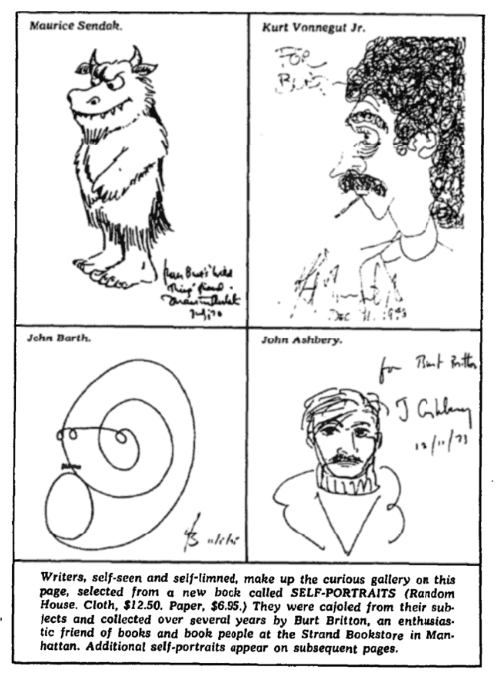
Also of note in the NYT list are Ron Kovic’s Born on the Fourth of July, Maxine Hong Kingston’s The Woman Warrior, and Britt Britton’s collection of author Self-Portraits (the article is peppered with some of the portraits).
The Book Review piece also notes collections of letters by Sylvia Plath, E.B. White, and Virginia Woolf, as well as more diaries of Anaïs Nin. There are multiple memoirs of Hemingway (one by his son and one by his last wife) and David Heyman’s Ezra Pound biography. The list of literary bios and memoirs conveys the beginnings of a strange autopsy of the Modernist past giving way to something new.
Here are some of the fiction titles the New York Times Book Review includes in its “Selection of Noteworthy Titles” that I thought more noteworthy than other titles included:
The Acts of King Arthur and His Noble Knights, John Steinbeck
The Autumn of the Patriarch Gabriel García Márquez (trans. Gregory Rabassa)
The Easter Parade, Richard Yates
Flight to Canada, Ishmael Reed
The Franchiser, Stanley Elkin
Lady Oracle, Margaret Atwood
Lucinella, Lore Segal
Meridian, Alice Walker
Ratner’s Star, Don DeLillo
Orsinian Tales, Ursula K. Le Guin
Slapstick, Kurt Vonnegut
Speedboat, Renata Adler
The Takeover, Muriel Spark
Travesty, John Hawkes
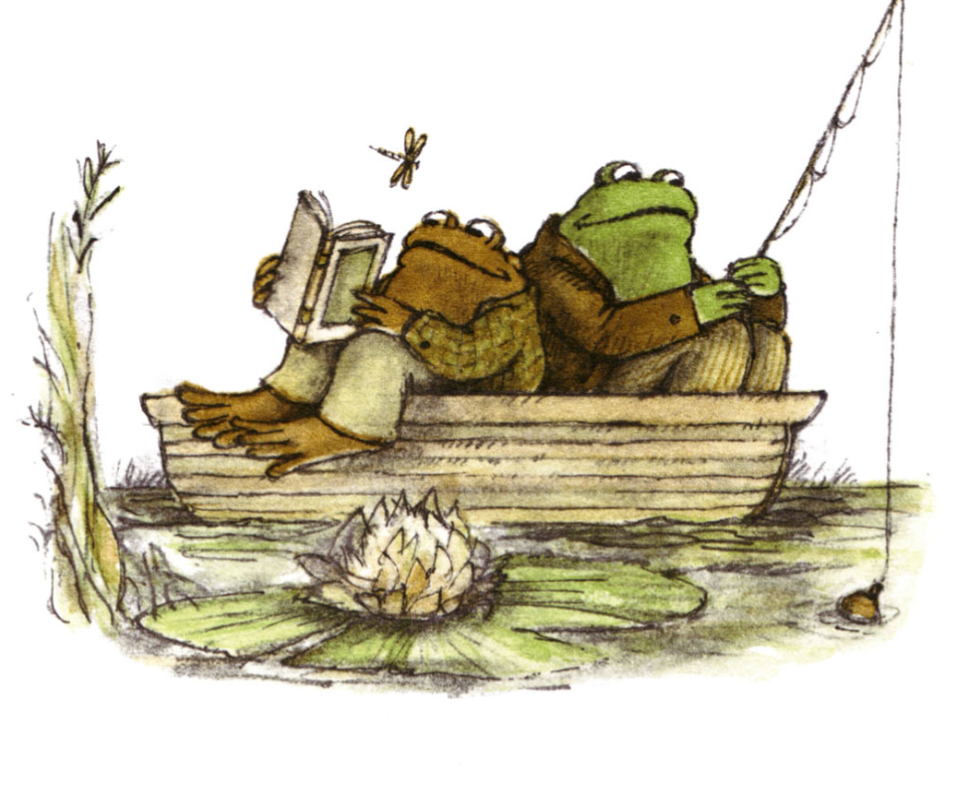
Frog and Toad All Year, Arnold Lobel
Children of Dune, Frank Herbert
The Fifth Head of Cerberus, Gene Wolfe
Triton, Samuel R. Delany
I’ll do some more with that list in a second. But for now–
One of the best sections of the NYT Book Review’s year-end recap is “Author’s Authors,” in which they ask various writers to pick their three favorite reads of 1976. John Cheever picks John Updike’s Picked Up Pieces (1975). Bernard Malamud picks García Márquez’s The Autumn of the Patriarch. Vladimir Nabokov, always humble selects his own manuscript for The Original of Laura (it remained unpublished until 2009).
William H. Gass selects buddies William Gaddis (J R, 1975) and Stanley Elkin (The Franchiser); I’ll pick up Craig Nova’s 1975 novel The Geek on his recommendation. I’ll also be on the look out for one of Ishmael Reed’s recommendations: Dangerous Music (1975) by Jessica Tarahata Hagedorn. He also recommends one of the many, many Watergate books of the era, Blind Ambition by John Dean and Shouting! by Joyce Carol Thomas. As far as I can tell, Shouting! wasn’t published until 2007.
By far the best entry belongs to John Updike though:
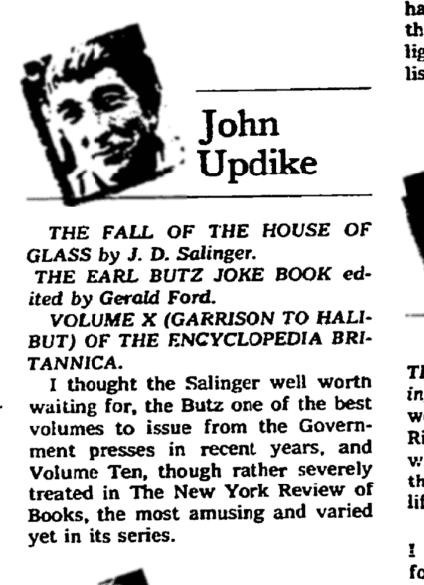
Shitposting in the Times in the late seventies. Gotta love it.
In her “Author’s Authors” write up, the novelist Lois Gold makes the only mention of Anne Rice’s Interview with the Vampire in the NYTBR piece. Rice’s seminal postmodernist vampire romance currently sits at #1 on Goodreads list of most popular books published in 1976, a testament to its populist staying power. Other notable books on the Goodreads list that were absent from the lofty NTYBR’s contemporary coverage include Tom Robbins’ Even Cowgirls Get the Blues, Marge Piercy’s Woman on the Edge of Time, Michael Crichton’s Eaters of the Dead, David Seltzer’s The Omen, Raymond Carver’s Will You Please Be Quiet, Please?, Marian Engel’s Bear, Octavia Butler’s Patternmaster, Harry Crews’ A Feast of Snakes, Hubert Selby Jr.’s The Demon, Richard Brautigan’s Sombrero Fallout, Kingsley Amis’s The Alteration, and many, many more. I’ll do more with that list momentarily, but next —
–prizes!
Saul Bellow won both the 1976 Nobel Prize in Literature (“for the human understanding and subtle analysis of contemporary culture that are combined in his work”) and the 1976 Pulitzer Prize for Fiction, specifically for his 1975 novel Humboldt’s Gift.
David Saville’s novel Saville was awarded the 1976 Booker Prize. The shortlist consisted of An Instant in the Wind by André Brink, Rising by R. C. Hutchinson, The Doctor’s Wife by Brian Moore, King Fisher Lives by Julian Rathbone, and The Children of Dynmouth by William Trevor.
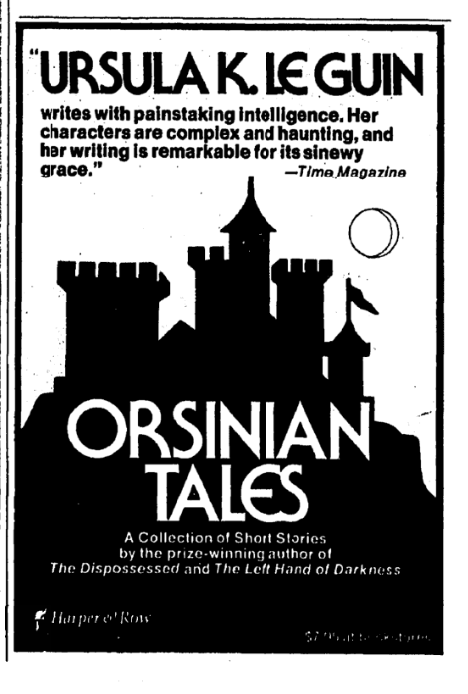
The 1977 National Book Award winner for fiction was Wallace Stegner’s The Spectator Bird. Runners-up were Will You Please Be Quiet, Please? by Raymond Carver, Orsinian Tales by Ursula K. Le Guin, The Balloonist by MacDonald Harris, and A Fine Romance by Cynthia Propper Seton.
The 1976 National Book Critics Circle award for best fiction went to John Gardner’s October Light. Finalists were Renata Adler’s Speedboat, Valdimir Nabokov’s Details of a Sunset and Other Stories, Cynthia Ozick’s Bloodshed and Three Novellas, and The Easter Parade by Richard Yates. Haley’s Roots was runner up to Maxine Hong Kingston’s The Woman Warrior.
The Nebula Awards for fiction published in 1976 gave first place to Inferno by Larry Niven and Jerry Pournelle. Notable finalists included Marta Randall’s Islands, Delany’s Triton and Where Late the Sweet Birds Sang by Kate Wilhelm.
I have read many but hardly all the books mentioned in this post. But this is my blog, so here are my picks for the best books of 1976:
The Autumn of the Patriarch, Gabriel García Márquez (trans. Gregory Rabassa)
Bear, Marian Engel
A Feast of Snakes, Harry Crews
Flight to Canada, Ishmael Reed
The Franchiser, Stanley Elkin
Orsinian Tales, Ursula K. Le Guin
Ratner’s Star, Don DeLillo
Slapstick, Kurt Vonnegut
Speedboat, Renata Adler
 Biblioklept