Mass-market Monday | Eye of the Heart: Short Stories from Latin America

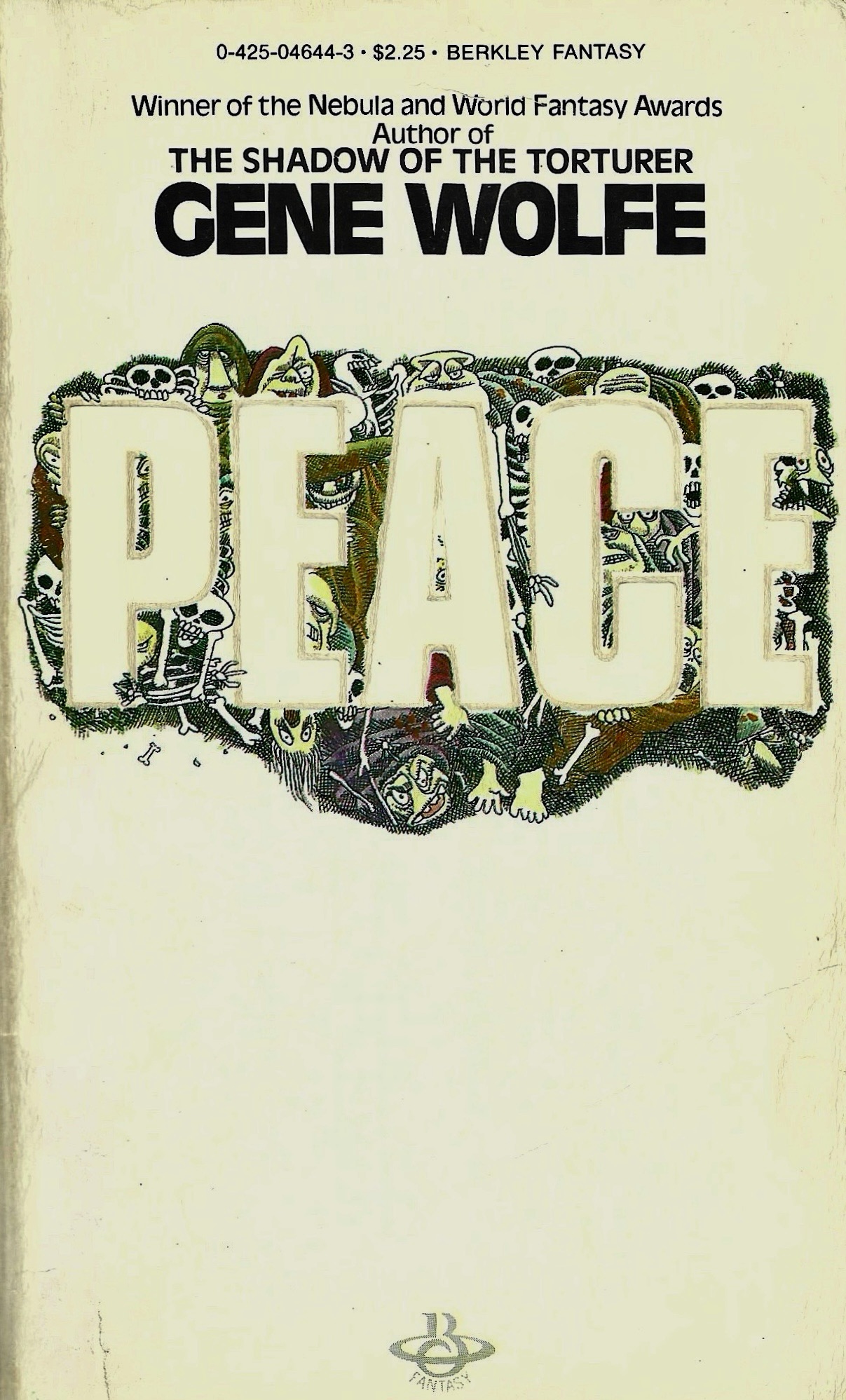
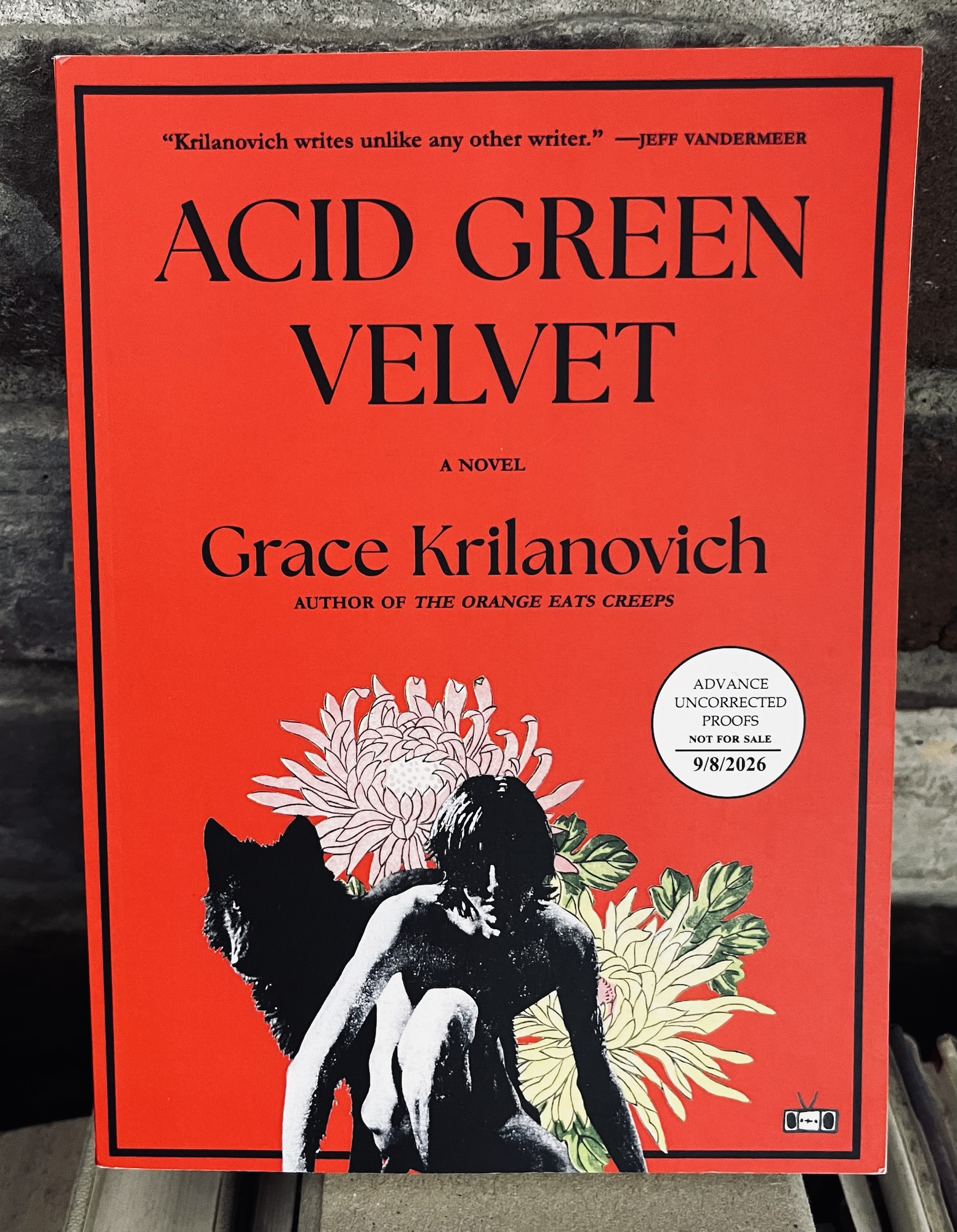
Eye of the Heart: Short Stories from Latin America, ed. by Barbara Howes, 1973. Avon-Bard (1974). No cover artist or designer credited. 576 pages.

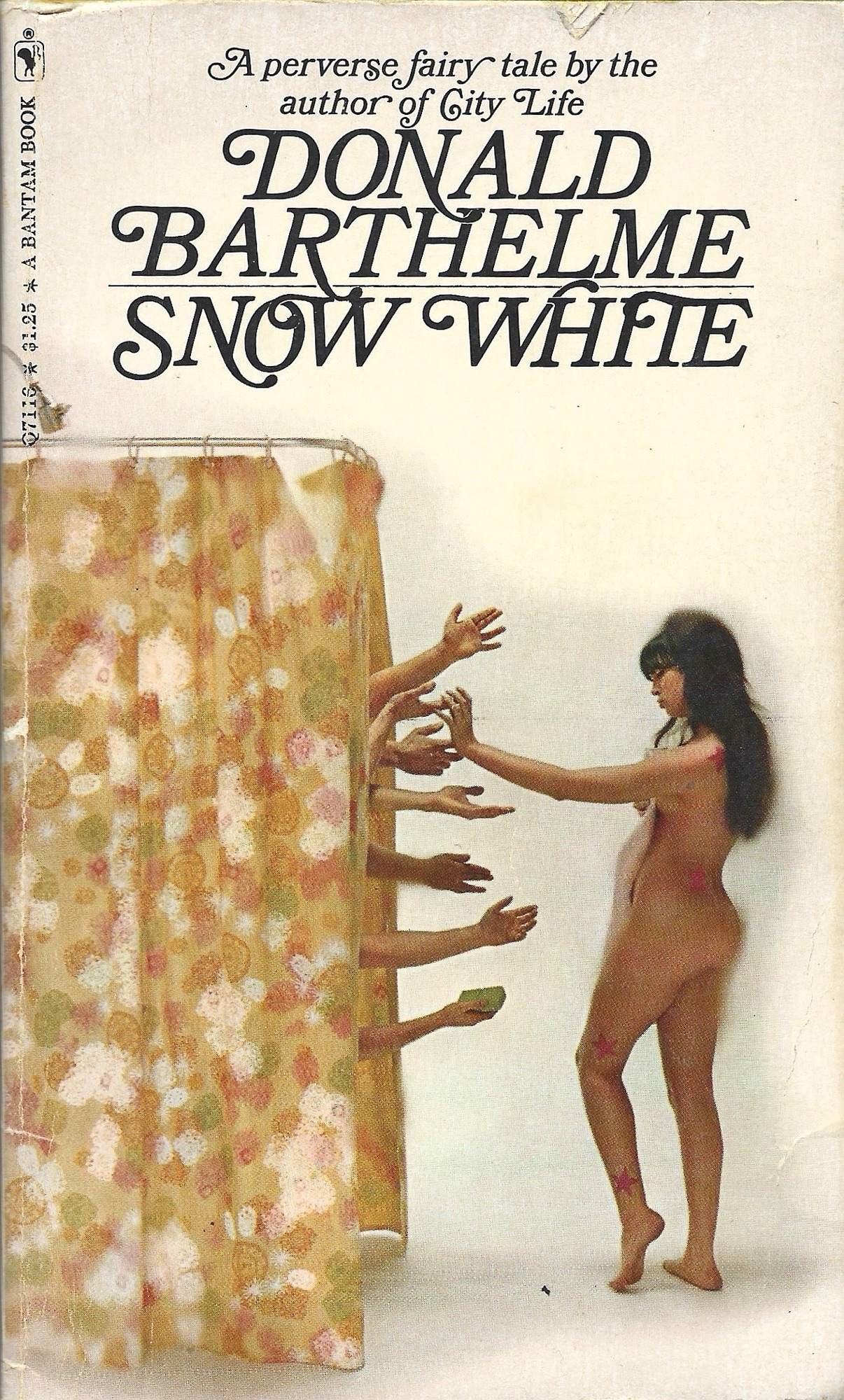
A promising mixtape, via many translators. Clarice Lispector might not have been a big enough name for English-reading audiences in the 1970s to make the front or back cover, but editor Barbara Howes included two of her stories.

Here is a piece (the shortest) from the collection:


“Why Reeds Are Hollow”

by

Gabriela Mistral

Translated by William Jay Smith


For don Max. Salas Marchant

I

Even in the peaceful world of plants, a social revolution once took place. It is told that in this case the leaders were those vain reeds. A master of rebellion, the wind, disseminated propaganda, and in no time at all there was talk of nothing else in the vegetal centers. Virgin forests fraternized with silly gardens, in a common struggle for equality.

Equality of what? Of their thickness of trunk, the excellence of their fruit, their right to pure water?

No, simply equality of height. The ideal was that all should raise their heads uniformly. The corn had no thought of making itself strong like the oak, but only of stirring its hairy tassels at the same elevation. The rose did not strive to be useful like the rubber plant, but just wanted to reach that high crown, and make of it a pillow on which to lull its flowers to sleep.

Vanity, vanity! Delusions of grandeur, even if they went against Nature, caricatured their aims. In vain, some modest flowers—the shy violet and flat-nosed lily—spoke of divine law and the evils of pride. Their voices seemed dotty.

An old poet, bearded like the River God, condemned the project in the name of beauty, and had some wise things to say about uniformity, hateful to him in every respect.

II

How did it all turn out? People tell of strange influences at work. Earth spirits blew upon the plants with their monstrous vitality, and so it was that an ugly miracle took place.

One night, the world of lawn and shrub grew dozens of feet, as if obeying some imperious appeal from the stars.

Next day, the country people were dismayed—when they came out of their huts—to find clover high as a cathedral and wheat fields wild with gold!

It was maddening. Animals roared with fright, lost in the darkness of their pastures. Birds chirped in desperation, their nests having risen to unheard-of heights. Nor could they fly down in search of seed: gone was the sunbathed soil, the grass’s humble tapestry.

Shepherds lingered by their flocks beside dark pastures; their sheep refused to enter anything so dense, afraid they might be swallowed up completely.

Meanwhile, victorious, the reeds laughed aloud, whipping their riotous leaves against the blue tops of the eucalyptus.

III

Thus a month is said to have passed. Then the decline set in.

And it came about in this fashion: violets, which delight in shade, dried up when their purple heads were exposed to full sunlight.

“It doesn’t matter,” the reeds hastened to say. “They’re a mere nothing.”

(But in the country of the spirits, they were mourned.)

Lilies, stretching their height to fifty feet, broke in two. Like the heads of queens, white marble heads lay lopped off all around.

The reeds argued as before. (But the Graces ran wild through the wood, lamenting.)

Lemon trees at that height lost all their blossoms to the violent winds. Adios, harvest!

“It doesn’t matter,” the reeds stated yet again. “Their fruit was so bitter.”

The clover dried out, its stems twisting like threads in a fire.

Corn tassels drooped, but no longer from gentle lassitude. In all their extravagant length they fell upon the earth, heavy as rails.

Potatoes, to strengthen their stems, put forth feeble tubers; these were little bigger than apple seeds.

Now the reeds laughed no more; at last they grew serious.

Blossoms of shrub or grass were no longer being fertilized: the insects could not reach them without overheating their little wings.

Furthermore, it was said that man had neither bread nor fruit nor forage for his animals; hunger and sorrow were abroad in the land.

In such a state of things, only the tall trees remained sound, trunks rising strongly as ever: they had not yielded to temptation.

The reeds were the last to fall, signaling the total disaster of their tree-level theory; roots rotted from excessive humidity, and even the network of foliage could not keep them from drying out.

It was then clear that, compared with their former solid bulk, they’d become hollow. They reached hungry leagues upward, but, their insides being empty, they were laughable, like marionettes or dolls.

In the face of such evidence, no one could defend their philosophy; no more was said about it for thousands of years.

Nature—generous always—repaired the damage in six months, seeing to it that all wild plants would again spring up in the usual way.

The poet, bearded like the River God, appeared after a long absence and, rejoicing, sang of the new era.

“So be it, dear people. Beautiful is the violet for its minuteness, and the lemon tree for its gentle shape. Beautiful are all things as God made them: the noble oak and the brittle barley.”

The earth bore fruit once again; flocks fattened, the people were nourished.

But the reeds—those rebel chieftains—bore for all time the mark of their disgrace: they were hollow, hollow . . .


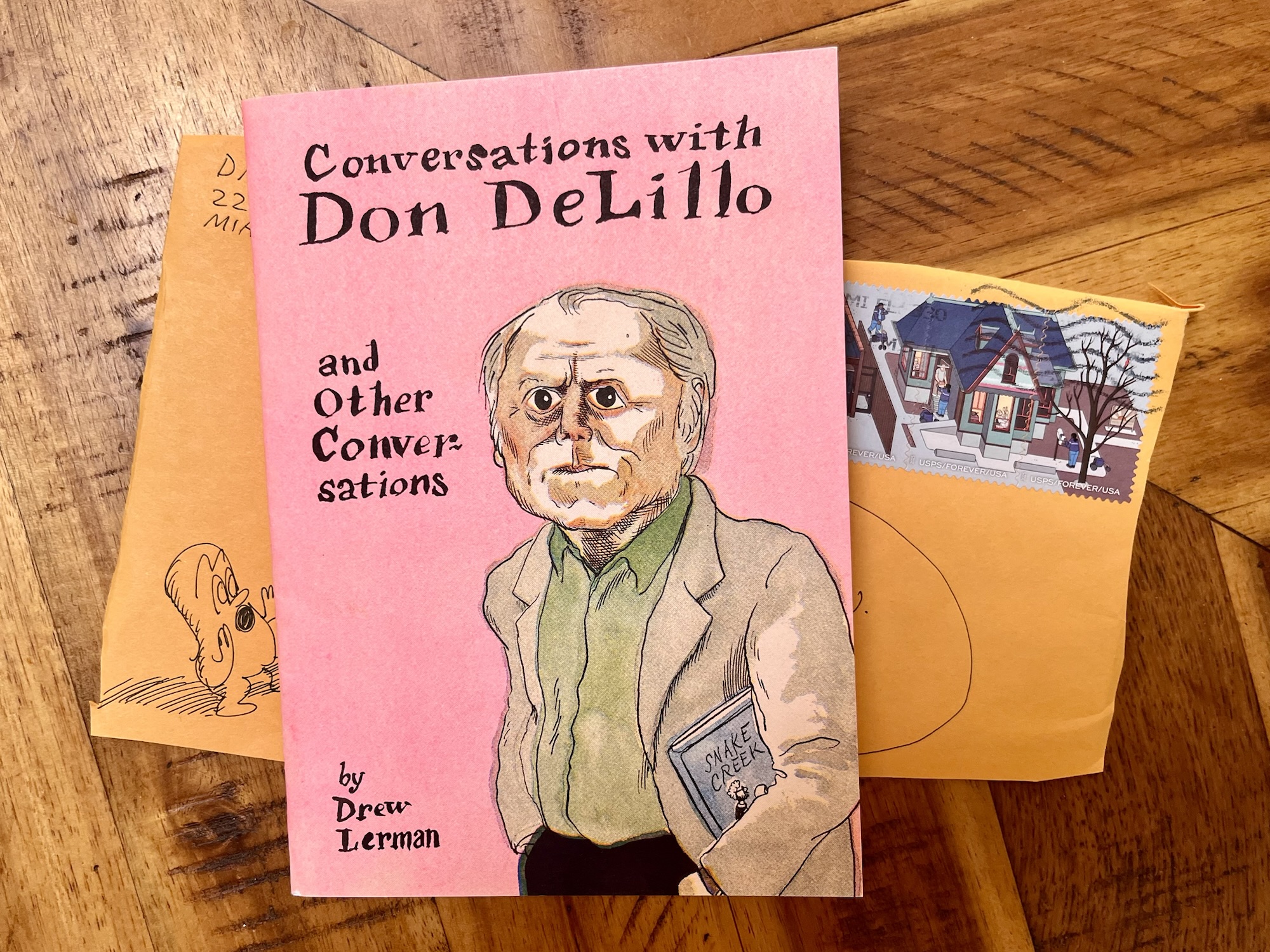
Conversations with Don DeLillo and Other Conversations by Drew Lerman (Book acquired, 3 June 2026)

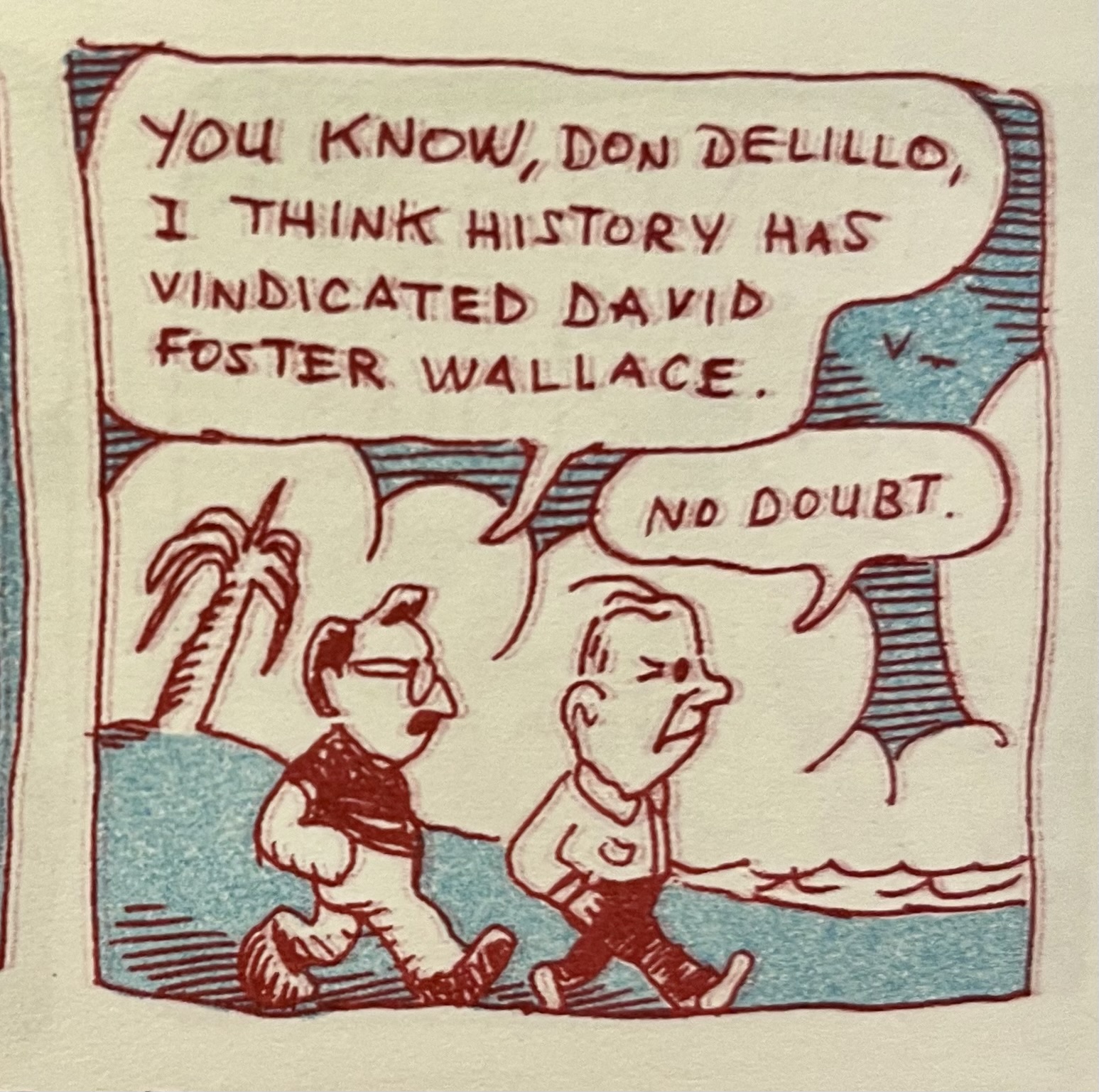
I’m a big fan of Drew Lerman’s work, and I’m always excited when he puts together a new collection. His latest is Conversations with Don DeLillo and Other Conversations, collecting his recent strips. I would describe these strips as functioning in the mode of pseudoautiobiographical postmodern literary interrogation, only that makes them sound pretentious, which they aren’t. They are very funny and very niche, and I often feel like I am Lerman’s ideal reader. This is my niche.

Each one-page strip features (a version of) Lerman encountering (and often trailing) a writer (DeLillo, obv., but also Joy Williams, Jonathan Franzen, Gordon Lish, William T. Vollmann…); the conversations are often very one-sided and allow Lerman to interrogate his subject on the kind of minutiae that often overtakes our ability to see the forest for the trees, so to speak, when it comes to art. In one of my favorite bits, for example, Lerman critiques the implementation of (“middle school book report-ass”) Courier New Unjustified as the font for DeLillo’s novel The Silence. I could go on but I should save it for a proper review.

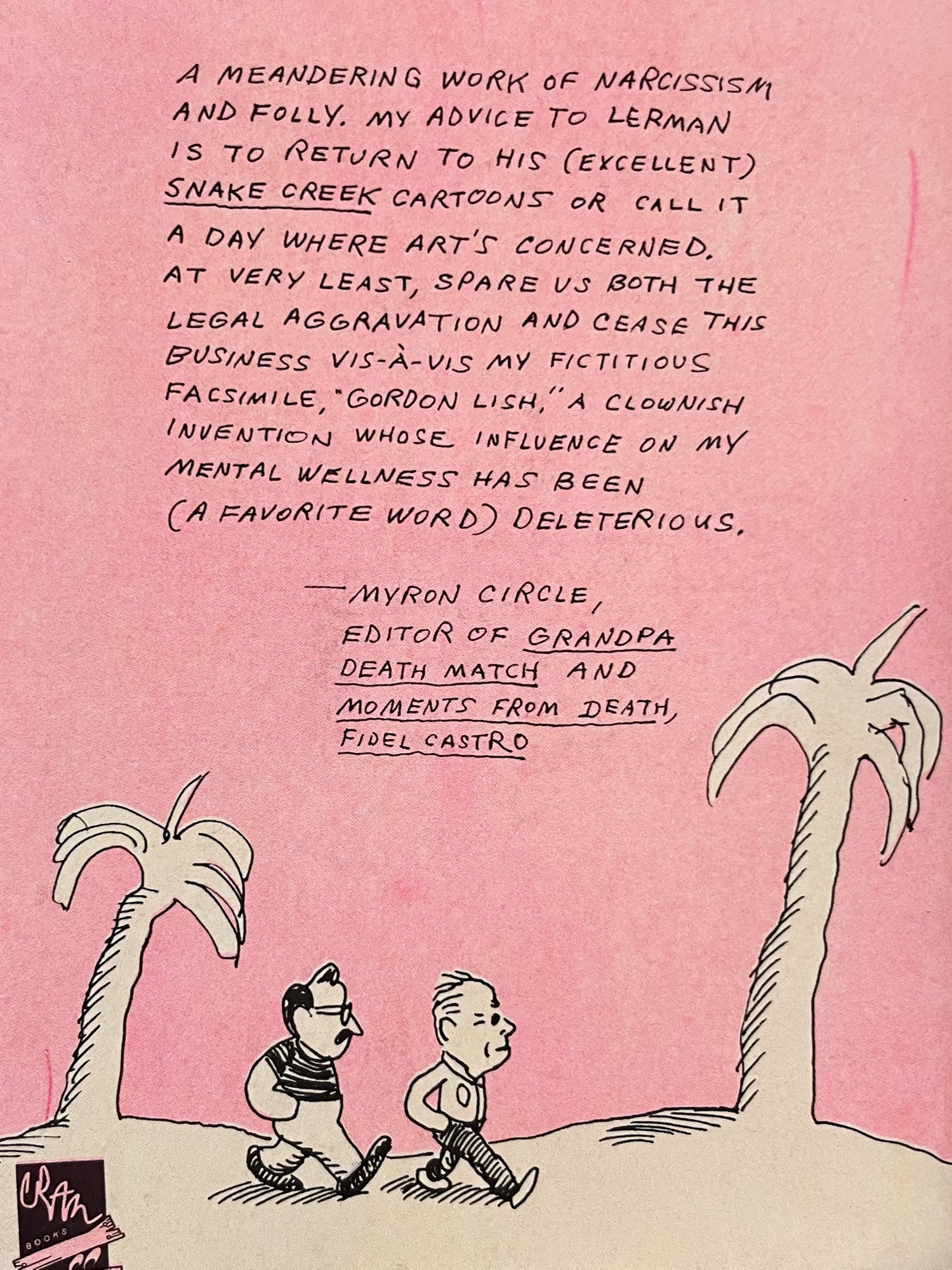
Conversations with Don DeLillo also features a great negative blurb by a certain grouchy “Myron Circle”:

And maybe this is corny of me, but I love that Lerman used Chris Ware stamps to mail me Conversations with Don DeLillo. (Chris Ware shows up in Conversations, btw — he tries to give Lerman a bunch of his books and tell Lerman how much he loves Snake Creek

More thoughts to come.

RIP Marjane Satrapi

RIP Marjane Satrapi, 19-2026

I was saddened to learn today of the death of the artist Marjane Satrapi. Satrapi was only 56.

Satrapi is probably most recognized for her first published work, Persepolis, a graphic novel she completed in 2003. Persepolis was one of the first books I wrote about on Biblioklept, way back in 2007, when this blog was not half a year old. Here is the entire post:

“It was funny to see how Marx and God looked like each other.”

Marjane Satrapi’s Persepolis makes a nice introduction to the graphic novel autobiography for anyone who hasn’t read one before. Marjane’s memoir weaves the political turmoil of the Islamic Revolution with the everyday stuff of childhood experience. As the the repressive Islamic regime revokes liberal freedoms, Marjane’s folks (secular intellectuals, of course) smuggle Iron Maiden posters back from Turkey; young Marjane sneaks cigarettes and rock music to a backdrop of political assassinations and war with Iraq.

Persepolis succeeds by engaging the reader in a personal experience of revolution and cultural alienation. It works as a history lesson and as a coming of age story. Readers who try something different (maybe suspend some prejudices?) will be rewarded with an enriched perspective on a political/cultural upheaval still affecting global politics today.

I wrote that twenty years ago, and there are any number of things I could pick at, I think my defensive tone is the most interesting to me. I think that general audiences have come to understand that comics, just like any other medium, can express the highest ideals of art. Persepolis, now a staple on many school reading lists, contributed to that cultural shift.

I looked around for my copy, but then realized that my daughter took Persepolis with her when she left for college last year. I remember reading the book to her when she was little; later she read it herself. We repeated the process with our son. And then we watched Satrapi’s 2007 film adaptation together a few times.

We also watched her film adaptation of her graphic novel Chicken with Plums. The film is good, but the book is better. My 2009 review of the paperback edition again highlighted an anxiety that mainstream audiences held prejudices against the comics medium:

Casual readers to comics often make the error of supposing that the medium is merely words with accompanying pictures. Satrapi’s deft work here might do wonders in correcting this ignorance. There isn’t a wasted panel in Chicken with Plums, and Satrapi commands intense emotion from her thick, black lines. There’s a seamless quality to Chicken with Plums; the text and the pictures, indivisible, add up to more than the sum of their parts. Satrapi knows when to hold back and let her simple black and white images tell the story. There is a certain economy of storytelling that great comic writers can achieve in ways entirely possible in prose, and here Satrapi has surpassed her earlier work in Persepolis, which, while great, often relied heavily on textual exposition. In Chicken with Plums, Satrapi’s evocations of troubled family life, unfulfilled love, the perils of Iranian immigration to California, and Sufi mysticism all blend into a poignant, often-funny, and occasionally devastating portrait that exemplifies the best of the comics medium.

While comparisons to her Persepolis series will undoubtedly hang over all of Satrapi’s work, Chicken with Plums is a wonderful successor, and in some senses, a more achieved work. Although it doesn’t convey the first-person immediacy of Persepolis, nor that memoir’s dramatic scope, the story of Nasser Ali is intimately detailed and achieves something rare in an age of overstuffed books: it leaves its readers hungry for more.

The plot of Chicken with Plums is devastatingly simple. Nasser Ali, a renowned Iranian musician (and Satrapi’s great uncle), elects to die after his wife destroys his beloved instrument. He quits eating and refuses to leave his bedroom. The story is very much an extrapolation of hazy events revealed in dreams and flashbacks, with a tint of magical realism.

I was a bit taken aback, given the plot of Chicken with Plums, while reading the following detail from Satrapi’s obituary in Le Monde today. The French newspaper reported that those close to the artist declared that, “Marjane Satrapi died of sadness a little over a year after the death of Mattias Ripa, her husband and the love of her life.” How very sad. I hope she has found some peace.

Question | From John A. Williams’ novel The Man Who Cried I Am

Nine million, n-­i-­n-­e million. Ah, the world got what it deserved. The lessons had been written on the board in big letters thousands of years ago and repeated several times every century since.

Question: How many men can I kill if I dig out the Suez Canal?

Question: How many men can I kill if I build myself a Great Pyramid?

Question: How many men, women and children can we kill if we retake the Holy Land from the heathens? (We’ll call it a Crusade.)

Question: How many men, women and children can we kill if we establish a slave trade between Africa and the New World?

Question: How many men can we kill to make the world safe for democracy?

Question: How many men can we kill to make the world safe for communism?

Answer: Hundreds, thousands, millions, billions.

And then, we’ll start all over again.

From John A. Williams’ 1967 novel The Man Who Cried I Am.

Mass-market Monday | Claude McKay’s Home to Harlem

Home to Harlem, Claude McKay, 1928. Pocket Cardinal Editions (1956). No cover artist or designer credited. 180 pages.

The cover art, while unattributed inside the book, is likely the work of Isadore Seltzer. McKay’s first novel is now in the public domain and available online.

Sunday Comix

A page by Charles Burns from BLAB! no. 2, Summer 1987, Monte Comix Productions.

“This demon is capitalism. Special Ability: Ravenous hunger” | On Thomas Kendall’s cybernoir novel How I Killed the Universal Man

Thomas Kendall’s How I Killed the Universal Man is a near-future sci-fi novel working squarely in the cybernoir tradition of Philip K. Dick and William Gibson. Like Gibson, Kendall constructs a world where corporate systems saturate daily life and set the limits of perception. Like PKD, Kendall foregrounds reality’s instability, where what is seen, felt, and remembered can’t be trusted as one’s own. Kendall reworks the cybernoir lineage through a critique of media culture and wellness technology, showing how late-capitalist systems present themselves as therapeutic while covertly expanding their nefarious authority. 

Our hero John Lakerman is a journalist for donkeyWolf, a “self-consciously edgy multi-social new(s) presence with a polyamorous approach to truth and ethics” that profits from “Attention Disordering Content.” From the outset, Lakerman understands himself less as an agent than as a conduit. He describes himself as “merely language, an impoverished language uninhabited by being,” and just “a data leak.” This diminished sense of self becomes explicit in one of the novel’s most telling admissions: “He had always wanted to be a robot…He’d always wanted to be a machine.” Lakerman’s desire isn’t so much a nihilist fantasy as it is an adaptive response to a world that already treats him as a tool, mere equipment.

Lakerman is sent to Miami to investigate Noumenon, a designer drug whose name strikes him as empty philosophical branding, “self-consciously clever and a total misunderstanding of the concept.” It’s a gonzo gig: he’ll take the drug himself and “report back from the other side of its meaning.” Under the supervision of Dr. Andrea Christoff at Lifepax (“here to carry you when nature can’t”), he enters a controlled Noumenon trial before exploring the Miami club circuit, where the drug circulates freely.

Crossing (literally) the threshold, Lakerman reads “cryptic messages” in the movement of club-goers’ bodies: “What they might see meant everything. What they could see was possibility. What they would see was another matter.” Capital, via biotech, mediates, manages, and tiers perception, parceled in preset doses. Kendall’s hyperheated dystopian Miami, a landscape of “block-shaped universes” and horizons “constructed by deprivation,” gives that logic spatial form. Space is segmented, experience preformatted, and Lakerman’s role as “reporter” starts to look like another interface the system ventriloquizes.

Lakerman leaves Miami, but the cityscape’s stratified logic stays with him. Back in London, news of a mass-shooting in Miami finds its way into his feed, and the “quaintness of a non-global catastrophe” showing up there strikes the jaded Lakerman as unusual. A too-specific detail from the report finds him returning to his last story on Noumenon, and his investigation widens into a corporate network linking Lifepax to the now-defunct Phenom Games. What began as a gonzo drug story becomes an inquiry into how experience itself is engineered, circulated, and monetized.

Lakerman’s investigation leads him to UbIQ, a biotech platform offering implants framed as “an advanced biometrics wellness program and early health warning system.” The smooth clinical reassurance of corporate jargon masks UbIQ’s reality as a tool of continuous emotional surveillance: “It registers how much you cry, when you cry, and at what.” As Lakerman encounters UbIQ (the name a loud, clear echo of PKD’s 1969 novel Ubik), the ground of proof gives way beneath him. Official records deny what he remembers, corroborating traces disappear, and even his own logs refuse to stabilize events into something demonstrably real.

He keeps investigating though, and the novel shifts to question not simply what Lakerman can know, but what kind of system makes knowing structurally dependent on corporate infrastructures and then repackages that dependence as “care.” Kendall distills this systemic condition, the internalization of capitalist infrastructure as perception, feeling, and “wellness,” into a blunt image of saturation: “Like plastic in fish, the way everything has a little capitalism mixed in.” Control arrives as smart drugs, implants framed as therapy, games that train attention and identity. It surrounds the self and takes up residence inside it.

A Boschian mural on the side of a church (titled a bit-on-the-nosedly Allegorical Futures) states the book’s critique outright: “This demon is capitalism. Special Ability: Ravenous hunger.” The mural is signed T.OR who Kendall later links to the game-world Lakerman is pulled toward. The mural names the engine; the game teaches how to live with it: “HIKTUM is a game that teaches you how to be multiple.” That “multiplicity” isn’t Whitman’s multitudinous freedom but training: become flexible, divisible, easier to manage. The endpoint is the Universal Man, “a thing [that] cannot be rendered but can be leased.” The novel’s late refrain “Nobody survives love” marks the cost of a world where even intimacy is folded into the logic of extraction.

Lakerman’s trajectory isn’t a personal tragedy so much as a case study in a world where media platforms, pharmaceuticals, and “wellness” tech jointly manage what can be felt, remembered, and proved — and where that management manufactures people who want to be managed. Kendall leaves Lakerman’s final position unresolved, but the arc is clear. The wish to become a machine (seamless, efficient, immune) collapses into submission to the systems already in place. In HIKTUM, control isn’t the existential threat of abstract violence, but rather what we feed to our heads and bodies. The diagnosis is that we don’t experience these systems as coercion. We submit to them as upgrades.

Readers drawn to cybernoir’s paranoiac pressures will get a kick out of Kendall’s transhumanist noir, which I’ve failed to describe the weirdness of here. How I Killed the Universal Man also makes a strong case for seeking out Whiskey Tit, an independent press committed to weirdness. Check it out.

On Robert Coover’s novel The Universal Baseball Association, Inc., J. Henry Waugh, Prop.


Robert Coover’s sophomore novel The Universal Baseball Association, Inc., J. Henry Waugh, Prop. is in print again via New York Review Books, with a new introduction by Ben Marcus. First published in 1968, The Universal Baseball Association connects the comparatively grounded late modernism of Coover’s first novel The Origin of the Brunists (1966) to the more overtly experimental postmodern fiction he became best known for — works like The Public Burning (1977), Spanking the Maid (1982), and Gerald’s Party (1986). In this light, The Universal Baseball Association makes an accessible point of entry into Coover’s oeuvre. (Coeuvre? Sorry. Sorry!) The Universal Baseball Association offers the conceptual daring and formal play of Coover’s mature work framed within a more emotionally-accessible narrative. Along with the metatextual fables collected in Pricksongs & Descants, it makes a strong starting place for readers coming to Coover for the first time. And unlike the zany and morally-elastic stories in Pricksongs & Descants (and a lot of Coover’s later work), UBA retains a realistic emotional core that many readers look for. It gives us someone to care about.

That someone is Henry Waugh, an accountant who spends his nights running a solitary baseball league of his own invention. He conjures his Universal Baseball Association with dice, elaborate scorecards, and meticulous record books — but most of all imagination. Henry’s is a coherent, vibrant world, a closed system with its own history, genealogy, politics, and language.

From the novel’s outset we sense that Henry’s game has already surpassed the imaginative confines of a normie’s pastime. Now in its fifty-sixth season, The Universal Baseball Association is an immersive, generative world, rich in folklore, mythos, culture. We also see (as those around him can see) that his  fantasyland threatens to subsume him entirely. Our boy is hardly excelling at his day job, as his concerned coworker Lou points out. Much of the novel’s early tension comes from Henry’s attempt to bridge his fantasy world to the “real” world. But his endeavors to recruit others to the game fail.

Still, Henry tries. Early on, he describes his project to his “old friend” Hettie, a “neighborhood B-girl” he takes home from a dive bar after a few (too many) drinks:

“I’m an auditor for a baseball association.”

“I didn’t know they had auditors, too,” she said.

“Oh, yes. I keep financial ledgers for each club, showing cash receipts and disbursements…And a running journalization of the activity, posting of it all into permanent record books… Politics, too. Elections. Team captains. Club presidents. And every four years, the Association elects a Chancellor, and I have to keep an eye on that.”

Inebriated Henry boasts, fumbles, and flirts with Hettie; the scene is pure Coover — manic horniness wrapped in nerdiness (or maybe vice versa). Henry continues his awkward seduction with this zinger:

He took a grip on her behind. “People die, you know.”

It excites Hettie! And sure, hypothetical deaths on a game boy’s ledger are, like, sexy. It’s Henry’s idealism that really soars here though. He describes the hunt for perfection that drives his exquisite archival project:

…what a wonderful rare thing it is to do something, no matter how small a thing, with absolute unqualified utterly unsurpassable perfection! …to do a thing so perfectly that, even if the damn world lasted forever, nobody could ever do it better, because you had done it as well as it could possibly be done. …In a way, you know, it’s even sad somehow, because, well, it’s done, and all you can hope for after is to do it a second time.

How sad is Henry’s satisfied melancholy? — or is it melancholic satisfaction? A thing done perfectly is finished, fixed, closed. The league’s record books promise such permanence, but in doing so foreclose living possibility into completed fact. What could happen becomes only what has happened.

Henry tries to counter that closure by designing a system that lives, generates, and regenerates. He rejects games that repeat themselves mechanically, like pinball, which he dismisses as “a static game, utterly lacking the movement, grace, and complexity of real baseball.” Instead, he builds a structure governed by controlled randomness. It’s worth quoting at length some of Henry’s process to give you a taste of his rational mania:

When he’d finally decided to settle on his own baseball game, Henry had spent the better part of two months just working with the problem of odds and equilibrium points in an effort to approximate that complexity. Two dice had not done it. He’d tried three, each a different color, and the 216 different combinations had provided the complexity, all right, but he’d nearly gone blind trying to sort the colors on each throw. Finally, he’d compromised, keeping the three dice, but all white, reducing the total number of combinations to 56, though of course the odds were still based on 216. To restore—and, in fact, to intensify —the complexity of the multicolored method, he’d allowed triple ones and sixes—1-1-1 and 6-6-6—to trigger the more spectacular events, by referring the following dice throw to what he called his Stress Chart, also a three-dice chart, but far more dramatic in nature than the basic ones. Two successive throws of triple ones and sixes were exceedingly rare—only about three times in every two entire seasons of play on the average—but when it happened, the next throw was referred, finally, to the Chart of Extraodinary Occurrences, where just about anything from fistfights to fixed ball games could happen. These two charts were what gave the game its special quality, making it much more than just a series of hits and walks and outs. Besides these, he also had special strategy charts for hit-and-run plays, attempted stolen bases, sacrifice bunts, and squeeze plays, still others for deciding the ages of rookies when they came up, for providing details of injuries and errors, and for determining who, each year, must die.

That final detail, must die, is crucial. Mortality is a rule of the UBA, a key ingredient to the league’s emotional, psychological, and moral ballast. Death gives the game stakes, introducing irreversibility into an otherwise repeatable system. Death also exposes the risk at the heart of Henry’s design. The same randomness that generates excitement also engenders loss. And Henry must submit to that randomness, even though he created it, even if it means killing off one of his most beloved players:

Oh, sure, he was free to throw away the dice, run the game by whim, but then what would be the point of it? Who would [the player] really be then? Nobody, an empty name, a play actor. Even though he’d set his own rules, his own limits, and though he could change them whenever he wished, nevertheless he and his players were committed to the turns of the mindless and unpredictable—one might even say, irresponsible—dice. That was how it was. He had to accept it, or quit the game altogether.

Henry is the great Creator of this system, but he’s also subject to its rules, an order of his own grace. The autonomy of the league depends on his restraint. Without the rules, the players would collapse into pure fiction (which of course they are); with the rules, the players acquire a simulacrum of reality.

These rules restrain Henry; they are the mechanism by which his inventions become more than inventions, and nowhere is that mechanism clearer than in the act of naming:

…name a man and you make him what he is. Of course, he can develop. And in ways you don’t expect. Or something can go wrong. Lot of nicknames invented as a result of Rookie-year surprises. But the basic stuff is already there. In the name. Or rather: in the naming.

Like Adam naming the animals, Henry brings his players into being through language. They do not preexist their names. Naming is not just merely descriptive, but generative. Once named, a UBA player can develop, succeed, fail, even die, but nothing happens until the name enters the system.

(An aside: in the UBA, Coover gives his contemporary Thomas Pynchon a run for his money in the zany names department. (Zany songs, too, but this review is already bloated.))

The naming, the rules, the chronicles are all bound in the auspiciously-capitalized archive of the Universal Baseball Association, The Book. A grandiose tome,

it consisted of some forty volumes, kept in shelves built into the kitchen wall, along with the permanent record books, league financial ledgers, and the loose-leaf notebooks of running life histories. He seemed to find more to write about, the more he played the game, and he foresaw the day when the number of archive volumes would pass the number of league years.

Too, Henry’s Book is an amalgam of discursive textual approaches, all filtered through his manic imagination:

Style varied from the extreme economy of factual data to the overblown idiom of the sportswriter, from the scientific objectivity of the theoreticians to the literary speculations of essayists and anecdotalists. There were tape-recorded dialogues, player contributions, election coverage, obituaries, satires, prophecies, scandals…His own shifting moods, often affected by events in the league, also colored the reports, oscillating between notions of grandeur and irony, exultation and despair, enthusiasm and indifference, amusement and weariness. Lately, he had noticed a tendency toward melancholy and sentimentality. He hoped he’d get over it soon. 

Henry’s archive expands, its relentless growth challenging the Association’s foundations. Record-keeping no longer mediates the league but rather constitutes it, collapsing the distinction between event and commentary. Statistics, essays, interviews, and speculative fragments stand on equal footing, none quite stabilizing the others. In this sense, the novel anticipates the metatextual logic of later works like the stories of Pricksongs & Descants and The Public Burning, where narration proliferates without authority and systems generate their own interpretive noise. Henry’s text-making generates layers of discourse that displace rather than resolve one another, much as Coover’s infamous story “The Babysitter” multiplies incompatible narrative versions without privileging a final account. The archive thickens without coherence. Henry’s attempt at a complete archive results in formal excess. It’s born of love, or obsession, or both, but Henry’s discursive text-making ultimately exposes the instability of both the league and the act of narration itself.

Coover juxtaposes the league’s self-enclosed textual machinery against the crowded, bodily immediacy of Henry’s everyday life. Scenes with his coworker Lou, especially in bars and restaurants, are full of conflicting textures and excess:

They bundled in, warm odors assailing them gently, past a sign that read: Go thy way and eat thy bread with joy! Piped-in radio music floated over the kitchen noises, the whump of doors, rattle of cocktail shakers, the bubble and buzz of underwater voices. Walls in a lush green with gold sparkle, cedar wainscoting, soft glow throughout, yet at the same time, linoleum floors and tawdry leatherette booths. Frilly lamps at the tables like little flowers, massive paintings and prints of whaling ships and dead pheasants on the walls. Elegant bar of carved wood in the romantic style, but the tabletops were cheap speckly formica. Dark-suited business types were conferring in one booth, young kids necking in the next. Yet somehow it all hung together okay.

Their meal (in Coover’s Henry’s free indirect imagination) tips into vivid grotesquerie:

Pink sea monsters, washed up on a shore of lettuce leaves and parsley, arrived, iced, their pungent sauce piercing through the present aroma of the Old Fashioneds’ bitters like an arrow: zingo! right to the nose! and to the palate! terrific!

The real world is messy, abject, excessive, embodied, lacking the clean structure of the league, but alive in a way the league cannot be. In the real world, bodies eat, drink, touch, but meaning is diffuse, nothing is fully accounted for. Real reality is a system without closure, with no stabilizing center. The UBA is Henry’s answer to messy reality.

But so and when the aforementioned tragic death of a beloved player occurs, Henry finds his fantasyland shaken, destabilized in ways his imagination had not anticipated. His careful system, with its ledgers and tables and charts cannot make meaning of the grief he feels. Already predisposed to melancholy, Henry slides into a depression that league play cannot resolve. There’s no joy in the game. A veteran player diagnoses the situation succinctly:

What if…we have passed, without knowing it, from a situation of sequential compounding into one of basic and finite yes-or-no survival, causing a shift of what you might call the equilibrium point, such that the old strategies, like winning ball games, sensible and proper within the old stochastic or recursive sets, are, under the new circumstances, insane!

By the outset of the novel’s final third act, Henry is in a bad place:

Not once, in the Universal Baseball Association’s fifty-six long seasons of play, had its proprietor plunged so close to self-disgust, felt so much like giving it up, a life misused, an old man playing with a child’s toy; he felt somehow like an adolescent caught masturbating… He was destroying the Association, he knew that now. He’d kept no records, hadn’t even logged a single entry in the Book.

As the UBA unravels, so do Henry’s relationships in the real world. He alienates and insults Hettie and his drunken bid to get Lou to play the game with him ends in another intrusion of wet, messy reality — Lou spills beer over the Henry’s charts and ledgers, the corporeal material of the game.

Dejected and alone in his apartment, drunkenly spinning, Henry returns to his game, a vengeful God cheating at dice to produce a 6-6-6 roll in an act of premeditated murder. The Creator has finally violated his own rules. Reality then literally spews out of our Henry, as he abjectly vomits “a red-and-golden rainbow arc of half-curded pizza over his Association” before passing out.

As the penultimate chapter begins, Henry has settled down a bit. The UBA’s season is over with no fanfare, no additional textuality beyond raw stats: “Journalists quit writing, just watched. Nobody interviewed anybody. No one sought autographs.” Nothing more to write.

Revivified, but a bit insane, Henry finds a way back to the “perfection”  he’s previously thought, but now understands it as something from the insulated system he’d previously imagined:

he’d discovered…that perfection wasn’t a thing, a closed moment, a static fact, but process, yes, and the process was transformation…

By the end of the chapter, our hero transforms, synthesizing the imaginative and the real. A fantasy baseball player walks into a bar. There he finds all his favorite figments:

…Witness York and Ham Craft and Maggie Everts and Walt McCamish and Bo McBean, here they come! and Rag Rooney and Jaybird Wall and Cash Bailey with his champion Patsies, the whole goddamn whooping and hollering lot of them! and Chauncey O’Shea and Royce Ingram!

Our hero is finally subsumed into the game. He will not appear again in the novel.

The final, eighth chapter is set a hundred years in the future (the future of the UBA, that is), and is populated by the league descendants of Henry’s creation, now more philosophical (and disembodied) than ever. As one player remarks: 

We have no mothers… The ripening of their wombs is nothing more than a ceremonious parable. We are mere ideas, hatched whole and hapless…”

The players have moved on to their own meta-narratives, without the authorial impositions of Henry. A kind of fatalistic-but-perhaps-optimistic view takes hold: “Even if there weren’t [a record-keeper], I think we’d have to play the game as though there were,” one player remarks.

The novel ends with a baseball game, a match nestled comfortably into a mythology generated from fateful Season LVI (a season so fateful that it rattled the Creator J.W.H. such that he has disappeared from the narrative). Descendants of that season’s two victims face off as pitcher and batter — but with the reassurance of the new perfection:

“It’s not a trial,” says Damon, glove tucked in his armpit, hands working the new ball. …”It’s not even a lesson. It’s just what it is.”

The radical inconclusiveness here is mirrored in Coover’s architecture for his eight-chapter baseball novel, which refuses to give its readers a perfect ninth inning. The structure seems to dare the reader to imagine that ninth inning.

In the Universal Baseball Association, games require a witness. The continuity of record keeping requires the fiction of someone who guarantees continuity. The league persists only at the cost Henry has been paying from the start: life displaced by its administration. For The Universal Baseball Association, Inc., J. Henry Waugh, Prop., the reader is the witness, called up to Coover’s minor majors (or is that vice versa?). It’s a workout for the imagination, I suppose —  rules, events, records, history, myth. 

And it’s more fun than I think I’ve expressed here — I’ve quoted Coover’s prose at length, maybe too much, but I don’t think I’ve fully conveyed how rich and hardy the text is, how warm and comforting the world that he conjures is, populated by singers and slingers and general bonhomie. It’s Famous Times All the Time, except when it’s melancholy, sad, or just plain bonkers. The Universal Baseball Association is part of the great American postmodern canon. Come and play.

Blog about some recent reading (Jan. and Feb. 2026)

Joy Williams’ collection The Pelican Child was the first book I read this year. I picked up a copy back in December and surprised myself by reading most of it over a few days. It’s a much heavier collection than the wry vignettes of 2013’s Ninety-Nine Stories of God or its sequel, Concerning the Future of Souls (2024). The stories here alight on mortality, human ecological cultural aesthetic, etc. Opener “Flour” strikes me as a postmodern riff on Emily Dickinson’s “Because I Could Not Stop for Death” and the fable (literally fabulous?) closer “Baba Yaga and The Pelican Child” made me tear up a little and then hate myself a little. A book about death where young people, tattooed with the lines of long-dead poets, are the clean-up crew working the night shift sweeping up the detritus of the 21st century. (It was “Argos,” about Odysseus’s good and loyal boy, that really killed me if I’m honest.)


There are still a few stories at the back of Robert Bingham’s 1997 collection Pure Slaughter Value. I will tuck them away for another time. I loved these stories and then I found myself angry at his spoiled clever preppy narrators. “The Other Family” is one of the better stories I’ve read in a long time.


I reread Robert Coover’s second novel, The Universal Baseball Association, Inc., J. Henry Waugh, Prop. (1968), back in January and made some notes for a review. This is not that review. I am not a Coover expert but I think this is as good an introduction to his novels as anything. (No it’s not; get Pricksongs & Descants.)


Speaking of Universal—I had an early misfire with Thomas Kendall’s 2023 novel How I Killed the Universal Man, but then started it again the other night with a perhaps clearer idea of what the author was trying to do. I think I was thinking something more straightforward, more cyberpunknoir, something less, I dunno, formally meta or post. More thoughts to come.


I think George Saunders’ new novel Vigil fucking sucks.


Is Helen DeWitt’s The English Understand Wool a novella? A novelette? A short story? Should we care? I loved The Last Samurai (2000), thought Lightning Rods (2011) seemed like a novel written quickly for money, and found myself embarrassed for everyone involved with her collection Some Trick (2018), including the editor, publisher, bookseller who sold it to me, and myself — but maybe I should go back and try it again? I thought The English Understand Wool was really good! It was funny and silly and sharp.


I have spent the past few months reading what I could get my little pink hands on of David Ohle’s incredible post-apocalyptic comedy, the Moldenke Saga (a term I have just now coined, maybe). I will do a Whole Thing on these novels at some point, but I read The Blast in one night and felt really sad that it was over and then the next night I read most of the last Moldenke novel, The Death of a Character, and then I woke up around 4am that morning and finished it and got a little choked up. In novels like Motorman, The Age of Sinatra, and The Old Reactor, Ohle has given us a fittingly grotesque, grody, gnarly, abject, hilarious, zany, and emotionally-resonant zombie funhouse mirror for our own gross times. These novels are woefully underread and still, for the most part, in print. Seek them out.


Wanting to scratch an Ohle itch, I turned to Literature Map to suggest some proxy; this machine offered Stanley Crawford as a proximal prosist. I picked up a few of his novels the other weekend, including 1972’s Log of the S.S. The Mrs Unguentine, which I read over the course of a few hours late at night and then reread the next night. It’s not like the Ohle oeuvre, excepting that it’s wholly, utterly original at the conceptual aesthetic rhetorical level, is generally tragicomical, mythical, epic — but also compact, and funny and alarming. So it’s very much in the Ohlesphere. Seek it out.


And also scratching that apocalyptic itch is  Antoine Volodine’s 2021 novel The Monroe Girls (in translation by Alyson Waters). It’s got this cracked bifocal Bardo thing going on, which I will not explain here and now. The print in the Archipelago edition is small for my aging eyes. I’ve read it in the afternoon; it is not an afternoon book, it is a 2am book.


I read the first half of Jan Kerouac’s “semi-autobiographical” novel Baby Driver (1981) last night. The writing immediately struck me as very bad, very overwritten, ostentatious and clumsy, but I kept going, charmed by the charmingly charming naivety of the novel, which is not a naive novel at all, which turns into a rough and ready sex and drug novel, or sex and drug autobiography, or autofiction. (My instinct is that this is an autobiography with a lot of whoppers.) Our heroine is on heroin pretty quick, then turning tricks, then on to other adventures. But there’s a glib smudging of purple prose over any would-be tragic contours. She likes it! She really likes it! At least I think.

And yes, J. Kerouac is J. Kerouac’s only (acknowledged) child, and yes, he pops in now and then, a jolly fibbing wino, the poseur some of us always pegged him for, maybe a better phrase-turner than lil Jan, but somehow I think less real.


Mass-market Monday | Joanna Russ’s Picnic on Paradise

Picnic on Paradise, Joanna Russ, 1968. Ace Books (1968). Cover art by Leo and Diane Dillon. 157 pages.


From Joachim Boaz’s review at SF Ruminations:

Joanna Russ’ first published novel Picnic on Paradise (1968) delightfully subverts traditional SF pulp adventure tropes.  Although not as finely wrought as The Female Man (1975), And Chaos Died (1970), or her masterpiece We Who Are About To… (1976), Picnic is worthwhile for all fans of feminist SF and the more radical visions of the 60s.

Unfortunately, the metafictional implications/literary possibilities of the Alyx sequence of short stories and novels—of which Picnic on Paradise is part of—are not realized until the publication of the short story “The Second Inquisition” (1970).

The Bookworm’s Rules | Reading advice from Michael Silverblatt

The great reader Michael Silverblatt, host of Bookworm, has passed away at 73. Silverblatt was a powerful influence on my development as an adult reader, and his approach to reading helped shape my own appreciation of fiction as I emerged from/recovered from academia. It’s been a few years since I listened to an episode; I think the last one I recall was with Robert Coover and Art Spiegelman together, maybe five or six years ago, by which point the show seemed to be initiating a slow winding down process. But for years, when blogging was still very much a real thing and social media wasn’t, Bookworm was one of the best outlets for literary discussion. Its archive remains impeccable.

Here are ten “rules” Silverblatt offered in a 1997 LA Times profile:

  1. Sit. If you’re lying down you’ll fall asleep.
  2. Read at least 100 pages in your first session with a new book. You must get well in.
  3. If you’re reading for pleasure, finish a book before starting a new one. Don’t keep three or four going.
  4. If your eyes get tired, try cotton compresses with witch hazel—they’re soothing and refreshing.
  5. Read a book about a country you’ve never visited.
  6. Ask close friends to name their favorite book, one that changed their life or one that accompanied a change in life. You will learn not just about the book, but about the person who recommended it.
  7. Don’t be embarrassed to keep a vocabulary list. Reading without understanding is not a virtue.
  8. Don’t torture yourself or read out of duty. A great book has an obligation to enrich and alter your life.
  9. There are certain books you’ll find you’re not ready for. Please suspend your judgment of them. It took me seven years and six tries to read Faulkner’s As I Lay Dying.
  10. If you can’t discard preconceptions that come from bad classroom experiences—for example, A Tale of Two Cities and Silas Marner are not Dickens’ or Eliot’s best works—if you’ve X’d them out of your list, you’re missing something of pleasure. You’re ready now. Try them.

Blog about George Saunders’ novel Vigil, a novel I have not yet read (Book acquired 11 Feb. 2026)

I’ve been reading a lot of David Ohle lately — the Moldenke cycle, specifically. I read The Pisstown Chaos (2008) late last year, then kept going with The Old Reactor (2013), and then reread The Age of Sinatra (2004). I’m near the end of a  reread of Ohle’s seminal weirdo novel Motorman (1972) right now, and I’ve got The Blast (2014) and The Death of a Character (2021) on the way.

The Moldenke books take place in an abject, stinky, ruinous post-apocalyptic landscape populated with jellyheads, neutrodynes, imps, Stinkers, and Americans. The world runs on broken logic and bureaucratic absurdity. Order is repeatedly disrupted by Chaoses and Forgettings. Bodies fail; technology fails. Ohle relates these stories in a genteel, dry tone (especially in the later books) that mocks any hint of a Hero Saving the Day. His novels, especially those published during US America’s foolish GWOT misadventures, capture the spirit of my country’s farcical post-twentieth-century trajectory.

But this blog post is ostensibly about George Saunders, or rather George Saunders’ new novel Vigil, which I have not yet read, having only just today received a review copy in the mail.

I do not think that a writer has a cultural duty to respond to now, or Now, or even “Now!” if you like–but I do think that Saunders has always aimed to respond to the US American zeitgeist in his fictions. And in the best of his fictions — including the stories “CivilWarLand in Bad Decline,” “Pastoralia,” “Sea Oak,” and “The Semplica Girl Diaries” — Saunders skewered US American absurdity with a tender pathos that balanced his dark humor without overpowering its core anger. But Saunders’ later fiction is perhaps over-seasoned with love, empathy, all that hippy-dippy shit. It’s not necessary to look through everyone’s eyes. Empathy has its limits. Latter-day Saunders often read to me as, in its worst moments, sanctimonious.

NYT critic Dwight Garner didn’t use the word “sanctimonious” to describe Saunders in his negative review of  Vigil, but his lede comes close:

“Once you start illustrating virtue, you had better stop writing fiction,” Robert Penn Warren wrote. It was once difficult to imagine this dictum might apply to George Saunders.

From the start, in the mid-1990s, he’s been an American original, a briskly whiskered national asset. He’s an ineluctably strange, dark and funny writer whose work has some of Mark Twain’s subversive wit, Kurt Vonnegut’s cosmic playfulness and Donald Barthelme’s laboratory blitzing of high and low culture.

It was my colleague who alerted me to this review, which I skimmed, noting the phrase “Downhill Alert!”, before dispensing with it. (My colleague wants me to read the book in some kind of, uh, I don’t know, tandem?, with him.)

This colleague loved Saunders’ 2017 novel Lincoln in the Bardo. I did not love Lincoln in the Bardo. I couldn’t even finish it. I found it maudlin, trite. It was like watching your dad try and impress your boss (I don’t know what that means). I wrote that year, 2017, that

Lincoln in the Bardo might be a really good novel and I just can’t see it or hear it or feel it. I see postmodernism-as-genre, as form; I read bloodless overcooked posturing; I feel schmaltz. I failed the novel, I’m sure. I mean, I’m sure it’s good, right? The problem is me, as usual.

By 2018 I had changed my mind on that last sentence. I read Saunders’ New Yorker published short story “Little St. Don” and thought it was a massive, massive failure to respond to the incipient fascist encroachment of the first Trump administration. I concluded that,

Saunders loves his reader too much. The story wants to make us feel comfortable now, comfortable, at minimum, in our own moral agency and our own moral righteousness. But comfort now will not do.

I thought Saunders’ next two New Yorker stories were a smidge stronger, calling “Elliott Spencer,” “a stylistically-bold tale about poor people who are reprogrammed and then deployed as paid political protesters.” Of “Love Letter,” I suggested that the exercise “reads like a thought experiment with no real conclusion, no solid answer. Or, rather, the solution is there in the title: love. But is that enough?”

Vigil is about a dying oil tycoon visited by a comforting angel, or series of angels, or something like that. It is, if I understand correctly, Saunders’ take on “climate fiction,” which I imagine will not really dwell in the nasty gross irreal reality of the fall we are falling into right now. But I could be wrong. I can’t help but notice that Vigil seems to be organized, like Lincoln in the Bardo, around a “Great Man” in USAian history — a mover and shaker, a powerbroker, a markmaker, etc. I’ll try to read it with an open mind, but I have to admit that even the prospect pales against my recent dip into Ohle’s sour, funky flavors. But we shall see.


Mass-market Monday | Philip K. Dick’s The Divine Invasion

The Divine Invasion, Philip K. Dick, 1981. Timescape Books (July 1982). Cover by Rowena Morrill. 223 pages.


I love Rowena’s cover for PKD’s second entry in the VALIS trilogy. (Saddam Hussein was a fan of her art too, btw.)

The James Joyce riff from early in The Divine Invasion

Into the stereo microphones Asher said distinctly, ” ‘O tell me all about Anna Livia! I want to hear all about Anna Livia. Well, you know Anna Livia? Yes, of course, we all know Anna Livia. Tell me all. Tell me now. You’ll die when you hear. Well, you know, when the old cheb went futt and did what you know. Yes, I know, go on. Wash quit and don’t be dabbling. Tuck up your sleeves and loosen your talktapes. And don’t butt me- hike !-when you bend. Or whatever-‘”

“What is this?” the autochthon said, listening to the translation into his own tongue. Grinning, Herb Asher said, “A famous Terran book. ‘Look, look, the dusk is growing. My branches lofty are taking root. And my cold cher’s gone ashley. Fieluhr? Filou! What age is at? It saon is late. ‘Tis endless now senne- “The man is mad,” the autochthon said, and turned toward the hatch, to leave.

“It’s Finnegans Wake,” Herb Asher said. “I hope the translating computer got it for you. ‘Can’t hear with the waters of. The chittering waters of. Flittering bats, fieldmice bawk talk. Ho! Are you not gone ahome? What Thom Malone? Can’t hear-‘

The autochthon had left, convinced of Herb Asher’s insanity. Asher watched him through the port; the autochthon strode away from the dome in indignation. Again pressing the switch of the external bullhorn, Herb Asher yelled after the retreating figure, “You think James Joyce was crazy, is that what you think? Okay; then explain to me how come he mentions ‘talktapes’ which means audio tapes in a book he wrote starting in 1922 and which he completed in 1939. Before there were tape recorders! You call that crazy? He also has them sitting around a TV set — in a book started four years after World War I. I think Joyce was a– The autochthon had disappeared over a ridge. Asher released the switch on the external bullhorn.

It’s impossible that James Joyce could have mentioned ‘talk- tapes” in his writing, Asher thought. Someday I’m going to get my article published; I’m going to prove that Finnegans Wake is an information pool based on computer memory systems that didn’t exist until a century after James Joyce’s era; that Joyce was plugged into a cosmic consciousness from which he derived the inspiration for his entire corpus of work. I’ll be famous forever.

The spectator, at this point, is certain to wonder whether he must now endure a football game in print | Don DeLillo

(The spectator, at this point, is certain to wonder whether he must now endure a football game in print — the author’s way of adding his own neat quarter-notch to the scarred bluesteel of combat writing. The game, after all, is known for its assault-technology motif, and numerous commentators have been willing to risk death by analogy in their public discussions of the resemblance between football and war. But this sort of thing is of little interest to the exemplary spectator. As Alan Zapalac says later on: “I reject the notion of football as warfare. Warfare is warfare. We don’t need substitutes because we’ve got the real thing.” The exemplary spectator is the person who understands that sport is a benign illusion, the illusion that order is possible. It’s a form of society that is rat free and without harm to the unborn; that is organized so that everyone follows precisely the same rules; that is electronically controlled, thus reducing human error and benefiting industry; that roots out the inefficient and penalizes the guilty; that tends always to move toward perfection. The exemplary spectator has his occasional lusts, but not for warfare, hardly at all for that. No, it’s details he needs — impressions, colors, statistics, patterns, mysteries, numbers, idioms, symbols. Football, more than other sports, fulfills this need. It is the one sport guided by language, by the word signal, the snap number, the color code, the play name. The spectator’s pleasure, when not derived from the action itself, evolves from a notion of the game’s unique organic nature. Here is not just order but civilization. And part of the spectator’s need is to sort the many levels of material: to allot, to compress, to catalogue. This need leaps from season to season, devouring much of what is passionate and serene in the spectator. He tries not to panic at the final game’s final gun. He knows he must retain something, squirrel some food for summer’s winter. He feels the tender need to survive the termination of the replay. So maybe what follows is a form of sustenance, a game on paper to be scanned when there are stale days between events; to be propped up and looked at — the book as television set — for whatever is in here of terminology, pattern, numbering. But maybe not. It’s possible there are deeper reasons to attempt a play-by-play. The best course is for the spectator to continue forward, reading himself into the very middle of that benign illusion. The author, always somewhat corrupt in his inventions and vanities, has tried to reduce the contest to basic units of language and action. Every beginning, it is assumed, must have a neon twinkle of danger about it, and so grandmothers, sissies, lepidopterists and others are warned that the nomenclature that follows is often indecipherable. This is not the pity it may seem. Much of the appeal of sport derives from its dependence on elegant gibberish. And of course it remains the author’s permanent duty to unbox the lexicon for all eyes to see — a cryptic ticking mechanism in search of a revolution.)

From Don DeLillo’s 1972 novel End Zone.

A note to readers new to Infinite Jest

A note to readers new to Infinite Jest

David Foster Wallace’s 1996 novel Infinite Jest poses rhetorical, formal, and verbal challenges that will confound many readers new to the text. The abundance of (or excess of) guides and commentaries on the novel can perhaps have the adverse and unintentional consequence of making readers new to Infinite Jest believe that they can’t “get it” without help.  Many of the online analyses and resources for Infinite Jest are created by and targeted to readers who have finished the novel or are rereading the novel. While I’ve read many insightful and enlightening commentaries on the novel over the years, my intuition remains that the superabundance of analysis may have the paradoxical effect of actually impeding readers new to the text. With this in mind, I’d suggest that first-time readers need only a dictionary and some patience.

Infinite Jest is very long but it’s not nearly as difficult as its reputation suggests. There is a compelling plot behind the erudite essaying and sesquipedalian vocabulary. That plot develops around three major strands which the reader must tie together, with both the aid of—and the challenge of—the novel’s discursive style. Those three major plot strands are the tragic saga of the Incandenzas (familial); the redemptive narrative of Ennet House Drug and Alcohol Recovery House, with Don Gately as the primary hero (sociocultural); and the the schemes of the Québécois separatists (national/international/political). An addictive and thus deadly film called Infinite Jest links these three plots (through discursive and byzantine subplots).

Wallace often obscures the links between these plot strands, and many of the major plot connections have to be intuited or outright guessed. Furthermore, while there are clear, explicit connections between the plot strands made for the reader, Wallace seems to withhold explicating these connections until after the 200-page mark. Arguably, the real contours of the Big Plot come into (incomplete) focus in a discussion between Hal Incandenza and his brother Orin in pages 242-58. Getting to this scene is perhaps a demand on the patience of many readers. And, while the scene by no means telegraphs what happens in IJ, it nonetheless offers some promise that the set pieces, riffs, scenes, lists, and vignettes shall add up to Something Bigger. 

Some of those earliest set pieces, riffs, scenes, lists, and vignettes function almost as rhetorical obstacles for a first-time reader. The  novel’s opening scene, Hal Incandenza’s interview with the deans at the University of Arizona, is chronologically the last event in the narrative, and it dumps a lot of expository info on the reader. It also poses a number of questions or riddles about the plot to come, questions and riddles that frankly run the risk of the first-time reader’s forgetting through no fault of his own.

The second chapter of IJ is relatively short—just 10 pages—but it seems interminable, and it’s my guess that Wallace wanted to make his reader endure it the same way that the chapter’s protagonist–Erdedy, an ultimately very minor character—must endure the agonizing wait for a marijuana delivery. The chapter delivers the novel’s themes of ambivalence, desire, addiction, shame, entertainment, “fun,” and secrecy, both in its content and form. My guess is that this where a lot of new readers abandon the novel.

The reader who continues must then work through 30 more pages until meeting the novel’s heart, Don Gately, but by the time we’ve met him we might not trust just how much attention we need to pay him, because Wallace has shifted through so many other characters already. And then Gately doesn’t really show up again until, like, 200 pages later.

In Infinite Jest, Wallace seems to suspend or delay introducing the reading rules that we’ve been trained to look for in contemporary novels. While I imagine this technique could frustrate first-time readers, I want to reiterate that this suspension or delay or digression is indeed a technique, a rhetorical tool Wallace employs to perform the novel’s themes about addiction and relief, patience and plateaus, gratitude and forgiveness.

Where is a fair place to abandon Infinite Jest

I would urge first-time readers to stick with the novel at least until page 64, where they will be directed to end note 24, the filmography of J.O. Incandenza (I will not even discuss the idea of not reading the end notes. They are essential). Incandenza’s filmography helps to outline the plot’s themes and the themes’ plots—albeit obliquely. And readers who make it to the filmography and find nothing to compel them further into the text should feel okay about abandoning the book at that point.

What about a guide?

There are many, many guides and discussions to IJ online and elsewhere, as I noted above. Do you really need them? I don’t know—but my intuition is that you’d probably do fine without them. Maybe reread Hamlet’s monologue from the beginning of Act V, but don’t dwell too much on the relationship between entertainment and death. All you really need is a good dictionary. (And, by the way, IJ is an ideal read for an electronic device—the end notes are hyperlinked, and you can easily look up words as you read).

Still: Two online resources that might be useful are “Several More and Less Helpful Things for the Person Reading Infinite Jest,” which offers a glossary and a few other unobtrusive documents, and “Infinite Jest: A Scene-By-Scene Guide” which is not a guide at all, but rather a brief series of synopses of each scene in the novel, organized by page number and year; my sense is that this guide would be helpful to readers attempting to delineate the novel’s nonlinear chronology—however, I’d advise against peeking ahead. After you read you may wish to search for a plot diagram of the novel, of which there are several. But I’d wait until after.

An incomplete list of motifs readers new to Infinite Jest may wish to attend to

The big advantage (and pleasure) of rereading Infinite Jest is that the rereader may come to understand the plot anew; IJ is richer and denser the second go around, its themes showing brighter as its formal construction clarifies. The rereader is free to attend to the imagery and motifs of the novel more intensely than a first-time reader, who must suss out a byzantine plot propelled by a plethora of characters.

Therefore, readers new to IJ may find it helpful to attend from the outset to some of the novel’s repeated images, words, and phrases. Tracking motifs will help to clarify not only the novel’s themes and “messages,” but also its plot. I’ve listed just a few of these motifs below, leaving out the obvious ones like entertainment, drugs, tennis (and, more generally, sports and games), and death. The list is in no way definitive or analytic, nor do I present it as an expert; rather, it’s my hope that this short list might help a reader or two get more out of a first reading.

Heads

Cages

Faces

Masks

Teeth

Cycles

Maps

Waste

Infants

Pain

Deformities

Subjects

Objects

One final note

Infinite Jest is a rhetorical/aesthetic experience, not a plot.

[Ed. note: Biblioklept first posted a version of this note in the summer of 2015. Today marks the thirtieth anniversary of Infinite Jest’s publication. Wallace’s novel remains underread by overtalkers].

Mass-market Monday | Joanna Russ’s And Chaos Died

And Chaos Died, Joanna Russ, 1970. Ace Books (n.d., c. 1978). No cover artist or designer credited. 189 pages.


From Samuel R. Delany’s review of And Chaos Died:

The first two pages of this hardcover reprint of And Chaos Died present the protagonist, Jai Vedh, as a quietly despairing modern man with a nearly psychotic desire to merge with the universe. Moreover, it is suggested that this essentially religious desire is a response to the meaninglessness and homogeneity of every day life. There is a vacuum inside him; and when, on a business trip in a spaceship that has taken him off the surface of Old Earth (“on which every place was like every other place, ” p. 9), he senses the great vacuum of space itself about the ship, the real vacuum and the psychological vacuum become confused. Propelled by his desire for mergence,

on the nineteenth day he threw himself against one of the portals, flattening himself as if in immediate collapse, the little cousin he had lived with all his life become so powerful in the vicinity of its big relative that he could not bear it. Everything was in imminent collapse. He was found, taken to sick bay, and shot full of sedatives. They told him, as he went under, that the space between the stars was full of light, full of matter — what was it someone had said, an atom in a cubic yard? — and so not such a bad place after all. He was filled with peace, stuffed with it, replete; the big cousin was trustworthy.

Then the ship exploded. (p. 10)

The place Jai Vedh comes to, along with the philistine captain of the exploded spaceship, is the first of Russ’s SF utopias. Noting the January 1970 publishing date on the original edition, and thus inferring 1968/1969 as the most probable time of composition, we may be tempted to read this particular utopia as a kind of arcadian fall-out of that decade’s ecological crusade. A more sensitive reader of SF will, however, notice its sources in SF works that substantially predate that crusade: the nameless planet of telepaths takes its form from Clarke’s Lys (the more ruralized companion city to mechanical Diaspar in The City and the Stars, 1953) and from the world in Theodore Sturgeon’s “The Touch of Your Hand” ( 1953). What characterizes this particular SF image is not rural technology, but advanced technology hidden behind a rural facade; not human communication in good faith, but ordinarily invisible communicational pathways (some form of ESP); and it is always left and then returned to.

Richard Hell’s Godlike (Book acquired, 23 Jan. 2026)

Richard Hell’s 2005 novel Godlike is getting a new printing from NYRB. Godlike reimagines the volatile Verlaine–Rimbaud dyad as a 1970s No Wave New York collision of art, desire, and language language language. Symbolist rebellion transmutes into downtown punk nihilism, drugs, and poetry. This corrosive Künstlerroman was originally issued by Dennis Cooper’s Little House on the Bowery (an imprint of Akashic books). Read the description/blurb at NYRB; here’s a taste from Chapter 15, around the middle of the novel:

They spent the greatest amount of their time together reading and writing and sometimes talking in T’s apartment. These were probably their best times too despite being experienced largely as tedium. They preferred the times of thrills, but the thrills grew out of the tension; and the mild, mildly restless, half-frustrated times of the many nights and late afternoons of doing almost nothing in T’s apartment, or walking the streets without direction, were their true lives.

T’s room was like some kind of glum office in its lack of daylight and its featurelessness, but with the little pictures now tacked on the walls, and the typewriter and sheets of paper, and the drugs, it got some character. He’d picked up a few stray pieces of furniture on the streets, including a table and three chairs, crates for shelves, and a beat-up old oriental rug. There was a secondhand portable record player too and a few albums.

They drank coffee and beer and sometimes codeine cough syrup and sometimes smoked some grass or snorted a little THC or mescaline and every once in a while a tiny bit of heroin, but mostly they lay around and lazily, impatiently goofed and wrote and complained, goading each other. Sometimes in the middle of the night one of them would go out for a container of fresh ice cream from Gem’s Spa. They’d go to a movie sometimes, or wander the rows of used bookstores on Fourth Avenue, or drink in a bar, but most of t he time was spent in the dim back apartment.

The days and nights were as endless as wallpaper patterns. Boredom and irritation were normal and lengthened out into sometimes-mean giggles and into pages of writing. Writing was their pay. Books were reality. The room was a cruder dimension-poor annex to the pages of writing. The writing, as casual as it was—smeared eraseable typing-pages with revisions scribbled on and crumpled pages of rejected tries—was the brightly lit and wildly littered universe erupting out from the dark, poor, inexpressive room.

How odd is it to have as a purpose in life the aim of treating life-in the medium created for the purpose of coldly corresponding to it, words—as raw material for amusing variations on itself? Sometimes T. and Paul fantasized about this, imagining themselves as godlike philosopher poets encouched in the advanced civilization, languorously sipping their fermented grain as they spun ideas and mental-sensual constructions of life-language in the air for the pleasure of their own delectation.