On Antoine Volodine’s novel The Monroe Girls, an abject post-apocalyptic romantic comedy

Each time I’ve written about an Antoine Volodine novel, I’ve dithered and dallied and despaired over neatly summarizing his expansive post-exotic project. It seems almost impossible to write about one of his novels without discussing how that novel fits within a robust textual (anti-)system. My abortive prefatory attempts might start with pointing out that “Antoine Volodine” is itself a fiction; the pen name is one of several heteronyms taken by a person whose “real” name may or may not be Jean Desvignes. I’d probably then point out that his works are crowded with writers, dissidents, rebels, narrators, all speaking after the apocalypse, and sometimes even after death. And then I’d likely try to somehow encapsulate the intertextuality of Volodine’s post-exotic project, which project is closer, I’d likely claim, to Fernando Pessoa’s or Søren Kierkegaard’s use of heteronyms than, say, an easier corollary, like Faulkner’s Yoknapatawpha or Tolkien’s Middle Earth. (I’d probably bring up Roberto Bolaño too.)

And then I would delete all that shit and just write about the fucking novel.

That was the deal when I wrote last year about Mevlido’s Dreams (2007) or the year before that when I riffed on Radiant Terminus (2014). I loved those books, although “loved” might not be the right word.

(I felt much freer writing about Writers (2010), the first Volodine fiction I read. After I read Writers I read more Volodine novels and began to better “understand” his project and consequently felt more a stifling self-imposed pressure to preface any piece of writing about a Volodine fiction with the kind of ridiculous swollen agglomeration of sweaty word salad that I’ve thus far heaped up on your plate, unasked for, dear reader.)

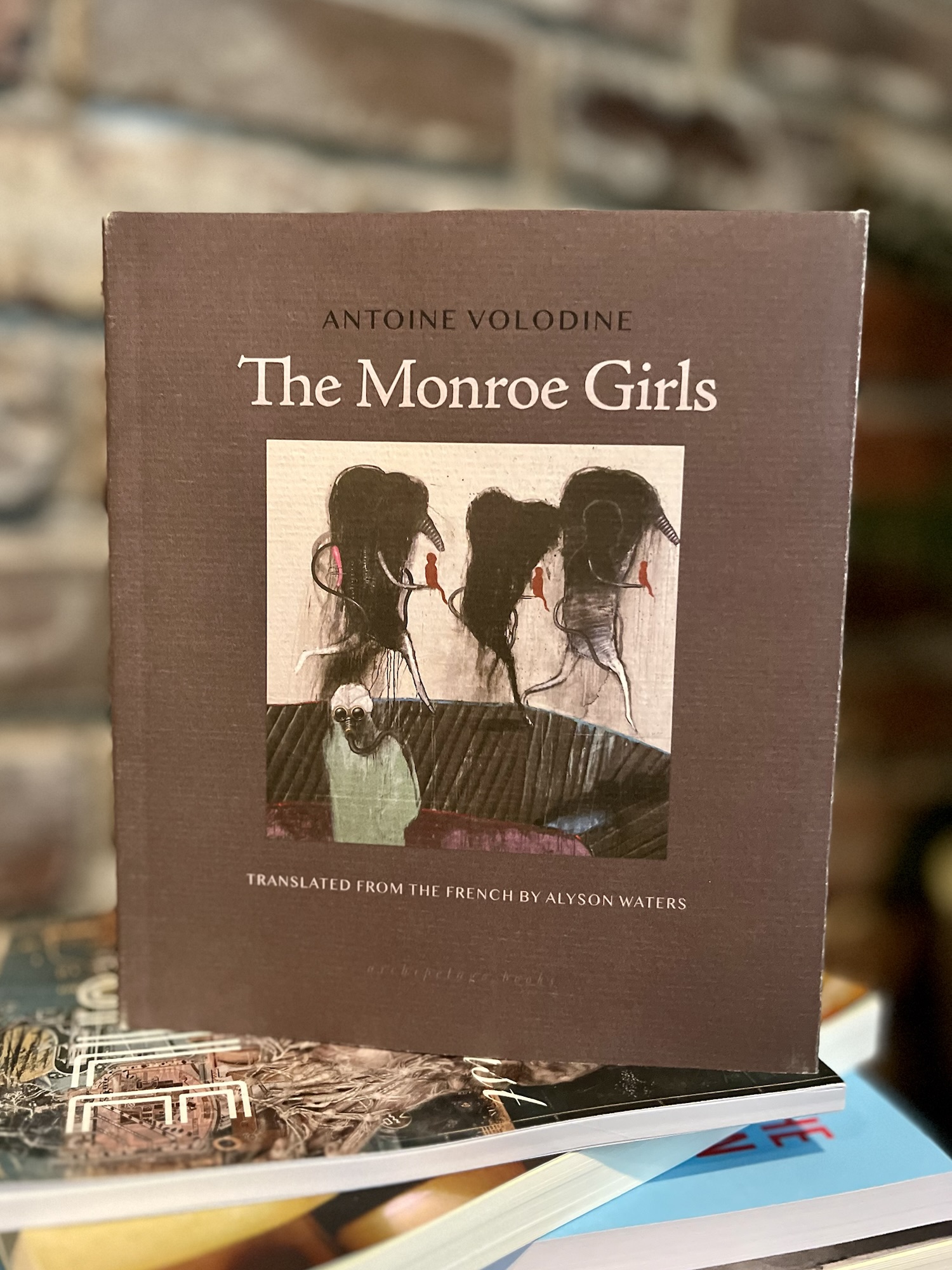
All of which is a ridiculous way to begin writing about The Monroe Girls, Volodine’s 2021 novel which is now available in English translation thanks to Alyson Waters (and publisher Archipelago Books).

What I want to say is something like: The Monroe Girls reads like a romantic comedy. An abject post-apocalyptic romantic comedy. An abject post-apocalyptic romantic comedy with a schizophrenic coward as its hero, a hero who anxiously vomits in pretty much every chapter he’s in.

The Monroe Girls is grim and gross, like all of Volodine’s stuff, but it also has an endearing, goofy, slapstick quality that ambles alongside a romantic, if insane, longing. And the reason that I’ll keep all my prefatory bullshit in this time is, like, I think some familiarity with what Volodine is doing across these books helps clarify why The Monroe Girls, while very much part of his oppressive, dread-soaked, dilapidated post-historical world, also feels like an outlier in its heightened (though still deadpan) humor and romantic flourishes.

I will call in a ringer to provide the context I think my reader needs. I will borrow the authority of no less than the great translator David Bellos, who describes Volodine’s project so clearly in a 2012 essay:

Roughly speaking, all Volodinian literature comes from after the final collapse and defeat of the revolution. What revolution? It is never directly identified with an event catalogued in world history, but the movement to which all narrators have or had belonged prior to their capture, incarceration or expulsion has general features that are quite clear. The movement was internationalist, egalitarian, anti-authoritarian and anti-capitalist. It has no hope of ever making a difference anymore, save that fidelity to its ideas is what keeps all Volodine’s friends (his characters) in their cells and psychiatric wards.

…Wherever you venture in the Volodinian universe–jungle, steppe, city, slum–things are a mess. The environment is degraded, resources are scarce, buildings are dilapidated, equipment is either non-existent or in an advanced state of decay, and no productive activities appear to be going on at all. Perhaps, outside of the camps, prisons, wards and detention centers whence come the works of post-exotic literature there may still be structures that resemble normal life, but they impinge only briefly and aggressively into the carceral world of Volodine’s characters.

…One of the more striking features of Volodine’s narrator-characters is that some of them, for at least some of the time, are dead. Others are insane, and others are suffering (and aware that they are suffering) from amnesia. These partly fantastical premises (that is to say, partly characteristic of fantastic literature) are not just literary tropes. The post-exotic world from which Volodine reports pays little of our normal heed to the distinctions between memory and imagination, sanity and madness, or life and death.

So all of what Bellos describes there is true too for The Monroe Girls.

I used words like goofy and humor above, and said that The Monroe Girls is a romantic comedy. A brief description of the plot would not support such claims. Here goes:

Breton is our schizophrenic narrator. He hangs out with himself in a nearly-abandoned psychiatric compound where he spies (via special oneiric goggles and his own telepathy) on the “daydreams and adventures of the dead.” Specifically, the dead he spies on are Monroe and his titular girls. A former Party leader, Monroe was “executed once upon a time for deviationism.” In “the black space” he now operates from, Monroe molds his girls into revenant commandos, “formidable, beautiful, tough, brave, intelligent…the last egalitarian warriors.” He sends them back into the world of the living, the vanguard “armed faction of the future Party for whom he’d hoped and prayed since his execution.” The Party is anxious about this return, and enlists Kaytel, a kind of police chief to force Breton to track and monitor the Monroe girls. Unfortunately for the Party, it turns out that Breton was — is?— “madly in love” with one of these girls, a certain Rebecca Rausch. Our lovefool will do what he can to preserve Rebecca and the other girls, even as the oppressive Central Committee threatens (and delivers) violence upon him. The Monroe Girls progresses as a series of misadventures between Breton (and Breton), the various Monroe girls, and Kaytel, who ends up an oddly sympathetic character.

I don’t want to spoil too much — the fun and thrill of this novel is in its odd but brisk pacing and strange eruptions of humor — but I feel the need to share a climactic moment which is simultaneously heroic and ironic, romantic and mordant, as if Volodine inflates the revolutionary rhetoric simply to puncture it. Here is a scene, late in the novel; Rebecca, accompanied by Breton (and Breton) makes a “declaration of general policy…composed to recite before the final offensive…to convince the masses of the validity of the current action” (the “current action” being revolutionary violence):

“Workers, peasants!” she began. “Obscure members and members of no rank of the hospital personnel. Mental dissidents! Organic dissidents! Earthlings without a party and survivors! Schizophrenics and patients treated like cattle! Misguided torturers! Futureless thugs! Ordinary Party sympathizers! Dead soldiers! Living dead!”

Because I recognized myself in a few of the categories she was reeling off, I went to sit quietly in front of her, on a cement milestone that was wet but at the right height. I was pleased that someone, in a solemn speech, was taking into account the existence of people like me. Breton hesitated for ten seconds then sidled up beside me.

“She’s raving,” he whispered.

“Shut up,” I instructed.

One of the novel’s central formal conceits is Breton’s schizophrenia, which is less a psychological detail than another way the text refuses stable narrative position. The Breton/Breton split is not corrected or explained away; it persists as a structural doubling of perspective, in which even the “I” cannot remain singular. Early in the novel, the effect can be wonderfully confusing. Indeed, the novel’s second chapter reads like a revision or rewrite or reimagining of the novel’s first chapter. It also seems clear to the reader that the divided or doubled Breton exists within the narrative framework just as “realistically” as the single or solitary Breton. The “second” Breton is never remarked upon by other characters, but there is also nothing in the story that suggests that the double is merely a figment. The “other” Breton is just as valid an entity as any of the Bardo creatures that float through the Volodineverse.

Primarily, these Bardo creatures are, like, dead folks — not zombies, just, like, not living. Obviously there are the Monroe girls, who emerge from the “black and floating territory” to wreak havoc on the Party. It’s key to point out that they are flesh and blood, and Volodine renders them (and their armor, equipment, and weaponry) like action heroes or even comic-book heroes. At the same time, they are sleepwalkers, the spirit of failed revolution returned to the earth.

The Monroe girls contribute to the world of the dead, killing Party enforcers. One such episode is particularly comic; the dead don’t die right away in Volodineville; no, they’ll linger a bit, hang out, do a little investigating even. In one of my favorite bits of the novel, a pair of freshly-dead cops search an apartment. On the stairway, a long-dead but still-bickering couple snipe at the cops and each other. “It truly is a city of the dead,” one of the Monroe girls observes.

Intimate doubling pervades The Monroe Girls: the aforementioned dead cops; the old dead couple; Breton and Rebecca; Breton and BretonThroughout his work, Volodine has often foregrounded loyalty to comrades as a virtue, one to be practiced even as the world turns to shit. The Monroe Girls imagines comradeship in different forms — bureaucratic, idealistic, romantic, and even sexual. There’s a strange horniness to some of the novel that points to sensual generation, an impulse I haven’t detected in other Volodine novels. Consider Kaytel’s other partner, Party leader Dame Patmos:

Despite being well over the hump of fifty, Dame Patmos remained attractive. Her face had grown wider, her flesh swollen, but the harmony of her features and even the lascivious proportions of her body had changed accordingly and today were still practically intact. The excess fat barely erased the memory of the radiant thirty-year-old woman she had been. She had metamorphosed into an enormous female mammal of fifty, voluptuous and still at ease with herself. She was aware she still had seductive powers if she put in some effort.

Volodine’s description of the sexual tension between Kaytel and Dame Patmos ironizes and undercuts any horny swelling though:

The two of them remained facing each other without a word for a long moment, like in a Taiwanese movie under terrible French influence, or like in a post-exotic tale right before a scene of criminal violence.

I love how Volodine doubles his simile here. The first simile points outward, toward a recognizable filmic register; the second turns inward. Both similes are rooted in the image of narrative, as if the scene can still be held together by recognizable frames — cinema, genre, the tale.

But Volodine’s narrators don’t get to stay safely inside those frames for long. The book keeps staging moments as if they belong to a legible scene of erotic or emotional intensity, and then breaking that scene from within, almost immediately, with something bodily and unassimilable. What looks like stylized tension tips into leakage, exhaustion, or violence, as if narrative itself can’t contain the material it is trying to organize.

Even romance, even the faint possibility of sensual connection, only ever holds for a second before the body insists on itself again. Volodine’s writing recalls and restages Julia Kristeva’s notion of abjection (discussed at length in Powers of Horror). Abjection here is not simply disgust but the moment the seams that keep the illusion of a stable, coherent “I” intact give way: when inside and outside, self and other, life and death begin to leak into one another. What should stay expelled returns: odor, fatigue, nausea, proximity. Here’s Breton (and Breton’s) description:

I began to think about death. It was a question we rarely raised, Breton and I. The idea of life made us vomit. It returned constantly, this idea, and it startled us, fueled our hiccups and the various fluids we coughed up. It was extremely difficult to live, to survive, to continue this long passage through the universal madness, the universal schizophrenia of the camp, to face the hostility of all and sundry day after day. It was extremely difficult and pointless to take part in this slow obstacle course, to sense within ourself deep mental and physical decline, to feel our bodies grow exhausted, overcome with awful pains and awful smells. It was extremely wearisome to be obliged to move forward at all costs, with at most the perspective of a next step, a next chapter in a book whose end escaped us and would always escape us. Extremely difficult, thus painful, pointless, and punishing. Death for us was merely a neighboring territory into which we’d venture naturally… [Death] did not really exist for us and, in any case, never had we imagined going there for good.

Oh shit wait did I say that this novel was, like, a romantic comedy? I think it still is, somehow. Or maybe it’s a romantic comedy after romance, after comedy, after the illusion that selves or worlds could ever remain coherent long enough to sustain those genres.

I do know that I laughed a lot; I do know that this one felt somehow more, I don’t know, concentrated than the sci-fi sprawl of Radiant Terminus or Mevlido’s Dreams, more linear than the fragmentary (although complete) works Post-Exoticism in Ten Lessons, Lesson Eleven (1998), Minor Angels (1999), Writers, and Bardo or Not Bardo (2004).

Maybe it’s because of Breton’s sweetness, so unexpected in a Volodine fiction, so contrasting with his intense abjection — how sweet his love for Rebecca feels. (Of course there isn’t one stable Breton in this novel, so maybe it’s my mood we’re seeing here.)

And I’ll add that the novel’s last chapter, “Annex,” has been one of the funniest things I’ve read all year. Throughout The Monroe Girls, characters are frequently having to attest to which faction of the Party they sympathize with. “Annex” is a list of “The 343 Factions of the Party in its Glory Days.” Some of the factions have cool names (“The Black Bonnets,” “The Partisans of the Red Lotus”), some have straightforward or even clinical names (“The Leninists of the Fifth Day,” “The Monroe-Absolutists”), but as the list grows, the names grow more comical, more absurd — “The Disappointed by Polpotism,” “The Chinese Takeout,” or, I think my favorite, “Frankenstein’s Fiancées.”

Last on the list is “The Faction ‘This is the end, my friend, the end,'” and recent posts on Twitter and Instagram suggest that Volodine’s post-exotic project may indeed be coming to some kind of conclusion this summer: eleven books, published simultaneously by eleven different publishers, all under the heteronym Infernus Iohannes. Strangely appropriate, I guess. Volodine’s fictions are not a discrete, stable literary system; the post-exotic novels are the proliferating afterlife of voices, identities, factions, and failures. Even its ending arrives as multiplication. Great stuff.

The Monroe Girls by Antoine Volodine in translation by Alyson Waters is now available from Archipelago Books.
Blog about some recent reading (Jan. and Feb. 2026)

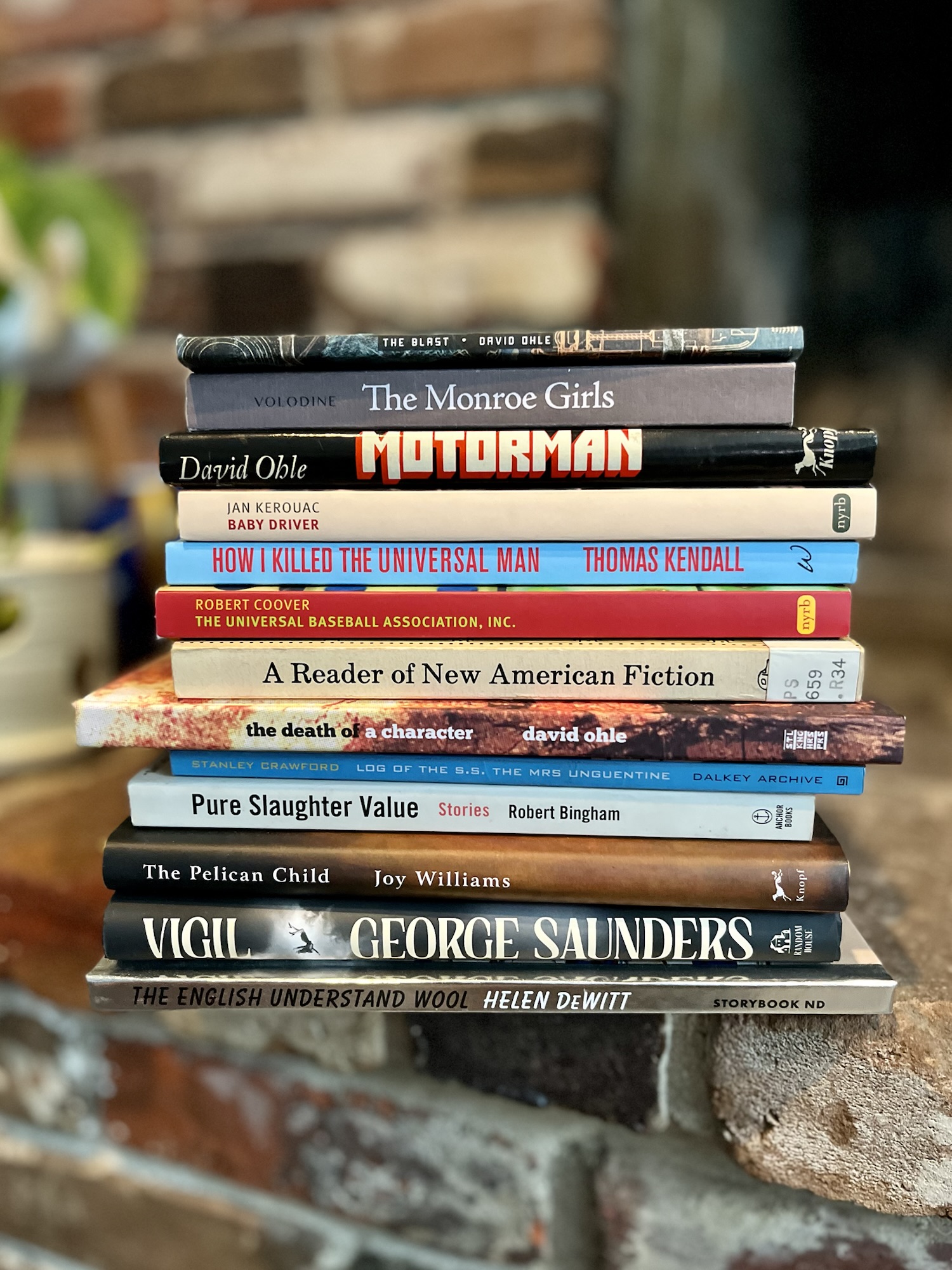
Joy Williams’ collection The Pelican Child was the first book I read this year. I picked up a copy back in December and surprised myself by reading most of it over a few days. It’s a much heavier collection than the wry vignettes of 2013’s Ninety-Nine Stories of God or its sequel, Concerning the Future of Souls (2024). The stories here alight on mortality, human ecological cultural aesthetic, etc. Opener “Flour” strikes me as a postmodern riff on Emily Dickinson’s “Because I Could Not Stop for Death” and the fable (literally fabulous?) closer “Baba Yaga and The Pelican Child” made me tear up a little and then hate myself a little. A book about death where young people, tattooed with the lines of long-dead poets, are the clean-up crew working the night shift sweeping up the detritus of the 21st century. (It was “Argos,” about Odysseus’s good and loyal boy, that really killed me if I’m honest.)


There are still a few stories at the back of Robert Bingham’s 1997 collection Pure Slaughter Value. I will tuck them away for another time. I loved these stories and then I found myself angry at his spoiled clever preppy narrators. “The Other Family” is one of the better stories I’ve read in a long time.


I reread Robert Coover’s second novel, The Universal Baseball Association, Inc., J. Henry Waugh, Prop. (1968), back in January and made some notes for a review. This is not that review. I am not a Coover expert but I think this is as good an introduction to his novels as anything. (No it’s not; get Pricksongs & Descants.)


Speaking of Universal—I had an early misfire with Thomas Kendall’s 2023 novel How I Killed the Universal Man, but then started it again the other night with a perhaps clearer idea of what the author was trying to do. I think I was thinking something more straightforward, more cyberpunknoir, something less, I dunno, formally meta or post. More thoughts to come.


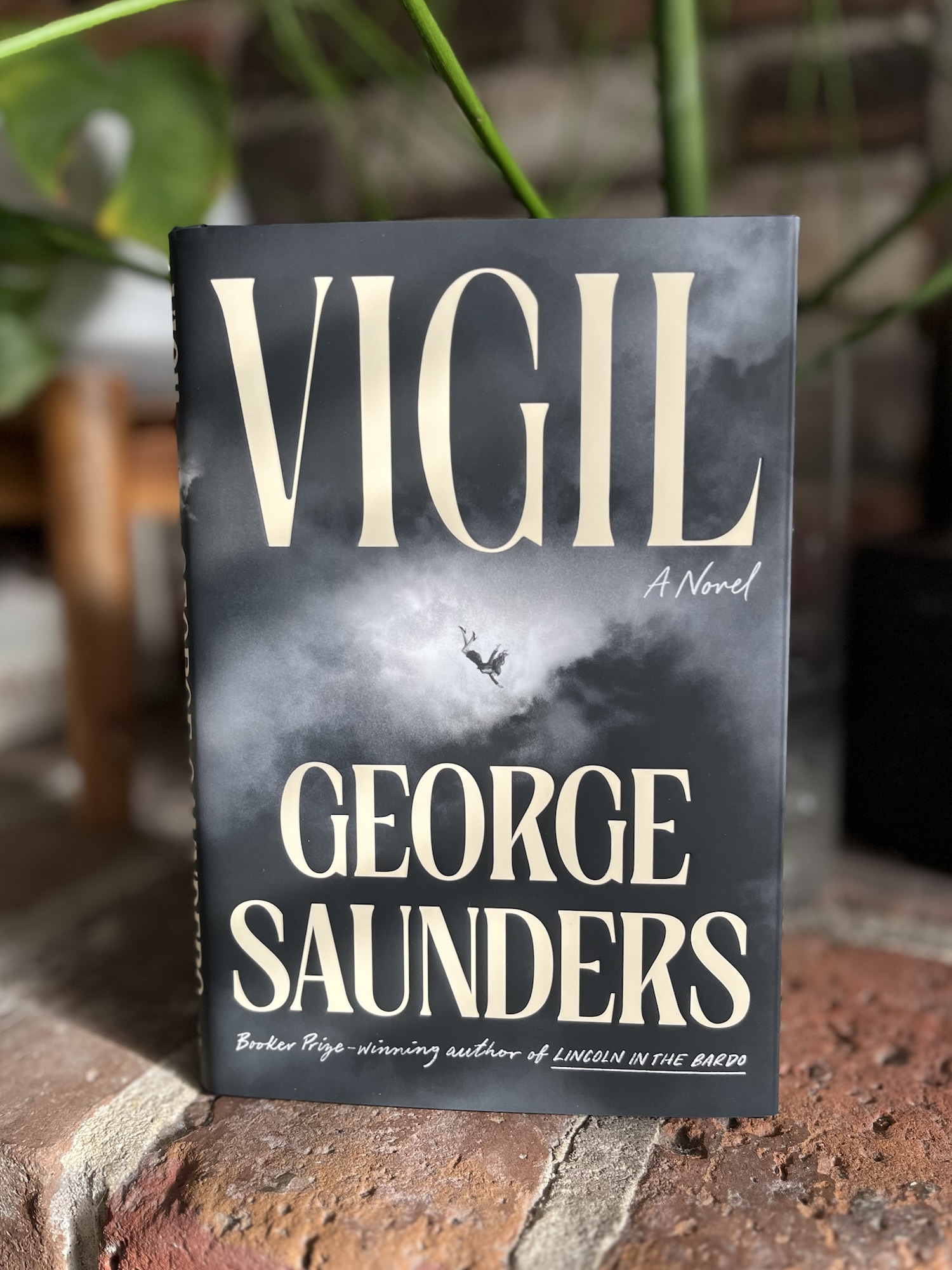
I think George Saunders’ new novel Vigil fucking sucks.


Is Helen DeWitt’s The English Understand Wool a novella? A novelette? A short story? Should we care? I loved The Last Samurai (2000), thought Lightning Rods (2011) seemed like a novel written quickly for money, and found myself embarrassed for everyone involved with her collection Some Trick (2018), including the editor, publisher, bookseller who sold it to me, and myself — but maybe I should go back and try it again? I thought The English Understand Wool was really good! It was funny and silly and sharp.


I have spent the past few months reading what I could get my little pink hands on of David Ohle’s incredible post-apocalyptic comedy, the Moldenke Saga (a term I have just now coined, maybe). I will do a Whole Thing on these novels at some point, but I read The Blast in one night and felt really sad that it was over and then the next night I read most of the last Moldenke novel, The Death of a Character, and then I woke up around 4am that morning and finished it and got a little choked up. In novels like Motorman, The Age of Sinatra, and The Old Reactor, Ohle has given us a fittingly grotesque, grody, gnarly, abject, hilarious, zany, and emotionally-resonant zombie funhouse mirror for our own gross times. These novels are woefully underread and still, for the most part, in print. Seek them out.


Wanting to scratch an Ohle itch, I turned to Literature Map to suggest some proxy; this machine offered Stanley Crawford as a proximal prosist. I picked up a few of his novels the other weekend, including 1972’s Log of the S.S. The Mrs Unguentine, which I read over the course of a few hours late at night and then reread the next night. It’s not like the Ohle oeuvre, excepting that it’s wholly, utterly original at the conceptual aesthetic rhetorical level, is generally tragicomical, mythical, epic — but also compact, and funny and alarming. So it’s very much in the Ohlesphere. Seek it out.


And also scratching that apocalyptic itch is  Antoine Volodine’s 2021 novel The Monroe Girls (in translation by Alyson Waters). It’s got this cracked bifocal Bardo thing going on, which I will not explain here and now. The print in the Archipelago edition is small for my aging eyes. I’ve read it in the afternoon; it is not an afternoon book, it is a 2am book.


I read the first half of Jan Kerouac’s “semi-autobiographical” novel Baby Driver (1981) last night. The writing immediately struck me as very bad, very overwritten, ostentatious and clumsy, but I kept going, charmed by the charmingly charming naivety of the novel, which is not a naive novel at all, which turns into a rough and ready sex and drug novel, or sex and drug autobiography, or autofiction. (My instinct is that this is an autobiography with a lot of whoppers.) Our heroine is on heroin pretty quick, then turning tricks, then on to other adventures. But there’s a glib smudging of purple prose over any would-be tragic contours. She likes it! She really likes it! At least I think.

And yes, J. Kerouac is J. Kerouac’s only (acknowledged) child, and yes, he pops in now and then, a jolly fibbing wino, the poseur some of us always pegged him for, maybe a better phrase-turner than lil Jan, but somehow I think less real.


Miserable comforters are ye all | On George Saunders’ hollow new novel Vigil

George Saunders’ latest novel Vigil is told primarily from the perspective of a ghost, Jill “Doll” Blaine, a spirit who has resisted elevation to up there in order to remain on Earth, where she guides her dying “charges” into the afterlife.

Her latest (and perhaps last) charge is one K.J. Boone, an oil tycoon dying in the “slop room” of his least favorite house. Boone spent his career denying climate science, spreading misinformation and doubt, and enriching himself from fossil fuels. He’s also a flaming asshole. He remains unrepentant as he approaches death. Gentle Jill takes compassion on the dying man, trying to “comfort” him into the next step, even as he verbally abuses her.

Jill is not the only spirit interested in Boone’s afterlife. Other ghosts pop up at the deathbed, some compassionate, some confrontational; some voices urge Boone toward self-awareness while others reinforce his denial.

We meet the most adversarial of Boone’s visiting spirits very early in the novel. As Jill arrives to comfort her “charge,” she’s interrupted by “the Frenchman,” a zany phantom who urges her not to comfort Boone but rather to “lead him, as quickly as possible, to contrition, shame, and self-loathing.” We soon learn that the Frenchman — presumably Étienne Lenoir — “had a hand in the invention of the beast.”

The “beast” here is the internal combustion engine, the great evil lurking in the background of Vigil. The Frenchman wails that his invention “poisons” the earth, air, and sea, and he spends his afterlife in a purgatory that’s one-part self-flagellation, one-part punishing avenger. It is his goal to make K.J. Boone suffer.

As Vigil toots out its plot in fragments and vignettes, we come to understand just why Boone might deserve to suffer. He conspired with other oil executives to suppress research about just how damaging carbon emissions are. Furthermore, he helped fund a right-wing ecosystem designed to manufacture constant doubt and discord. He was, in short, a willing and knowing architect of a great deal of awful shit.

Most of the obscene climate disaster takes place offstage. There are brief sketches of unstoppable fires, relentless drought, beached dolphins, ravaged forests. Famine. A climate refugee is even trotted out at one point. Etc. But Saunders focuses his camera primarily on the deathbed of the Great Man, K.J. Boone. When Boone’s degrading insults become too much — or when she’s simply distracted — Jill might confer with other spirits or drift into her own tragic past (and happy past, too). But mostly, yeah, Saunders is interested in attending to the dying old asshole.

Radical empathy has always been Saunders’ calling card, but Vigil asks too much of the reader’s patience and rewards very little in return. I suppose we are to take our narrator Jill’s charming naivety as Zen, but her mantra “Comfort. Comfort, for all else is futility” is hokey pablum.

Jill’s other mantra goes something like, you are an inevitable occurrence. All persons are inevitable; their choices are inevitable; their atrocities are inevitable. This passive worldview is a wonderful Get Out of Jail Free card, I suppose, but it’s ultimately unpersuasive. Isn’t Jill’s choice for compassion just that, a choice? Saunders’ argument — and the book does read like a sentimental screed — posits evitability with one hand while using inevitability in the other hand as a kind of cloth to wipe away real, earthly sin. It’s a parlor trick, an amusement to comfort us in dismal times.

Which is all good and yes I guess sure why not? would be fine if Vigil was, like, funny, right? Is Saunders not heir apparent to Vonnegut, to Parker, to Twain? But the humor of Vigil is not humor but rather the “idea of humor,” the shadow of humor. This novel is lifeless, bloodless, hollow.

I suppose we are meant to find some black humor in Boone’s bombastic blather and his encounters with the Frenchman and other spirits. But the premise wears thin quickly. It’s clear that Saunders wants his audience to find empathy for this imp; that he believes empathy is some kind of emotional solution. But there’s not enough of a human there to empathize with. The character is too flat, more a prop than a villain.

Vigil suffers too when compared to so many stories that mine similar territory, from A Christmas Carol to Citizen Kane to There Will Be Blood. In his NYT review of Vigil, Dwight Garner wrote that “it’s as if Clarence, the angel from It’s a Wonderful Life, came down to oblige Mr. Potter instead of George.” Garner’s characterization is fair, but Lionel Barrymore’s Potter evinces more twinkling Satanic charm than dull, horrible K.J. Boone.

Nor will Vigil fare favorably when compared to prominent climate fiction novels like The RoadThe Parable of the Sower, or Oryx and Crake (let alone the under-read Moldenke novels of David Ohle). To be fair, Saunders is not attempting “cli-fi”; the earth’s imminent ecological collapse is not the soul of the novel. The souls of the novel are dying Boone and comforter Jill.

The rhetorical style of Vigil becomes especially tedious. While Jill’s voice sometimes gives over to a purposeful “elevated” style, much of the novel blips out in choppy fragments and stilted dialogue. There’s no fat on the novel, but there also isn’t much muscle. The quippiness in the end feels hollow, the voices undifferentiated, the “wisdom” merely platitudes.

The one real exception to the verbal doldrums happens very early in the novel, as the Frenchman perches on Boone’s deathbed, reading from “a tremendous stack of papers”:

The cardinal, he shouted, feeds on bits of plastic piping. In a ballroom filling with mud, chairs squeak in objection. A groggy hippo (What hippo, I wondered, why speak of hippos in this fearful place, this somber moment?) rolls yellow eyes up at a hunter seeking its ivory canines. A juvenile jaguar creeps forward, dismembers a poodle in a bright pink jacket.

Saunders seems to lovingly parody something sharper and stranger than what’s happening in Vigil, as if a lost text by André Breton or Antonin Artaud had infiltrated the novel. The feral energy and burst of color here are more dramatic than the weak tea that follows. I have more empathy for the cardinal eating plastic or the jaguar eating pets than I do for C. Koch Jay Tee Boone Pickens Hayward Dee Woods Chevron Valdez, Esq.

Saunders’ strongest work, like the stories in CivilWarLand in Bad Decline and The Tenth of December, skewered the deadened language of late capitalism while showcasing real and earned small-h heroism from the ordinary people doing their best in a system that they do not have the energy to resist.

There was always a touch of sentimentality to Saunders’ early stuff, a nice note to balance the bitter humor. But his work over the past decade has overindulged the sweet stuff. The prescient satire of a few decades ago has mellowed into a tepid drip of self-satisfied invocations to comfort, forgive, and absolve. Saunders loves his characters; he loves his readers more. And he wants, I think, to offer his readers comfort now in a miserable, miserable time. But now is not the time for comfort.

Wolf Hall — Hilary Mantel

Wolf Hall, Hilary Mantel’s revisionist retelling of the Tudor saga through the eyes of Thomas Cromwell, is new in trade paperback this week from Picador. When the book won the Man Booker Prize last year, chairman James Naughtie credited its success to the “bigness of the book . . . [its] boldness [and] scene setting.” In The Atlantic, Christopher Hitchens noted that the book put Mantel “in the very first rank of historical novelists.” In The New York Review of Books, Stephen Greenblatt pointed out that this “is a novel too in which nothing is wasted, and nothing completely disappears.” Here’s what Biblioklept had to say:

I’m coming to the end of Hilary Mantel’s brilliant treatment of the Tudor saga,Wolf Hall. Sign of a great book: when it’s finished, I will miss her characters, particularly her hero Thomas Cromwell, presented here as a self-made harbinger of the Renaissance, a complicated protagonist who was loyal to his benefactor Cardinal Wolsey even though he despised the abuses of the Church. Mantel’s Cromwell reminds us that the adjective “Machiavellian” need not be a pejorative, applied only to evil Iago or crooked Richard III. The Cromwell of Wolf Hall presages a more egalitarian–modern–extension of power. Cromwell here is not simply pragmatic (although he is pragmatic), he also has a purpose: he sees the coming changes of Europe, the rise of the mercantile class signaling economic power over monarchial authority. Yet he’s loyal to Henry VIII, and even the scheming Boleyns. “Arrange your face” is one of the book’s constant mantras; another is “Choose your prince.” Mantel’s Cromwell is intelligent and admirable; the sorrows of the loss of his wife and daughter tinge his life but do not dominate it; he can be cruel when the situation merits it but would rather not be. I doubt that many people wanted yet another telling of the Tudor drama–but aren’t we always looking for a great book? Wolf Hall demonstrates that it’s not the subject that matters but the quality of the writing. Highly recommended.

Presenting all these reviews is simply a way of pointing out that if you know anything about contemporary lit, you probably already know that there’s a strong critical consensus that the book is excellent. Which it is. And if you like historical fiction, particularly of the English-monarchy variety, it’s likely you’ve already read it (and if not, why not? Jeez). However, I think it’s important–particularly now, with the current brouhaha over what literary fiction is and how female writers are treated by critics–to point out that what makes Mantel’s novel so excellent–and distinctly literary–is the writing: the narrative craft, the intensity of characterization, the vitality of prose. There’s nothing gimmicky about Wolf Hall even though its hero Cromwell has been traditionally reviled. Furthermore, Mantel resists fetishizing her set pieces, unlike so many writers of historical fiction, who feel the need to bombard their readers with extraneous details, as if the author’s painstaking research were a weapon rather than a tool.

My original review of Wolf Hall overlapped with a reading of James Wood’s essay on Thomas More from his collection The Broken Estate (also, incidentally, available in paperback from Picador). More is the major villain of Wolf Hall, and Wood savages him in “Sir Thomas More: A Man for One Season.” It was strange then (not too strange, though) to see Mantel and Wood intersect again a few months later, in Wood’s New Yorker review of David Mitchell’s historical novel The Thousand Autumns of Jacob de Zoet. Here’s Wood–

Meanwhile, the historical novel, typically the province of genre gardeners and conservative populists, has become an unlikely laboratory for serious writers, some of them distinctly untraditional in emphasis and concern. (I am thinking not just of Mitchell but of Thomas Pynchon, Susan Sontag, Steven Millhauser, A. S. Byatt, Peter Carey.) What such novelists are looking for in those oldfangled laboratories is sometimes mysterious to me; and how these daring writers differ from a very gifted but frankly traditional and more commercial historical novelist like Hilary Mantel is an anxiously unanswered question.

Wood is typically dismissive of the historical novel even as he admits its attraction–one he doesn’t understand (or pretends not to understand)–to “serious writers,” a collective from which he deems to exclude Mantel. Wood’s rubric seems to be that Mantel is too “commercial” and “traditional” to warrant her inclusion in his club (even as he damns her with faint praise), but I think that his Mitchell review reveals a deep antipathy to anything that seems, y’know, approachable for most readers. That Pynchon leads Wood’s list is telling. Pynchon’s historical fictions range from fantastic and funny (V.Gravity’s Rainbow) to belabored and difficult (Mason & Dixon) to dense and inscrutable (Against the Day). But Pynchon is Pynchon and it’s not fair to exclude Mantel from the “serious writers” club for not being Pynchon (I sometimes think that poor James Wood has just been a book critic too long and hates reading). This is a roundabout way of arguing that, yes, Wolf Hall is serious writing, that it is literary writing, that it transcends its subject matter and comments on the human condition, on soul, on psyche, on spirit. That it happens to entertain at the same time is, of course, why we care. Highly recommended.

The Obligatory Jonathan Franzen Post

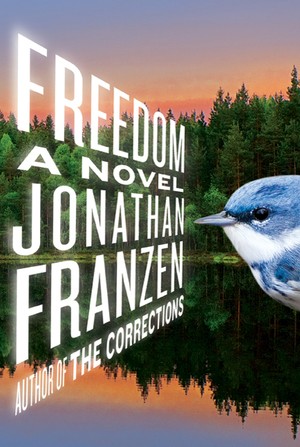
So, Jonathan Franzen’s Freedom is out today. The follow-up to 2001’s The Corrections was already in a second printing before its release today, pretty much pointing to the book being “the literary event” of 2010 (whatever that means). I haven’t read Freedom yet so I don’t have an opinion about it–but it’s hard to not have an opinion about the opinions about Freedom, at least if you follow literary-type news. The reviews have been overwhelmingly positive, even when they can find something to nitpick or quibble with. Obama picked up a copy last week on vacation. In an act of hyperbole so ridiculous as to turn comical, The Guardian’s Jonathan Jones called it “the novel of the century.” (Nevermind that the century isn’t even a decade old). But it’s probably the fact that Franzen appeared on the cover of Time magazine–the first writer in a decade to do so (the last was Stephen King)–that’s caused some professional jealousy and a backlash against Franzen. Again, this is all before the book has been released.

Yes, Franzenfreude. Authors Jodi Picoult and Jennifer Weiner felt the need to speak out against coverage of Freedom, crying foul that their books were not receiving the same critical attention as the “white male literary darling.” You can read an interview with the pair here, where their position seems to be that their work, frequently on the bestseller lists, is dismissed as genre fare. I don’t know Weiner’s stuff but Picoult’s novels strike me as the sort of maudlin crap that get turned into Lifetime movies (which they do). Picoult and Weiner don’t just play the gender card though. No, they also whip out a populist argument, the idea that literary critics ought to give more weight to “what people actually read.” In a series of recent columns on the attention Freedom has garnered, Lorin Stein pointed out that “It has become immensely hard to get a “literary” writer the attention he or she deserves.” (The comments section of Stein’s posts showcase a remarkable debate about just what “literary fiction” is).

Stein is absolutely right of course. (Weiner and Picoult will have to console themselves by sobbing into their piles of money). Franzen’s Freedom has become an opportunity for those who love literary fiction–which might be an endangered species–to call attention to the fact that novels are important, that they can somehow diagnose and analyze the spirit of an age. In his article for The Guardian, William Skidelsky strips the rhetoric away and gets to the point–

Underneath the words “Great American Novelist”, Time‘s strapline ran: “He’s not the richest or most famous. His characters don’t solve mysteries, have magical powers or live in the future. But in his new novel, Jonathan Franzen shows us all the way we live now.” It isn’t hard to unpick the subtext here: “Remember, folks, there’s such a thing as serious literature; it has little to do with Dan Brown or Harry Potter, and these days most of us tend to ignore it, but it’s actually kind of important.”

At The Faster Times, Lincoln Michel is even brassier–

There has always been a segment of the population that does not like it when intelligent artistic work gets praise. These people cry foul when an Academy Award goes to a well-crafted film with limited distribution instead of the latest Hollywood blockbuster, they moan when magazines cover innovative indie musicians instead of the most recent Nickelback CD, and you better believe they can’t stand it when that elitist literary fiction gets awards and coverage that should be reserved for books that people are “actually reading.”

Much of the critical reception of Freedom, then, is more about how the public–the reading public–is to connect with and interact with novels in an age of new media, in an age where some like to pretend the literary novel has lost its relevance, in an age where bozos go around declaring manifestos against novels. While Freedom need not be the novel to “save” the novel, it also shouldn’t be an occasion for backbiting, jealousy, and backlash. Maybe everyone should just calm down and read the damn thing.

[UPDATE: Read our obligatory review of Freedom].