Each time I’ve written about an Antoine Volodine novel, I’ve dithered and dallied and despaired over neatly summarizing his expansive post-exotic project. It seems almost impossible to write about one of his novels without discussing how that novel fits within a robust textual (anti-)system. My abortive prefatory attempts might start with pointing out that “Antoine Volodine” is itself a fiction; the pen name is one of several heteronyms taken by a person whose “real” name may or may not be Jean Desvignes. I’d probably then point out that his works are crowded with writers, dissidents, rebels, narrators, all speaking after the apocalypse, and sometimes even after death. And then I’d likely try to somehow encapsulate the intertextuality of Volodine’s post-exotic project, which project is closer, I’d likely claim, to Fernando Pessoa’s or Søren Kierkegaard’s use of heteronyms than, say, an easier corollary, like Faulkner’s Yoknapatawpha or Tolkien’s Middle Earth. (I’d probably bring up Roberto Bolaño too.)
And then I would delete all that shit and just write about the fucking novel.
That was the deal when I wrote last year about Mevlido’s Dreams (2007) or the year before that when I riffed on Radiant Terminus (2014). I loved those books, although “loved” might not be the right word.
(I felt much freer writing about Writers (2010), the first Volodine fiction I read. After I read Writers I read more Volodine novels and began to better “understand” his project and consequently felt more a stifling self-imposed pressure to preface any piece of writing about a Volodine fiction with the kind of ridiculous swollen agglomeration of sweaty word salad that I’ve thus far heaped up on your plate, unasked for, dear reader.)
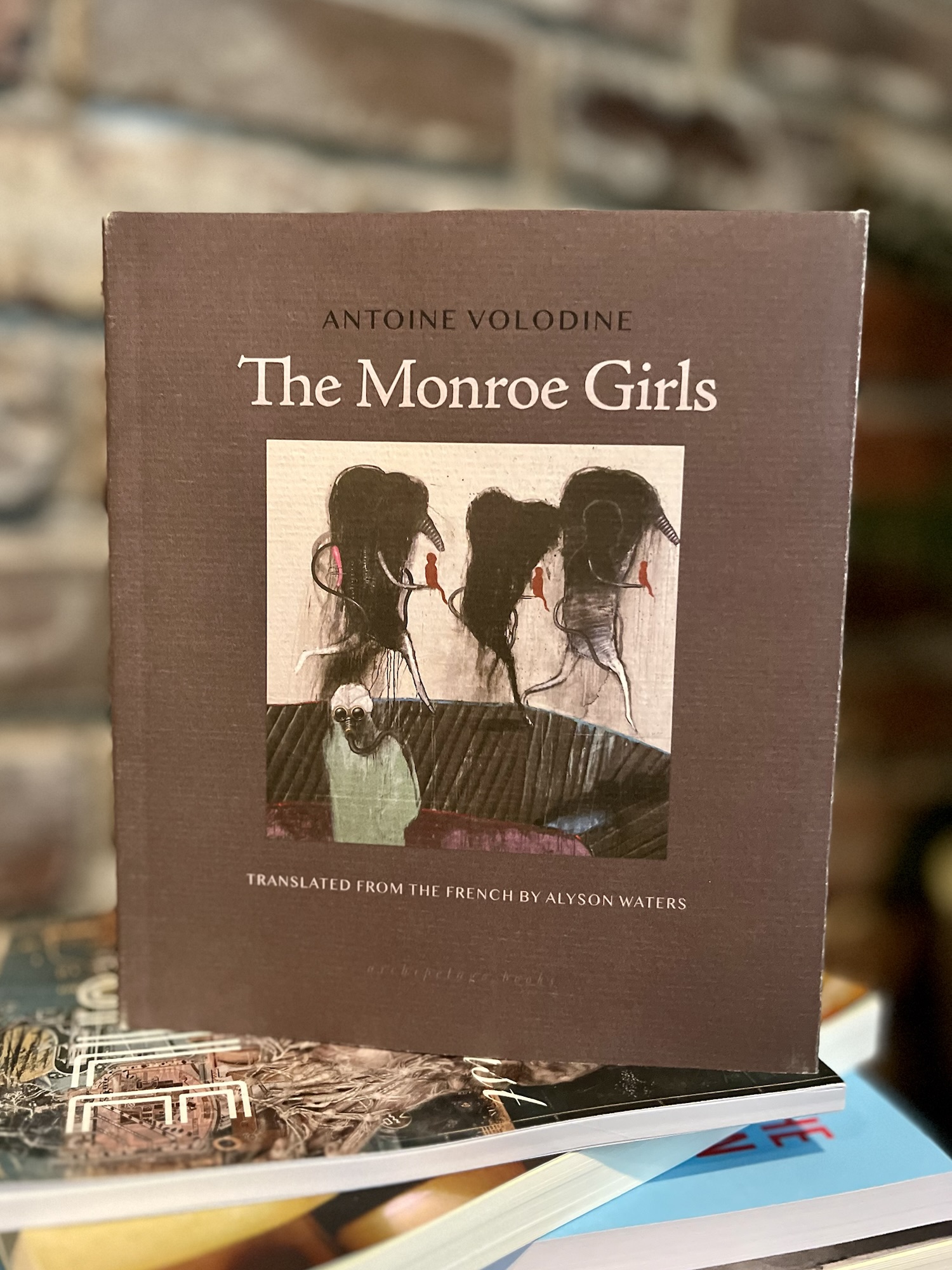
All of which is a ridiculous way to begin writing about The Monroe Girls, Volodine’s 2021 novel which is now available in English translation thanks to Alyson Waters (and publisher Archipelago Books).
What I want to say is something like: The Monroe Girls reads like a romantic comedy. An abject post-apocalyptic romantic comedy. An abject post-apocalyptic romantic comedy with a schizophrenic coward as its hero, a hero who anxiously vomits in pretty much every chapter he’s in.
The Monroe Girls is grim and gross, like all of Volodine’s stuff, but it also has an endearing, goofy, slapstick quality that ambles alongside a romantic, if insane, longing. And the reason that I’ll keep all my prefatory bullshit in this time is, like, I think some familiarity with what Volodine is doing across these books helps clarify why The Monroe Girls, while very much part of his oppressive, dread-soaked, dilapidated post-historical world, also feels like an outlier in its heightened (though still deadpan) humor and romantic flourishes.
I will call in a ringer to provide the context I think my reader needs. I will borrow the authority of no less than the great translator David Bellos, who describes Volodine’s project so clearly in a 2012 essay:
Roughly speaking, all Volodinian literature comes from after the final collapse and defeat of the revolution. What revolution? It is never directly identified with an event catalogued in world history, but the movement to which all narrators have or had belonged prior to their capture, incarceration or expulsion has general features that are quite clear. The movement was internationalist, egalitarian, anti-authoritarian and anti-capitalist. It has no hope of ever making a difference anymore, save that fidelity to its ideas is what keeps all Volodine’s friends (his characters) in their cells and psychiatric wards.
…Wherever you venture in the Volodinian universe–jungle, steppe, city, slum–things are a mess. The environment is degraded, resources are scarce, buildings are dilapidated, equipment is either non-existent or in an advanced state of decay, and no productive activities appear to be going on at all. Perhaps, outside of the camps, prisons, wards and detention centers whence come the works of post-exotic literature there may still be structures that resemble normal life, but they impinge only briefly and aggressively into the carceral world of Volodine’s characters.
…One of the more striking features of Volodine’s narrator-characters is that some of them, for at least some of the time, are dead. Others are insane, and others are suffering (and aware that they are suffering) from amnesia. These partly fantastical premises (that is to say, partly characteristic of fantastic literature) are not just literary tropes. The post-exotic world from which Volodine reports pays little of our normal heed to the distinctions between memory and imagination, sanity and madness, or life and death.
So all of what Bellos describes there is true too for The Monroe Girls.
I used words like goofy and humor above, and said that The Monroe Girls is a romantic comedy. A brief description of the plot would not support such claims. Here goes:
Breton is our schizophrenic narrator. He hangs out with himself in a nearly-abandoned psychiatric compound where he spies (via special oneiric goggles and his own telepathy) on the “daydreams and adventures of the dead.” Specifically, the dead he spies on are Monroe and his titular girls. A former Party leader, Monroe was “executed once upon a time for deviationism.” In “the black space” he now operates from, Monroe molds his girls into revenant commandos, “formidable, beautiful, tough, brave, intelligent…the last egalitarian warriors.” He sends them back into the world of the living, the vanguard “armed faction of the future Party for whom he’d hoped and prayed since his execution.” The Party is anxious about this return, and enlists Kaytel, a kind of police chief to force Breton to track and monitor the Monroe girls. Unfortunately for the Party, it turns out that Breton was — is?— “madly in love” with one of these girls, a certain Rebecca Rausch. Our lovefool will do what he can to preserve Rebecca and the other girls, even as the oppressive Central Committee threatens (and delivers) violence upon him. The Monroe Girls progresses as a series of misadventures between Breton (and Breton), the various Monroe girls, and Kaytel, who ends up an oddly sympathetic character.
I don’t want to spoil too much — the fun and thrill of this novel is in its odd but brisk pacing and strange eruptions of humor — but I feel the need to share a climactic moment which is simultaneously heroic and ironic, romantic and mordant, as if Volodine inflates the revolutionary rhetoric simply to puncture it. Here is a scene, late in the novel; Rebecca, accompanied by Breton (and Breton) makes a “declaration of general policy…composed to recite before the final offensive…to convince the masses of the validity of the current action” (the “current action” being revolutionary violence):
“Workers, peasants!” she began. “Obscure members and members of no rank of the hospital personnel. Mental dissidents! Organic dissidents! Earthlings without a party and survivors! Schizophrenics and patients treated like cattle! Misguided torturers! Futureless thugs! Ordinary Party sympathizers! Dead soldiers! Living dead!”
Because I recognized myself in a few of the categories she was reeling off, I went to sit quietly in front of her, on a cement milestone that was wet but at the right height. I was pleased that someone, in a solemn speech, was taking into account the existence of people like me. Breton hesitated for ten seconds then sidled up beside me.
“She’s raving,” he whispered.
“Shut up,” I instructed.
One of the novel’s central formal conceits is Breton’s schizophrenia, which is less a psychological detail than another way the text refuses stable narrative position. The Breton/Breton split is not corrected or explained away; it persists as a structural doubling of perspective, in which even the “I” cannot remain singular. Early in the novel, the effect can be wonderfully confusing. Indeed, the novel’s second chapter reads like a revision or rewrite or reimagining of the novel’s first chapter. It also seems clear to the reader that the divided or doubled Breton exists within the narrative framework just as “realistically” as the single or solitary Breton. The “second” Breton is never remarked upon by other characters, but there is also nothing in the story that suggests that the double is merely a figment. The “other” Breton is just as valid an entity as any of the Bardo creatures that float through the Volodineverse.
Primarily, these Bardo creatures are, like, dead folks — not zombies, just, like, not living. Obviously there are the Monroe girls, who emerge from the “black and floating territory” to wreak havoc on the Party. It’s key to point out that they are flesh and blood, and Volodine renders them (and their armor, equipment, and weaponry) like action heroes or even comic-book heroes. At the same time, they are sleepwalkers, the spirit of failed revolution returned to the earth.
The Monroe girls contribute to the world of the dead, killing Party enforcers. One such episode is particularly comic; the dead don’t die right away in Volodineville; no, they’ll linger a bit, hang out, do a little investigating even. In one of my favorite bits of the novel, a pair of freshly-dead cops search an apartment. On the stairway, a long-dead but still-bickering couple snipe at the cops and each other. “It truly is a city of the dead,” one of the Monroe girls observes.
Intimate doubling pervades The Monroe Girls: the aforementioned dead cops; the old dead couple; Breton and Rebecca; Breton and Breton. Throughout his work, Volodine has often foregrounded loyalty to comrades as a virtue, one to be practiced even as the world turns to shit. The Monroe Girls imagines comradeship in different forms — bureaucratic, idealistic, romantic, and even sexual. There’s a strange horniness to some of the novel that points to sensual generation, an impulse I haven’t detected in other Volodine novels. Consider Kaytel’s other partner, Party leader Dame Patmos:
Despite being well over the hump of fifty, Dame Patmos remained attractive. Her face had grown wider, her flesh swollen, but the harmony of her features and even the lascivious proportions of her body had changed accordingly and today were still practically intact. The excess fat barely erased the memory of the radiant thirty-year-old woman she had been. She had metamorphosed into an enormous female mammal of fifty, voluptuous and still at ease with herself. She was aware she still had seductive powers if she put in some effort.
Volodine’s description of the sexual tension between Kaytel and Dame Patmos ironizes and undercuts any horny swelling though:
The two of them remained facing each other without a word for a long moment, like in a Taiwanese movie under terrible French influence, or like in a post-exotic tale right before a scene of criminal violence.
I love how Volodine doubles his simile here. The first simile points outward, toward a recognizable filmic register; the second turns inward. Both similes are rooted in the image of narrative, as if the scene can still be held together by recognizable frames — cinema, genre, the tale.
But Volodine’s narrators don’t get to stay safely inside those frames for long. The book keeps staging moments as if they belong to a legible scene of erotic or emotional intensity, and then breaking that scene from within, almost immediately, with something bodily and unassimilable. What looks like stylized tension tips into leakage, exhaustion, or violence, as if narrative itself can’t contain the material it is trying to organize.
Even romance, even the faint possibility of sensual connection, only ever holds for a second before the body insists on itself again. Volodine’s writing recalls and restages Julia Kristeva’s notion of abjection (discussed at length in Powers of Horror). Abjection here is not simply disgust but the moment the seams that keep the illusion of a stable, coherent “I” intact give way: when inside and outside, self and other, life and death begin to leak into one another. What should stay expelled returns: odor, fatigue, nausea, proximity. Here’s Breton (and Breton’s) description:
I began to think about death. It was a question we rarely raised, Breton and I. The idea of life made us vomit. It returned constantly, this idea, and it startled us, fueled our hiccups and the various fluids we coughed up. It was extremely difficult to live, to survive, to continue this long passage through the universal madness, the universal schizophrenia of the camp, to face the hostility of all and sundry day after day. It was extremely difficult and pointless to take part in this slow obstacle course, to sense within ourself deep mental and physical decline, to feel our bodies grow exhausted, overcome with awful pains and awful smells. It was extremely wearisome to be obliged to move forward at all costs, with at most the perspective of a next step, a next chapter in a book whose end escaped us and would always escape us. Extremely difficult, thus painful, pointless, and punishing. Death for us was merely a neighboring territory into which we’d venture naturally… [Death] did not really exist for us and, in any case, never had we imagined going there for good.
Oh shit wait did I say that this novel was, like, a romantic comedy? I think it still is, somehow. Or maybe it’s a romantic comedy after romance, after comedy, after the illusion that selves or worlds could ever remain coherent long enough to sustain those genres.
I do know that I laughed a lot; I do know that this one felt somehow more, I don’t know, concentrated than the sci-fi sprawl of Radiant Terminus or Mevlido’s Dreams, more linear than the fragmentary (although complete) works Post-Exoticism in Ten Lessons, Lesson Eleven (1998), Minor Angels (1999), Writers, and Bardo or Not Bardo (2004).
Maybe it’s because of Breton’s sweetness, so unexpected in a Volodine fiction, so contrasting with his intense abjection — how sweet his love for Rebecca feels. (Of course there isn’t one stable Breton in this novel, so maybe it’s my mood we’re seeing here.)
And I’ll add that the novel’s last chapter, “Annex,” has been one of the funniest things I’ve read all year. Throughout The Monroe Girls, characters are frequently having to attest to which faction of the Party they sympathize with. “Annex” is a list of “The 343 Factions of the Party in its Glory Days.” Some of the factions have cool names (“The Black Bonnets,” “The Partisans of the Red Lotus”), some have straightforward or even clinical names (“The Leninists of the Fifth Day,” “The Monroe-Absolutists”), but as the list grows, the names grow more comical, more absurd — “The Disappointed by Polpotism,” “The Chinese Takeout,” or, I think my favorite, “Frankenstein’s Fiancées.”
Last on the list is “The Faction ‘This is the end, my friend, the end,'” and recent posts on Twitter and Instagram suggest that Volodine’s post-exotic project may indeed be coming to some kind of conclusion this summer: eleven books, published simultaneously by eleven different publishers, all under the heteronym Infernus Iohannes. Strangely appropriate, I guess. Volodine’s fictions are not a discrete, stable literary system; the post-exotic novels are the proliferating afterlife of voices, identities, factions, and failures. Even its ending arrives as multiplication. Great stuff.
The Monroe Girls by Antoine Volodine in translation by Alyson Waters is now available from Archipelago Books.
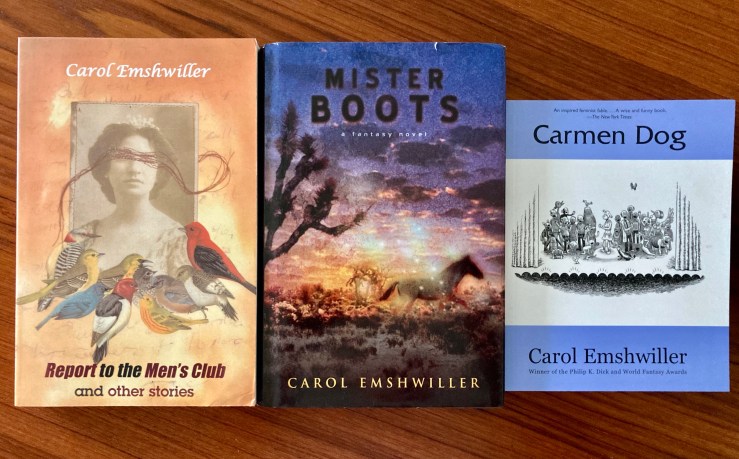 Small Beer Press had a warehouse sale last month, so I ordered two by the late avant-garde sci-fi writer Carol Emshwiller. I ordered Carmen Dog, which is what I take to be her most lauded novel, based on this blurb from Ursula Le Guin: