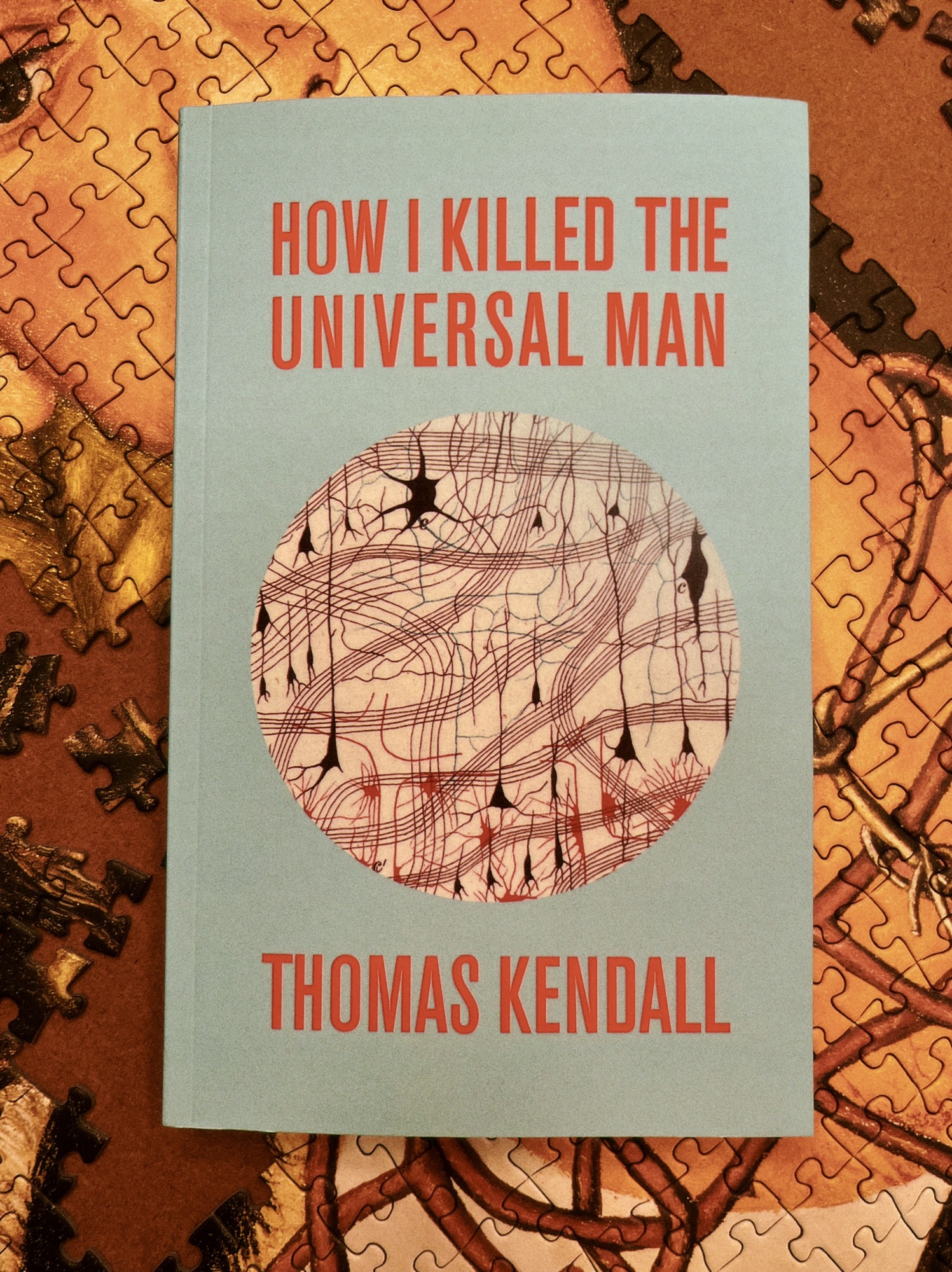
Thomas Kendall’s How I Killed the Universal Man is a near-future sci-fi novel working squarely in the cybernoir tradition of Philip K. Dick and William Gibson. Like Gibson, Kendall constructs a world where corporate systems saturate daily life and set the limits of perception. Like PKD, Kendall foregrounds reality’s instability, where what is seen, felt, and remembered can’t be trusted as one’s own. Kendall reworks the cybernoir lineage through a critique of media culture and wellness technology, showing how late-capitalist systems present themselves as therapeutic while covertly expanding their nefarious authority.
Our hero John Lakerman is a journalist for donkeyWolf, a “self-consciously edgy multi-social new(s) presence with a polyamorous approach to truth and ethics” that profits from “Attention Disordering Content.” From the outset, Lakerman understands himself less as an agent than as a conduit. He describes himself as “merely language, an impoverished language uninhabited by being,” and just “a data leak.” This diminished sense of self becomes explicit in one of the novel’s most telling admissions: “He had always wanted to be a robot…He’d always wanted to be a machine.” Lakerman’s desire isn’t so much a nihilist fantasy as it is an adaptive response to a world that already treats him as a tool, mere equipment.
Lakerman is sent to Miami to investigate Noumenon, a designer drug whose name strikes him as empty philosophical branding, “self-consciously clever and a total misunderstanding of the concept.” It’s a gonzo gig: he’ll take the drug himself and “report back from the other side of its meaning.” Under the supervision of Dr. Andrea Christoff at Lifepax (“here to carry you when nature can’t”), he enters a controlled Noumenon trial before exploring the Miami club circuit, where the drug circulates freely.
Crossing (literally) the threshold, Lakerman reads “cryptic messages” in the movement of club-goers’ bodies: “What they might see meant everything. What they could see was possibility. What they would see was another matter.” Capital, via biotech, mediates, manages, and tiers perception, parceled in preset doses. Kendall’s hyperheated dystopian Miami, a landscape of “block-shaped universes” and horizons “constructed by deprivation,” gives that logic spatial form. Space is segmented, experience preformatted, and Lakerman’s role as “reporter” starts to look like another interface the system ventriloquizes.
Lakerman leaves Miami, but the cityscape’s stratified logic stays with him. Back in London, news of a mass-shooting in Miami finds its way into his feed, and the “quaintness of a non-global catastrophe” showing up there strikes the jaded Lakerman as unusual. A too-specific detail from the report finds him returning to his last story on Noumenon, and his investigation widens into a corporate network linking Lifepax to the now-defunct Phenom Games. What began as a gonzo drug story becomes an inquiry into how experience itself is engineered, circulated, and monetized.
Lakerman’s investigation leads him to UbIQ, a biotech platform offering implants framed as “an advanced biometrics wellness program and early health warning system.” The smooth clinical reassurance of corporate jargon masks UbIQ’s reality as a tool of continuous emotional surveillance: “It registers how much you cry, when you cry, and at what.” As Lakerman encounters UbIQ (the name a loud, clear echo of PKD’s 1969 novel Ubik), the ground of proof gives way beneath him. Official records deny what he remembers, corroborating traces disappear, and even his own logs refuse to stabilize events into something demonstrably real.
He keeps investigating though, and the novel shifts to question not simply what Lakerman can know, but what kind of system makes knowing structurally dependent on corporate infrastructures and then repackages that dependence as “care.” Kendall distills this systemic condition, the internalization of capitalist infrastructure as perception, feeling, and “wellness,” into a blunt image of saturation: “Like plastic in fish, the way everything has a little capitalism mixed in.” Control arrives as smart drugs, implants framed as therapy, games that train attention and identity. It surrounds the self and takes up residence inside it.
A Boschian mural on the side of a church (titled a bit-on-the-nosedly Allegorical Futures) states the book’s critique outright: “This demon is capitalism. Special Ability: Ravenous hunger.” The mural is signed T.OR who Kendall later links to the game-world Lakerman is pulled toward. The mural names the engine; the game teaches how to live with it: “HIKTUM is a game that teaches you how to be multiple.” That “multiplicity” isn’t Whitman’s multitudinous freedom but training: become flexible, divisible, easier to manage. The endpoint is the Universal Man, “a thing [that] cannot be rendered but can be leased.” The novel’s late refrain “Nobody survives love” marks the cost of a world where even intimacy is folded into the logic of extraction.
Lakerman’s trajectory isn’t a personal tragedy so much as a case study in a world where media platforms, pharmaceuticals, and “wellness” tech jointly manage what can be felt, remembered, and proved — and where that management manufactures people who want to be managed. Kendall leaves Lakerman’s final position unresolved, but the arc is clear. The wish to become a machine (seamless, efficient, immune) collapses into submission to the systems already in place. In HIKTUM, control isn’t the existential threat of abstract violence, but rather what we feed to our heads and bodies. The diagnosis is that we don’t experience these systems as coercion. We submit to them as upgrades.
Readers drawn to cybernoir’s paranoiac pressures will get a kick out of Kendall’s transhumanist noir, which I’ve failed to describe the weirdness of here. How I Killed the Universal Man also makes a strong case for seeking out Whiskey Tit, an independent press committed to weirdness. Check it out.