Some unpleasant possibilities | Joanna Russ

One might argue—and justly—that many male writers are also represented by only one book or one group of poems. I would answer first that the damage done the women is greater because women constitute so few of the total in anthologies, classes, curricula, and reading lists at any level of education. Moreover, the real mischief of the myth of the isolated achievement, as it is applied to the “wrong” writers, is that the criteria of selection are in themselves loaded and so often lead to the choice of whatever in the writer’s work will reinforce the stereotypical notion of what women can write or should write. Some unpleasant possibilities:

If a woman writer presents herself as a public, political voice, delete this aspect of her work and emphasize her love poems, declared (on no evidence) to be written to her husband—Elizabeth Barrett Browning.

If a woman writer is frank about heterosexuality, delete any of her work that depicts male inadequacy or independent female judgment of men—Aphra Behn.

If a woman writes homosexual love poetry, suppress it and declare her an unhappy spinster—Amy Lowell.

If you still have trouble, invent an (unhappy) heterosexual affair for her to explain the poems—Emily Dickinson.

If a writer is openly feminist, delete everything of that sort in her work and then declare her passionless, minor, and ladylike—Anne Finch, Countess of Winchilsea.

If she is not easy to edit, writes ten-act plays about women going to war to rescue their men, plays about women’s academies becoming more popular than men’s academies, and endless prefaces about men, women, sexist oppression, and the mistreatment she herself endures, forget it; she’s cracked—Margaret Cavendish, Duchess of Newcastle.

If she writes about women’s relationships with women and “women heroes” (in Hacker’s phrase), print a few of her early lyrics and forget the rest—H. D.

If she writes about women’s experiences, especially the unpleasant ones, declare her hysterical or “confessional”—Sylvia Plath, Anne Sexton.

If she carefully avoids writing about female experience and remains resolutely detached, polished, impersonal, and nonsexual, you may praise her at first, then declare her Mandarin, minor, and passionless—Marianne Moore.
From How to Suppress Women’s Writing by Joanna Russ, 1983.

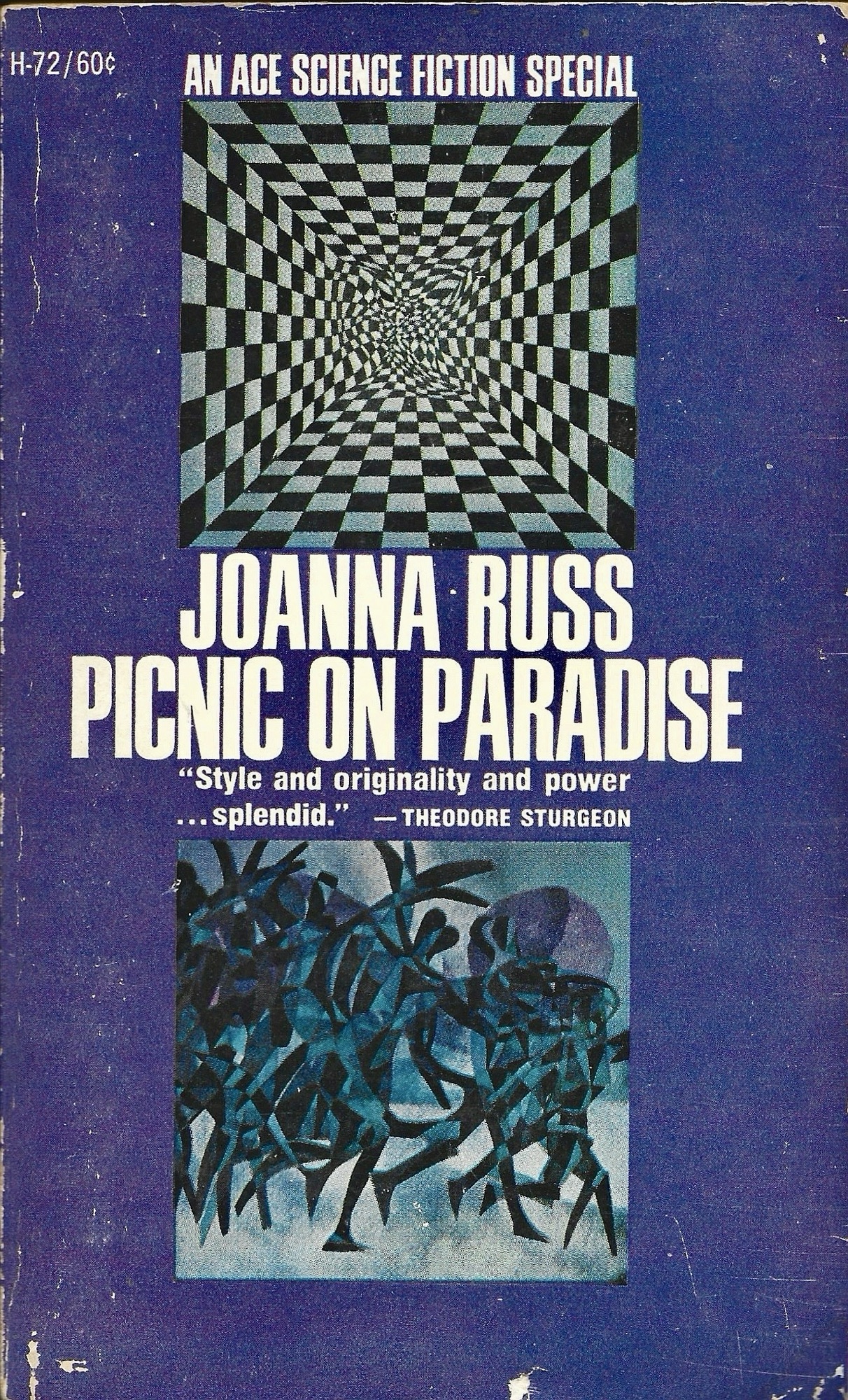
Mass-market Monday | Joanna Russ’s Picnic on Paradise

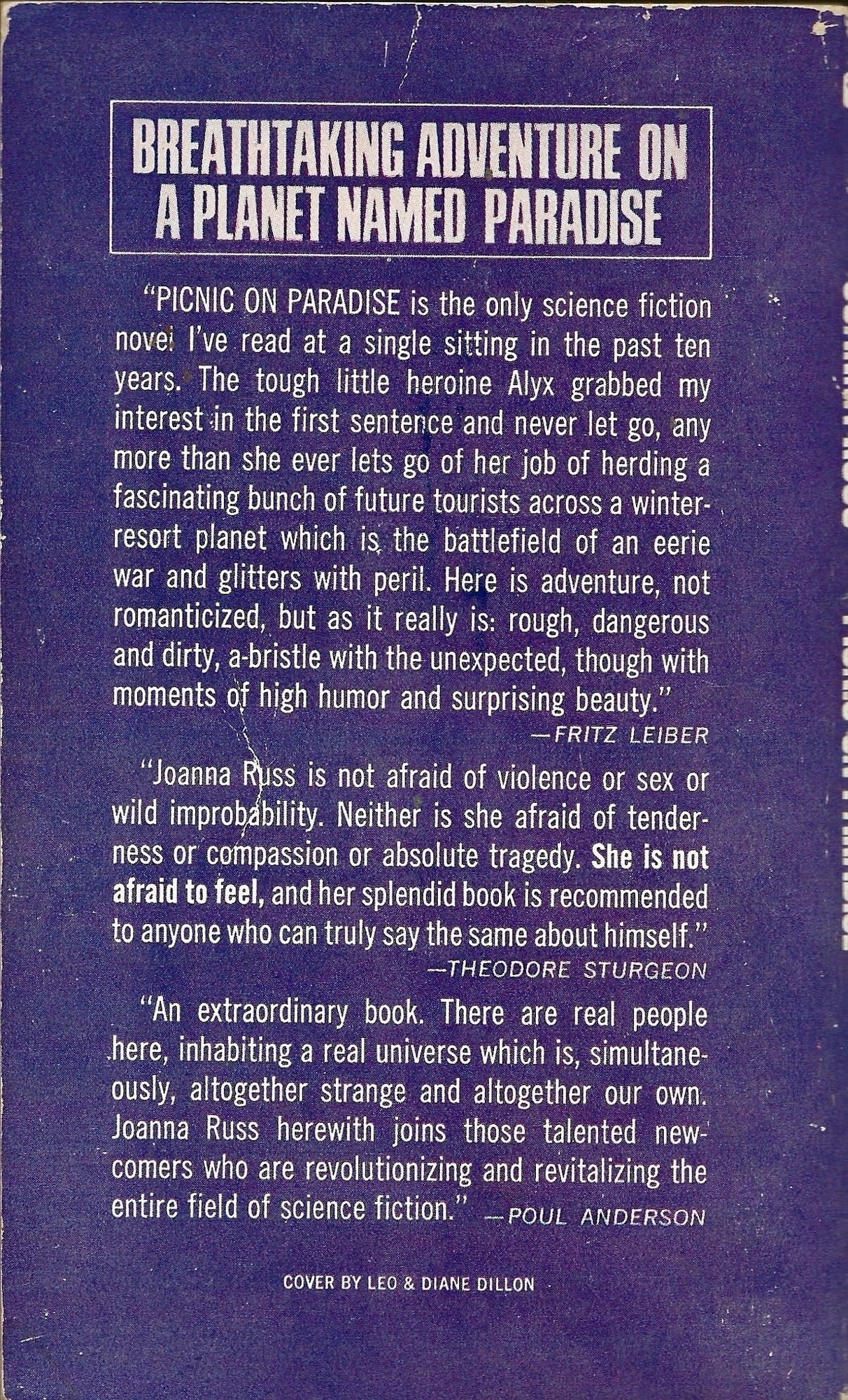
Picnic on Paradise, Joanna Russ, 1968. Ace Books (1968). Cover art by Leo and Diane Dillon. 157 pages.


From Joachim Boaz’s review at SF Ruminations:

Joanna Russ’ first published novel Picnic on Paradise (1968) delightfully subverts traditional SF pulp adventure tropes.  Although not as finely wrought as The Female Man (1975), And Chaos Died (1970), or her masterpiece We Who Are About To… (1976), Picnic is worthwhile for all fans of feminist SF and the more radical visions of the 60s.

Unfortunately, the metafictional implications/literary possibilities of the Alyx sequence of short stories and novels—of which Picnic on Paradise is part of—are not realized until the publication of the short story “The Second Inquisition” (1970).

Mass-market Monday | Joanna Russ’s And Chaos Died

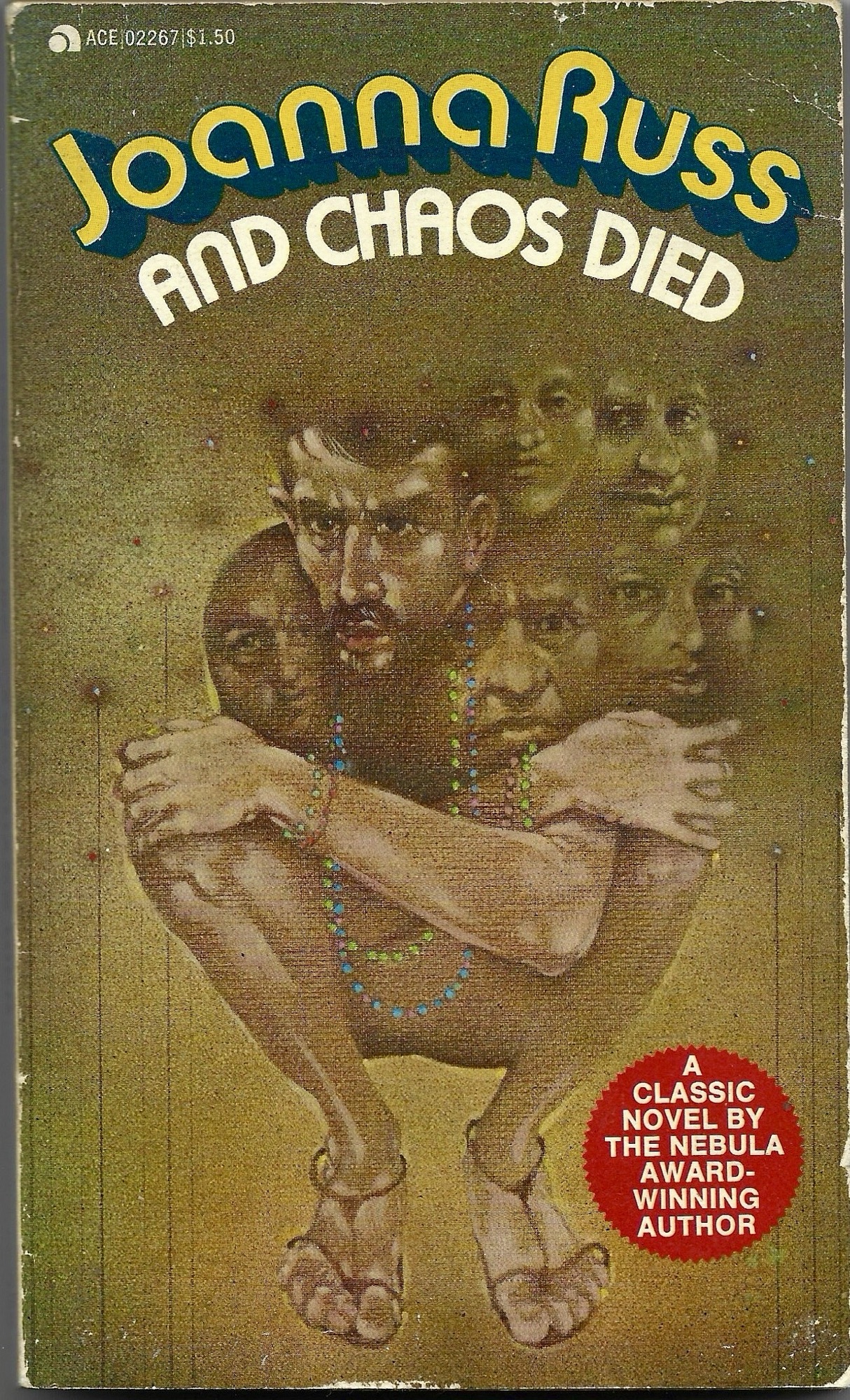
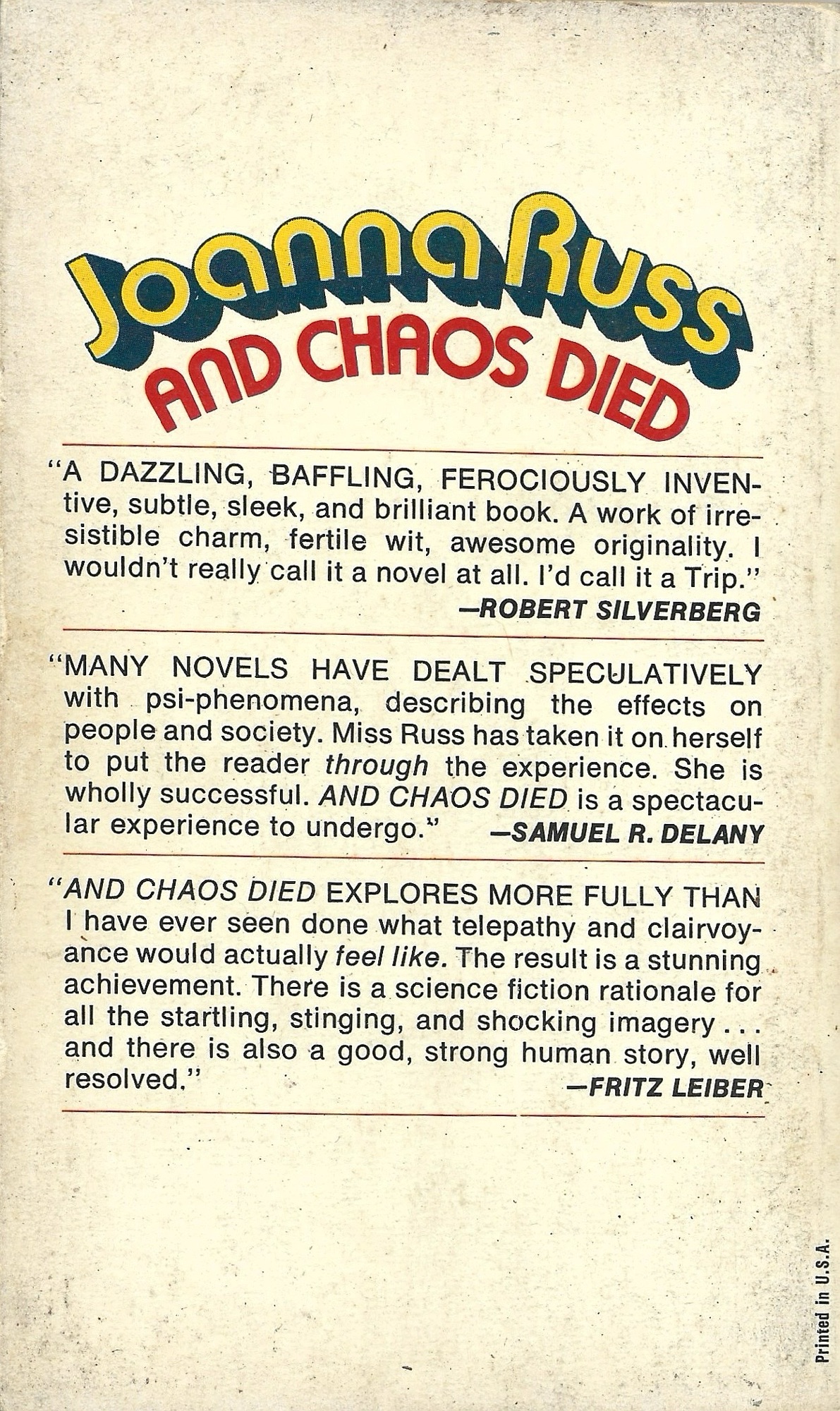
And Chaos Died, Joanna Russ, 1970. Ace Books (n.d., c. 1978). No cover artist or designer credited. 189 pages.


From Samuel R. Delany’s review of And Chaos Died:

The first two pages of this hardcover reprint of And Chaos Died present the protagonist, Jai Vedh, as a quietly despairing modern man with a nearly psychotic desire to merge with the universe. Moreover, it is suggested that this essentially religious desire is a response to the meaninglessness and homogeneity of every day life. There is a vacuum inside him; and when, on a business trip in a spaceship that has taken him off the surface of Old Earth (“on which every place was like every other place, ” p. 9), he senses the great vacuum of space itself about the ship, the real vacuum and the psychological vacuum become confused. Propelled by his desire for mergence,

on the nineteenth day he threw himself against one of the portals, flattening himself as if in immediate collapse, the little cousin he had lived with all his life become so powerful in the vicinity of its big relative that he could not bear it. Everything was in imminent collapse. He was found, taken to sick bay, and shot full of sedatives. They told him, as he went under, that the space between the stars was full of light, full of matter — what was it someone had said, an atom in a cubic yard? — and so not such a bad place after all. He was filled with peace, stuffed with it, replete; the big cousin was trustworthy.

Then the ship exploded. (p. 10)

The place Jai Vedh comes to, along with the philistine captain of the exploded spaceship, is the first of Russ’s SF utopias. Noting the January 1970 publishing date on the original edition, and thus inferring 1968/1969 as the most probable time of composition, we may be tempted to read this particular utopia as a kind of arcadian fall-out of that decade’s ecological crusade. A more sensitive reader of SF will, however, notice its sources in SF works that substantially predate that crusade: the nameless planet of telepaths takes its form from Clarke’s Lys (the more ruralized companion city to mechanical Diaspar in The City and the Stars, 1953) and from the world in Theodore Sturgeon’s “The Touch of Your Hand” ( 1953). What characterizes this particular SF image is not rural technology, but advanced technology hidden behind a rural facade; not human communication in good faith, but ordinarily invisible communicational pathways (some form of ESP); and it is always left and then returned to.