Imagine Buster — Samplerman

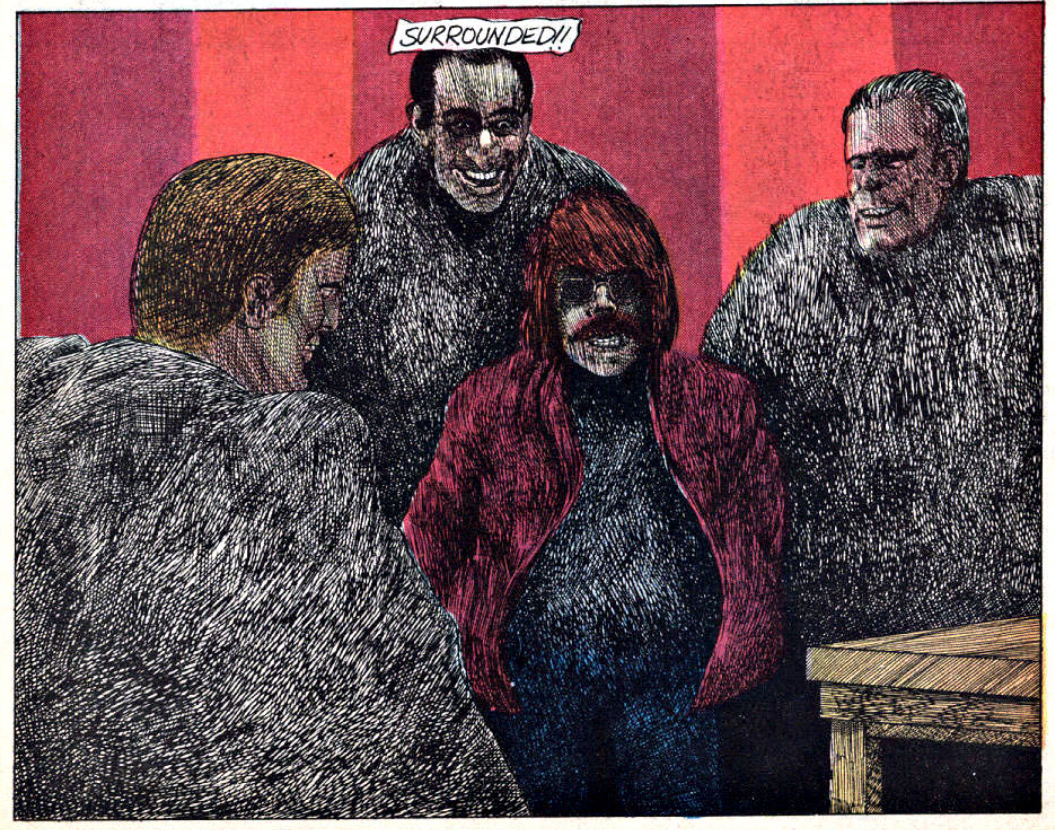
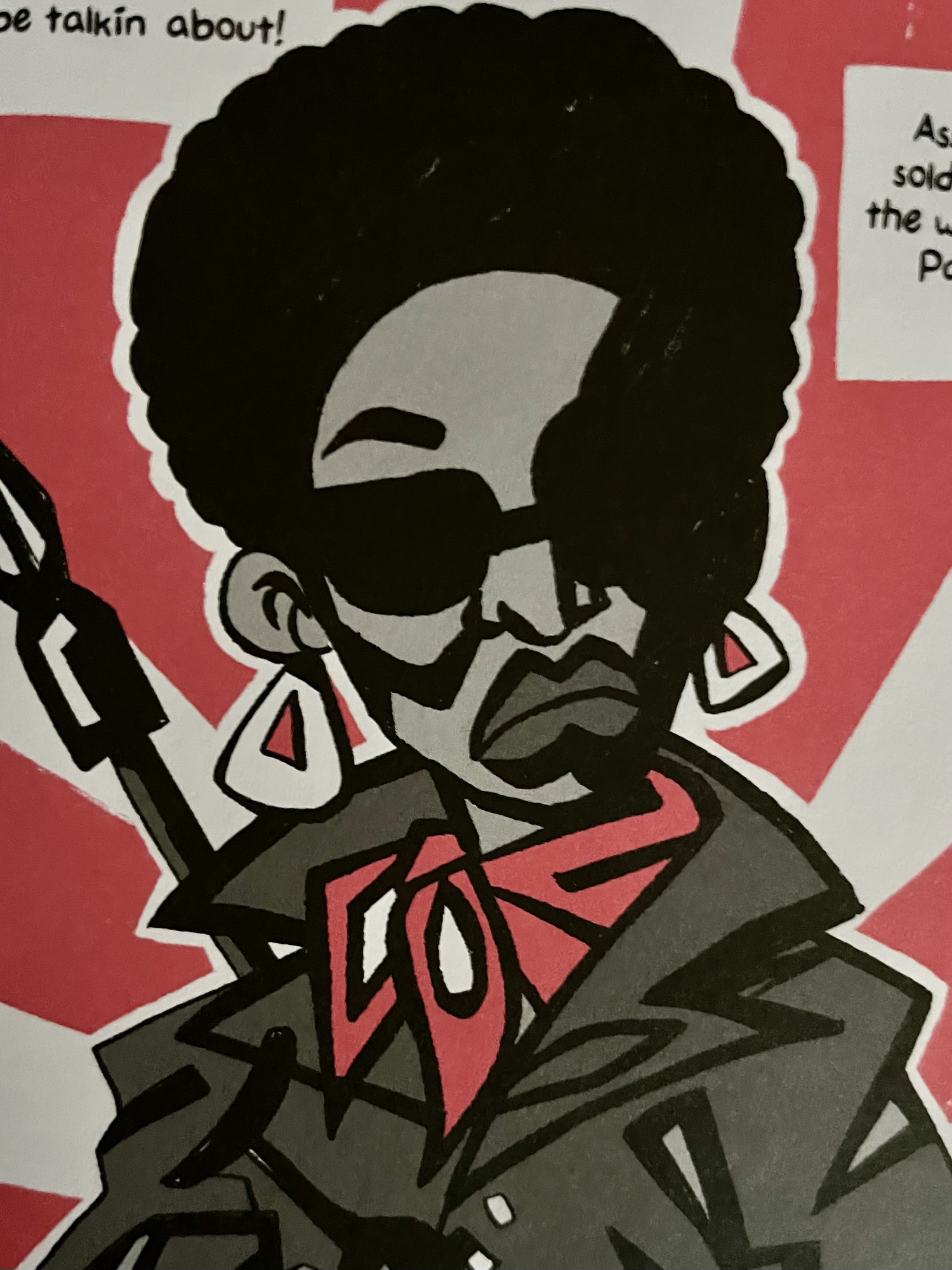
Imagine Buster, 2024 by Samplerman (Yvan Guillo)

RIP Michael Zulli

RIP Michael Zulli, 1952-2024

Comics artist Michael Zulli passed away this week at the age of 71. While Zulli was likely most known for his work on Neil Gaiman’s The Sandman comic (as well as an unpublished comic where Swamp Thing meets Jesus Christ), it was his work on The Puma Blues that really sank into my spirit as a kid.

I came to The Puma Blues in the very early nineties via the proselytizing of Dave Sim in Cerebus comics; I managed to a hold of a handful of back issues from very late in the comic’s run. I of course had no idea what was going on, but that didn’t matter. Working from Stephen Murray’s enigmatic script, Zulli crafted a post-apocalyptic dreamscape, an evocation in black and white. His wild animals always seemed more detailed, more pure, more real than the humans who walked through the world he’d conjured in black and white.

I quit regularly visiting comic shops by the mid-nineties, but if I ever happened to be adjacent to one I’d pop in to look for back issues of The Puma Blues (and a handful of other indie titles). It wasn’t until a decade or so later that (with the extralegal help of the internet) I was able to read the entire series. Great stuff—baffling, evocative, Zulli and Murray’s series ran on its own aesthetic logic.

In a 2016 interview at The Comics Journal to mark the publication of a complete volume of The Puma Blues, Zulli spoke on the work as an act of ecological witnessing:

The nature drawings in Puma especially, but so much of the detail in the book feels like an act of witness.

It is. It’s an idea that we’re surrounded in what scientists call the ecosphere, for lack of a better word. It’s this incredibly beautiful and sophisticated system and somehow we think we’re separate from it? I don’t think so. We are not superior to it, we are a part of it and we should take care of it because in doing so we take care of ourselves as a species, too. If not for nature and the earth’s own sake, do it at least for your sake and your children’s sake. That’s all we have got. One day somebody could stop your electricity. What are you going to do? You’re completely unprepared to think about life without your support systems. I don’t mean to be excessively grim. I see a lot of hope. I cling tenaciously to it, but at the same time, Puma is sort of a shot across the bow to wake the fuck up. Take a real good look around you and see what’s really there. Participate in it. Because like it or not you are part of it.

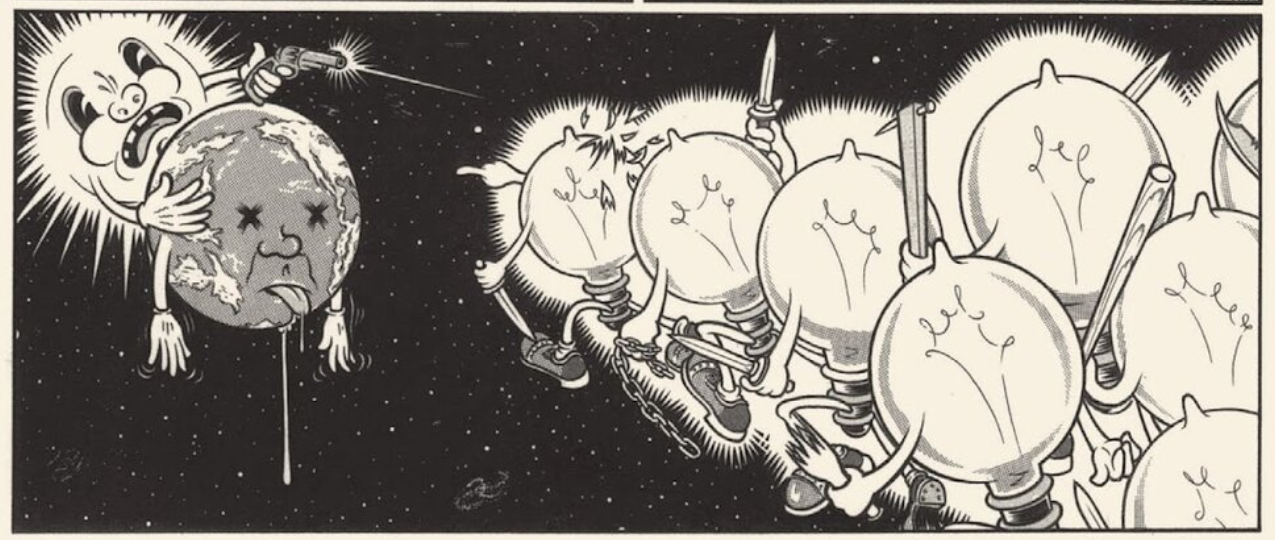
Experience non-existence | From Nicholas Gurewitch’s “Trauma Trooper”

A panel from Nicholas Gurewitch’s “Trauma Trooper.”

Behold!!! I am Senta Klaws (George Herriman)

Santa-Kat-1

(Via/more).

Portrait of Edgar Allan Poe — Alberto Breccia

A panel from “Poe? Yuck!”, 1983 by Alberto Breccia (1919-93)

“Double Escape” — Moebius

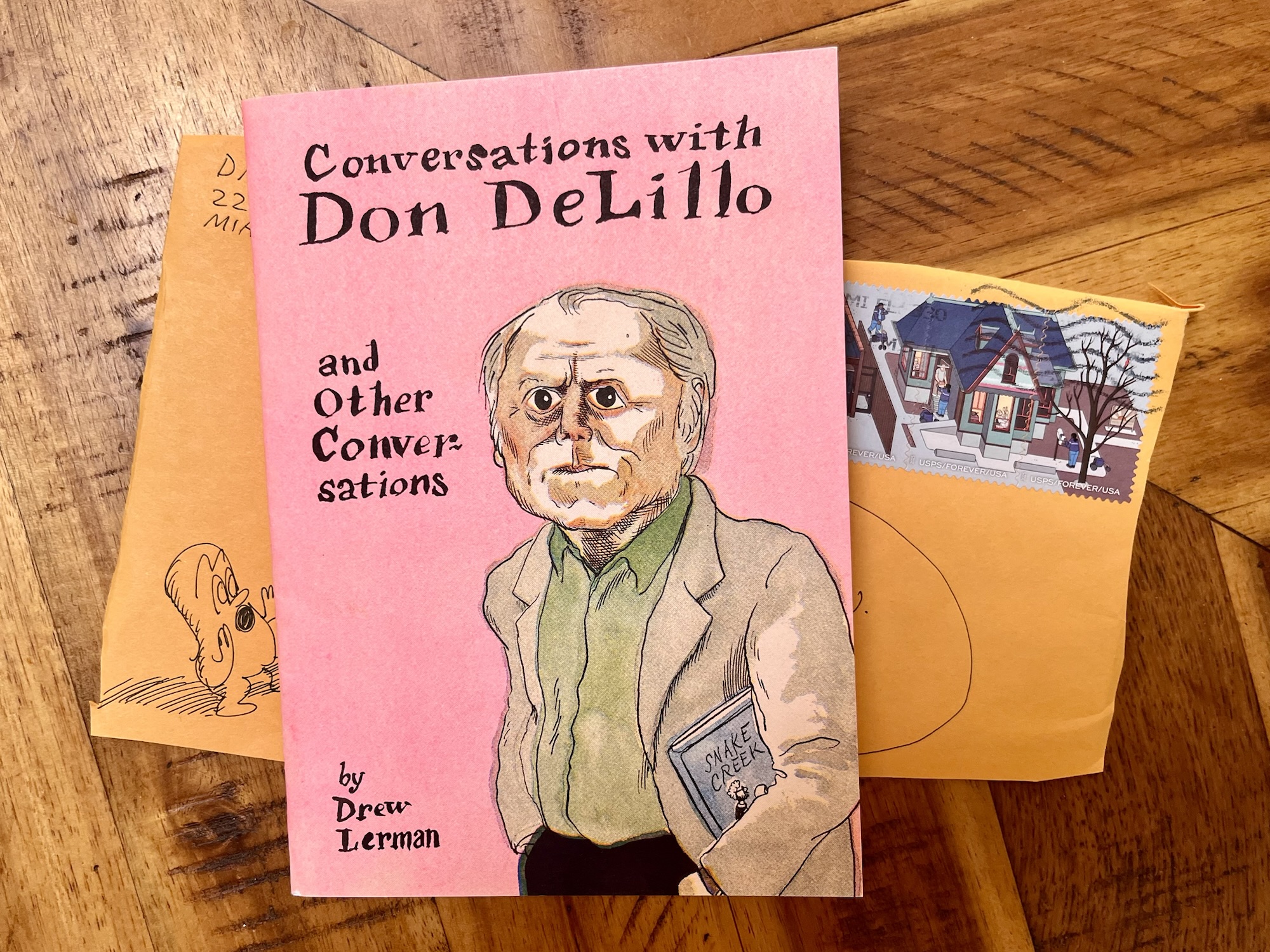
Drew Lerman’s Escape from the Great American Novel (Book acquired, end of April 2023)

I’ve long been a fan of Drew Lerman’s Snake Creek strip, and eagerly look forward to each new collection. The latest is Escape from the Great American Novel, which I’ve tried not to read all at once. I should have a full review in the next few weeks, but so far, Great Stuff—Escape is funny, erudite without being precious, and soulful. It also shows an expansion of Lerman’s narrative development (without sacrificing the kind of gags and send ups that one wants out of a great strip).

Here’s publisher Radiator Comics’ description:

Escape from the Great American Novel by Drew Lerman follows best friends, Roy and Dav, as they find themselves on opposite sides of a battle between apocalyptic oil barons and bomb-chucking anarchists. But Dav just wants to write the Great American Novel, while Roy wonders what the big deal is—after all, their world is only another fiction.

And here’s a nice little throwaway Gaddis gag:

Untitled (Driver) — Eric Haven

A page from “The Highway,” collected in Compulsive Comics, 2018 by Eric Haven.

To escape the insidious commercial excesses of Christmas (Glen Baxter)

f808a93d773c76507943e1eaee91ebe6-christmas-humor-merry-christmas

The way it goes (Peanuts)

Believe in me (Peanuts)

Fool

Little hope (Peanuts)

My entry in The Comics Journal’s “Best Comics of 2021” article

The Comics Journal’s lengthy write up of “The Best Comics of 2021” is up. Here’s my entry:

When I was a kid one of the greatest small joys of my short existence was reading the comics page in the morning newspaper, an experience that seems and quite literally is of another century. I loved Calvin & HobbesBloom County,and The Far Side, but my favorite was Peanuts. While it’s not exactly the same as poring over the morning paper’s comics, I love to see Peanuts on this Day in my Twitter feed. So much has been written on Charles Schulz‘s genius, so I won’t wax more – I’ll just add that Charlie Brown’s strange defeated ever-reemerging optimism still brings me a weird dark hope.

I also continue to really dig Drew Lerman‘s Snake Creek series. Roy and Dav are perfect heroes for the 21st century, a new Vladimir and Estragon wandering through Weirdest Florida. Lerman publishes Snake Creek on Instagram. He collected the first few years of the strip in a volume that is now out of print. I hope he’ll reprint it and put out the latest strips in a paperback at some point soon.

Another artist I followed initially on a social media app (Tumblr) is Yvan Guillo, aka Samplerman. Samplerman’s collages initiate his audience into a new world of pop art surrealism where the Ben-Day dots of twentieth-century pulp transmute into a comic book you read in a dream when you were a kid. I picked up his 2021 book Anatomie Narrative (Ion Edition) and got lost in it again and again. The word narrative in the title asks the audience to understand story in a new way (or to take the title ironically, which I do not). The story here is pure aesthetics.

Another book I loved this year was Paul Kirchner‘s Dope Rider: A Fistful of Delirium (Éditions Tanibis), which collects the Dope Rider revival published in High Times from 2015 to 2020 (Dope Rider‘s initial run was in the ’70s). Great art, great jokes, great goofy fun.

I also spent way too much of the little free time I have going through old issues of The East Village Other. The scans I pulled from JSTOR are difficult to read, but the graphics are really what interests me. Initially I was looking for comix by folks like Bernie Wrightson, Art Spiegelman, Robert Crumb, and Kim Deitch – but I also love all the old ads for weird albums, concerts, films, and books. A digital scan of an old, weird paper with its own weird comix isn’t exactly the same as having the paper in your hand. But it’s better than nothing.

“Scrooge” — Kate Beaton

New Snake Creek comix from Drew Lerman

I’ve been a fan of Drew Lerman’s strip Snake Creek for a few years now. Reviewing Lerman’s first collection (simply titled Snake Creek) in The Comics Journal, Brian Nicholson wrote that,

Looking at these strips, you’re looking at something that recalls George Herriman, Harvey Kurtzman, Robert Crumb, Daniel Clowes, Matt Groening, but also thinking: What if Stanley Elkin drew a comic strip?

What if Elkin drew a comic strip indeed?

Like Elkin, Lerman plays with a variety of voices and rhythms in his work. There’s a zaniness to the Snake Creek world, but also an almost-melancholy seriousness to it as well. His main characters are Dav and Roy. Roy is something of a would-be tortured artist; Roy his familiar/foil, a spritely interlocutor to bounce ideas off of. Like the swamp-dwellers of Walt Kelly’s seminal strip Pogo, there’s a real affection between the two characters that anchors the surreal plasticity of Lerman’s work in genuine emotion.

I got three Snake Creek comix last week and tried not to read them too quickly on Sunday afternoon. I needed to get the bad taste of a Serious Contemporary Novel out of my brain, and Detective! Double Digest did the trick. There are two stories here: Lerman’s “Cryonic Pain: A Snake Creek Mystery” and on the literal flipside, Pete Faecke’s “The Big Love Triangle” (which has a scuzzy punk noir vibe).

From Pete Faecke’s “The Big Love Triangle.”

Lerman’s detective story is an existentialist affair—a goofing riff on the myth of Sisyphus and the burden of a consciousness constrained by mortality and time. It’s also full of verbal slapstick and surreal shenanigans.

From Drew Lerman’s “Cryonic Pain.”

Back cover of Drew Lerman’s Schtick

Schtick is a mini-comic in full color compromised of five vignettes, each one a riff or routine rooted in vaudevillian humor and composed in an original vernacular. The longest of the pieces, “Herbit and Sheiler,” is an extended play on linguistic misunderstandings—good stuff.

From Drew Lerman’s strip “Levi & Cohn,” Schtick

My favorite of the three comix is the most recent, “Head Trip,” the cover feature for the latest issue of the Miami-based comics journal Spiny Orb Weaver. (The issue also features an essay by comics critic Rob Clough, an autobiographical comic by Chris López, and a lengthy interview with Lerman, conducted by SOW editor Neil Brideau.)

Detail from Drew Lerman’s cover for Spiny Orb Weaver no. 2

“Head Trip” sees Dav and Roy trying to take Snake Creek’s most anguished character, Head on a Stone, on an adventure he can remember. Unable to move or communicate, but nevertheless burdened by consciousness, Head on a Stone is a tragic figure, a “pulsing node of dread,” as Dav puts it. Dav and Roy decide, in their wisely wisdom, to take the large rock seafaring. What follows is an ironic series of tragic-comic-tragic-etc. reversals of fortune (as well as some of Lerman’s most lyrical work to date with his strip). “Head Trip” is as linguistically loose and visually goofy as we might expect from anything set in the Snake Creek universe, and also achieves a level of poignancy we might not expect. Great stuff.

From Drew Lerman’s “Head Trip.”


Don’t understand