Between parentheses | On Julio Cortázar’s “Letters from Mom”

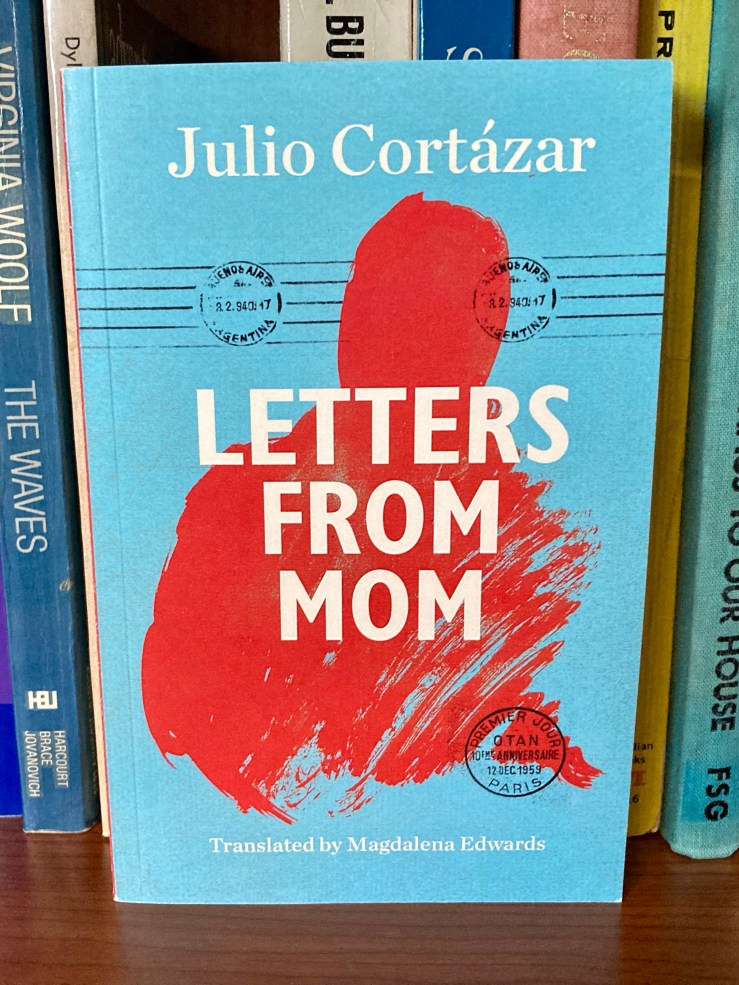
Julio Cortázar’s story “Letters from Mom” is available in English for the first time thanks to translator Magdalena Edwards and the good folks at Sublunary Editions. First published in Cortázar’s 1959 collection Las armas secretas, “Letters from Mom” centers on Luis and his wife Laura, Argentinian expatriates living in Paris, where Luis works as a designer for an advertising agency.

The story begins with Luis receiving a letter from his mother. The event underscores one of Cortázar’s main themes: writing itself. Luis’s mother’s letters arrive from Buenos Aires as “an alteration of time, a harmless little scandal within the order of things that Luis had wanted and designed and achieved” for himself. Luis’s designed “order” is a self-exile which relies on his and Laura’s refusal to speak a certain name. His mother’s latest letter evokes the name, stirring emotions that Luis has sought to repress.

Indeed, Luis’s entire life is rooted in repression. His time in Paris is “a heap of probation, the ridicule of living like a word between parentheses, divorced from the main sentence which nevertheless always supports and explains.” The simile “like a word between parentheses” (which appears in the very first paragraph of the story) teaches us to read the tale that unfolds. It’s between parentheses that we learn the emotional and psychological truth at the root of Luis’s repression. And as the story reaches its climax, Cortázar’s free indirect style paradoxically finds its freest expression within parenthetical boundaries.

Like so many self-exiles, Luis wants to escape the past. His desires again invoke similes of writing: “If the past could be torn up and thrown away like the draft of a letter or a book. But it’s always there, staining the clean copy, and I think that’s the real future.” The stain arrives again and again through his mother’s letters, which repeatedly invoke — and look, I don’t want to spoil the story, so maybe stop reading this now, hey — Continue reading “Between parentheses | On Julio Cortázar’s “Letters from Mom””

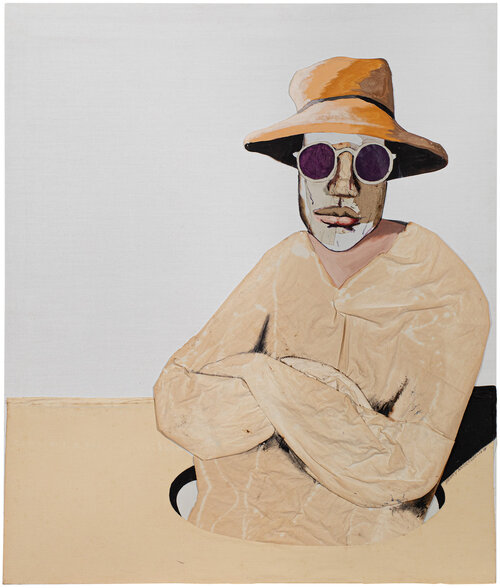
Untitled — Kerry James Marshall

Untitled, 2003 by Kerry James Marshall (b. 1955)

Posted in Art

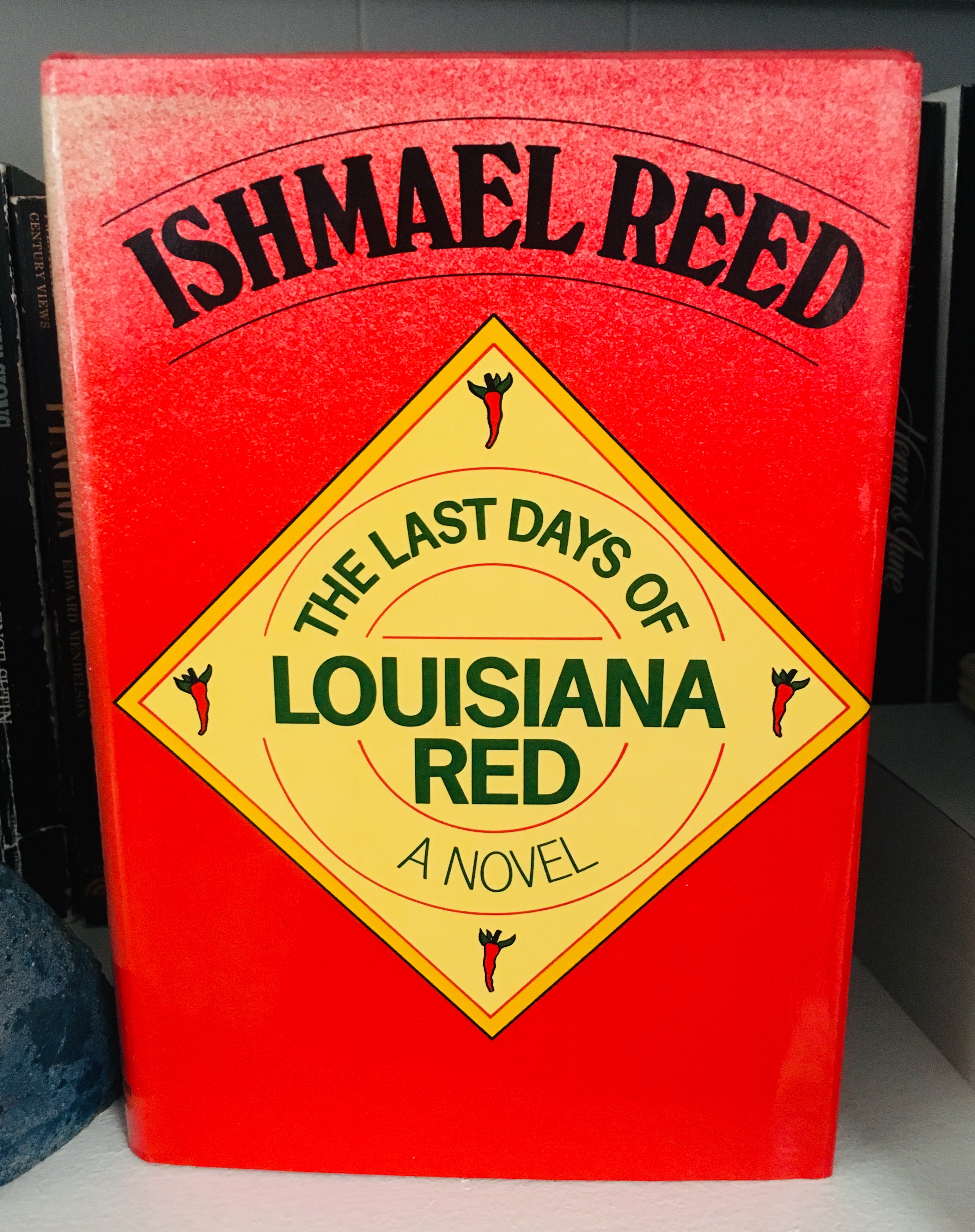
A review of Ishmael Reed’s sharp satire The Last Days of Louisiana Red

img_2323

Ishmael Reed’s 1974 novel The Last Days of Louisiana Red is a sharp, zany satire of US culture at the end of the twentieth century. The novel, Reed’s fourth, is a sequel of sorts to Mumbo Jumbo (1972), and features that earlier novel’s protagonist, the Neo-HooDoo ghost detective Papa LaBas.

In Mumbo Jumbo, Reed gave us the story of an uptight secret society, the Wallflower Order, and their attempt to root out and eradicate “Jes’ Grew,” a psychic virus that spreads freedom and takes its form in arts like jazz and the jitterbug. The Last Days of Louisiana Red also employs a psychic virus to drive its plot, although this transmission is far deadlier. “Louisiana Red” is a poisonous mental disease that afflicts black people in the Americas, causing them to fall into a neo-slave mentality in which they act like “Crabs in the Barrel…Each crab trying to keep the other from reaching the top.”

The Last Days of Louisiana Red begins with Ed Yellings, “an american negro itinerant who popped into Berkeley during the age of Nat King Cole. People looked around one day and there he was.” Yellings is the West Coast counterpart to New-York-based Papa LeBas, a fellow Worker of Neo-HooDoo who fights against the secret forces of psychic slavery.

Sliding into the mythological motif that ripple through Louisiana Red, Reed writes,

When Osiris entered Egypt, cannibalism was in vogue. He stopped men from eating men. Thousands of years later when Ed Yellings entered Berkeley, there was a plague too, but not as savage. After centuries of learning how to be subtle, the scheming beast that is man had acquired the ability to cover up.

Yellings’ mission is to destroy the psychic cannibalism that afflicts his people. He gets to it, and earns “a reputation for being not only a Worker [of the voodoo arts] but a worker too.” Yellings’ working class bona fides helps solidify his sympathies and his mission:

Since he worked with workers, he gained a knowledge of the workers’ lot. He knew that their lives were bitter. He experienced their surliness, their downtroddenness, their spitefulness and the hatred they had for one another and for their wives and their kids. He saw them repeatedly go against their own best interests as they were swayed and bedazzled by modern subliminal techniques, manipulated by politicians and corporate tycoons, who posed as their friends while sapping their energy. Whose political campaigns amounted to: “Get the Nigger.”

As always, Reed’s diagnosis of late 20th-century American culture seems to belong, unfortunately, just as much to our own time, giving his novels a perhaps-unintended sheen of prescience. Reed’s work points to dystopia, even as his heroes work for freedom and justice. And yet Reed gives equal air time to the forces that oppress freedom and justice, forces that find expression in “Louisiana Red”:

Louisiana Red was the way they related to one another, oppressed one another, maimed and murdered one another., carving one another while above their heads, fifty thousand feet, billionaires few in custom-made jet planes equipped with saunas tennis courts swimming pools discotheques and meeting rooms decorated like a Merv Griffin Show set….

The miserable workers were anti-negro, anti-chicano, anti-puerto rican, anti-asian, anti-native american, had forgotten their guild oaths, disrespected craftsmanship; produced badly made cars and appliances and were stimulated by gangster-controlled entertainment; turned out worms in the tuna fish, spiders in the soup, inflamatory toys, tumorous chickens, d.d.t. in fish and the brand new condominium built on quicksand.

As a means to fight the culture of erosion, decay, and entropy, Yellings founds the Solid Gumbo Works. Here, he manufactures a gumbo—a spell, really—to combat “Louisiana Red.” In the process he manages to cure cancer, which pisses off a lot of big corporations, and pretty soon Yellings is murdered. Papa LeBas is sent in from New York to solve the case.

Papa LeBas runs into trouble pretty quickly, mostly by way of Yellings’ adult children: Wolf, Street, Sister, and the provocative and gifted Minnie, who leads a group of militants called the Moochers. Each of the children seem to embody an allegorical parallel to some aspect of the American counterculture of the late sixties and seventies, allowing Reed to mash up genres and skewer ideologies. There are a lot flavors in this gumbo: voodoo lore and California history bubble in the same pot as riffs on astrology and Cab Calloway’s hit “Minnie the Moocher.” Reed frequently compares and contrasts East with West, New York with California, underscoring the latter’s anxieties of influence about being the New World of the New World. Throughout the novel, we get routines on Amos & Andy, slapstick pastiches straight out of George Herriman’s Krazy Kat comix, hysterical nods to Kafka. Reed plays off early blaxploitation films like Sweet Sweetback’s Baadasssss Song and Superfly (not to mention Putney Swope), and synthesizes these tropes with kung fu imagery and neo-Nazi nostalgia garb. He turns Aunt Jemima into a loa at one point.

Reed’s prose ping-pongs between genres, skittering from pulp fiction noir to surrealist frenzies, from bizarre sex to raucous action, from political essaying to postmodernist mythologizing. Through these stylistic shifts, Reed satirizes a host of ideologies that feed into “Louisiana Red.” Aspects of the Berkeley youth movement, radical feminism, free love, and intellectual hucksterism all get skewered, but through an allegorical lens—Reed dares us, often explicitly (by way of a character named Chorus) to read Louisiana Red as an allegorical retelling of Sophocles’ Antigone.

This retelling is both tragic and comic though, premodern and postmodern, a carnival of varied voices. The chapters are short, the sentences sting, and the plot shuttles along, pivoting from episode to episode with manic picaresque glee. Reed’s narrator is always way out there in front of both the reader and the novel’s characters, hollering at us to keep up.

Ultimately, The Last Days of Louisiana Red is a bit of a shaggy dog. It’s not that it doesn’t have a climax—it does, it has lots of climaxes, some quite literal. And it’s not that the novel doesn’t have a point—it very much does. Rather, it’s that Reed employs his detective story as a frame for the larger argument he wants to make about American culture. Sure, Papa LaBas gets to the bottom of Yellings’ murder, but that’s not ultimately what the narrative is about.

When we get to the final chapter, we find LaBas, sitting alone “on a plain box” in the empty offices of the Solid Gumbo Works reflecting on the case in a way that, in short, sums up what The Last Days of Louisiana Red is about:

He thought of the eaters and the eaten of this parable on Gumbo…all ‘oppressed people’ who often, like Tod Browning ‘Freaks,’ have their own boot on their own neck. They exist to give the LaBases, Wolfs and Sisters of these groups the business, so as to prevent them from taking care of Business, Occupation, Work. They are the moochers who cooperate with their ‘oppression,’ for they have the mentality of the prey who thinks his destruction at the fangs of the killer is the natural order of things and colludes with his own death. The Workers exist to tell the ‘prey’ that they were meant to bring down killers three times their size, using the old morality as their guide: Voodoo, Confucianism, the ancient Egyptian inner duties, using the technique of camouflage, independent camouflages like the leopard shark, ruler of the seas for five million years. Doc John, ‘the black Cagliostro,’ rises again over the American scene. The Workers conjure and command the spirit of Doc John to walk the land.

So here, near the end of The Last Days of Louisiana Red, Papa LeBas—and Ishmael Reed, of course—conjures up the spirit of Doctor John, the voodoo healer who escaped slavery and brought knowledge of the hoodoo arts to his people. There’s a promise of hope and optimism here at the novel’s end, despite its many bitter flavors. But the passage cited above is not the final moments of Louisiana Red—no, the novel, ends, despite what I wrote about its being a shaggy dog story, with a marvelous punchline.

Ishmael Reed remains an underappreciated novelist whose early work seems as vital as ever. The Last Days of Louisiana Red is probably not the best starting place for him, but it’s a great novel to read right after Mumbo Jumbo, which is a great starting place to read Reed. In any case: Read Reed. Highly recommended.

[Ed. note–Biblioklept first published this review in March, 2019.]

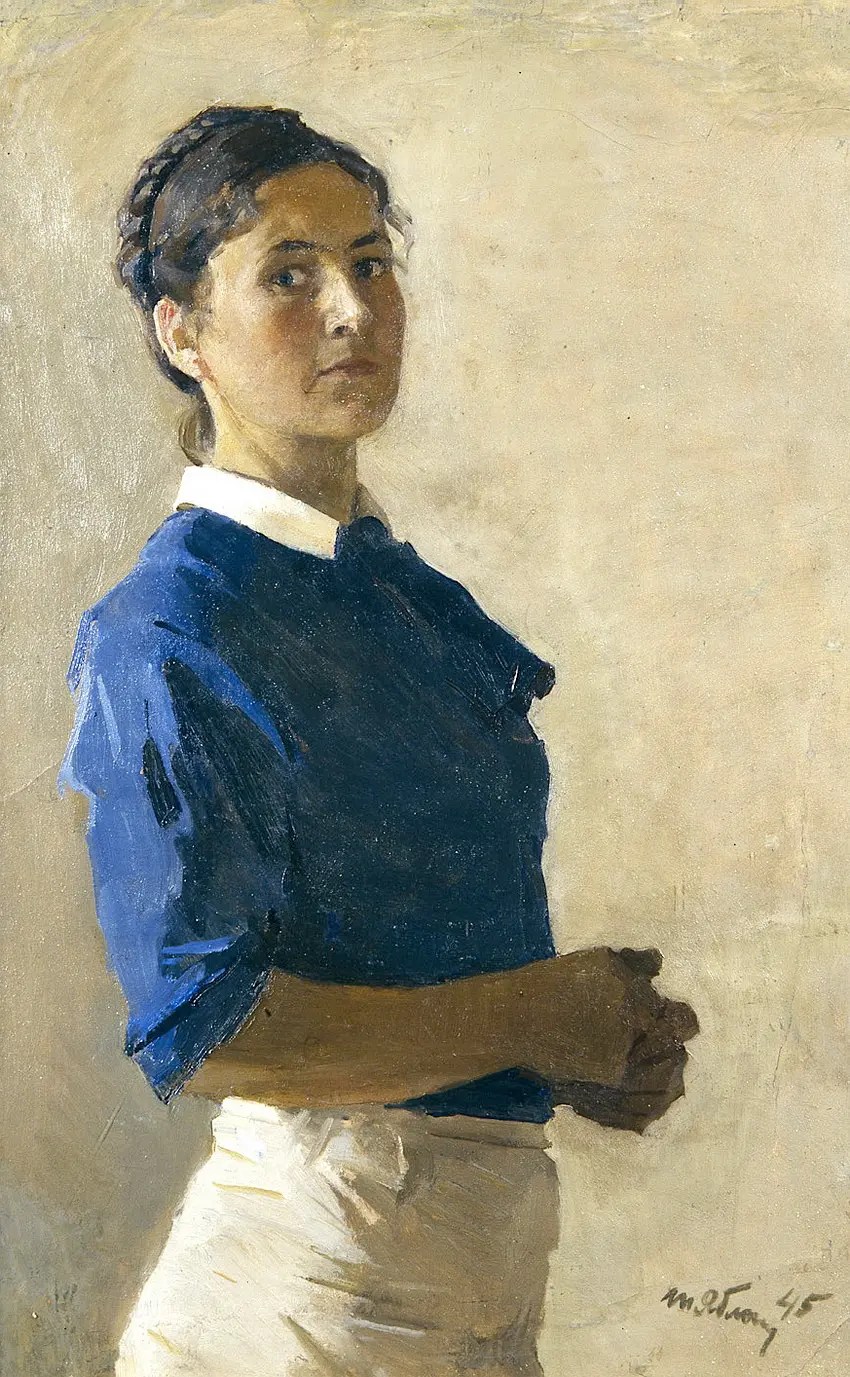
Self-Portrait — Tetyana Yablonska

Self-Portrait, 1945 by Tetyana Yablonska (1917-2005)

Grandfather — Michael S. Harper

“Grandfather”

by

Michael S. Harper


In 1915 my grandfather’s
neighbors surrounded his house
near the dayline he ran
on the Hudson
in Catskill, NY
and thought they’d burn
his family out
in a movie they’d just seen
and be rid of his kind:
the death of a lone black
family is the Birth
of a Nation,
or so they thought.
His 5’4” waiter gait
quenched the white jacket smile
he’d brought back from watered
polish of my father
on the turning seats,
and he asked his neighbors
up on his thatched porch
for the first blossom of fire
that would bring him down.
They went away, his nation,
spittooning their torched necks
in the shadows of the riverboat
they’d seen, posse decomposing;
and I see him on Sutter
with white bag from your
restaurant, challenged by his first
grandson to a foot-race
he will win in white clothes.

I see him as he buys galoshes
for his railed yard near Mineo’s
metal shop, where roses jump
as the el circles his house
toward Brooklyn, where his rain fell;
and I see cigar smoke in his eyes,
chocolate Madison Square Garden chews
he breaks on his set teeth,
stitched up after cancer,
the great white nation immovable
as his weight wilts
and he is on a porch
that won’t hold my arms,
or the legs of the race run
forwards, or the film
played backwards on his grandson’s eyes.

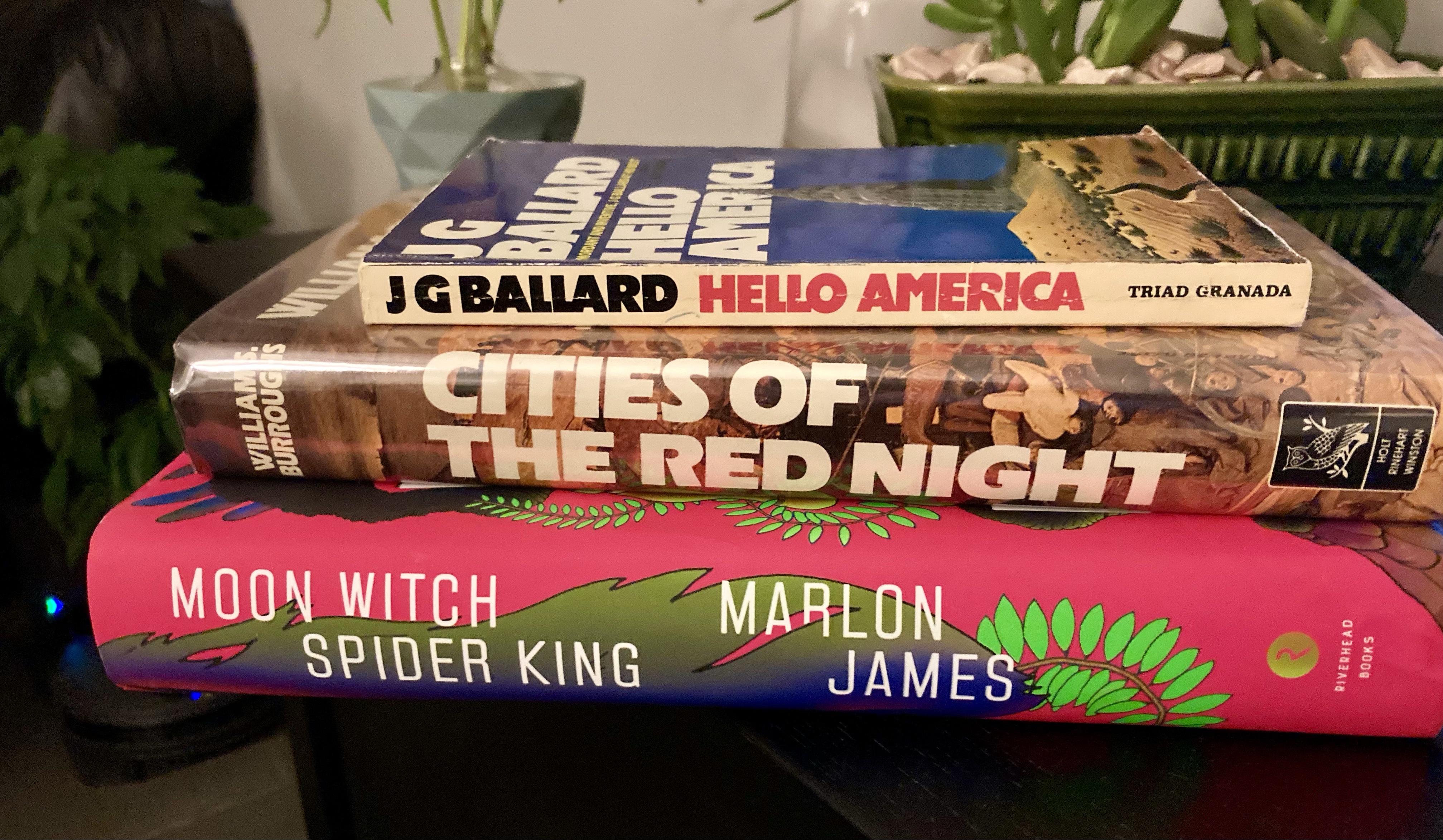
Ballard/Burroughs/James | Hello/Night/Witch (Books acquired 25 Feb. 2022)

Dropped by my beloved sprawling used bookstore yesterday to pick up a new copy of Marlon James’s Moon Witch, Spider King. It’s not exactly the sequel to 2019’s Black Leopard, Red Wolf as much as it is a kind of parallel story to that novel. From the publisher’s description:

In Black Leopard, Red Wolf, Sogolon the Moon Witch proved a worthy adversary to Tracker as they clashed across a mythical African landscape in search of a mysterious boy who disappeared. In Moon Witch, Spider King, Sogolon takes center stage and gives her own account of what happened to the boy, and how she plotted and fought, triumphed and failed as she looked for him. It’s also the story of a century-long feud—seen through the eyes of a 177-year-old witch—that Sogolon had with the Aesi, chancellor to the king. It is said that Aesi works so closely with the king that together they are like the eight limbs of one spider. Aesi’s power is considerable—and deadly. It takes brains and courage to challenge him, which Sogolon does for reasons of her own.

I also couldn’t pass up a first-edition hardback of William S. Burroughs’s late novel Cities of the Red Night. I haven’t read it in at least twenty years, but I remember it as my favorite Burroughs novel. An excerpt, via The Floating Library–

The Cities of the Red Night were six in number: Tamaghis, Ba’dan, Yass-Waddah, Waghdas, Naufana, and Ghadis. These cities were located in an area roughly corresponding to the Gobi Desert, a hundred thousand years ago. At that time the desert was dotted with large oases and traversed by a river which emptied into the Caspian Sea….

…The towns of Ba’dan and Yass-Waddah were opposite each other on the river. Tamaghis, located in a desolate area to the north on a small oasis, could properly be called a desert town. Naufana and Ghadis were situated in mountainous areas to the west and south beyond the perimeter of usual trade routes between the other cities…

….The inhabitants were divided into an elite minority known as the Transmigrants and a majority known as the Receptacles. Within these categories were a number of occupational and specialized strata and the two classes were not in practice separate: Transmigrants acted as Receptacles and Receptacles became Transmigrants.

To show the system in operation: Here is an old Transmigrant on his deathbed. He has selected his future Receptacle parents, who are summoned to the death chamber. The parents then copulate, achieving orgasm just as the old Transmigrant dies so that his spirit enters the womb to be reborn. Every Transmigrant carries with him at all times a list of alternative parents, and in case of accident, violence, or sudden illness, the nearest parents are rushed to the scene. However, there was at first little chance of random or unexpected deaths since the Council of Transmigrants in Waghdas had attained such skill in the art of prophecy that they were able to chart a life from birth to death and determine in most cases the exact time and manner of death.

Many Transmigrants preferred not to wait for the infirmities of age and the ravages of illness, lest their spirit be so weakened so to be overwhelmed and absorbed by the Receptacle child. These hardy Transmigrants, in the full vigor of maturity, after rigorous training in concentration and astral projection, would select two death guides to kill them in front of the copulating parents. The methods of death most commonly employed were hanging and strangulation, the Transmigrant dying in orgasm, which was considered the most reliable method of ensuring a successful transfer. Drugs were also developed, large doses of which occasioned death in erotic convulsions, smaller doses being used to enhance sexual pleasure. And these drugs were often used in conjunction with other forms of death.

I also couldn’t pass up a mass market edition of J.G. Ballard’s 1981 novel Hello America (with a nice cover by Tim White). I have not read Hello America. Yet.

Malice — Benny Andrews

Malice, 1978 by Benny Andrews (1930-2006)

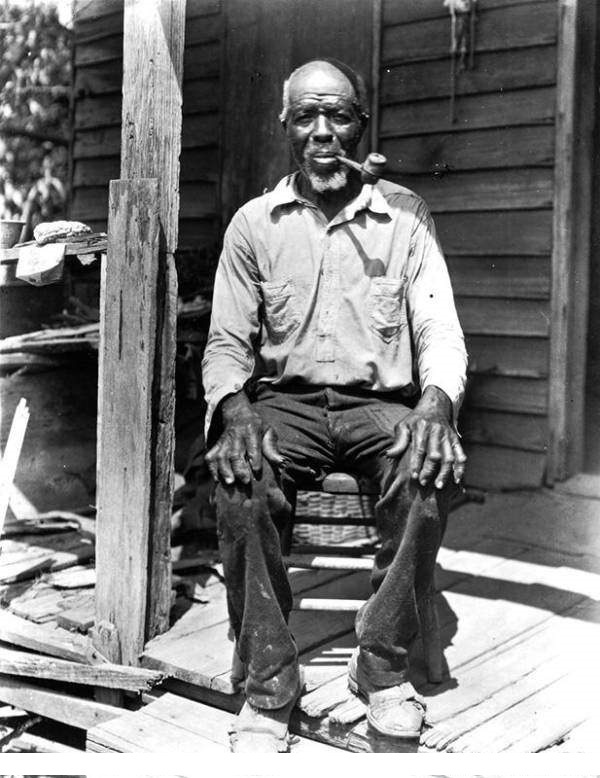
A review of Zora Neale Hurston’s Barracoon

151835599518773205

Zora Neale Hurston’s 1931 book Barracoon: The Story of the Last “Black Cargo” has finally been published. The book is based on Hurston’s 1927 interviews with Cudjo Lewis, the last known survivor of the transatlantic slave trade. Barracoon went previously unpublished due in part to Hurston’s refusal to revise the prose into a “standard” English. Hurston wrote Barracoon in a phonetic approximation of Cudjo’s voice. While this vernacular style may pose (initial) challenges for many readers, it is the very soul of the book in that it transmits Cudjo’s story in his own voice, tone, and rhythm. Hurston used vernacular diction throughout her work, but Cudjo’s voice is singular; it bears a distinctly different sound than the characters of Their Eyes Were Watching God, Hurston’s most famous novel. It is hard to conceive a more compelling version of Barracoon than this one, the one Hurston refused to compromise, with its intense, vital orality.

What is Barracoon about? I shall liberally borrow my summary from the book’s introduction, penned by Hurston scholar and biographer Deborah G. Plant:

On December 14, 1927, Zora Neale Hurston took the 3:40 p.m. train from Penn Station, New York, to Mobile, to conduct a series of interviews with the last known surviving African of the last American slaver—the Clotilda. His name was Kossola, but he was called Cudjo Lewis. He was held as a slave for five and a half years in Plateau-Magazine Point, Alabama, from 1860 until Union soldiers told him he was free. Kossola lived out the rest of his life in Africatown (Plateau). Hurston’s trip south was a continuation of the field trip expedition she had initiated the previous year.

Oluale Kossola had survived capture at the hands of Dahomian warriors, the barracoons at Whydah (Ouidah), and the Middle Passage. He had been enslaved, he had lived through the Civil War and the largely un-Reconstructed South, and he had endured the rule of Jim Crow. He had experienced the dawn of a new millennium that included World War I and the Great Depression. Within the magnitude of world events swirled the momentous events of Kossola’s own personal world.

Zora Neale Hurston, as a cultural anthropologist, ethnographer, and folklorist, was eager to inquire into his experiences. “I want to know who you are,” she approached Kossola, “and how you came to be a slave; and to what part of Africa do you belong, and how you fared as a slave, and how you have managed as a free man?” Kossola absorbed her every question, then raised a tearful countenance. “Thankee Jesus! Somebody come ast about Cudjo! I want tellee somebody who I is, so maybe dey go in de Afficky soil some day and callee my name and somebody say, ‘Yeah, I know Kossula.’”

Those final sentences should give you a quick taste of Barracoon’s central rhetorical conceit. After her own introductory chapter (which details the historical circumstances of the Clotilda’s illegal journey to West Africa), Hurston lets Cudjo inspirit the text, telling his own story in his own voice. Hurston, who spent three months with Cudjo, initially interposes herself in the story, as we see early in the book’s first chapter:

“My grandpa, he a great man. I tellee you how he go.”

I was afraid that Cudjo might go off on a tangent, so I cut in with, “But Kossula, I want to hear about you and how you lived in Africa.”

He gave me a look full of scornful pity and asked, “Where is de house where de mouse is de leader? In de Affica soil I cain tellee you ’bout de son before I tellee you ’bout de father; and derefore, you unnerstand me, I cain talk about de man who is father (et te) till I tellee you bout de man who he father to him, (et, te, te, grandfather) now, dass right ain’ it?

This brief “cutting in” is one of the last moments in the narrative that Hurston attempts to steer Cudjo in a particular direction. Instead, she befriends the old man, bringing him watermelons, hams, peaches, and other treats. These little gifts serve to frame Cudjo’s narrative as he moves from one episode to the next. Otherwise, Hurston disappears into the background, an ear for Cudjo’s voice, a witness for his story.

Cudjo’s story is astounding. He describes life in his own West African village and the terrible slaughter of his people at the hands of “de people of Dahomey,” a tribe that eventually sells Cudjo and the other young people of his village to white men. Cudjo describes his early enslavement in Alabama, which took place in secret until the Civil War, and his eventual freedom from bondage. He tells Hurston about the founding of Africatown, a community of West Africans. He describes his life after capture and slavery—his marriage, his children, his near-fatal railroad accident. Cudjo’s life and his children’s lives were incredibly difficult. They were always othered:

“All de time de chillun growin’ de American folks dey picks at dem and tell de Afficky people dey kill folks and eatee de meat. Dey callee my chillun ig’nant savage and make out dey kin to monkey.

“Derefo’, you unnerstand me, my boys dey fight. Dey got to fight all de time. Me and dey mama doan lak to hear our chillun call savage. It hurtee dey feelings. Derefo’ dey fight. Dey fight hard. When dey whip de other boys, dey folks come to our house and tellee us, ‘Yo’ boys mighty bad, Cudjo. We ’fraid they goin’ kill somebody.”

Somehow most devastating in a narrative full of devastation are the deaths of Cudjo’s children. After his daughter dies in infancy, his namesake is killed by a sheriff, a scene that resonates with terrible pain in 2018:

Nine year we hurtee inside ’bout our baby. Den we git hurtee again. Somebody call hisself a deputy sheriff kill de baby boy now.

He say he de law, but he doan come ’rest him. If my boy done something wrong, it his place come ’rest him lak a man. If he mad wid my Cudjo ’bout something den he oughter come fight him face to face lak a man. He doan come ’rest him lak no sheriff and he doan come fight him lak no man.

Another of his sons is decapitated in a railroad accident. A third son, angry with the injustice of the world, simply disappears: “My boy gone. He ain’ in de house and he ain’ on de hill wid his mama. We both missee him. I doan know. Maybe dey kill my boy. It a hidden mystery.”

Cudjo, ever the survivor, went on to outlive his wife and all of his children.  In her foreword to Barracoon, Alice Walker captures the pain and pathos of this remarkable position:

And then, the story of Cudjo Lewis’s life after Emancipation. His happiness with “freedom,” helping to create a community, a church, building his own house. His tender love for his wife, Seely, and their children. The horrible deaths that follow. We see a man so lonely for Africa, so lonely for his family, we are struck with the realization that he is naming something we ourselves work hard to avoid: how lonely we are too in this still foreign land: lonely for our true culture, our people, our singular connection to a specific understanding of the Universe. And that what we long for, as in Cudjo Lewis’s case, is gone forever. But we see something else: the nobility of a soul that has suffered to the point almost of erasure, and still it struggles to be whole, present, giving.

I cannot improve on Walker’s phrase here. Hurston brings that “nobility of soul” to life via Cudjo’s own rich language.

While Barracoon is of a piece with Hurston’s anthropological collections Mules and Men and Tell My Horse, it does not read like an autoethnography. It is rather a compelling first-person narrative. Hurston collecteed stories from Cudjo–fables, parables, games—but these are included as an appendix, a wise narrative choice as any attempt to integrate them into the main narrative would hardly be seamless. The appendix adds to the text’s richness without imposing on it, and links it to Hurston’s work as a folklorist.

I’ve noted some of the additional material already—Walker’s foreword, the appendix of folklore, as well as Plant’s introduction. Included also is an afterword by Plant that contextualizes Barracoon within Hurston’s academic career, a list of the original residents of Africatown, a glossary, a bibliography, and a lengthy compendium of endnotes. This editorial material frames the historic and academic importance of Barracoon, and will be of great interest to anyone who wishes to study the subject more. However, Cudjo’s narrative stands on its own as a sad, compelling, essential story. It’s amazing it took this long to reach a wider audience. Recommended.

[Ed. note–this review originally ran in May, 2018.]

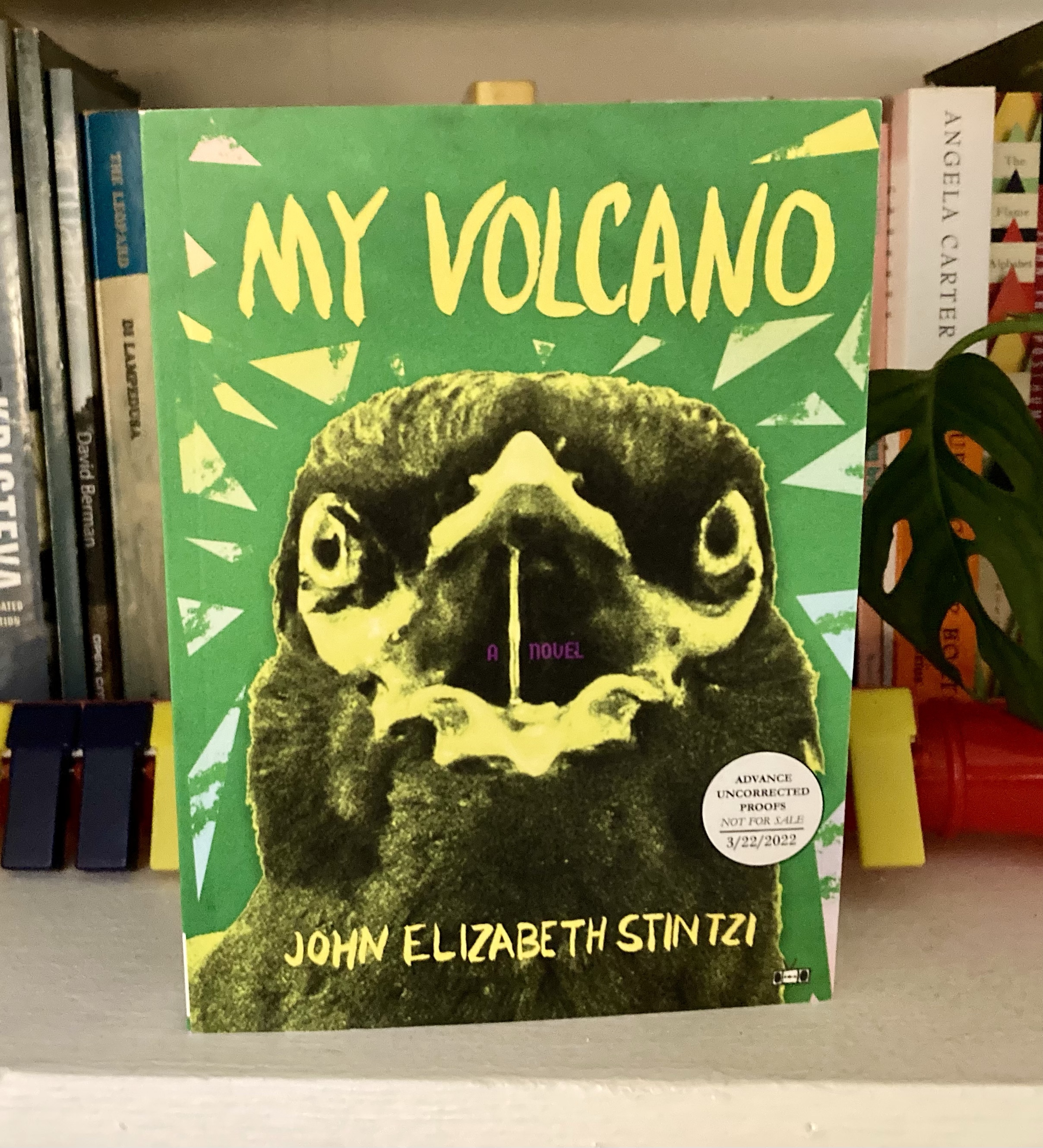
John Elizabeth Stintzi’s novel My Volcano (Book acquired, 20 Feb. 2022)

I finally had a spare half hour to dip into John Elizabeth Stintzi’s novel My Volcano this afternoon. After hearing about the novel from the good folks at weirdo indie stalwart Two Dollar Radio, I thought—well, look, here’s the publisher’s blurb:

My Volcano is a kaleidoscopic portrait of a menagerie of characters, as they each undergo personal eruptions, while the Earth itself is constantly shifting. It takes place during the turbulent summer of 2016, which saw the Pulse nightclub shooting in Orlando, and a spate of horrific hate-crimes across the country. This grounding in reality, contrasted with the sensational action that occurs in the narrative, floats the idea — which appears as the epigraph to the book, and also as a line within — that “reality is nothing but the opinion of power.” Parable, myth, science-fiction, eco-horror, My Volcano is a radical work of literary art, emerging as a subversive, intoxicating artistic statement.

–and the blurb at the TDR website is more detailed—

On June 2, 2016, a protrusion of rock growing from the Central Park Reservoir is spotted by a jogger. Three weeks later, when it finally stops growing, it’s nearly two-and-a-half miles tall, and has been determined to be an active volcano.

As the volcano grows and then looms over New York, an eight-year-old boy in Mexico City finds himself transported 500 years into the past, where he witnesses the fall of the Aztec Empire; a Nigerian scholar in Tokyo studies a folktale about a woman of fire who descends a mountain and destroys an entire village; a white trans writer in Jersey City struggles to write a sci-fi novel about a thriving civilization on an impossible planet; a nurse tends to Syrian refugees in Greece while grappling with the trauma of living through the bombing of a hospital in Kunduz, Afghanistan; a nomadic farmer in Mongolia is stung by a bee, magically transforming him into a green, thorned, flowering creature that aspires to connect every living thing into its consciousness.

With its riveting and audacious vision, My Volcano is a tapestry on fire, a distorted and cinematic new work from the fiercely talented John Elizabeth Stintzi.

—anyway, I expected a kind of weirdness of prose, something “experimental” — but Stintzi’s prose is tight, lucid, and crisp. They employ filmic techniques, including interstitial chapters announcing the myriad horrific deaths recorded in 2016, including Philando Castile, Alton Sterling, and the victims of the Pulse nightclub massacre. Flicking through the novel to graze these placards reminded me of the cruelty of the 2016, but also underlined that that cruelty was not especially special, besides, maybe, the fact that more folk could not deny systematic institutional violence in the grand ole USA. (Accept that they did. A lot of folk signed up for denying that shit.)

—well anyway, the intriguing thing, so far, is Stintzi’s spare evocations of extraordinary moments. There’s something both banal and beautiful in a sentence like, “The bumblebee in central Mongolia was eaten by a whitethroated needletail on JUNE 5.” Or hardly banal, but still frank and clear: “It didn’t take more than seeing strangely dressed Angel ingest a cloud for the Mexica people of Tenochtitlan to believe that he was holy.”

There’s also a heavy sadness under what I read, although maybe I brought that myself.

“Coal” — Audre Lorde

“Coal”

by

Audre Lorde


I
Is the total black, being spoken
From the earth’s inside.
There are many kinds of open.
How a diamond comes into a knot of flame
How a sound comes into a word, coloured
By who pays what for speaking.

Some words are open
Like a diamond on glass windows
Singing out within the crash of passing sun
Then there are words like stapled wagers
In a perforated book—buy and sign and tear apart—
And come whatever wills all chances
The stub remains
An ill-pulled tooth with a ragged edge.
Some words live in my throat
Breeding like adders. Others know sun
Seeking like gypsies over my tongue
To explode through my lips
Like young sparrows bursting from shell.
Some words
Bedevil me.

Love is a word another kind of open—
As a diamond comes into a knot of flame
I am black because I come from the earth’s inside
Take my word for jewel in your open light.

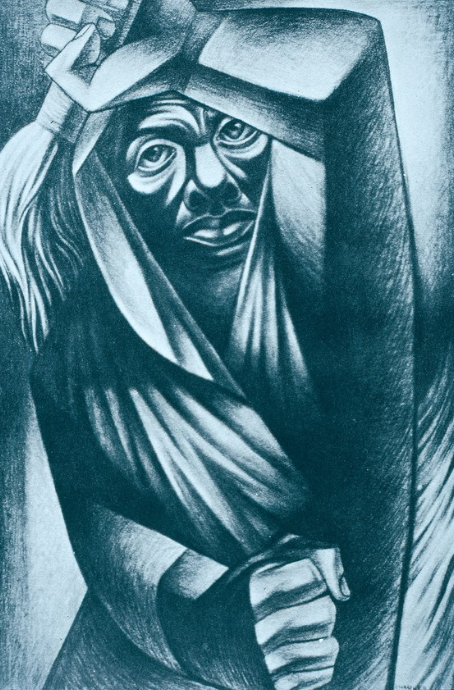
Sojourner — Charles White

Sojourner, 1948 by Charles White (1918-1979)

Fifty years after the appearance of Motorman, the strangeness only seems all the more believable | David Green on David Ohle

At Big Other, David Green has a nice big fat essay on the fiction of David Ohle. The occasion for Green’s piece is the publication of Ohle’s latest novel, The Death of a Character, which again features his cypher Moldenke, the hero (?) of Ohle’s 1972 cult classic Motorman (“Fifty years after the appearance of Motorman, the strangeness only seems all the more believable,” writes Green).

Opening bars:

Readers encountering David Ohle’s work for the first time through his most recent novel, The Death of a Character (2021), will indeed find the depiction promised in its title, but those familiar with Ohle’s previous books, especially his first and eventual cult favorite, Motorman (1972), will know that the character whose dying the narrative chronicles is the protagonist of that novel as well. Called simply Moldenke, he makes additional appearances in the long-delayed follow-up to MotormanThe Age of Sinatra (2004), as well as its successors, The Pisstown Chaos (2008) and The Old Reactor (2013). (In The Pisstown Chaos, Moldenke turns up as a minor character in a story focusing on others, but The Death of a Character marks the fourth time his picaresque existence has been the focus of an Ohle novel.) Moldenke has been the principal conduit to the singularly bizarre and often grotesque world Ohle invokes in his fiction, and thus his demise seems more a consummation of that world’s creation, its full achievement perhaps, than merely the portrayal of a fictional character’s death.

Read the rest of the essay here.

From Motorman:

“Abraham Lincoln of Rock Spring Farm” — Melvin B. Tolson

“Abraham Lincoln of Rock Spring Farm”

by

Melvin B. Tolson


I

Along the Wilderness Road, through Cumberland Gap,
The black ox hours limped toward Sunday’s sun,
Across a buff clay belt with scrawls of stone,
Where bird and beast quailed in the bosom brush
From February’s fang and claw; the stars,
Blue white, like sheer icicles, spired aglow
As if the three wise men barged in the East
Or priests in sackcloth balked the Scourge of God.

Foursquare by the rite of arm and heart and law,
The scrubby log cabin dared the compass points
Of Rock Spring farm, man’s world, God’s universe,
The babel of the circumstance and era.
The frozen socket of its window stared
Beyond the spayed crabapple trees, to where
The skulls of hills, the skeletons of barrens,
Lay quiet as time without the watch’s tick.

Not knowing muck and star would vie for him,
The man Tom sank upon ax-split stool,
Hands fisted, feet set wide to brace the spirit,
Big shoulders shoved, dark hazel eyes glazed by
Grotesqueries of flame that yawled and danced
Up, up, the stick-clay chimney. While fire imps combed
The black and bristling hair, the acids of thoughts
Made of the orby face an etching-plate.

II

Near pyrotechnic logs, the purling kettle,
Aunt Peggy puffed her pipe on God’s rich time:
A granny at a childbed on the border,
Where head and backbone answered the tomahawk
Her wise old eyes had seen a hundred Nancys
In travail tread the dark winepress alone;
Her wise old hands had plucked a stubborn breed
Into the outer world of pitch and toss.

The cabin that her myth and mission entered
Became a castle in which Aunt Peggy throned
A dynasty of grunts and nods and glances.
The nest, the barn, the hovel had schooled her in
The ABC of motherhood, and somehow
She’d lost her ego in the commonweal:
She sensed so accurately a coming child
That rakes dubbed her the St. Bernard of Sex!

And now her keyhole look explored Tom Lincoln
Beneath the patched homespun, the hue and cry
Of malice, until she touched his loneliness,
The taproot that his fiber gave no tongue.
Then, lulling the wife, troubled in flesh and mind,
She eased the sack quilts higher and mused the while:
There’s but one way of coming into the world,
And seven times seventy ways of leaving it!

III

The woman Nancy, like a voyager sucked
Into the sea’s whale belly by a wreck,
Buoyed to the surface air of consciousness
And clutched the solace of her corn-husk bed.
Her dark face, sharped in forehead, cheekbone, chin,
Cuddled in dark brown hair; her eyes waxed grayer
With wonder of the interlude: her beauty
And courage choked Aunt Peggy’s hyperbole!

Out of the fog of pain, the bog of bygones,
The bag of cabin cant and tavern tattle,
She picked the squares to piece tomorrow’s quilt:
She puzzled now, as then, about her father
Who let wild Lucy Hanks bundle and carry
Flesh of his flesh beyond the Cumberland Gap;
A strange roof is no roof when imps of fear
Pilfer the fatherless in blossom time.

Year in, year out, the daughter tinkered with
The riddle of her birth; the mother chided
The woman Nancy as she had the child,
“Hush thee, hush thee, thy father’s a gentleman.”
The butt of bawd, grand jury, Sunday bonnet,
Lucy, driven, taught her daughter the Word,
And Nancy, driven, taught her son the Word,
And Abraham, driven, taught his people the Word!

IV

The man Tom bit his fingernails, then rammed
His pockets with the hector hands that gave
Raw timber the shape of cabinet and coffin,
And in his lame speech said: “Aunt Peggy, listen,
Now that our Nancy’s time is come, I’m haunted
By my own nothingness. Why breed nobodies?”
He tapped the dirt floor with the iron-capped boot
That aided fist and skull in border fights.

Aunt Peggy counseled: “Tom, you say the say
Poor Joseph probably said in that low stable
Ere Jesus came into this mishmash world.”
She paused, then boxed the ears of cynicism:
“It’s true, down in the barnyard, blood speaks loud,
Among the hogs, the chickens, the cows, the horses;
But, when it comes to Man, who knows, who knows
What greatness feeds down in the lowliest mother?”

The man Tom turned and spat: his naked surmise
Ranged out and out. Aunt Peggy’s innermost said:
“Your father Abraham, bred like Daniel Boone,
Conquered a land with gun and ax and plow,
Baptized it in his blood! I say, I’ve said,
What’s in a baby is God Almighty’s business;
How the elders wring it out is worry enough!
The best, the worst—it’s all, all human nature.”

V

The tavern, Tom remembered, the New Year’s Eve,
The clubfoot scholar bagged in Old World clothes,
With arrowy eyes and a hoary mushroom beard.
An Oxford don, he hymned the Bastille’s fall
In spite of the hair-hung sword; his betters set
Him free to hail new truths in new lands, where
He seined with slave and master, knave and priest,
And out of all fished up the rights of man:

“As Citizen Lincoln asks, ‘What’s human nature?’
His full mug says a clear mind puts the question
Which ties the fogey scholar in a knot!
My new idea fed to his new baby
Would fetch the New World and the New Year peace!
The sum of anything unriddles the riddle:
The child whose wet nurse is the mother-of-all
Grows like a pine unmarked by rock or wind.

“To make a New World and a New Year, Plato
And Jesus begged the boon of little children!
Now Citizen Lincoln asks, ‘What’s human nature?’
It’s what we elders have: no baby has it.
It’s what our good and bad graft on the neutral.
It’s what our rulers feed the boy and girl.
It’s what society garbs nature in.
It’s a misnomer: call it human nurture!”

VI

Aunt Peggy hovered closer, with flawless rites
Grown lyrical from habit: muffled pain sounds
Dragged from the bed of cleated poles; she hawed
Tom Lincoln, as one turns a nag aside,
Then swooped her way, even as a setting hen
Carves a dictatorship from yard to nest.
And Tom again was squeezed into a cell
Whose inmates were the ghosts of unsuccess.

Later his memories climbed a gala peak,
His Nancy’s infare that ran riotous:
The bear meat, venison, wild turkey, duck,
The maple sugar hanging for the whiskey,
The red ham, gourds of syrup, bowls of honey,
The wood coal pit with brown and juicy sheep,
The guzzling, fiddling, guttling, monkeyshining:
A continent sprawled between that day and this!

A havenot on the frontier is no havenot;
A Crusoe without Friday has no conscience:
Yet Tom’s grub living gnawed him like the teeth
Of slavery, land titles, melancholy.
He, like his forebears, visioned a Promised Land
And tidied ways and means to fly the barrens
That doomed the flesh to peck, to patch, to pinch,
And wrung the soul of joy and beauty dry.

VII

The black ox hours limped by, and day crawled after.
White prongs of ice, like dinosaur fangs, gleamed in
The cavernous mouth of Rock Spring; snowbirds shivered
And chirped rebellion; a cow with jags and gaps
Chewed emptily; hogs squealed in hunger fits;
And scrags of dogs huddled against the chimney,
Which shoveled smoke dust into the throats and noses
Of ragged winds kicking up snow in the desert.

Nancy lay white, serene, like virgin milk
After the udder’s fury in the pail.
Beneath the sack quilts and the bearskin robe,
In yellow petticoat and linsey shirt,
The baby snuggled at her breast and gurgled—
An anonymity of soft red wrinkles.
Aunt Peggy, hovering, grinned, “He’s Sabbath-born.
Remember …Sunday—it’s red-letter day!”

Like ax and helve, like scythe and snath, the bond
Held Tom and Nancy; she smiled at his halt smile,
His titan’s muss in picking up the baby.
Tom frowned and spat, then gulped, “He’s legs! All legs!”
Aunt Peggy beamed, “Long legs can eat up miles.”
Tom gloomed, “The hands—look at the axman’s hands!”
And Nancy mused, “The Hankses’ dream, the Lincolns’,
Needs such a man to hew and blaze the way.”
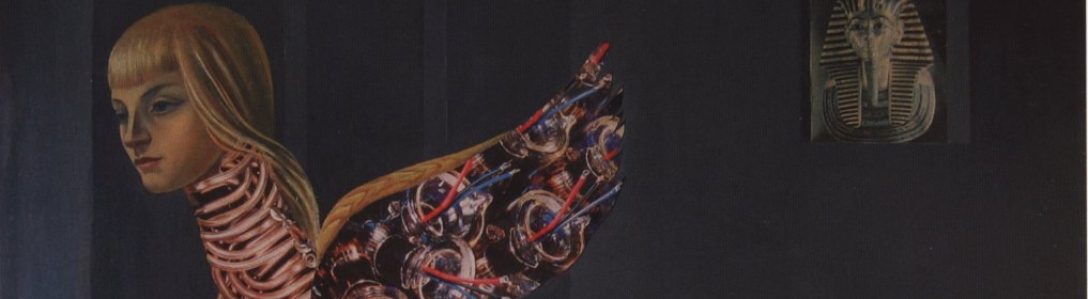
First Lady Michelle Obama — Amy Sherald

First Lady Michelle Obama, 2017 by Amy Sherald (b. 1973)

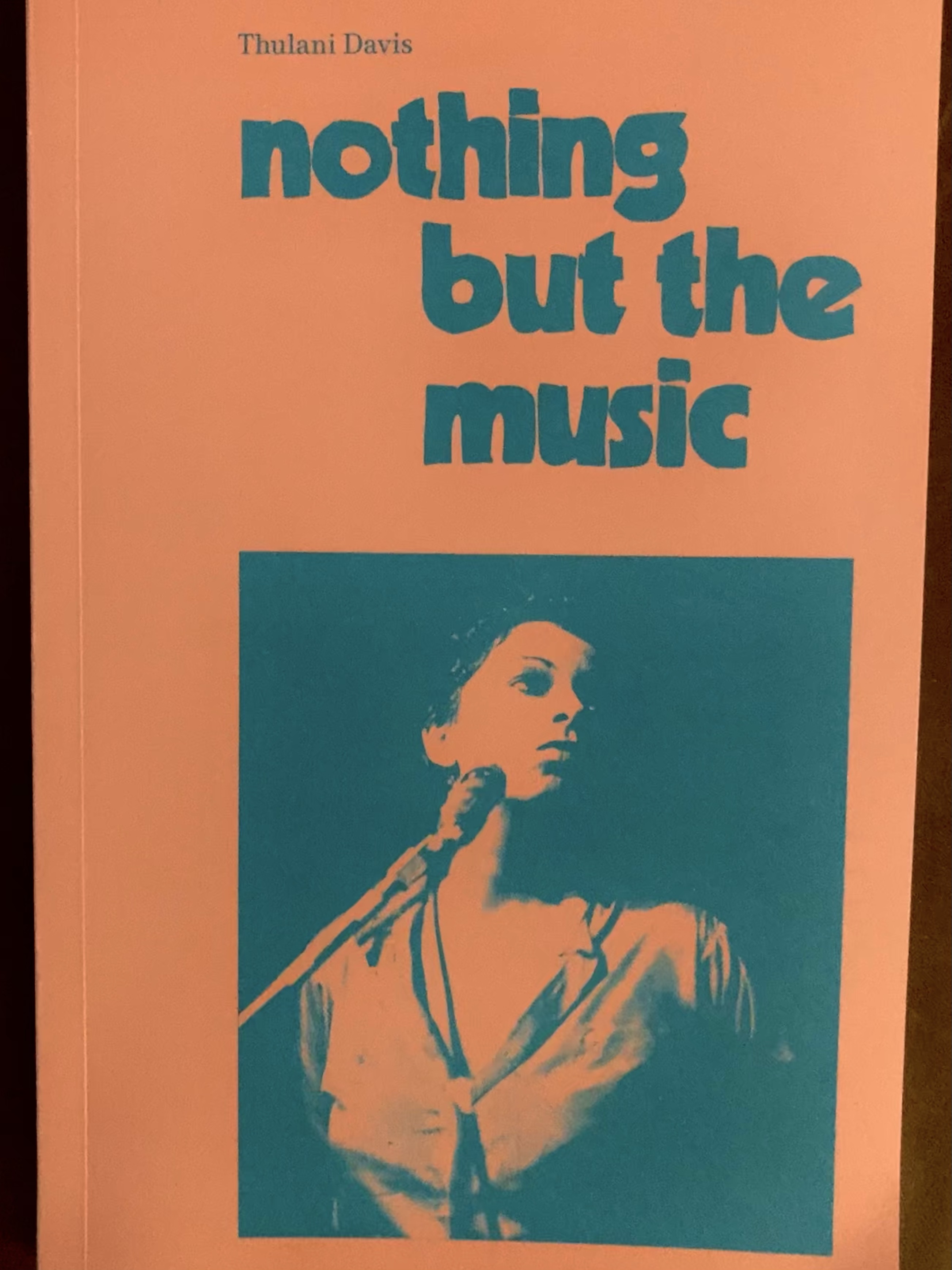
Behind God’s back | On Thulani Davis’s poetry collection Nothing but the Music

Here are the first lines of Thulani Davis’s 1978 poem “Mecca Flats 1907”:

On this landscape

Like a thin air

Hard to breathe

Behind God’s back

I see the doors

I wanted to underline the line Behind God’s back—such an image! But the book itself is so pretty, lithe, lovely. Better to leave it unmarked?

The book is Nothing but the Music, a new collection of Thulani Davis’s poems. Its subtitle Documentaries from Nightclubs, Dance Halls, & a Tailor’s Shop in Dakar: 1974-1992 is a somewhat accurate description of the content here. These are poems about music—about Cecil Taylor and The Commodores and Thelonious Monk and Henry Threadgill and Bad Brains and more. “About” is not really the right word, and of course these poems are their own music; reading them aloud reveals a complexity of rhyme and rhythm that might be lost to the eye on the page.

But where was I—I wanted to underline the line Behind God’s back, but I didn’t. I didn’t even dogear the page. Instead, I went back to read Davis’s acknowledgements, a foreword by Jessica Hagedorn, and an introduction by Tobi Haslett. The material sets the stage and provides context for the poems that follow. Davis’s acknowledgments begin:

I have heard this music in a lot of clubs that no longer exist, opera houses in Italy that will stand another hundred years parks in Manhattan, Brooklyn, L.A., San Francisco, and Washington, DC as well as on Goree Island and in Harare, Zimbabwe. Some of it was in lofts in lower Manhattan now inhabited by millionaires, crowded bistros in Paris that are close, and legendary sites like Mandel Hall and the Apollo, radio studios, recording studios, and my many homes.

Acknowledging the weird times that have persisted (behind God’s back or otherwise), Davis touches on the COVID-19 lockdown that took the joy of live music from her—and then returned it in the strange form of “masked protesters massed in the streets singing ‘Lean on Me'” during the protests following the murder of George Floyd.

Poems in Nothing but the Music resonate with the protests against police violence and injustice we’ve seen this year. The speaker of “Back Stage Drama (For Miami)” (surely Davis herself?) repeats throughout the poem that “I was gonna talk about a race riot,” but the folks around her are absorbed in other, perhaps more minute affairs:

They all like to hang out

Thinking is rather grim to them.

Composed in 1980, the poem documents an attempt to attempt to address the riots in May of the same year in Miami, Florida, after several police officers were acquitted in the murder of Arthur McDuffie, a black man.

The speaker of the poem embeds a poetic plea, a poem-within-a-poem:

I said, ‘they’re mad, they’re on the the bottom going down/

stung by white justice in a white town

and then there’s other colored people

who don’t necessarily think they’re colored people

taking up the middle/leaving them the ground.’

But her would-be audience is weary:

I am still trying to talk about this race riot.

Minnie looked up and said, ‘We don’t have anywhere

to put any more dead.’

Snake put on his coat to leave, ‘We never did,

we never did.’

1992’s “It’s Time for the Rhythm Revue” takes for its erstwhile subject the riots that ensued after the acquittal of the LAPD officers who beat Rodney King. The subject is far more complex though—the speaker of the poem desires joy of course, not violence:

did they acquit somebody in LA?

will we burn it down on Saturday

or dance to the Rhythm Revue

the not too distant past

when we thought we’d live on?

Is God’s back turned—or do the protagonists just live behind it?:

…I clean my house

listening to songs from the past

times when no one asked anyone

if they’d seen a town burn

cause baby everybody had.

In Nothing but the Music, music is part and parcel of the world, entangled in the violence and injustice of it all, not a mere balm or solace but lifeforce itself, a point of resistance against it all. In “Side A (Sir Simpleton/Celebration), the first of two poems on Henry Threadgill’s 1979 album X-75, Vol. I, Davis’s narrator evokes

at the turning of the day

in these winters/in the city’s bottomless streets

it seems sometimes we live behind god’s back

we/the life blood

of forgotten places/unhallowed ground

sometimes in these valleys

turning the corner of canyons now filled with blinding light streams caught between this rock & a known hard place

sometimes in utter solitude

a chorale/a sweetness/makes us whole & never lost

And again there that line, a note from a previous jam—it seems sometimes we live behind god’s back—I’ll dogear it here, digitally, underline it in my little blog scrapbook.

I think seems is the right verb though, above. Does the star of “Lawn Chair on the Sidewalk” not remain in God’s gaze?

there’s a junkie sunning himself

under my front tree

that tree had to fight for life

on this Brooklyn street

disease got to its limbs

while still young

Typing the lines out, I wonder who I meant by star above.

Nothing but the Music is filled with stars. Here’s avant-piano great Cecil Taylor in “C.T. at the Five Spot”:

this is not about romance & dream

it’s about a terrible command performance of the facts

of time & space & air

In a synesthestic moment, the speaker merges her art with its subject:

the player plays/Mr. Taylor plays

delicate separate licks of poems

brushes in tones lighter & tighter/closer in space

In the end it’s one art:

I have heard this music

ever since I can remember/I have heard this music

There are plenty more famous musicians, of course, but more often than not minor players emerge with the greatest force. There’s the unknown hornplayer whose ecstatic playing inspired 1975’s “He Didn’t Give Up/He Was Taken.” In “Leaving Goree” there are the “two Bambara women…gold teeth gleaming” who “sit like mountains” and then explode in song.

Davis crafts here characters with deft economy. Here’s the aforementioned couple of “Back Stage Drama (For Miami)”:

Snake & Minnie

who love each other dearly

drink in different bars,

ride home in separate cars.

They like to kiss goodnight

with unexplored lips.

They go out of town

to see each other open.

Or the hero of 1982’s “Bad Brains, A Band”—

the idea that they think must scare people to death

the only person I ever met from southeast DC

was a genius who stabbed her boyfriend for sneaking up on her in the kitchen

she was tone deaf and had no ear for French

she once burned her partner in bid whist

for making a mistake

At the core of it all is Davis’s strong gliding voice, pure and clean, channeling miracle music and synthesizing it into new sounds. The speaker of “C.T. at the Five Spot” assessed Taylor’s performance as a work of physics, a transcendence beyond “romance & dream,” but the speaker of 1982’s “Zoom (The Commodores)” gets caught up in the aural romance of The Commodore’s pop magic:

zoom I love you

cause you won’t say no/cause you don’t want to go

cause it’s so cruel without love

give me the tacky grandeur of Atlantic City

on the Fourth of July

the corny promises of Motown

give me the romance & the Zoom.

I love those corny promises too. The romance and the zoom are not, at least in my estimation, behind God’s back, but rather, if you believe in that sort of thing, might be God’s special dream. Nothing but the Music cooks raw joy and raw pain into something sublime. I like poems best when they tell stories, and Davis is a storyteller. The poems here capture place and time, but most of all sound, sound, rhythm, and sound. Lovely stuff.

Nothing but the Music is available from Blank Forms Editions.

[Ed. note–Biblioklept first published this review in Nov. 2020.]

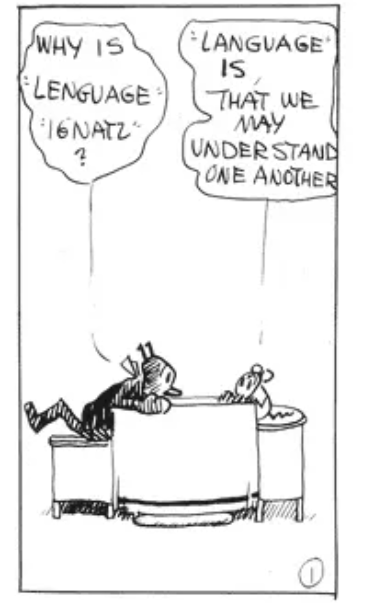
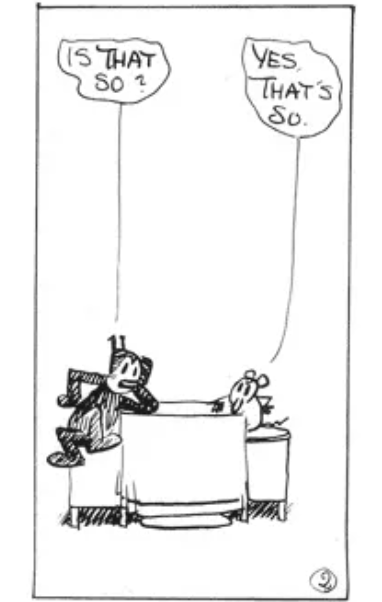
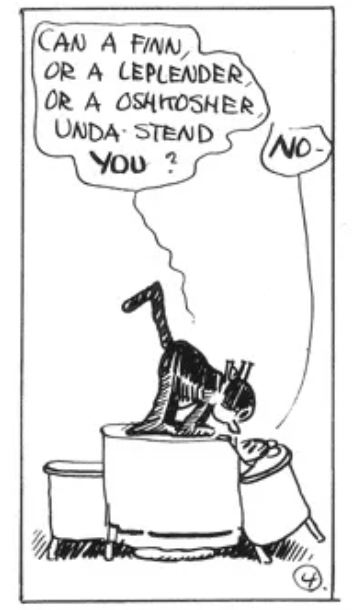
Why is lenguage/Language is (George Herriman)

“Art vs. Trade” — James Weldon Johnson

“Art vs. Trade”
by
James Weldon Johnson

Trade, Trade versus Art,
Brain, Brain versus Heart;
Oh, the earthiness of these hard-hearted times,
When clinking dollars, and jingling dimes,
Drown all the finer music of the soul.
Life as an Octopus with but this creed,
That all the world was made to serve his greed;
Trade has spread out his mighty myriad claw,
And drawn into his foul polluted maw,
The brightest and the best,
Well nigh,
Has he drained dry,
The sacred fount of Truth;
And if, forsooth,
He has left yet some struggling streams from it to go,
He has contaminated so their flow,
That Truth, scarce is it true.
Poor Art with struggling gasp,
Lies strangled, dying in his mighty grasp;
He locks his grimy fingers ’bout her snowy throat so tender.
Is there no power to rescue her, protect, defend her?
Shall Art be left to perish?
Shall all the images her shrines cherish
Be left to this iconoclast, to vulgar Trade?
Oh, that mankind had less of Brain and more of Heart,
Oh, that the world had less of Trade and more of Art;
Then would there be less grinding down the poor,
Then would men learn to love each other more;
For Trade stalks like a giant through the land,
Bearing aloft the rich in his high hand,
While down beneath his mighty ponderous tread,
He crushes those who cry for daily bread.