Trying to write about every film I watched what was exhausting and I’m not really sure what I got out of it, if anything. Here are the other films that I remember watching and not writing about:
All eight of the Star Wars films, again, sort of, with my kids.
Samsara (dir. Ron Fricke, 2011)—bought a new TV for the first time in eleven years and used this film to test the screen. Ended up watching it twice.
Thor: Ragnarok (dir. Taika Waititi, 2017)—another one I watched with the kids, although I’m not sure it was for them. It wasn’t for me. A lot of wasted potential in this one.
The Company of Wolves (dir. Neil Jordan, 1984)—I think this one holds up well. I remember renting it for 99 cents from the Hollywood Video next to my apartment in Gainesville, FL in 1997 and thinking it was a work of genius.
I also wrote about finishing Middlemarch, but edited out a few paragraphs about how much the last paragraphs of Eliot’s novel reminded me of the last lines of Walt Whitman’s Song of Myself.
In what is either strange felicity or my need to connect everything to Whitman, I did connect the end of Song to one of Denis Johnson’s posthumous stories, the title story in The Largesse of the Sea Maiden.
But postmodern perspectives have thoroughly soaked our culture (whether we recognize this our not), and good old-fashioned postmodernism-by-numbers isn’t going to work. “Little St. Don” reveals nothing new to its audience, it simply amplifies what they already know and believe, and does so in the very rhetoric that we need to overpower. Literary satire needs to do more than confirm our own morality while lambasting those who perpetrate evil—it needs to invent its own rhetoric, its own form, its own new language.
They will not do us any good—the good books—no—if by good we mean good looks, good times, good shoes; yet they still offer us salvation, for salvation does not wait for the next life, which is anyhow a vain and incautious delusion, but is to be had, if at all, only here—in this one. It is we who must do them honor by searching for our truth there, by taking their heart as our heart, by refusing to let our mind flag so that we close their covers forever, and spend our future forgetting them, denying the mind’s best moments. They extend the hand; we must grip it. Spinach never made Popeye strong sitting in the can. And the finest cookbook ever compiled put not one pot upon the stove or dish upon the table. Here, in the library that has rendered you suspect, you have made their acquaintance—some of the good books. So now that you’ve been nabbed for it, you must become their lover, their friend, their loyal ally. But that is what the rest of your life is for. Go now, break jail, and get about it.
From William H. Gass’s essay “To a Young Friend Charged with Possession of the Classics.” Collected in A Temple of Texts.
Faces at lunch, oh, yes, smirking, lordly, bored or weary—here and there a flash of passion, of dreams or loving seriousness; these signs I saw, notwithstanding the sweep of a fork like a Stuka dive-bomber, stabbing down into the cringing salads, carrying them up to the death of unseen teeth between dancing wrinkled cheeks; a breadstick rose in hand, approached the purple lips in a man’s dull gray face; an oval darkness opened and shut and the breadstick was half gone! A lady in a red blazer, her face alert, patient and professionally kind like a psychoanalyst’s, stuck her fork lovingly into a tomato, smiling across the table at another woman’s face; everything she did was gentle, and it was but habit for her to hurt the tomato as little as possible; nonetheless she did not see it. Nodding and shaking her head, she ate and ate, gazing sweetly into the other woman’s face. Finally I saw one woman in sunglasses who studied her arugula as she bit it…It disappeared by jagged inches, while across the table, in her husband’s lap, the baby watched in dark-eyed astonishment. Her husband crammed an immense collage of sandwich components into his hairy cheeks. He snatched up pommes-frites and they vanished in toto. When the dessert cart came, the starched white shoulders of businessmen continued to flex and shine; the faces gazed at one another over emptiness, maybe happier now that they had eaten, unthinking of what they had wrought.
Toward the end of the 130 page monologue that is Roberto Bolaño’s novella By Night in Chile, narrator Father Sebastián Urrutia Lacroix claims that “An individual is no match for history.” His statement neatly encapsulates (what might be) the dominant theme of By Night in Chile, namely an individual person’s capacity and ability to correctly–and sanely–somehow measure, attest to, confront, and witness the horror and brutality of history. In this case, Bolaño’s narrator, a Catholic priest–and conservative literary critic (and, of course, failed poet)–Father Urrutia, via a sweeping deathbed confession of sorts, recounts his life story, leading inexorably to Pinochet’s coup and its attendant subsequent draconian reforms and abuses. While it would be a mistake to reduce Bolaño’s rich novella to one conflict, I think the root of Urrutia’s struggle emanates from his inability to come to terms with his role as an intellectual (let alone an artist, critic, or priest) complicit somehow in Pinochet’s crimes. Throughout the book, from the very beginning, Urrutia blames his inner turmoil on a “wizened youth” (I don’t want to spoil this antagonist’s identity, but puzzling out that paradoxical appellation provides a major clue), a kind of idealist who stands apart from the dying priest, mocking and taunting him. After his claim that “An individual is no match for history,” Urrutia avers that “The wizened youth has always been alone, and I have always been on history’s side.” For Urrutia, this is of paramount importance, not just as a Catholic priest (which, it must be pointed out, is a role he doesn’t seem particularly suited for) but also as a literary critic and intellectual: Urrutia wants to systematize and critique history, to be “on the right side of history,” to quote Barack Obama. And yet his own attempt to narrativize his own life ironizes and critiques this very possibility at every turn–he is a sham, a charlatan, motivated and prompted by fear and even hate.
And on that attempt to narrativize a life: I would call By Night in Chile an anti-bildungsroman. Although Urrutia relates a life story, the free flow of psychic impressions that characterizes his telling slip and sail and rock and crash throughout years and over decades, often flowing backwards and forwards, sometimes spending pages on what could only be considered inconsequential minutiae, while at times glossing over the profoundest events with little more than a word or two. It is often what Urrutia does not remark upon that characterizes what is of the greatest importance in this work, and this is a testament to the power of Bolaño’s writing, to his command of voice. In one of the greatest performances of the novel, Urrutia describes the time right before, during, and after Pinochet’s coup. The passage is less than four pages, and for every contemporary action of immediate consequence, Urrutia seems to provide twice as many examples of his retreat into the past: ” . . . the first anti-Allende march was organized, with people banging pots and pans, and I read Aeschylus and Sophocles and Euripides, all the tragedies, and Alkaios of Mytilene and Aesop and Hesiod and Herodotus . . . .” Urrutia doesn’t bother to scrutinize or analyze the visceral reality of history in the making around him, regressing instead to the comfort of established philosophical tradition–the history of Herodotus in favor of the chaos, anarchy, and brutality happening around him. He’s really quite a terrible priest, and as an intellectual he refuses to be engaged. Confident that he will always be “on history’s side,” he refuses to actively even try come to terms with history until he’s dying. And thus we get the narrative of By Night in Chile.
This reckoning with the past takes the form of a long monologue but, as those familiar with Bolaño will attest, there are plenty of other voices here, stories nested within stories like Russian dolls. The force and vitality of Urrutia’s speech is astonishing; one envisions the monologue as a single immediate and discrete exhalation, a stream of memory, the living wail of a dying man. Bolaño’s rhetorical style here conveys this ironic energy. He employs long (very, very long) sentences, sometimes going on for several pages, and often uses little or no transitions between what should be major shifts of space and time. There are plenty of references to writers, of course, many obscure, and more motifs and leitmotifs than I can work out here (or elsewhere, to be honest). I’m going to go out on a limb and suggest that the book is probably even more intense in the original Spanish, although I think Chris Andrews has done a brilliant job translating here, just as he did in Last Evenings on Earth. And since I’ve brought up that book, I’m going to make another suggestion: if you’ve yet to read Bolaño, you should, and Last Evenings of Earth (or 2666 if nearly a thousand pages doesn’t seem too daunting)is probably the best place to start–which is kind of another way of saying that By Night in Chile is not the best entry point to Bolaño–at least not for anyone intimately familiar with Latin American history. It’s not that By Night is particularly challenging or hard to read. However, I think that this particular book will probably be better enjoyed with more context. As Rodrigo Fresán points out in his essay “The Savage Detective,” (published in the March 2007 issue of The Believer), By Night in Chile could be (should be?) read as part of one cohesive book along with Amulet and Distant Star. Indeed, as many critics have pointed out, Bolaño’s works seem to coalesce into one great work, a secret universe parallel to Tolkien’s Middle Earth or Faulkner’s Yoknapatawpha. Urrutia’s voice enriches this universe, but one must have something of a foothold on Bolaño’s themes in order to appreciate the complex ironies of By Night in Chile. Or maybe not. Maybe this is a great entry point to Bolaño. Either way, great book. Highly recommended.
Editorial note: Biblioklept ran the original version of this review in July of 2010. I saw the new cover for By Night in Chile today in a bookstore I was visiting in a town that I do not live in, and the new cover—the picture of which is the only new “content” for this review—is the occasion for republishing this Bolaño review.
Even though I haven’t gotten to Minor Angels yet, I went ahead and picked up Antoine Volodine’s Post-Exoticism in Ten Lessons, Lesson Eleven. Publisher Open Letter’s blurb:
Like with Antoine Volodine’s other works (Minor Angels, We Monks & Soldiers), Post-Exoticism in Ten Lessons, Lesson Eleven takes place in a corrupted future where a small group of radical writers—those who practice “post-exoticism”—have been jailed by those in power and are slowly dying off. But before Lutz Bassmann, the last post-exoticist writer, passes away, journalists will try and pry out all the secrets of this powerful literary movement.
With its explanations of several key “post-exoticist” terms that appear in Volodine’s other books, Lesson Eleven provides a crucial entryway into one of the most ambitious literary projects of recent times: a project exploring the revolutionary power of literature.
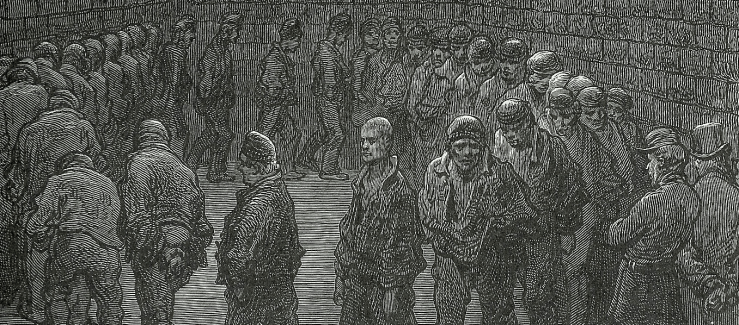
Detail from Newgate Exercise Yard by Gustave Dore, 1872
Denis Johnson’s story “Strangler Bob” is the third selection in The Largesse of the Sea Maiden. At about 20 pages, it’s also the shortest piece in the collection (the other four stories run between 40 and 50 pages). While still a bit longer than the stories in Johnson’s seminal collection Jesus’ Son, “Strangler Bob” nevertheless seems to pulse from that same vein, its narrator Dink another iteration of Jesus’ Son’s Fuckhead. Indeed, “Strangler Bob” feels a bit like an old sketch that’s been reworked by Johnson into something that fits thematically into Largesse.
Here’s the opening paragraph of “Strangler Bob” in full, which gives us the basic premise and setting (and you can’t beat those two opening sentences):
You hop into a car, race off in no particular direction, and blam, hit a power pole. Then it’s off to jail. I remember a monstrous tangle of arms and legs and fists, with me at the bottom gouging at eyes and doing my utmost to mangle throats, but I arrived at the facility without a scratch or a bruise. I must have been easy to subdue. The following Monday I pled guilty to disturbing the peace and malicious mischief, reduced from felony vehicular theft and resisting arrest because—well, because all this occurs on another planet, the planet of Thanksgiving, 1967. I was eighteen and hadn’t been in too much trouble. I was sentenced to forty-one days.
Those forty-one days take us from Thanksgiving to the New Year, with the story’s spiritual climax occurring on Christmas Eve.
Before we get to that climax Johnson builds an unexpectedly rich world in the county lockup, populating it with young toughs who can’t yet see how bad the paths they’ve chosen will be. The men of Johnson’s jail aren’t simply down on their luck or somehow morally misunderstood. They are jovial young fuck-ups who plan to continue fucking up their lives the minute they get out.
A lot of the stage-setting and background characterization in “Strangler Bob” reads like picaresque sketches that Johnson had lying about unused from decades ago. Much of the early part of the story is dedicated to “the blond sociopathic giant Jocko,” a sort of prince of the jail who saves a crazy kid from being murdered by the other inmates. Such scenes give the story a ballast of baroque energy and even an unexpectedly-comic realism, but they don’t fully fit into the main theme of the story, which is hunger.
On his first day in the jail the narrator Dink is warned not to oversleep or he will have his breakfast stolen. Hardheaded, he sleeps in anyway, but learns from his mistake:
After that I had no trouble rousing myself for the first meal, because other than the arrival of food we had nothing in our lives to look forward to, and the hunger we felt in that place was more ferocious than any infant’s. Corn flakes for breakfast. Lunch: baloney on white. For dinner, one of the canned creations of Chef Boyardee, or, on lucky days, Dinty Moore. The most wonderful meals I’ve ever tasted.
Hunger in “Strangler Bob” is an expression of the deep boredom the prisoners feel, and mealtimes become the only way these men measure the passing of time. The hunger in “Strangler Bob” is not just a desire for food, but rather something to fill up the void, the space, the empty feeling. In this world, romantic adventure is ironized into confined torpor:
Dundun, BD and I formed a congress and became the Three Musketeers—no hijinks or swashbuckling, just hour upon hour of pointless conversation, misshapen cigarettes, and lethargy.
Dundun and BD are perhaps unlikely friends for Dink—
Dundun was short and muscled, I was short and puny, and BD was the tallest man in the jail, with a thick body that tapered up toward freakishly narrow shoulders.
—but their fellowship holds together because they had “long hair and chased after any kind of intoxicating substance.” Thanks to BD they get their mitts on some LSD:
BD told us he had a little brother, still in high school, who sold psychedelic drugs to his classmates. This brother came to visit BD and left him a hotrod magazine, one page of which he’d soaked in what he told BD was psilocybin, but was likelier just, BD figured, LSD plus some sort of large-animal veterinary tranquilizer. In any case: BD was most generous. He tore the page from the magazine, divided it into thirds, and shared one third with me and one with Donald Dundun, offering us this shredded contraband as a surprise on Christmas Eve.
The ink from the newsprint turns their tongues black. Narrator Dink seems to think that the LSD was not evenly distributed on the page though—BD trips the hardest, seeing snow falling indoors, but Dink seems to think he’s mostly unaffected, while Dundun denies any effect at all. However, consider this exchange between Dink and Dundun, which suggests that they might be tripping harder than they think:
“I’m feeling all the way back to my roots. To the caves. To the apes.” He turned his head and looked at us. His face was dark, but his eyeballs gave out sparks. He seemed to be positioned at the portal, bathed in prehistoric memories. He was summoning the ancient trees—their foliage was growing out of the walls of our prison, writhing and shrugging, hemming us in.
A sloppy and unnecessary Freudian analysis of the three kids parcels them out easily as id (Dundun the apeman), super ego (BD the strange moralist), and ego, our narrator who rejects any kind of spirituality in a world where “Asian babies fried in napalm.”
Dink’s cellmate, the eponymous Strangler Bob, poses a challenge to the narrator’s easy nihilism though. Even though Dink believes that he’s not affected by the LSD, his encounter with Bob on Christmas Eve reads like a bad trip:
The only effect I felt seemed to coalesce around the presence of Strangler Bob, who laughed again—“Hah!”—and, when he had our attention, said, “It was nice, you know, it being just the two of us, me and the missus. We charcoaled a couple T-bone steaks and drank a bottle of imported Beaujolais red wine, and then I sort of killed her a little bit.”
To demonstrate, he wrapped his fingers around his own neck while we Musketeers studied him like something we’d come on in a magic forest.
Dundun then exclaims that Strangler Bob is “the man who ate his wife” — but Bob admonishes that his cannibalism was greatly exaggerated:
Strangler Bob said, “That was a false exaggeration. I did not eat my wife. What happened was, she kept a few chickens, and I ate one of those. I wrung my wife’s neck, then I wrung a chicken’s neck for my dinner, and then I boiled and ate the chicken.”
The hunger in Strangler Bob is perverse and abject; his crime is of a moral magnitude far more intense than the malicious hijinks the youthful Musketeers have perpetrated–it’s taboo, a challenge to all moral order. He’s also an oracle of strange dooms:
He said, “I have a message for you from God. Sooner or later, you’ll all three end up doing murder.” His finger materialized in front of him, pointing at each of us in turn—“Murderer. Murderer. Murderer”
We learn in the final melancholy paragraphs of the story that Bob’s prophecy comes true, more or less. In those paragraphs too there is a moment of grace, albeit a grace hard purchased. Of the latter part of his life, the Dink tells us:
I was constantly drunk, treated myself as a garbage can for pharmaceuticals, and within a few years lost everything and became a wino on the street, drifting from city to city, sleeping in missions, eating at giveaway programs.
It’s worth noting that if Dink were 18 in the fall of 1967, he would likely have been born in 1949, the year that Denis Johnson was born. The narrators of two other stories in Largesse are also born in or around 1949, and it’s my belief that all of the narrators are essentially the same age, and all are pseudoautofictional iterations of Johnson.
In “Strangler Bob,” Dink is an iteration that fails to thrive, that can’t survive addiction and recovery and enter into a new life. He does not heed Bob’s warning, and at the end of the story he laments that he is a poisoned person who has poisoned others:
When I die myself, B.D. and Dundun, the angels of the God I sneered at, will come to tally up my victims and tell me how many people I killed with my blood.
These final lines push the narrator into a place of bare remorse and regret, as he reflects back on his time in the jail, which he describes in retrospect as “some kind of intersection for souls.” Dink now sees that he’s failed to acknowledge the messengers that might have sent him on a better path. Angels come in strange forms.
Very early Christmas morning on the planet of 1967, after “the festival of horrors” that constituted the LSD trip, Strangler Bob gives one last message, a strange delivered in Dink’s grandmother’s voice:
I studied him surreptitiously over the edge of the bunk, and soon I could see alien features forming on the face below me, Martian mouth, Andromedan eyes, staring back at me with evil curiosity. It made me feel weightless and dizzy when the mouth spoke to me with the voice of my grandmother: “Right now,” Strangler Bob said, “you don’t get it. You’re too young.” My grandmother’s voice, the same aggrieved tone, the same sorrow and resignation.
“You’re too young” — wisdom is purchased through folly, pain, terrible mistakes, crimes and sins. The narrator’s grandmother ventriloquizes Strangler Bob, but she doesn’t have a moral message, just tired pain.
The voice here is Denis Johnson’s voice too, inhabiting a mad oracle, warning some version of himself that exists today.









 Biblioklept