The grist, grit, and horror of the big postwar world will cling to the present. Nobody’s stepping down from heaven, or Heaven, and there are no magic words—but there is a kind of love, a loving with your mouth shut, a kind of radical, earnest, transcendent love that Pynchon evokes, soils, and sanctifies here.
Last week, the wife and I drove five hours north to Atlanta, Georgia where we stayed five days in the Cabbagetown neighborhood. Our ostensible purpose was an anniversary trip focused around a Slowdive concert last Friday, but I think we really went to just hang out and eat and drink away from our kids for a few nights. It was famous times.
The Slowdive concert itself was excellent, despite the best efforts of the awful opening band, a dubious and I must assume ironic project called Drab Majesty, and the sound system at the The Eastern. The venue seemed ill-equipped to handle the tonality of either band. I don’t want to sound like a very old man but it was Too Fucking Loud. Opener Drab Majesty, whose sound came from a single guitar, a single synth, and, I’m guessing, a few loop pedals, seemed to have plugged directly into the PA system. It was the absolute worst sound I’ve ever heard. (Earlier that day, driving in awful Atlanta traffic, we listened to a seventeen-minute Merzbow song on the alternate band of Georgia Tech’s WREK radio station; although Merzbow is “noise” music, that song had more musicality, tonality, and depth of rhythm than Drab Majesty.)
Slowdive was excellent live–much more of a rock sound than I’d expected; I’ve really enjoyed their two newer records, particularly the self-titled one from a few years back, but the songs from Souvlaki sounded particularly fierce live. The setlist was great, and they closed with a cover of Syd Barrett’s “Golden Hair” that might have gone on for 10 or 12 minutes; it was hypnotic. Here is the single picture I took during the show:
But books—
Without children about and with my wife having to work half days from the rented garage apartment, I had enough time to indulge going to pretty much any bookstore I wanted to in Atlanta. I ended up sticking mostly to East Atlanta where we were staying though.
I had been to A Capella Books a few years ago and had somehow entirely missed their used book annex, which had some really great stuff in it, including a first edition of Blood Meridian and Joseph McElroy’s Women and Men. I ended up chatting with the owner Frank for a bit; a very nice guy, he showed me his personal collection of Vintage Contemporaries and we talked in general about our shared sickness of book collecting. I left with Mauro Javier Cárdenas’s new novel American Abductions and a first-edition hardback of McCarthy’s Cities of the Plain. This second purchase seems to have initiated the trip’s theme of buying editions of books I already own—but now I have all three Knopf editions of The Border Trilogy, so everyone can sleep easier.
I stopped by Criminal Records in Little Five Points and didn’t pick anything up, although I’m happy to see that CDs have made such a comeback. (I almost certainly would have bought the new Gastr del Sol box set if it was out yet.) I then made my way to Bibliotech Books in Candler Park. The proprietor assured me that he was in the process of reorganizing, but the store was frankly a mess. One bookcase was organized by the color of the book’s spines. The inventory seemed to be someone’s childhood and adolescent books.
I headed to Virginia Highland Books, a perfectly-respectable book shop in the perfectly-respectable Virginia Highland neighborhood. The perfectly-respectable inventory was not particularly interesting, although I imagine it perfectly suits the perfectly-respectable clientele. On the way to Virginia Highland Books, at a red light, I found myself stopped next to something called Videodrome, so of course I pulled in. I got dizzy in Videodrome a DVD-rental shop stuffed with thousands and thousands of cult films, non-English language films, art films, concert films…amazing stuff. The only thing I could compare it to were some of the rental shops I’d gone to decades ago when I lived in Tokyo. I mean, this place had the Cannibal Ferox soundtrack on vinyl. I spoke to the proprietor for a while. He gave me a sticker. I saw him at the Slowdive show the next night but left him alone.
My last bookshop visit that day was to Bookish, a small indie spot specializing in books by women. I liked the store but was honestly too tired to look around much after two tallboys at a PBR-themed bar in Virginia Highland.
Over the next few days, I visited three more bookshops, all more or less by chance. We went to Decatur, simply to check it out, and parked in Decatur Square right in front of Little Shop of Stories. Framed original artwork by visiting authors adorns the walls of this children’s bookshop, and there’s a life-sized reproduction of the room from Margaret Wise Brown’s classic Good Night Moon that one can hang out in. I felt a little melancholy that our children have outgrown children’s books.
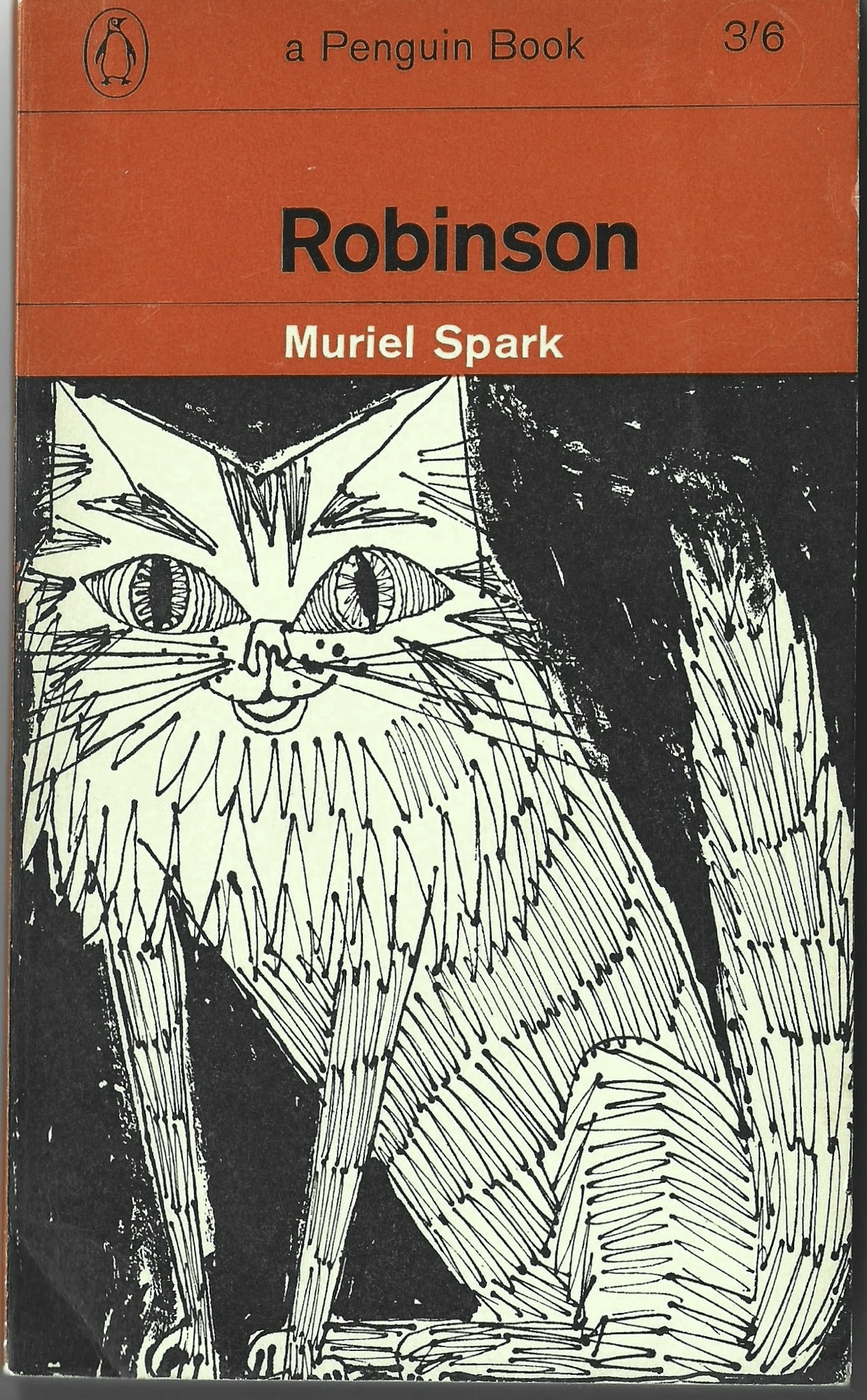
On the way back to Atlanta, we swung by Eagle Eye Books, a Decatur spot specializing in used books (with a large collection of vintage sci-fi hardbacks in a back room). They have several carts of dollar books that are supposedly accessible 24/7—there are lock boxes to slide your dollars into. I ended up picking up different editions of two books I already own: Wells Tower’s Everything Ravaged, Everything Burnedin hardback and the 1985 Elisabeth Sifton Books/Penguin Books printing of William Gaddis’s J R. The J R is basically falling apart and is crammed with annotations; I love it. I gave three crumpled dollars over for these two books and then drove back to our garage apartment so we could walk to tacos and then the concert.
The mid-morning after the Slowdive concert we hung out for a while at the Virginia Highland Porchfest. We parked at the Ponce City Market to walk to Porchfest and on the way back stopped at Posman Books. I’d been there before, and while it’s basically a gift shop, its literature section is surprisingly robust, and it even offers a decent number of Spanish-language novels. The vibe at Porchfest was more frat-boys-drinking-sixers and sunburned golf dads than it was hippies and freaks. The neighborhood is Nice, with plenty of In This House signs declaring Attested Beliefs. We felt more at home in Cabbagetown, with its murals and ambivalence, even if our own presence as fucking tourists made us balk at times. But in a plant shop in Virginia Highland, we did meet an interesting clerk who let me take a photograph of their Pynchon tattoo. So that was pretty cool.
I couldn’t make it through Delany’s cult favorite Dhalgren a few years back, but Nova was easier sledding. The book is a riff on Moby-Dick, tarot, monoculture, and the grail quest. It’s jammed with ideas and characters, and if it never quite coheres into something transcendent, it’s a fun quick read (even if the ending, right from the postmodern metatextual playbook is too clever by half).
A new translation of Oğuz Atay’s story collection Waiting for the Fear by Ralph Hubbell is forthcoming later this year from NYRB. Their blurb:
Adored in Turkey for his post-modern fiction and regarded internationally as one of Turkey’s greatest writers, Oğuz Atay remains largely untranslated into English. First published in 1975, Waiting for the Fear is Atay’s only collection of short stories, a book that is routinely praised in Turkey, by, among others, the Nobel Prize winner Orhan Pamuk, for having transformed the art of short fiction.
The eight stories that the book contains, all of them focused on characters living on the margins of society, are dramatic and even tragic, while also being shot through with irony and a humor. In the title story, a nameless young man, of a thoughtful and misanthropic turn of mind, returns to his home on the outskirts of an enormous nameless city to find waiting for him a letter in a foreign language of which he has no knowledge at all, and from this anomalous, if seemingly trivial, turn of events, one thing after another unfolds with stark inevitablity. Another story nods to Gogol’s “The Overcoat”: its hero is a speechless beggar wandering around the back streets of Istanbul dressed in a woman’s fur coat who will end up stuck in a shop window like a manikin. Elsewhere, a professional story peddler lives in a hut beside a train station in a country that is at war—unless it isn’t. He can’t remember. What do such life and death realities matter, however, so long as there are stories to tell? Atay’s stories are full of a vivid sense of life’s absurdities while also being psychologically true to life; his characters, oddballs and losers all, are also utterly individual with distinctive voices of their own, now plainspoken, wistful, womanly, now sophisticated and acerbic, with a dangerous swagger. And if Atay is a brilliant examiner of the inner life, he is no less aware of the flawed social world in which his people struggle to make their way.
Waiting for the Fear is a book that, page by beguiling page, holds the reader’s attention from beginning to end, the rare collection of short stories that not only reflects a unique authorial vision but reads like a page-turner. Ralph Hubbell’s new translation will introduce readers of English to a still insufficiently known giant of modern Turkish and world literature.
Margaret told me via email that On Homo rodans and Other Writings “includes a few new stories and other interesting things that [she] found in the archive in Mexico City in 2022, and also has a rearranged presentation of everything (as requested by the estate).” I hope to have a second interview with Margaret on this new collection soon; in the meantime, check out our conversation from 2019.
The following discussion of Vladimir Sorokin’s novel Blue Lard (in translation by Max Lawton) is intended for those who have read or are reading the book. It contains significant spoilers; to be very clear, I strongly recommend entering Blue Lard cold.
When I started this series of posts, I was rereading the print edition of Blue Lard after having read Max’s manuscript translation a few years ago. I have gotten so behind in this post series that I am now re-rereading. After having read the book essentially three times now, I find that it is far more precise and controlled than my initial impression–which I guess makes sense. Blue Lard is hypersurreal, shocking, deviant. But it’s also more balanced and nuanced than a first go-through might suggest, not just absurdist shit-throwing and jabberwocky, but an accomplished analysis of the emerging post-Soviet era.
We left off our Blue Lard riffs with the pop art glamour and swagger of the Stalin family, drawn in bold but neat caricature. Stalin departs the dramatic inner circle/family circle on his way first to lieutenant Beria’s and then to his part-time lover Khrushchev’s, but as he’s on his way, “a fat woman dressed in rags hurl[s] herself toward the motorcade with a mad cry.” Stalin’s guards draw their weapons, but Our Boy is quicker: “‘Don’t shoot!’ Stalin ordered. ‘It’s Triple-A! Stop!'”
Triple-A is the poet Anna Akhmatova (who we first met via reincarnation as the kindaclone Akhmatova-2 back in the future). She’s fat gross and happy, pregnant with an aesthetic revelation of abjection:
Her wide, round face with its broken nose was flat and her small eyes shone with madness; tiny rotten teeth stuck out from beneath her formless wet lips; her unbelievably tattered rags adorned a squat body that widened freakishly as it went down; her dirty gray hair stuck out from beneath a ragged woolen kerchief; her bare feet were black with filth.
AAA is one of Sorokin’s fouler concoctions, proclaiming proclamations like
“Did you know that Kharms feeds canaries with his worms?” Stalin asks AAA. (The absurdist poet and children’s author Daniil Kharms died in a Soviet prison in his mid-thirties. “Send him to the deepest north!” Sorokin’s Akhmatova advises Sorokin’s Stalin.) The conversation over Soviet writing continues: “‘I have an active dislike for Fadeyev’s Young Guard,'” declares Stalin.” A paragraph or two later, AAA licks the soles of his boots. I don’t know nearly enough about Soviet and Russian literature to figure out what or if Sorokin is satirizing here, but I think I know enough about the relationship of aesthetics and power to take a big hint.
Stalin’s motorcade drove up to Arkhangelskoye. Here, in a magnificent palace built during the reign of Catherine II, lived the count and previous member of the Politburo and of the Central Committee of the CPSU Nikita Aristarkhovich Khrushchev, who had been removed from his state duties by the October Plenum of the Central Committee.
There is a famous infamous horny sensual sex scene between Stalin and Khrushchev coming up, one that has made Blue Lard famously infamous—but let’s set that aside for now. Sorokin’s Khrushchev’s patronymic Aristarkhovich doesn’t gel with our historical Khrushchev’s patronymic Sergeyevich. Is the “new” patronymic “Aristarkhovich” an allusion to the avant-garde painter Aristarkh Lentulov?
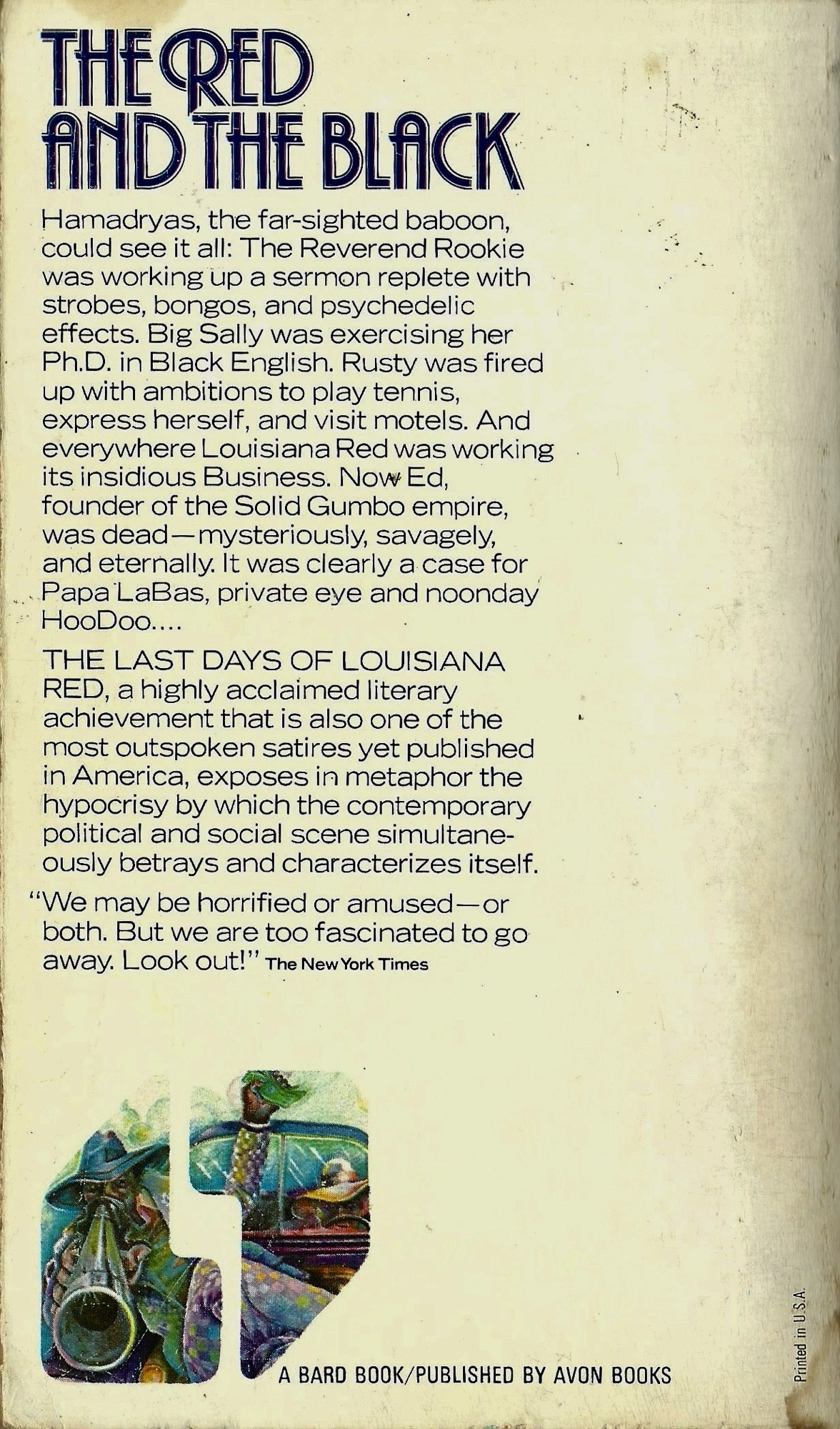
Ishmael Reed’s 1974 novel The Last Days of Louisiana Red is a sharp, zany satire of US culture at the end of the twentieth century. The novel, Reed’s fourth, is a sequel of sorts to Mumbo Jumbo (1972), and features that earlier novel’s protagonist, the Neo-HooDoo ghost detective Papa LaBas.
In Mumbo Jumbo, Reed gave us the story of an uptight secret society, the Wallflower Order, and their attempt to root out and eradicate “Jes’ Grew,” a psychic virus that spreads freedom and takes its form in arts like jazz and the jitterbug. The Last Days of Louisiana Red also employs a psychic virus to drive its plot, although this transmission is far deadlier. “Louisiana Red” is a poisonous mental disease that afflicts black people in the Americas, causing them to fall into a neo-slave mentality in which they act like “Crabs in the Barrel…Each crab trying to keep the other from reaching the top.”
Page 628 from Zak Smith’s Pictures Showing What Happens on Each Page of Thomas Pynchon’s Novel Gravity’s Rainbow (2006)
A week before she1 left, she came out to “The White Visitation”2 for the last time. Except for the negligible rump of PISCES, the place was a loony bin again. The barrage-balloon cables3 lay rusting across the sodden meadows, going to flakes, to ions and earth4—tendons that sang in the violent nights, among the sirens wailing in thirds smooth as distant wind, among the drumbeats of bombs, now lying slack, old, in hard twists of metal ash. Forget-me-nots boil everywhere underfoot, and ants crowd, bustling with a sense of kingdom. Commas, brimstones, painted ladies coast on the thermoclines along the cliffs.5 Jessica has cut fringes since Roger saw her last, and is going through the usual anxiety—“It looks utterly horrible, you don’t have to say it. . . .”
“It’s utterly swoony,” sez Roger, “I love it.”
“You’re making fun.”
“Jess, why are we talking about haircuts for God’s sake?”6
While somewhere, out beyond the Channel, a barrier difficult as the wall of Death7 to a novice medium, Leftenant Slothrop, corrupted, given up on, creeps over the face of the Zone. Roger doesn’t want to give him up: Roger wants to do what’s right. “I just can’t leave the poor twit out there, can I? They’re trying to destroy him—”8
But, “Roger,” she’d smile, “it’s spring. We’re at peace.”9
No, we’re not. It’s another bit of propaganda. Something the P.W.E. planted10. Now gentlemen as you’ve seen from the studies our optimum time is 8 May11, just before the traditional Whitsun exodus, schools letting out, weather projections for an excellent growing season, coal requirements beginning their seasonal decline, giving us a few months’ grace to get our Ruhr interests back on their feet—no, he sees only the same flows of power, the same impoverishments he’s been thrashing around in since ’3912. His girl is about to be taken away to Germany, when she ought to be demobbed like everyone else. No channel upward that will show either of them any hope of escape13. There’s something still on, don’t call it a “war” if it makes you nervous, maybe the death rate’s gone down a point or two, beer in cans is back at last and there were a lot of people in Trafalgar Square one night not so long ago . . . but Their enterprise goes on.
The sad fact, lacerating his heart, laying open his emptiness, is that Jessica believes Them14. “The War” was the condition she needed for being with Roger. “Peace” allows her to leave him. His resources, next to Theirs, are too meager.
1 The she here, for those wishing to tune in, is Jessica Swanlake, who has decided post-War to return to her normie roots: she will choose a petite bourgeoisie life with Beaver/Jeremy, and reject Roger Mexico (and, implicitly, refuse the Counterforce and the mission to save Tyrone Slothrop).
2 Normally wouldn’t give a gloss for this, as its so late in the novel, but it’s been like eight years since I’ve done one of these, so: Pynchon Wiki gives the following description for the White Visitation:
former mental hospital located in the fictional town of Ick Regis on the coast of southern England; now part of SOE [Special Operations Executive; aka the “Firm”]; location of PISCES; D-Wing still has “loonies”; “devoted to psychological warfare”
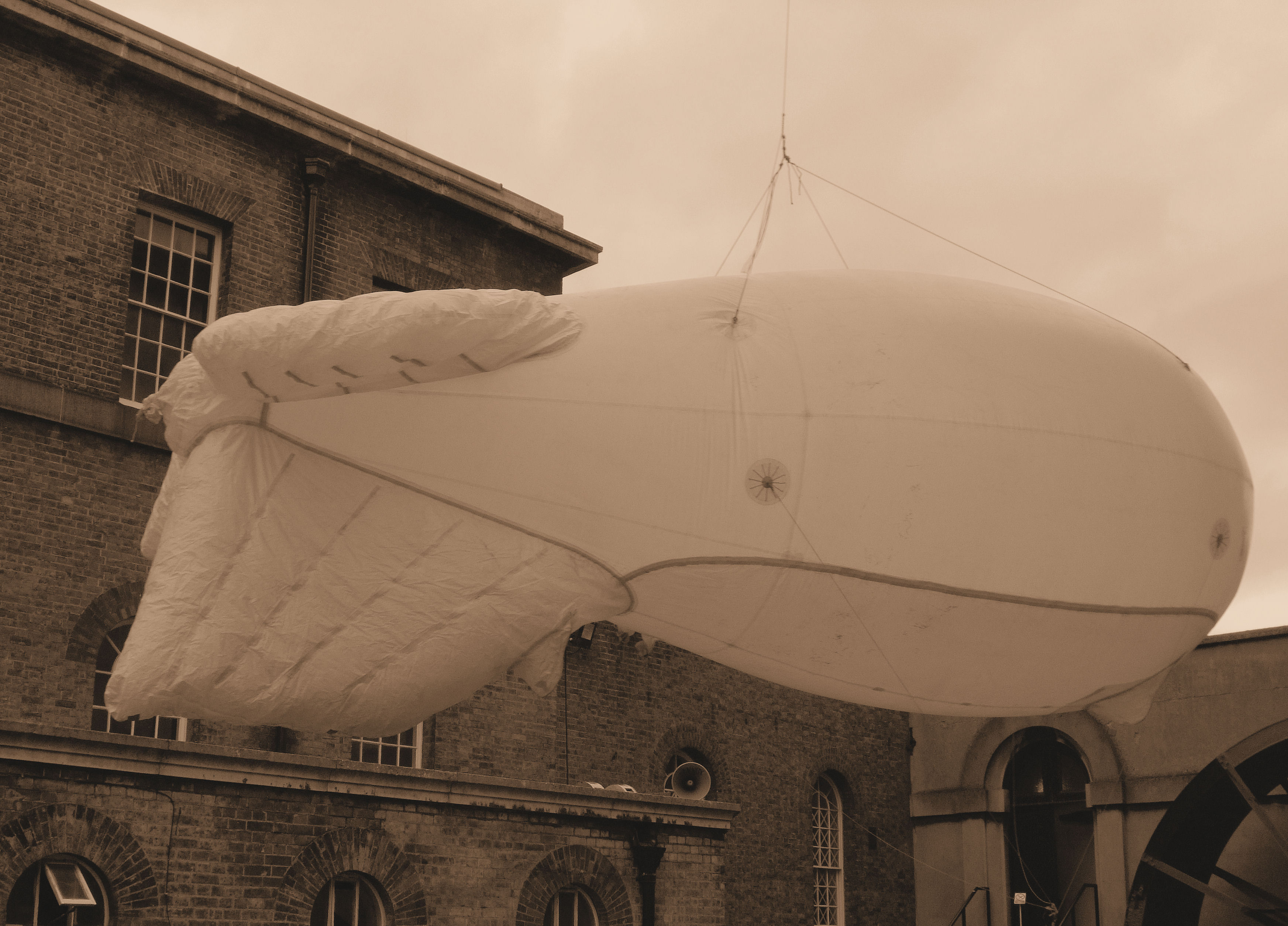
3 I’ve read Gravity’s Rainbow like half a dozen times and rusting barrage-balloon cables is the kind of image I just keep going past, just kinda sorta like, letting my imagination fill in the details. But doing these posts makes me stop and look around a bit. A description from Keith Thomson’s website:
Barrage balloons are large balloons tethered to the ground or the deck of a ship with metal cables. They are deployed as a defense against low-level air attack, damaging aircraft on collision with the cables or, at the least, making flying in the vicinity treacherous.
1940s Barrage Balloon At The Kew Bridge Steam Museum, London. Jim Linwood.
4 Everything in the Zone is disintegrating–including Our Hero Tyrone Slothrop.
5 “Commas, brimstones, painted ladies coast on the thermoclines along the cliffs” — an absolutely gorgeous sentence, and also one we might pass over at this fragmented, surreal section of the novel as a bit of surrealist poetry.
But it’s not—these are butterflies. From Pynchon Wiki:
627.28-29 Commas, brimstones, painted ladies
Three taxa of butterflies. The Comma (Polygonia c-album) is one of the anglewings; sulfur-yellow brimstones are in the genus Gonepteryx in the family Pieridae; painted ladies are in the genus Vanessa. The Comma is named for a so-shaped white mark on the underside of its hindwing; a similarly-marked North American congener is called the Question Mark (P. interrogationis).
Cigarette card depicting a fanciful “brimstone butterfly”
6 “Can’t say it often enough–change your hair, change your life,” Inherent Vice.
7 “Wall of Death,” Richard and Linda Thompson, 1982:
Let me ride on the Wall of Death one more time / You can waste your time on the other rides / This is the nearest to being alive / Oh let me take my chances on the Wall of Death / You can go with the crazy people in the Crooked House / You can fly away on the Rocket or spin in the Mouse / The Tunnel of Love might amuse you / Noah’s Ark might confuse you / But let me take my chances on the Wall of Death
8 Every time I go through Gravity’s Rainbow, I find Slothrop’s fate more distressing and dispiriting—but also more inspiring. I think what’s important to remember here is that Roger Mexico is a numbers guy, a statistics guy—in 2024 terms, he might be a spreadsheet guy, a potential money guy. But he finds himself dedicated to Something Bigger Even If It Destroys Him, which means dedicating hope to the ever-fragmenting figure of Tyrone Slothrop, who, through his dispersal, might sow new seeds.
9 A devastating reversal of “They are in love. Fuck the war,” the lines we get from our first meeting of the failed lovers.
10 Political Warfare Executive (an iteration of Them). From Pynchon Wiki:
In 1940, MIR and Section D were combined with the War Office to form the Special Operations Executive (SOE). A “black” (sub rosa) propaganda section of SOE, created by the Foreign Office and named “Electra House,” was attached to the SOE in 1940 to become the Political Warfare Executive (PWE), charged with political and psychological warfare.
11 Thomas Ruggles Pynchon was born on 8 May 1937. Today is his 87th birthday.
If you’re the kinda weirdo who likes to celebrate Pynchon’s work and legacy, indulge in Pynchon in Public Day.
Steven Weisenburger’s 2nd’ edition of the Companion gives the following gloss on the date:
8 May, just before the traditional Whitsun exodus. Recall that part 2 ends with Pointsman and crew spending “Whitsun by the sea” (V269.26n). This traditional British holiday weekend fell on May 20 in 1945.
12 Roger Mexico “sees only the same flows of power, the same impoverishments” that he’s seen throughout the war. Unlike Jessica, he’s hep now to the knowledge that “the real business of the War is buying and selling.”
13 Pynchon here reiterates one of GR’s central themes, of the preterite vs the elect, of a “channel upward” or crashing down. The theme permeates the book, right from its opening lines. Consider the novel’s fourth sentence “The Evacuation still proceeds, but it’s all theatre.” The opening “evacuation” scene is surreal and apocalyptic, with each potential evacuee hearing an inner voice that cruelly coos, “You didn’t really believe you’d be saved. Come, we all know who we are by now. No one was ever going to take the trouble to save you, old fellow. . . .” The narrator’s very early note that “it’s all theatre” is one of Pynchon’s central diagnoses of power in GR, and one that not every character comes to fully understand. As if to underline that it’s all kayfabe, Pynchon ends GR by introducing a new character, Richard M. Zhlubb, a parody of Nixon. Zhlubb is the night manager of the Orpheus Theatre.
14 I think what finally most breaks Roger’s heart isn’t the loss of Jessica, but that “Jessica believes Them.” She’s subscribed to the theater of “war” and “peace,” an illusion that can no longer comfort Roger.
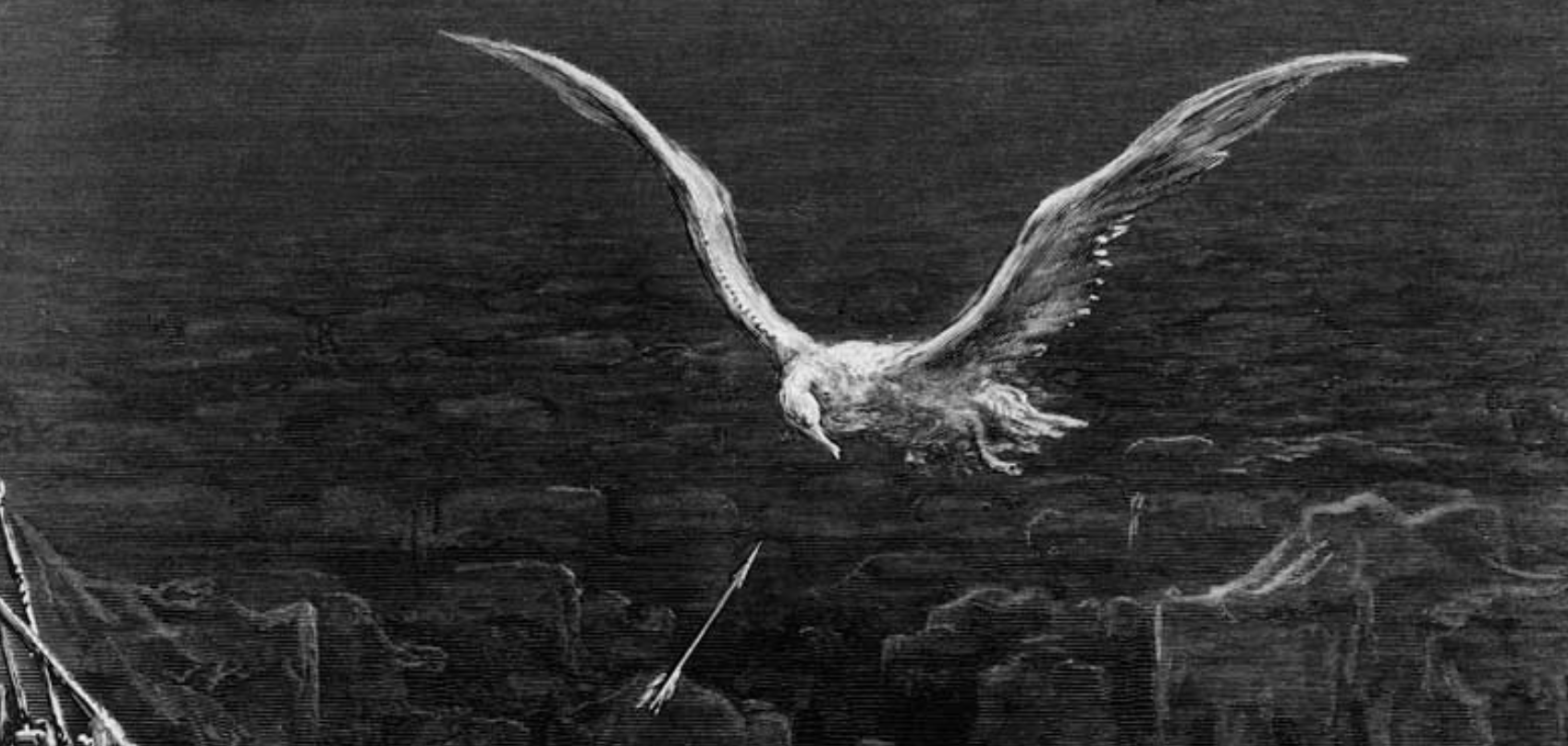
Illustration for Coleridge’s The Rime of the Ancient Mariner, Gustave Doré, 1876
Well1, if the Counterforce2 knew better what those categories3 concealed, they might be in a better position to disarm, de-penis and dismantle the Man4. But they don’t. Actually they do, but they don’t admit it. Sad but true. They are as schizoid, as double-minded in the massive presence of money, as any of the rest of us, and that’s the hard fact5. The Man has a branch office in each of our brains, his corporate emblem is a white albatross, each local rep has a cover known as the Ego, and their mission in this world is Bad Shit6. We do know what’s going on, and we let it go on7. As long as we can see them, stare at them, those massively moneyed, once in a while. As long as they allow us a glimpse, however rarely. We need that. And how they know it–how often, under what conditions. . . .8 We ought to be seeing much popular-magazine coverage on the order of The Night Rog and Beaver Fought Over Jessica While She Cried in Krupp’s Arms, and drool over every blurry photo–9
Roger must have been dreaming10 for a minute here of the sweaty evenings of Thermidor11: the failed Counterforce, the glamorous ex-rebels, half-suspected but still enjoying official immunity and sly love, camera-worthy wherever they carry on . . . doomed pet freaks.
They will use us. We will help legitimize Them12, though They don’t need it really, it’s another dividend for Them, nice but not critical. . . .
Oh yes, isn’t that exactly what They’ll do.
1 Well, hell, the last time I composed one of these silly annotations posts was way back in the unfortunate Fall of 2016, when I lost my goddamn mind for a while. I never made any notes on the novel’s final quadrant, “The Counterforce,” and never mustered any more notes when I reread GR in 2020. Over the past two weeks, I listened to George Guidall’s excellent narration in a long, long audiobook that kept me good company through some serious Spring cleaning projects. As has been the case in each of my treks through GR, I found it intensely prescient, a wonderful, terrifying diagnosis of the grand ugly 20th c. that we will never recover from.
2 I’ve read Gravity’s Rainbow all the way through six or seven times now, and each time I always find myself buoyed by the Counterforce—Pynchon’s heroic band of preterite rebels who resist the forces of Control. And every time I reread it I seem to forget that the Counterforce fails—the Counterforce (I dare not use the appropriate pronoun they, for They is the enemy of the Counterforce’s We) simply can’t stop the coming new world order of the military-industrial-entertainment complex. The short passage I’ve selected here, with Counterforce hero and one-time lover Roger Mexico as its medium, showcases one of the many reasons the Counterforce will fail.
3 Those categories refers to Pynchon’s previous paragraph, an academic spoof highlighting various “albatross nosologies”; nosology refers to the classification of diseases; the albatross is a metaphorical curse, of course.
Illustration for Coleridge’s The Rime of the Ancient Mariner, Gustave Doré, 1876
4 The Man: authority, control, They, the force, the fuzz, the cops, the heat, the money guys, the enemies of art, love, and the human soul…
5 A depressing notion, of course, and one Pynchon would return to in his 1990 follow-up to GR, Vineland, a novel that parodied the so-called counterculture of the 1960’s massive ideological failure, to, like, follow through with any true revolutionary project.
6 The economic metaphors here are appropriate. Again, fuck the money guys whose mission in this world is Bad Shit.
7 An even more depressing notion—that the double-mindedness of Counterforce consciousness includes knowing that we let the Bad Shit go on; maybe our resistant spirit curdles into a brittle apathy; maybe we overindulge in mindless pleasures; maybe we explode.
An early trial cover for GR, featuring one of its working titles, Mindless Pleasures
8 The date of publication for this post coincides with the May 6, 2024 annual Met Gala, a capitalist spectacle of wealth and fame costumed in the trappings of art. This year’s ticket is $75,000, more than the average U.S. salary. And yet it might be fair to consider that those “massively moneyed” costumed revelers at the Met Gala aren’t even really the true massively moneyed, but rather their avatars, projected on innumerable screens, avatars of mindless pleasures to distract us from all the Bad Shit the massively moneyed are up to.
9 Pynchon here plays on lurid tabloid headlines that aren’t too different from the ones we see today, reconfiguring the one-time lovers Jessica and Roger as the elect, figures of celebration. It’s all fantasy though—literally; as the next lines seem to suggest, we’ve been in Roger’s addled mind. Pynchon’s headline reminds me of Donald Barthelme’s 1964 short story “Me and Miss Mandible,” which includes a list of trashy titles about Elizabeth Taylor, Debbie Reynolds, and Eddie Fisher like “The Private Life of Eddie and Liz,” “Debbie Gets Her Man Back?” and “Eddie’s Taylor-Made Love Nest.”
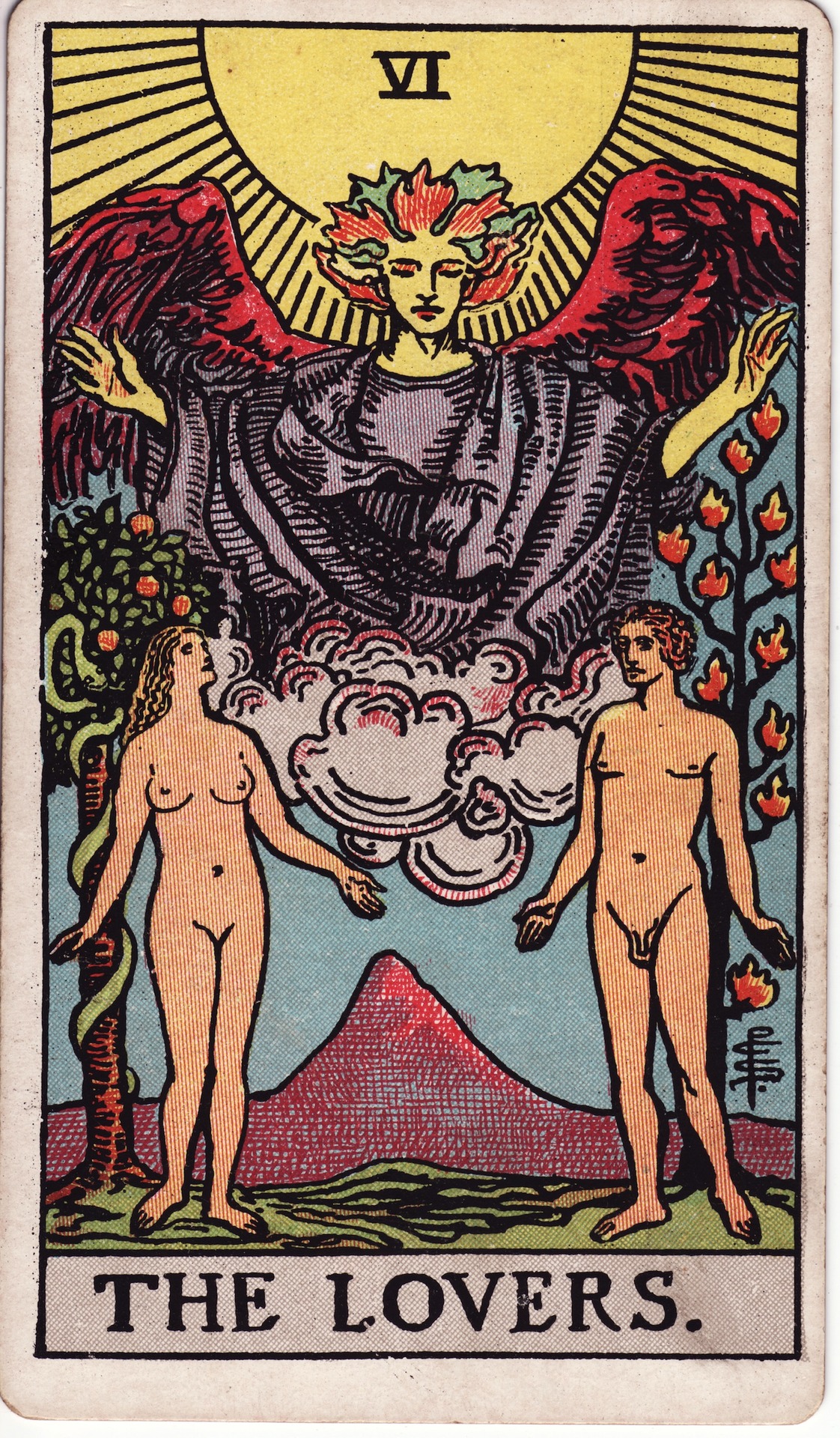
I found the wartime love affair between Jessica and Roger more depressing this time than in previous reads of Gravity’s Rainbow. When we first meet them, we get one of the best lines in the novel: “They are in love. Fuck the war.” But it is the war that licenses their love; in its absence (or, really dormancy), a bureaucratizing control subsumes their ardor. They fail.
The Lovers card from the Rider–Waite tarot deck
10 The gerund dreaming here helps to foreground Roger’s current tabloid-headline-revenge-against-the-powers-that-be-fantasy as fantasy while also analeptically connecting the post-WW2 Counterforce’s nebulous mission to the fallout of the French Revolution. Dreaming also suggests that Roger is the “narrator” of this section; it also reminds me of Roger’s mentor Pirate Prentice, whose dream (of failed escape, “all theater”) initiates Gravity’s Rainbow. Pirate’s psychic power is to inhabit the fantasies of others; this is also Thomas Pynchon’s power.
11 In the second edition of his A Companion to Gravity’s Rainbow, Steven Weisenburger gives the following gloss:
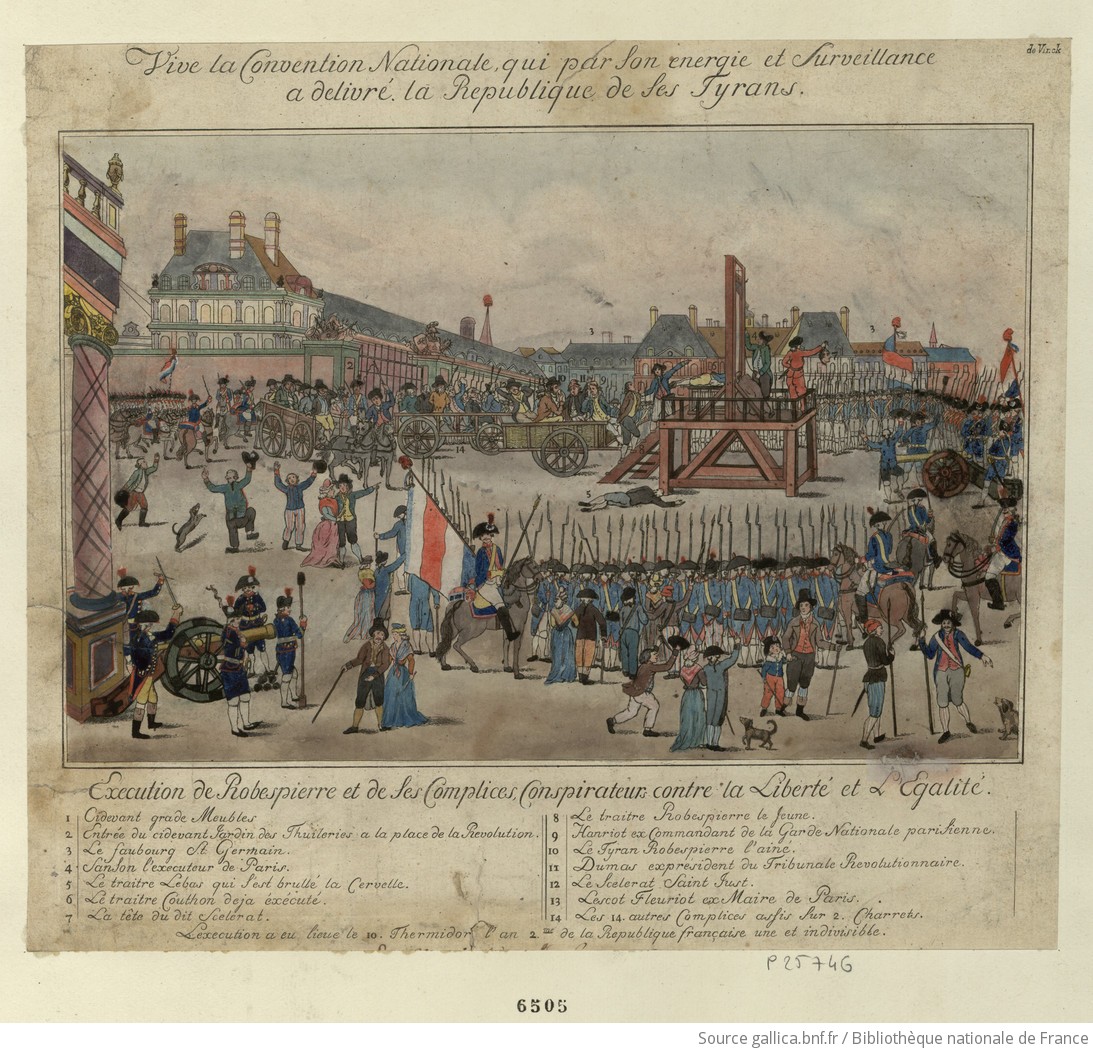
If Roger Mexico is dreaming of these evenings, then his dreams contain a warning. Thermidor was the eleventh month of the French revolutionary calendar, corresponding to the period from July 19 to August 17. Moreover, it was on the eighth of Thermidor, in the French Revolution’s second year (in other words, July 27, 1794), that Robespierre, Saint-Just, and other leaders of massive redistribution of wealth and upheaval of the aristocratic order, known as the Reign of Terror, were arrested and, the next day, executed.
Weisenburger’s annotation here is a significant update from the Companion’s first edition, which essentially gives a brief definition of what Thermidor was without any greater political or historical context.
I have no idea what “one of his newspaper articles” is being referenced here. What immediately came to mind was likely “Is It Okay to Be a Luddite?” or “Nearer, My Couch, to Thee,” both of which appeared in The New York Times, and neither of which, as far as I can tell, use the phrase “Thermidorian reaction” or “Nixon.” (In “Luddite,” Pynchon does refer to the French Revolution—and also gives us a nice little summary of Roger’s complaint against Power in our little passage here: “there is now a permanent power establishment of admirals, generals and corporate CEO’s, up against whom us average poor bastards are completely outclassed”). The closest phrasing I can find to the Pynchon Wiki’s framing comes from a 2016 essay by James Liner that primarily deals with Inherent Vice. Liner writes: “Even in the Thermidor of Nixon’s 1970s, on the eve of the Reagan/Thatcher ’80s, Doc holds fast to utopian hope and the possibility of antisystemic praxis.”
Execution de Robespierre et de ses complices conspirateurs contre la liberté et l’egalité : vive la Convention nationale qui par son energie et Surveillance a delivré la Republique de ses Tyrans
12 Doomed pet freaks. The money guys will put the counterculture on the market as a Fuck You to freaks and rubes alike, icing on their cake.
Don’t legitimize their grasping at capital as culture.
We might be freaks, but We are not doomed and We are not Their pets.






 Previously on Blue Lard…






 Biblioklept