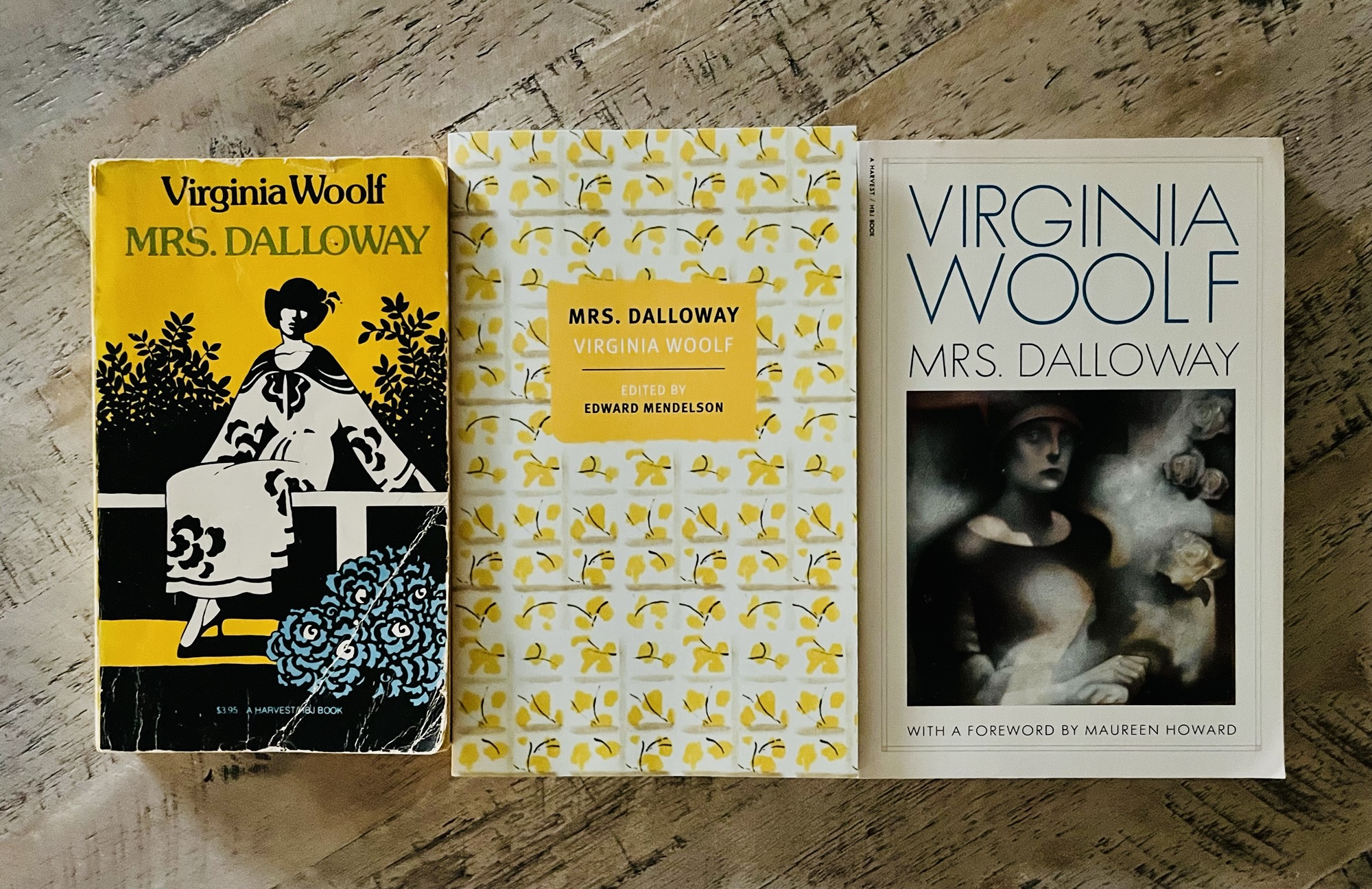
Virginia Woolf’s modernist classic Mrs Dalloway is getting a centennial update from publisher NYRB. The new edition is edited by literary critic Edward Mendelson, who makes a persuasive case for his version of the text in the book’s afterword, an essay with the appropriately flat title “The Text of This Edition.” “This edition is an attempt to provide the least bad, perhaps, among many possible editions,” Mendelson writes, before appending after a semicolon: “other editors will rank it more harshly.” I imagine it’s hard work to tidy a giant.
As a point of comparison, I pulled out the HBJ mass-market paperback of Mrs Dalloway that I read at least three times years and years ago; there’s no front or back matter, no intro or afterword, not even a credit for the lovely art. I (a version of myself) had scribbled “symbol is not universal” in the narrow margin of page 41; underlined “narrower and narrower” on page 45; boxed a paragraph catching salmon freely on page 152. Two photographs fell from the book — a picture of my wife and my infant daughter, c. 2008; the other, a picture of my wife and her eighteen-years-younger brother, also an infant in the picture, also held by wife, c. 1998. Those are probably the years I read the book. The older person made more scribbles, I think. What I most remember of the novel Mrs Dalloway is the WWI veteran, Septimus; I recall his anguish as a throbbing (organizing) pulse in the novel’s so-called stream-of-consciousness style. I remember generally enjoying the novel, but preferring Woolf’s Orlando; I remember a sort of sneer on the face of a fellow grad student after this declaration. Orlando is a more fun book, a picaresque sci-fi gender jaunt. I suppose Dalloway is more, like, important.
As another point of comparison, I pulled out the 1990 HBJ trade paperback of Mrs Dalloway that I picked up at the beginning of the summer at a Friends of the Library sale. I wrote in a post about those acquisitions that, “…I’ll be happy to trade out the cheap mass markets of Mrs. Dalloway and To the Lighthouse I’ve had forever in favor of these HBJ Woolfs (Wolves?)” — but that’s not true. I’ve decided I love the cheap mass market Dalloway. (A sixteen-year-old picture of my wife and daughter falling out of it didn’t hurt.) This 1990 edition features a 1981 introduction by novelist Maureen Howard. She voices her intro in the first-person plural, an unfortunate choice that we employed on this blog in our earlier years, insecure as we were. The occasion of Ms Howard’s introduction is, I think–we think, we mean–the fiftieth anniversary of the novel’s publication, although that math doesn’t add up. I dig Susan Gallagher’s cover art.
The cover for the new NYRB edition features a “specially commissioned” cover that pays “tribute to the original designs by Hogarth Press.” The publisher notes that forthcoming “new editions of To the Lighthouse and The Waves [reprinted] in celebration of their respective centenaries” will also get the cover updates. These editions are also Mendelson edits.
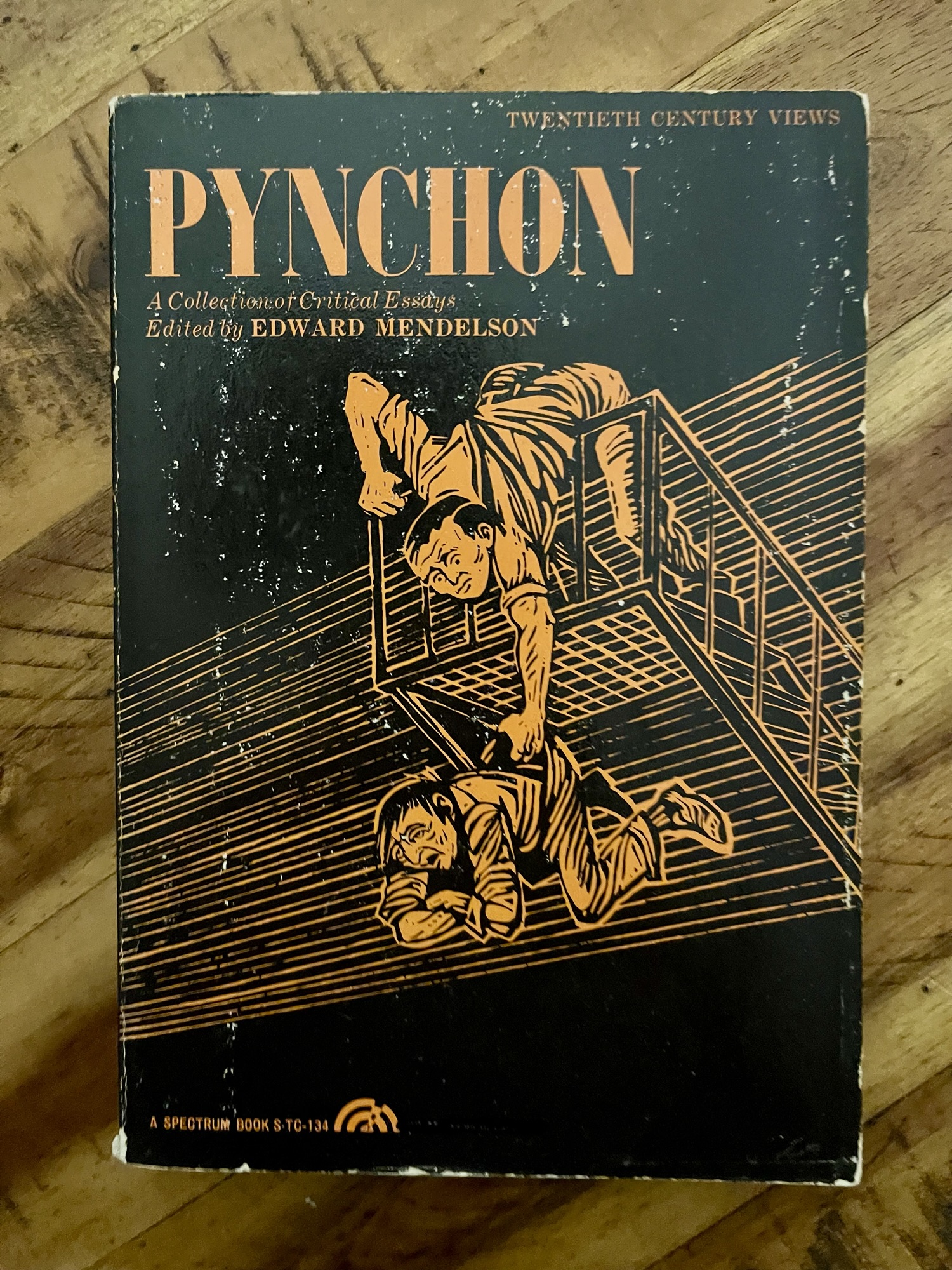
I mostly know Mendelson as the editor of Pynchon: A Collection of Critical Essays, and as the author of “The Sacred, the Profane, and The Crying of Lot 49.”
NYRB’s edition of Mrs Dalloway publishes next month.
 Biblioklept