
America’s Most Commodified: Ernest Hemingway

A few posts back, this blog turned some attention to what happens when writers become commodities sold by persona. Commodification results in a kind of lazy cultural shorthand that pre-empts the need to actually read the author and discuss their works: the author instead becomes a signifier of an abstracted ideal, a rubric of adjectives that the consumer can use to “identify” with their own life. It seems to me that no author has been more commodified than Ernest Hemingway. For example, check out The Ernest Hemingway Collection for a selection of clothes, home furnishings, and other chintzy crap. From their website:

“You can now share in his spirit as an adventurer, author and romantic. His legend can be brought to your home through this entire Ernest Hemingway Collection. Every item has been hand selected and approved to ensure authenticity. Enjoy this celebration of the man and the memory.”

Yes! You too can buy a certain kind of authenticity! But do throw pillows and bed spreads really convey a balance of macho resolve and artistic sensitivity just because a corporartion sticks Hemingway’s name on them? Who buys this stuff anyway? According to this article, it’s the “new male shoppers” that are interested in this kind of decor–and what do the “new male shoppers” read? They don’t have to read Hemingway, because distinguished literary journals such as Maxim and Men’s Vogue have already digested and sanctified it for them: Hemingway gets the stamp of approval–he was macho, a hunter and a drinker and a fighter–just one of the frat boys.

Years ago, at a party in Gainesville, I remember a guy bringing up Hemingway. I was on the outs with Hemingway at this point, so I prodded the guywhy did he like Hemingway? What about the work was so meaningful to him? More prompting yielded what I should have guessed: the guy drunkenly, laughingly admitted that he hadn’t read anything by Hemingway, it was just a stock answer that he gave to the question: “Who’s your favorite writer?”
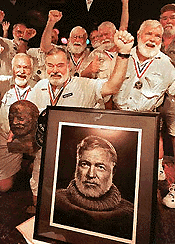
ernest.gif

Who are the future stock answers? It seems like the hard-drinking ex-pat writers of the 30’s and 40’s had the right balance of persona and mystique to create their own mythos–but what about today’s greats? How will the future sell them?
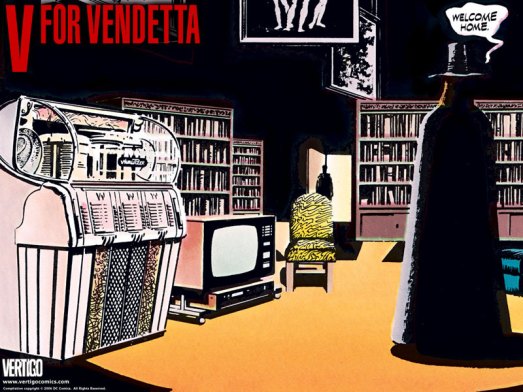
Guy Fawkes Day and V for Vendetta

“Remember, remember the 5th of November…”

I was lucky enough to live in New Zealand for a few years as a kid, so I got to experience Guy Fawkes Day. We made effigies of Guy, and then we burned them on a bonfire. There was a barbecue, and fireworks. To me it seemed a strange mixture of the Fourth of July and Halloween.

It was a few years after my last Guy Fawkes experience that I read Alan Moore’s V for Vendetta. V, an anarchist who wears a stylized Guy Fawkes mask, wages a vigilante war on a harsh authoritarian government. Along with Frank Miller’s The Dark Knight Returns, V was a first for me, something different than the stuff I was reading at the time, stuff like The Uncanny X-Men and the ill-fated Valiant Comics imprint (I actually made a small fortune selling early Valiant issues I owned).  

A film version of V for Vendetta was released in 2006; Alan Moore famously had his name removed from it. I enjoyed the film, although it certainly wasn’t as good or thought-provoking as Moore’s original story; and even though the film looked good, the passive experience of watching an action movie can’t measure up to David Lloyd’s original art work and that wonderful space between the panels of comics that engages the reader’s imagination.

v_for_vendetta_5_800×600.jpg

This afternoon I finished the first graphic novel of Alan Moore’s  run writing Swamp Thing, and I can’t wait until my library hold on the second graphic novel comes in. I had no idea Saga of the Swamp Thing would be as good as it was, nor as beautifully illustrated; it’s actually much better than V for Vendetta or Moore’s other famed work, Watchmen (and none of these titles are even in the same league as Moore’s masterpiece, From Hell). Alan Moore and Steve Bissette’s run on the DC Comics series essentially led to DC’s creation of the edgier Vertigo imprint for their more “mature” titles, such as The Sandman. These titles helped to change the audiences of “comic books” and helped to make the graphic novel a new standard in the medium (no mean feat, considering the fanboyish culture of comic nerds, a culture that prizes rarity of print run over quality of storytelling).

V for Vendetta illustrates what happens when we don’t allow for dissent, what happens when ideas are both prescribed and proscribed, and all dialogue is muted. Authoritarian governments consolidate their power from the silencing of ideas. A healthy society requires all sorts of opinions, even ones we don’t like. The smiling Americans in this photo aren’t burning effigies of would-be revolutionaries, they are burning something much more dangerous–books.

book-burning.jpg