
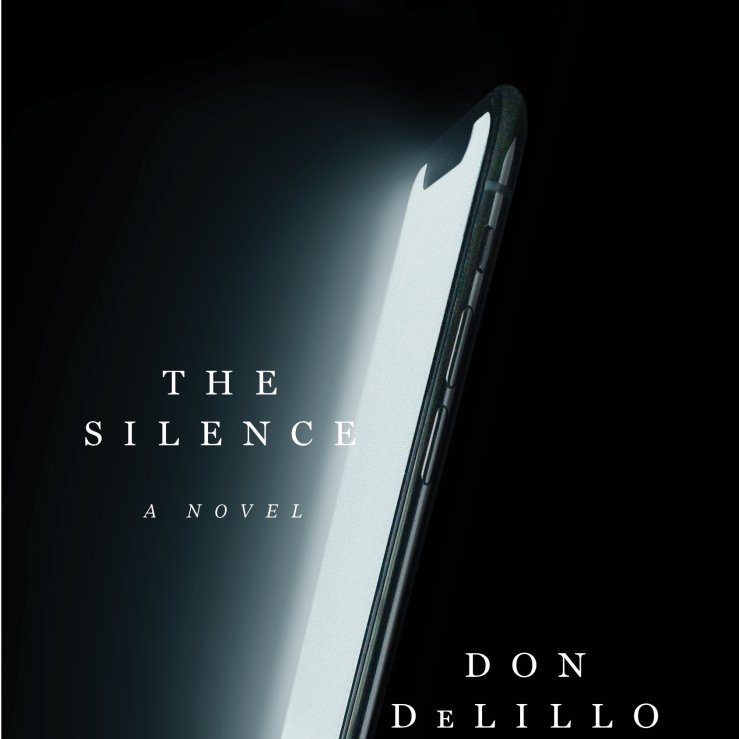
Don DeLillo’s latest fiction The Silence is set on Super Bowl Sunday in the year 2022. The story, such as it is, takes place over the course of a few hours, focusing primarily on five characters who gather in a New York apartment to watch the big game. The quintet is unable to see the game though because, for reasons unknown and never really explored, contemporary communication systems and technologies fail worldwide. No email, no internet, no teevee.
“Seemingly all screens have emptied out, everywhere. What remains for us to see, hear, feel?” the narrator—or maybe one of the characters—wonders. Other characters insist that what’s happening is the beginning of World War III (The Silence opens with Einstein’s famous quote about World War IV being fought with sticks and stones). “The drone wars,” another quips blankly, worrying—is he worrying?—that the “drones have become autonomous.”
We’re told of chaos, panic, and “small riots” in response to this unexplained failure of technology, but DeLillo doesn’t show us any of the pandemonium, let alone evoke much of a sense of anxiety about the titular silence. Instead, the book plods along a course of droll ennui and flat utterances that I suppose are meant to sound profound. “What if we are not what we think we are?” asks a character, and if DeLillo is pulling our leg with such banal dialogue, there’s little in The Silence to signal that the book is open to an ironic reading.
Instead we get blank references to Einstein, deep time, mass surveillance, and Jesus of Nazareth, as if these would-be motifs can signal meaning (or, like, lack of meaning, man!?) on their own. Characters repeat buzzwords; a dude riffs on microplastics; another treats his auditor to a pre-coital definition of capitalism. “The woman realizes she is still in the thrall of cryptocurrencies” is a real sentence in this book.
The rhetorical moves here have long been staples of DeLillo’s toolkit, but the verbal obliquity of The Silence feels anemic. The sentences are thin, the book is thin. The ideas don’t stick. Or rather, the insights that DeLillo offers here seem, well, obvious.
I used the verb plods a few paragraphs above, which doesn’t seem like the obvious choice for such a skinny book. I checked out an ebook of The Silence from my library and read it in about 75 minutes. (I am not a fast reader.) DeLillo’s publisher Scribner lists the hardback at 128 pages. I imagine the font must be huge and the margins pretty wide. What I read could’ve fit neatly into 40 or 50 pages of a mass-market paperback. (The hardback retails for twenty US dollars.) The American cover insists that The Silence is a novel, but it sure doesn’t read like one.
Despite its brevity, The Silence plods. For a book with a plane crash, a football game, casual sex, planet-wide panic, and the maybe-advent of WW III, The Silence is notably listless. Perhaps that’s by design, but if so it’s a design I didn’t care for.
Reviews and descriptions of DeLillo’s last novel Zero K (2016) deterred me from reading it, even though I liked its predecessor Point Omega (2010) more than many reviewers. I was intrigued by The Silence’s brevity, hopeful that DeLillo might pack the narrative with rich sentences and deep thoughts. I was hoping that he might bring some of the magic that we got in Pafko at the Wall (1992), a wonderful novella that DeLillo repurposed as the prologue for Underworld (1997).
But no. The Silence is a slim disappointment, a scant morality play whose thinly-sketched characters speak at (and not to) each other liked stoned undergrads. At least it’s short.
 Biblioklept