Previously,
23 . “A Few Moments of Sleeping and Waking” (Unspeakable Practices, Unnatural Acts, 1968)
I’ve been reading the stories in Forty Stories as kinda-sorta palate cleansers, usually ingesting one or two between novels; my method is to take a few initial notes to come back to, cross-reference against Tracy Daugherty’s Barthelme biography Hiding Man, and then riff on my general impression. Sometimes a few weeks go by from the time I’ve read or reread one of these stories and the time I actually get around to writing about them. Until now, the title alone has activated some memory or aesthetic impression about the story, but “A Few Moments of Sleeping and Waking” was a total blank for me. I suppose in my memory it simply segued out of the story that preceded it in Barthelme’s excellent 1968 sophomore collection, Unspeakable Practices, Unnatural Acts. That story was “Edward and Pia,” metapseudoautobiographical stand-ins for Barthelme and his third wife Birgit. “A Few Moments” is more droll low-stakes tension between the pair; there’s a little here on films and dreams and their interpretations. The best bit of the story is a moment on cabbage:
Pia was chopping up an enormous cabbage, a cabbage big as a basketball. The cabbage was of an extraordinary size. It was a big cabbage.
“That’s a big cabbage,” Edward said.
“Big,” Pia said.
They regarded the enormous cabbage God had placed in the world for supper.
22 . “The Flight of Pigeons from the Palace” (Sadness, 1972)
A lovely little story, so short and sweet it really can’t be summarized! But I’ll give it a shot: “The Flight” is a comic riff on the audience’s addiction to novelty and sensation. The third-person “we” who narrates “Flight” is a kind of postmodern carnival barker, barking new wonders into existence:
The lineup for opening night included:
A startlingly handsome man
A Grand Cham
A tulip craze
The Prime Rate
Edgar Allan Poe
A colored light
We asked ourselves: How can we improve the show?
We auditioned an explosion.
Barthelme’s not really a moralist, hardly a Hawthorne, but I think he does offer oblique lessons, or warnings really, to his reader. “Flight” culminates thus:
The supply of strange ideas is not endless.
The development of new wonders is not like the production of canned goods. Some things appear to be wonders in the beginning, but when you become familiar with them, are not wonderful at all.
The story concludes in the threatening specter of newly-contracted volcano.
21 . “At the Tolstoy Museum” (City Life, 1970)
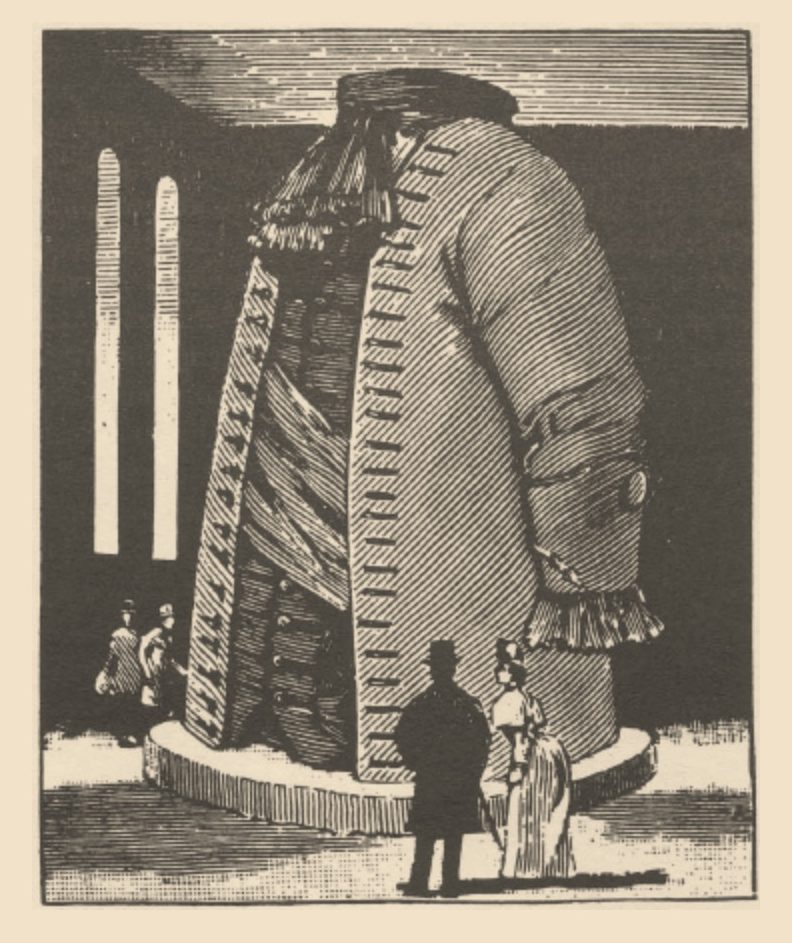
Like “Flight,” “At the Tolstoy Museum” is one of Barthelme’s literal cut-and-paste collage stories — that is, a story to include the author’s own visual collages, juxtaposed against his verbal collages. In “Flight,” the collages seem incidental. They aren’t exactly affectations, and they don’t add anything to the story–but they don’t detract either. The visual collages in “At the Tolstoy Museum” are deployed more judiciously, serving as punchlines that resound off of the narrator’s flat, affectless pose:
I was eating a sandwich at the Tolstoy Museum. The Tolstoy Museum is made of stone—many stones, cunningly wrought Viewed from the street, it has the aspect of three stacked boxes: the first, second, and third levels. These are of increasing size. The first level is, say, the size of a shoebox, the second level the size of a case of whiskey, and the third level the size of a box that contained a new overcoat. The amazing cantilever of the third level has been much talked about. The glass floor there allows one to look straight down and provides a “floating” feeling. The entire building, viewed from the street, suggests that it is about to fall on you. This the architects relate to Tolstoy’s moral authority.
In Hiding Man, Daugherty relates that after “At the Tolstoy Museum” was published in The New Yorker (24 May 1969) “a family from Holly Hill, Florida [wrote to the magazine to learn the location of the Tolstoy Museum.” About two weeks later, Tolstoy’s daughter, the Countess Alexandra L. Tolstoy sent a more indignant letter to the magazine, referring to the story as “Donald Barthelme’s absurd article…What is the aim of such an article? To make people laugh? … How funny! Ha, ha, ha.” Great stuff all around.
20 . “The Wound” (Amateurs, 1976)
A surreal sketch featuring a bullfighter, his mother, his mistress, a bishop, and a famous aficionado (of, implicitly, bullfighting, and, explicitly, breasts), as well as a cast of grumbling minions and peons. Barthelme’s stories are often collage-like, anti-real, hyper-real, or outright absurd, but they are, at least in my estimation, rarely dreamlike. But “The Wound” moves like a dream — a brief, stifled dream, one that reveals something about himself to the dreamer, who later might lament, But I already knew that, like the Bishop who laments his therapy:
The Bishop begins to talk about his psychoanalysis: “I am a different man now,” the Bishop says. “Gloomier, duller, more fearful. In the name of the Holy Ghost, you would not believe what I see under the bed, in the middle of the night.” The Bishop laughs heartily. The torero joins him. The torero’s mistress is filming the Bishop. “I was happier with my whiskey,” the Bishop says, laughing even harder.
The Queen of Gypsies arrives, claiming wounds. There’s “An ecstasy of shrinking” and the final vision of “an immense black bull” blocking the door way. It “begins to ring, like a telephone.”
“The Wound” is a short example that might be handed off to any young person clamoring for meaning or theme or symbolism from every text they read. Sometimes it’s just a dream, a goof, an aesthetic gesture. Sometimes there’s just a surreal punchline that needs to erupt, like a giant black bull ringing like a telephone, blocking the only exit in sight.

 Biblioklept