

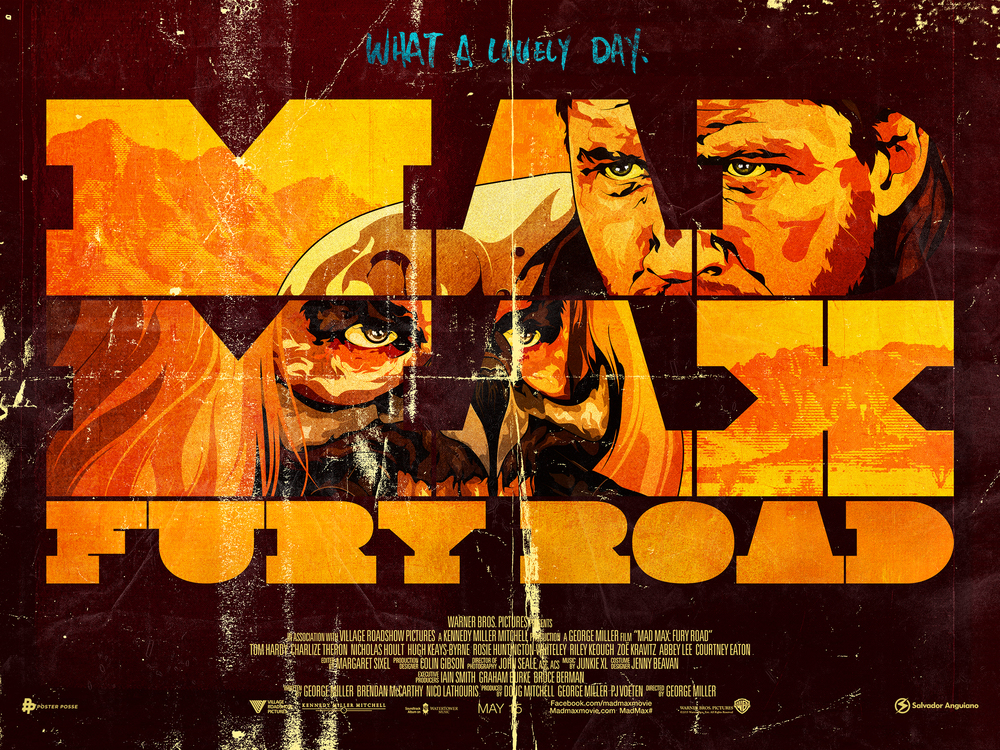
Those who would contend there’s more to Fury Road, that would protest I’m missing some depth here, might refer me to the film’s feminist motifs. Yes, this is a film that critiques and rebels against patriarchal authority (going so far as to spell out its message in big block letters even). Maybe there’s a Freudian or Lacanian analysis in there too: Charlize Theron’s Imperator Furiosa (she’s the real star of the film—Tom Hardy’s Max is a bland substitute for old crazy eyes Mel), shorn of both hair and an arm (castration symbols, no?) driving an enormous phallus (one dangling a big testicle full of fuel, power, no less) across the desert wastes, plunging it violently ahead to save some concubines (their eminence derives from their non-mutant genes and marvelous cheekbones—like Zack Snyder’s 300, Fury Road always privileges ideal body types over aberrations).
Where was I? It doesn’t really matter.
Ah, yes: I claimed that the movie obviates criticism.
Fury Road is a product, a commodity that successfully camouflages its very commodification. It’s fan service for our post global id.
The film has been nearly universally praised, as a quick tour through the aggregator site Rotten Tomatoes shows. I’ll lazily pull from RT’s pull quotes lazily: “This movie will melt your face off,” promises Christy Lemire. (Uh, okay). For David Edelstein, seeing the film a second time “became about digging the spectacle – not to mention the hilarious sexual politics.” (Were they really “hilarious”?) “An A-plus B-movie that at times feels almost like a tone poem to early-’80s excess,” writes Christopher Orr, who may or may not know what a tone poem is. Mark Kermode, a crank whom I generally admire, calls it “an orgy of loud and louder, leaving us alternately exhilarated, exasperated and exhausted.”
I stuff these quips in here to show how Fury Road precludes any real criticism. Like I said up front, it does what it intends to do, and what it intends to do is show us something wholly familiar in a way that makes us think that we are not seeing something wholly familiar. But for me, anyway, Fury Road does feel familiar, like any number of movies I’ve already seen. Maybe blame it on Miller’s earlier Mad Max films. Maybe they colonized our cultural imagination so much that any strangeness in Fury Road is difficult to glean, hence the filmmaker’s central trick: Speed the damn thing up. Less character development, less bothersome talking.
I cherry-tomato-picked the Kermode quote above, but his full review is more measured and insightful than that quote alone suggests. He ends with a warning: “…at two hours it’s more of a slog, battle-fatigue teetering on the edge of burn-out and even boredom.” Reader, I’ll admit to that boredom.
The first edges of that boredom actually creep in early, when we see how little is actually at stake in the film. Miller’s gambit is to keep Max constrained for the first quarter of the film—bound, chained, even muzzled. Tied to the prow of a rumbling car like some mythic figure, Max is relentlessly imperiled by spears and bullets and an apocalyptic sandstorm. But like some mythic figure, we know he’ll never die. Like the Roadrunner cartoons it so closely resembles, Fury Road imagines a slapstick world of zany cause-and-effect non-logic, producing kinetic anxieties in its audience that are ultimately relieved (over and over again) with a belief so strong that it cannot be suspended: Max will not die. Max can never die. There must be a sequel.
That promise of a sequel finds its affirmation in the film’s most clichéd final moments. (I’m going to discuss the end of the film now. Spoilers coming up—fair warning, eh?)
 Biblioklept