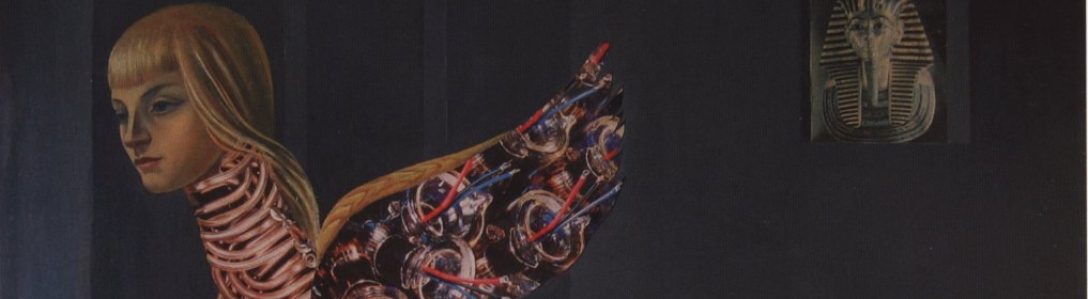

I was quite excited earlier this week to get a pair of books in new English translations from the Czech publisher Twisted Spoon Press.
I started in on Gerhard Rühm’s Cake & Prostheses (translated from the German by Alexander Booth) late last night and kept reading and reading, greedily consuming the surreal, poetic “mini dramas” as thought experiments played out in my head. Here’s an early example of one:
practiced biblical saying
catechist : love thy neighbor as thyself.
exegete: i hate myself! (gives the former a hard hook to the chin tho crumples him to the floor).
I’ll admit I didn’t know of Gerhard Rühm, but I’m enjoying Cake & Prostheses and hope to muster a review in the next week or so. Here’s Twisted Spoon’s blurb:
An inveterate experimenter with image and text and music, Gerhard Rühm is truly one of the major figures of the postwar European avant-garde. Yet reprehensibly little of his work has appeared in English. This edition brings together a selection of his work spanning the past seven decades, displaying a wide thematic range (as he has remarked, “there is nothing that cannot become part of one’s poetic universe”) and ingenious combinations of music, pornography, banality, humor, and mythology. The first section comprises “mini dramas,” the text often combined with images and musical notation to create sensorial episodes, the expression of a singular aesthetic perception. The second section is a wry deconstruction of Grillparzer’s play Hero and Leander that juxtaposes original passages with images from a swimming manual and with a more contemporary erotic retelling of the mythological tale. The final section presents 24 short prose pieces: 12 from the early 1950s and 12 from the past few years.
I had heard of the surrealist Romanian poet Max Blecher, but am still largely unfamiliar with his work. Twisted Spoon is publishing his 1934 collection Transparent Body along with some, uh, other texts, in a translation by Gabi Reigh. Blurb:
Blecher’s very first book, the poetry collection Transparent Body, appeared in 1934, in a limited edition for bibliophiles. Yet general recognition as one of the most inventive European writers of his day came only with the publication of two of his three “novels” a few years later. And then he died, at the age of twenty-eight. But since 1930 Blecher had been publishing his poetry, short prose, essays, critiques, and other texts in the leading Romanian periodicals, some even appearing in important French publications, such as Le Surréalisme au service de la révolution. In addition, the past half century has seen the posthumous first publication of many texts in a variety of Romanian editions.
Transparent Body & Other Texts brings together Blecher’s entire output of poetry and short prose, from the earliest texts published during his lifetime to those appearing for the first time only recently. They range from stories in the vein of his fantastical, hallucinatory longer work to aphorisms, reportage, and notebook fragments. The volume also includes a selection of his correspondence with such major figures of Romanian interwar modernism as Geo Bogza, Ilarie Voronca, and Saşa Pană to give a fuller picture of Blecher’s engagement with the avant-garde and literary life even as his health was progressively deteriorating over the course of the 1930s.
 Biblioklept