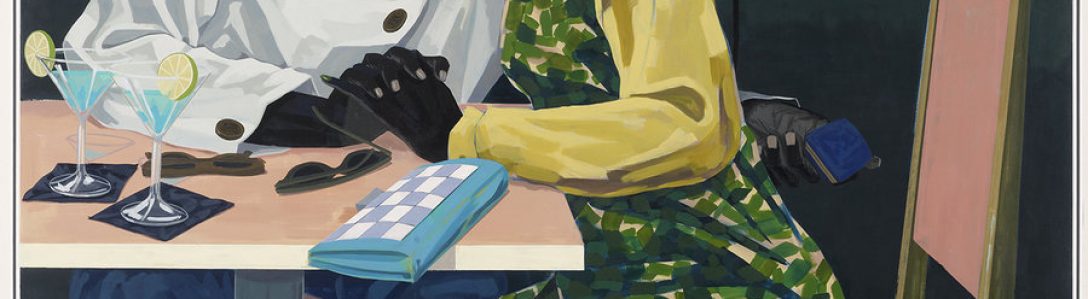
There are few who do not know that Lilith was Adam’s first wife | From Olga Tokarczuk’s novel The Books of Jacob

  There are few who do not know that Lilith was Adam’s first wife, but that since she didn’t want to be obedient to Adam, or to lie beneath him as God decreed, she fled to the Red Sea. There she turned red as though flayed. God sent three fearsome angels after her, Senoy, Sansenoy, and Semangelof, to drag her back by force. They accosted her in her hiding place, tormented her, and threatened to drown her. But she didn’t want to go back. Even if she had wanted to, she would no longer have been able; Adam would have been forbidden to accept her, for according to the Torah, a woman who has lain with another must not resume relations with her husband. And who was Lilith’s lover? Samael himself.

So God had to create a second, more obedient woman for Adam. This one was gentle, if rather stupid. The unfortunate creature ate the forbidden fruit, resulting in the Fall. That was how the rule of law came to be, as a punishment.

But Lilith and all beings similar to Lilith belong to a world from before the Fall, which means that human laws do not apply to them, that they’re not bound by human rules or human regulations, and that they don’t have human consciences or human hearts, and never shed human tears. For Lilith, there’s no such thing as sin. Their world is different. To human eyes, it might seem strange, as if drawn in a very fine line, since everything it contains is more luminous and lightweight, and beings belonging to that world may pass through walls and objects, and each other, back and forth—between them, there are no differences as there are between people, who are closed in on themselves as though in tin cans. Things are different there. And between man and animal there isn’t such a great gap, either—maybe only on the outside, for in their world you can converse soundlessly with animals, and they will understand you, and you them. It’s the same with angels—here they’re visible. They fly around the sky like birds, sometimes huddling on the roofs of houses where their own houses are, like storks.

From Olga Tokarczuk’s novel The Books of Jacob. Translation by Jennifer Croft.
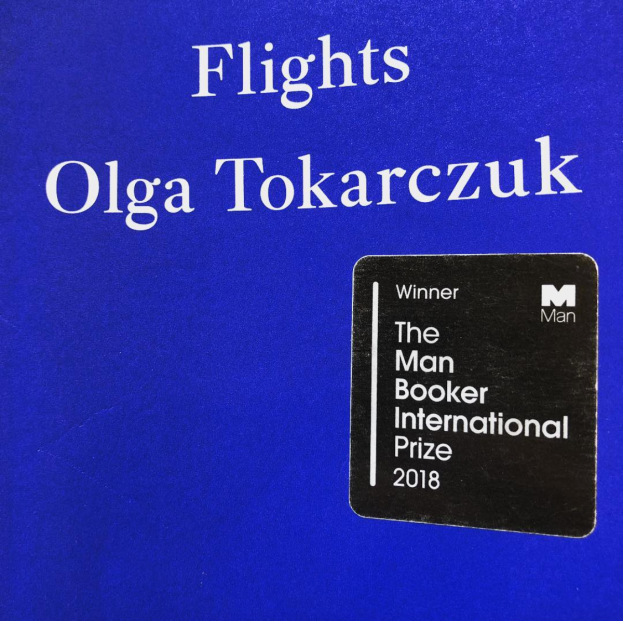
A review of Olga Tokarczuk’s novel Flights

Olga Tokarczuk’s Flights,

being a book of diversions, of anything but the straight and narrow; a book bound by water, in that it is fluid, unfixed, and preoccupied with the very stuff, and the whales within; an interminable book, in which numerous stories never finish (for what is an ending but a wall to be destroyed or circumnavigated by time and other stories), but also a terminal book, in that it is “situated at the extremity of something” (New Oxford American Dictionary), like a book set on the eve of an important day, the day we leave, the day we make our move, the day we attack; and speaking of extremities, it is a book obsessed with fingers and toes and the blood vessels within, and all of the body’s parts, muscles in particular, and their preservation, long after the soul has left the body, submerged in anything from booze to Kaiserling III and held in a jar, transported across the world via horse and buggy or Russian galleon, to be placed on full display before students, kings, curious onlookers, and a grieving daughter, whose letters challenge the dubious practice of plastination; a book in which letters cross paths with lists, travelogues, tall tales, myths, ruminations on plastic bags and sanitary pads, dark matter and swastikas, stories that traverse the ruins of Athens, a boiler room in Moscow, the olive groves of Croatia, not to mention places without names, impossible to find on a map, without coordinates, all of it jumping from past to present and back again, if linear time is to be believed; a book of wandering women, who disappear and reappear on their own accord, slipping into the divine rhythms of circular time; a book about the temptation to make meaning out of any assortment of objects; a book made of 116 sections in all, which is the number of years the Hundred Years’ War actually lasted, and is the prefix for several European telephone helplines such as 116000, the hotline for missing children, or 116123, the emotional support helpline, according to Wikipedia, a site which may be, says Tokarczuk, “mankind’s most honest cognitive project,” except that it cannot index “its inverse, its inner lining, everything we don’t know”; a book populated by characters who either do not know, can’t figure it out, are lost, are trying to figure out what happened in that span of time that slipped their grasp, or those who know it all, who know the map like the back of their hand, or so they think; a book that anticipates the sovereignty of airports, those modern portals that make us time travelers, where you and I might collide, and if we do, will we talk to each other, tell our stories, move beyond the Three Travel Questions (where are you from, where are you coming from, where are you going) and into our ideas, those dangerous, viscous things, or will we simply utter apologies and head to our gates; a book that floods, that breaks at the seams and spills out into the world, so that fact and fiction get scrambled and mix in the deluge, becoming indistinguishable; a book with no answers, only arrows pointing in other directions, toward books yet to be written, histories to be retold, cities at the ends of the earth, or to the person nearest you; a book oriented, most importantly, toward other pilgrims…

…is masterfully translated from the Polish by Jennifer Croft, available from your English publisher of choice, and a magnificent read, one that travelled with me across Poland, Ireland, and the UK, and has convinced me, once and for all, that it is a crime never to read Moby-Dick.

(Image above, a map of Novaya Zemlya, via. Read an excerpt over at Asymptote, in their January 2016 issue.)

[Ed. note–Biblioklept originally ran Ryan Mihaly’s review of Flights in the summer of 2018. We run it again in recognition of Olga Tokarczuk, who was awarded the Nobel Prize for Literature for 2018. The 2018 award was initially canceled after a sexual assault scandal. Noted genocide-apologist Peter Handke won the 2019 award.] 

A review of Olga Tokarczuk’s novel Flights

Olga Tokarczuk’s Flights,

being a book of diversions, of anything but the straight and narrow; a book bound by water, in that it is fluid, unfixed, and preoccupied with the very stuff, and the whales within; an interminable book, in which numerous stories never finish (for what is an ending but a wall to be destroyed or circumnavigated by time and other stories), but also a terminal book, in that it is “situated at the extremity of something” (New Oxford American Dictionary), like a book set on the eve of an important day, the day we leave, the day we make our move, the day we attack; and speaking of extremities, it is a book obsessed with fingers and toes and the blood vessels within, and all of the body’s parts, muscles in particular, and their preservation, long after the soul has left the body, submerged in anything from booze to Kaiserling III and held in a jar, transported across the world via horse and buggy or Russian galleon, to be placed on full display before students, kings, curious onlookers, and a grieving daughter, whose letters challenge the dubious practice of plastination; a book in which letters cross paths with lists, travelogues, tall tales, myths, ruminations on plastic bags and sanitary pads, dark matter and swastikas, stories that traverse the ruins of Athens, a boiler room in Moscow, the olive groves of Croatia, not to mention places without names, impossible to find on a map, without coordinates, all of it jumping from past to present and back again, if linear time is to be believed; a book of wandering women, who disappear and reappear on their own accord, slipping into the divine rhythms of circular time; a book about the temptation to make meaning out of any assortment of objects; a book made of 116 sections in all, which is the number of years the Hundred Years’ War actually lasted, and is the prefix for several European telephone helplines such as 116000, the hotline for missing children, or 116123, the emotional support helpline, according to Wikipedia, a site which may be, says Tokarczuk, “mankind’s most honest cognitive project,” except that it cannot index “its inverse, its inner lining, everything we don’t know”; a book populated by characters who either do not know, can’t figure it out, are lost, are trying to figure out what happened in that span of time that slipped their grasp, or those who know it all, who know the map like the back of their hand, or so they think; a book that anticipates the sovereignty of airports, those modern portals that make us time travelers, where you and I might collide, and if we do, will we talk to each other, tell our stories, move beyond the Three Travel Questions (where are you from, where are you coming from, where are you going) and into our ideas, those dangerous, viscous things, or will we simply utter apologies and head to our gates; a book that floods, that breaks at the seams and spills out into the world, so that fact and fiction get scrambled and mix in the deluge, becoming indistinguishable; a book with no answers, only arrows pointing in other directions, toward books yet to be written, histories to be retold, cities at the ends of the earth, or to the person nearest you; a book oriented, most importantly, toward other pilgrims…

…is masterfully translated from the Polish by Jennifer Croft, available from your English publisher of choice, and a magnificent read, one that travelled with me across Poland, Ireland, and the UK, and has convinced me, once and for all, that it is a crime never to read Moby-Dick.

(Image above, a map of Novaya Zemlya, via. Read an excerpt over at Asymptotein their January 2016 issue.)