
Ishmael Reed on John A. Williams’ !Click Song

The following essay is from Rediscoveries II, a 1988 “gathering of essays by novelists…asked to rediscover their favorite neglected work of fiction.” Ishmael Reed’s overview of John Williams’ 1982 novel !Click Song motivated me to track down a copy of the book. And while elements of Reed’s typically prickly essay are dated in their contemporaneous references, the essay’s thrust — that the Invisible Empire persists — is as timely as ever. Read more on Rediscoveries II at Neglected Books.


Ishmael Reed

on

John A. Williams’ !Click Song


The Ku Klux Klan may appear to be clownish, and inept to some, but they have one thing right. They do represent an “Invisible Empire,” of which, the kind of monkeyshines that go on in places like Forsyth County belong to those of a small ignorant outpost. On the day that some joker held a sign warning of welfare disaster if blacks moved into the county, a New York Times columnist and a book reviewer spread the same lie about welfare being an exclusively black problem, yet, I doubt whether demonstrators will march on the editorial offices of the Times.

Klan thinking goes on in the editorial rooms of our major newspapers, in the film, and television studios; and in the public schools, and universities whose white male supremacist curricula are driving Hispanic, and black children out of education. One hears Ku Kluxer remarks in places that present themselves as the carriers of “Western civilization” like National Public Radio where,recently, a man congratulated a musician for using the saxophone as a “serious” symphonic instrument. “Up to now,” he said,
“the saxophone has merely been used to make ‘jazzy howls.’ ” In “the Invisible Empire,” George Shearing will always receive more recognition than Bud Powell, Paul Cummings more recognition than Cato Douglass, and racist mediocrities will always get more publicity and praise than John A. Williams. Continue reading “Ishmael Reed on John A. Williams’ !Click Song”
Ever since the birth of our nation, White America has had a schizophrenic personality on the question of race | Martin Luther King Jr.

Ever since the birth of our nation, White America has had a schizophrenic personality on the question of race. She has been torn between selves: one in which she proudly professes the great principle of democracy, and another in which she madly practices the antithesis of democracy. This tragic duality has produced a strange indecisiveness and ambivalence toward the Negro, causing America to take a step backward simultaneously with every step forward on the question of racial justice. It is a state of being at once attracted to the Negro and repelled by him, to love and to hate him. There has never been a solid, unified, and determined thrust to make justice a reality for Afro-Americans.

The step backward has a new name today; it is called the white backlash, but the white backlash is nothing new. It is the surfacing of old prejudices, hostilities, and ambivalences that have always been there. It was caused neither by the cry of black power nor by the unfortunate recent wave of riots in our cities. The white backlash of today is rooted in the same problem that has characterized America ever since the black man landed in chains on the shores of this nation.

This does not imply that all White Americans are racist; far from it. Many white people have, through a deep moral compulsion, fought long and hard for racial justice. Nor does it mean that America has made no progress in her attempt to cure the body politic of the disease of racism or that the dogma of racism has not been considerably modified in recent years. However, for the good of America, it is necessary to refute the idea that the dominant ideology in our country, even today, is freedom and equality, while racism is just an occasional departure from the norm on the part of a few bigoted extremists.

Racism can well be that corrosive evil that will bring down the curtain on Western civilization. Arnold Toynbee has said that some twenty-six civilizations have risen upon the face of the Earth; almost all of them have descended into the junk heap of destruction. The decline and fall of these civilizations, according to Toynbee, was not caused by external invasion but by internal decay. They failed to respond creatively to the challenges impinging upon them.

If America does not respond creatively to the challenge to banish racism, some future historian will have to say that a great civilization died because it lacked the soul and commitment to make justice a reality for all men.

From Martin Luther King Jr.’s 1967 address to the National Conference on New Politics in Chicago.

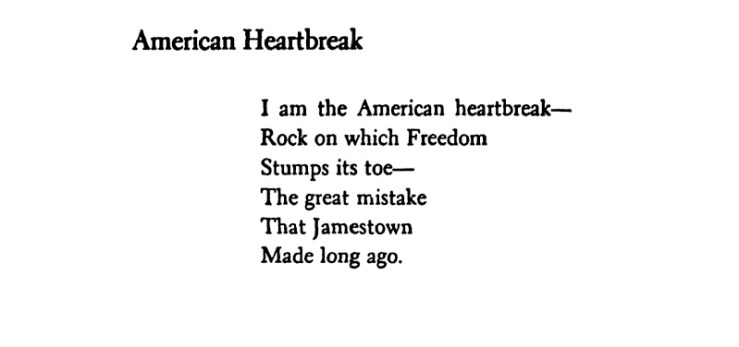
“American Heartbreak” — Langston Hughes

american heartbreak

“American Heartbreak” — Langston Hughes

american heartbreak