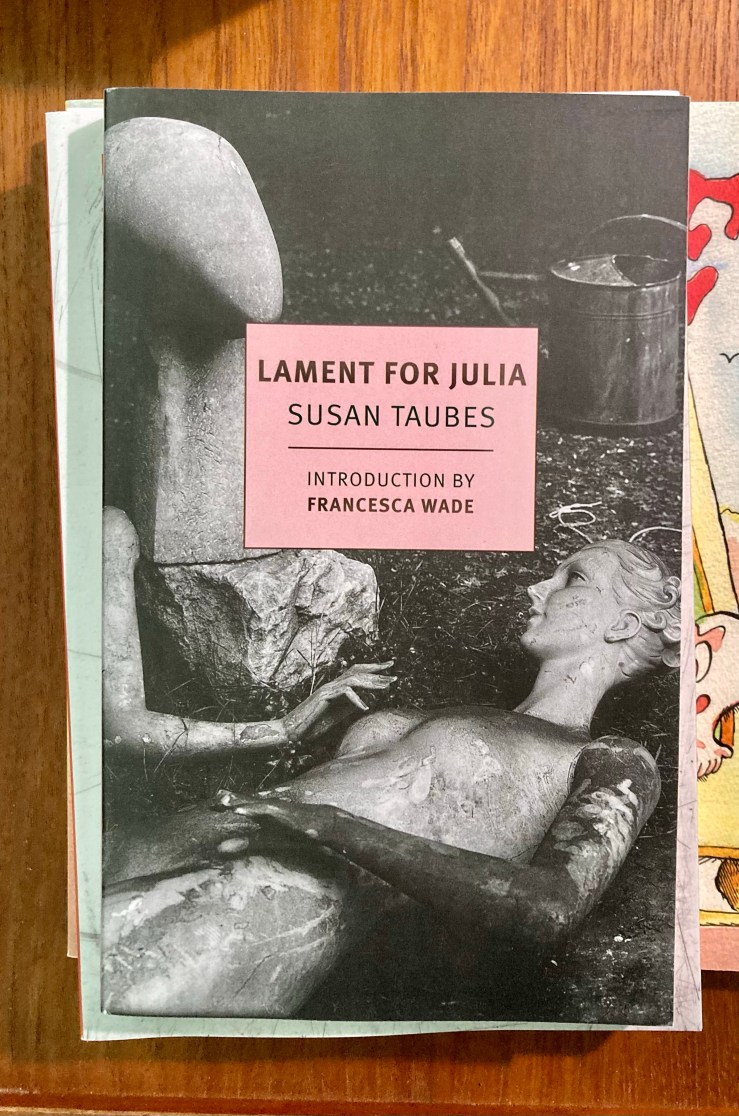
Susan Taubes’ Lament for Julia (Book acquired, 18 April 2023)

Susan Taubes’ Lament for Julia collects the eponymous posthumous novella with a handful of Taubes’ stories. The book is out this summer from NYRB. Their blurb–

Susan Taubes’s novella “Lament for Julia” is the story of a young woman coming of age in the twentieth century as seen through the eyes of a sexless spirit who supposes himself to be charged with her oversight.

What is this spirit? An operator from on high (though hardly holy), a narrative I, and a guiding presence that is more than a bit of a voyeur, who remains entirely unknown to Julia herself. About her, the spirit knows both a good deal and very little, since Julia’s emotional and physical and sexual being are all baffling, if also fascinating, to an entity that is pure mind.

The I and Julia are a mismatched couple, set up for failure from the start, it seems, even if they do somehow manage to deal in their different ways with childhood and Mother and Father Klopps and ugly pink outfits and dances and crushes for a while. After which come love and marriage, not necessarily in that order, at which point things really start to go wrong.

Unpublished during Taubes’s lifetime, “Lament for Julia” appears here with a selection of her stories. A brilliant metaphorical exploration of a woman’s double consciousness that is also a masterpiece of the grotesque, it is a novel like no other, a book, as Samuel Beckett wrote to his French publisher, “full of erotic touches of an emphatic sort [and] raw language,” the product of an “authentic talent,” adding, “I shall reread it.”
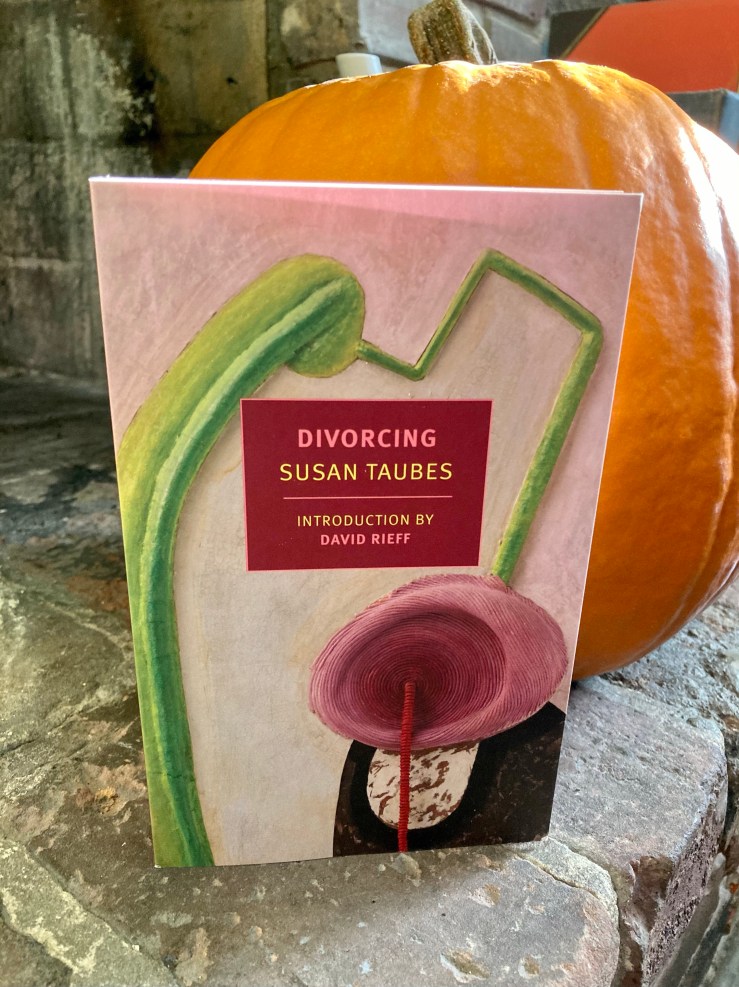
Susan Taubes’s Divorcing (Book acquired, 14 Oct. 2020)

Susan Taubes’s forgotten semi-autobiographical novel Divorcing is being republished by NRYB.

I had never heard of Taubes until Divorcing showed up at Biblioklept World Headquarters yesterday. Divorce was Taubes’s first, and only (to my knowledge) novel. It was first published in 1969 and received a mixed (and somewhat sexist) review in The New York Times by Hugh Kenner. A few days after the review was published, Taubes committed suicide by walking into the Atlantic Ocean. Her body was identified by her friend and contemporary Susan Sontag.

Here’s NYRB’s blurb for Divorcing:

Dream and reality overlap in Divorcing, a book in which divorce is not just a question of a broken marriage but names a rift that runs right through the inner and outer worlds of Sophie Blind, its brilliant but desperate protagonist. Can the rift be mended? Perhaps in the form of a novel, one that goes back from present-day New York to Sophie’s childhood in pre–World War II Budapest, that revisits the divorce between her Freudian father and her fickle mother, and finds a place for a host of further tensions and contradictions in her present life. The question that haunts Divorcing, however, is whether any novel can be fleet and bitter and true and light enough to gather up all the darkness of a given life.

Susan Taubes’s startlingly original novel was published in 1969 but largely ignored at the time; after the author’s tragic early death, it was forgotten. Its republication presents a chance to discover a splintered, glancing, caustic, and lyrical work by a dazzlingly intense and inventive writer.

Here’s a note on Taubes from one of Sontag’s 1965 journal entries. Sontag’s son edited the journals collected in As Consciousness is Harnessed to Flesh: Journals and Notebooks 1964-1980, and provides the note that Sontag identified Taubes’s body: