
I teach four sections of 11th grade AP English Language and Composition; I’m really hard on these kids. I also teach one section of 10th graders. I see these kids dark and early every morning, and I’m not very hard on them. It’s impossible to be, really. They–and I–are still sort of asleep. So, even though the FCAT is but a week away, when one assertive young lady in the class thought to tape record the new TV movie version of A Raisin in the Sun and bring it in, I agreed to let them watch it. After all, we’d read the play in class back in November, and watched the entire 1989 filmed stage production starring Danny Glover, as well as parts of the 1961 version starring Danny Glover.

I’ve been using Lorraine Hansberry’s play in the classroom for years, with great success, I might add–the themes of race, economics, integration, assimilation, acculturation, generational change, and women’s rights continue to be as vital and thought-provoking as when the play was first produced a half-century ago. Which is why the early aughties revival starring Sean “Puff Daddy P-Diddy, No, Just Diddy (Diddy Dumb Diddy Do)” Combs seemed like a great idea. It was met with good reviews and ran to 88 performances. I know this play inside and out, and was excited to see a new version of it.
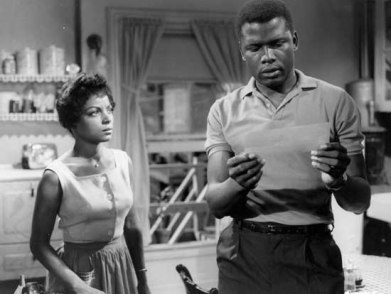
It was awful. Just plain awful. I can only hope that most of the people who saw it last week had some previous exposure. The depth of inter-generational conflict of Hansberry’s original text is drained of all energy and force, leaving only a weak trace of sappy melodrama. Both Poitier and Glover carried their versions, exploring the role of Walter Lee, a man whose dreams and ambitions are outmatched by the limited station thrust upon him. Walter Lee, properly, must be a man-child animal, lean and angry, a volcano ready to explode in rage and desperation. Walter Lee’s transformation into an adult man is painful; it almost undoes his family, metonymized neatly in the abortion his wife plans to have. Diddy, however, turns in one of the laziest one-note performances I’ve ever seen. He relies on every hackneyed trope of melodrama as a substitution for really emoting his part. In short, it’s impossible to believe that he’s Walter Lee. He’s just Diddy casually pretending to be Walter Lee. And the producers and director seem to know this. Whereas Walter Lee at least punctuates each scene of ARITS–and usually is at the forefront of catalytic action–the 2008 version reduces the scope of Diddy’s screen time, even omitting the famous “flaming spear” scene (my students were appalled at this elision–they determined that Diddy wouldn’t want to appear foolish). Furthermore, every single scene with Puffy Daddy (yes, I kept track) relies on the most saccharine of music to make sure the audience knows how to feel.

It’s left then to a chubbyish Phylicia Rashad to carry the movie, and while she’s a great actress, her Mama Younger is far too keenly self-aware. She’s simply not Hansberry’s Mama; instead, she’s Rashad’s late aughties update on what Rashad thinks a strong black woman should be. The original Mama’s ideology is defined (perhaps even limited) by the Great Migration; ARITS is largely the story of this mentality clashing with the artistic, educational, and economic aspirations inherent in the Civil Rights movement. Rashad’s Mama is never confused or even especially distraught over this changing ideology, and even some of the original lines that show her distress are cut. It just doesn’t work.
Maybe I gripe too much–my kids enjoyed it on the whole, but conceded that it wasn’t nearly as good as Glover’s take. I have to admit that I liked John “Uncle Jessie” Stamos as Mr. Lindner. He brought a silly unself-conscious humor to the role that exposed the inherent conflict of the original character: a guy whose actions are incredibly racist who can at no point recognize this racism because it’s so indelibly entrenched within him.
Still, if you’ve never seen the play before, I recommend going to the Danny Glover version, or at least the Poitier “classic.” Our inaugural post was about A Raisin in the Sun.
 Biblioklept