
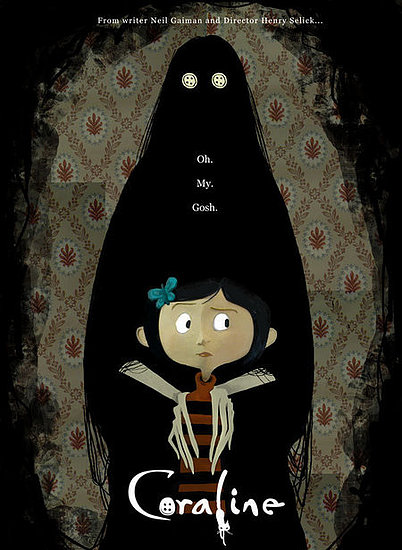
Even if Coraline didn’t have an engaging plot, well-developed characters an audience can really care about, and an especially singular sense of setting, rhythm, and movement, it would still be worth seeing in the theater for its astounding 3D visuals. Director Henry Selick (The Nightmare Before Christmas), working from Neil Gaiman‘s short novel of the same name, has created an endearing, imaginative, and often disturbing fairytale in meticulous stop-motion animation, dramatically enhanced in 3D. Selick doesn’t rest simply on the film’s amazing optical effects; rather, Coraline‘s plot and characterization are seamlessly, often dreamily (or nightmarishly) crafted through those marvelous visuals. Even when a scene veers into outright spectacle, it is always purposeful, cohesive, and forwards the logic of the plot, the story of young Coraline and her strange adventures in an alternate universe.
Bored and largely ignored by her parents who have just moved her to a country boarding house, Coraline discovers a tunnel to a world that doubles her own, replete with an “other mother” who cooks all sorts of delicious foods and loves to play games, and an “other father” who dotes on his little girl. This alternate universe also contains more glamorous versions of the boarding house’s other tenants, a circus performer who works with musical mice, and two aging actresses with a predilection for salt water taffy. The alternate world becomes a site of spectacle and wonder for Coraline, as well as the setting for some pretty mind-bending 3D set-pieces for the audience–however, like all fairy tales, Coraline always toes the line between fantasy and nightmare, joy and shocking horror. Savvy audience members will pick up on a sinister thread underlying the early scenes with Coraline’s “other mother,” a creepiness artfully balanced with the notion that this woman represents Coraline’s wish-fulfillment to be loved, adored, and entertained at all times. The reality of this fantasy world soon becomes painfully apparent to Coraline, who must go on a hero’s quest–in her own home–to save her “real” parents.
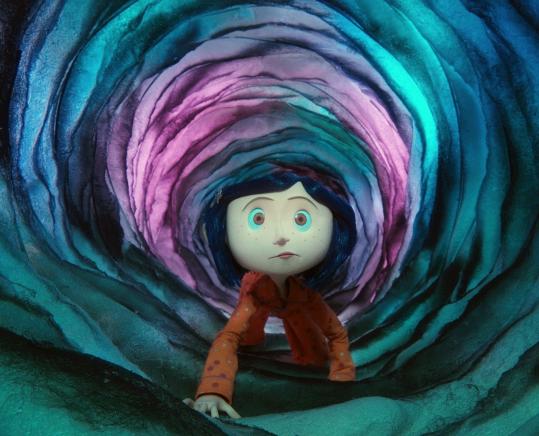
Coraline thrills at all the right moments, and at times is downright scary (although the seven year old behind me seemed unafraid; he just kept saying “Awesome!” every five minutes). The plot is rich with allusions to Alice and Wonderland and the Brothers Grimm fairy tales, and, in keeping with these sources, Coraline often exposes its dark side with little or no buffer. From frightening birthing tropes to threats of infanticidal cannibalism, Coraline always purchases its spectacular fantasy with reminders of grim, almost cruel reality. One scene in particular lays this cost literally bare; the aging actresses perform a high-wire trapeze act half-naked, their clumsy, inept bodies overexposed to every kind of peril–including the potential mockery of the audience. In an act of fantastic wish-fulfillment, the old women strip their fat, wrinkled bodies away like the husks of fruit; they emerge young women, their impossible rejuvenation the climax of a fantasy involving an intricate clash of sexuality and death. And yet Coraline repeatedly makes clear the costs of these fantasies, working its way toward a satisfying conclusion that doesn’t attempt to gloss over the erosion, corrosion, and mundane deathliness of life, but rather reconciles how a person might live happily in the “real world.” Very highly recommended.

 Biblioklept
Neil Gaiman is a master storyteller. I’m glad some of his work has been given such a faithful and impressive adaptation. I just hope this doesn’t precipitate Sandman 3D!
LikeLike
I wasn’t going to see this because I thought Tom Selleck directed it. I feel better about checking it out now.
LikeLike