It’s an old story. Or maybe it’s just a common story. Anyway, Biblioklept World Headquarters, as one might reasonably expect, is larded with books, bursting at metaphorical seams, etc. Bibliophilia, that terrible disease, drives us to buy new (and old books) with a ridiculous frequency, a frequency that could never match a realistic able-to-be-read-in-the-allotted-time-we-have-to-read matrix. The Biblioklept Mission to review new books ironically compounds this problem. Advance review copies and galleys arrive, solicited or no, with publication dates stamped boldly on publicity sheets, publication dates that remind the reviewer that timeliness matters, that a Serious Editor would get out reviews in a Timely Manner. So. What happens? You know what happens, dear reader: books begun with the best intentions are brushed aside for just a week so that forthcoming novels might be appraised; but rhythm is lost; narrative drops away. We lose the thread. And before you know it, another set of new books crowds the doorstep. The following books were all great, in so far as we got into them, and we will do our best to finish them sometime in the near future.
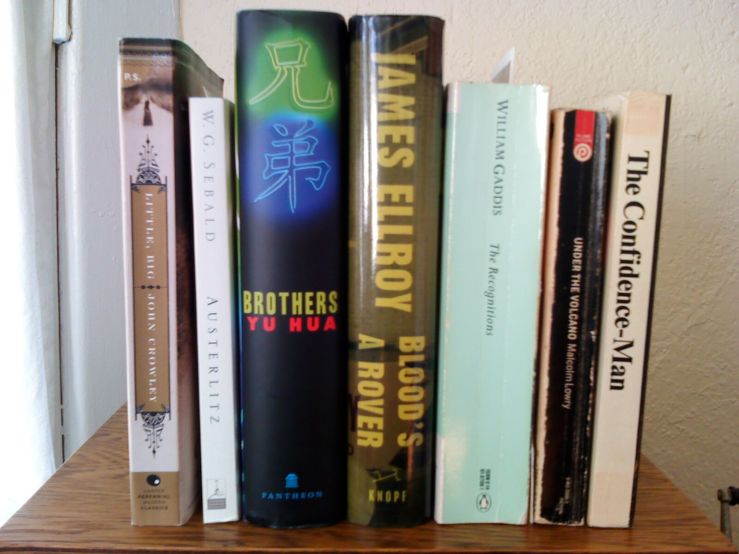
The Recognitions — William Gaddis
We had the foresight to review the first book of this massive, massive novel. The first chapter is probably the best thing we read all year, but the book seemed to lose some of that initial energy, instead settling into a frustrating and ungenerous rhythm. But there we go, blaming the book, when its difficulty was also very rewarding. It’s embarrassing really. We read 342 of the book’s 956 pages and then turned our attention, for just a second, to a few new paperbacks, and poof! — we lost it.
The Confidence Man — Herman Melville
We got about 50 pages into the Norton annotated edition we found for a dollar at the Friends of the Library sale. And that was that. Will try again in 2010.
Under the Volcano — Malcolm Cowley
We’d been wanting to read this for awhile now, after reading David Foster Wallace cite it as a special kind of book, or a book that needed to be read (or maybe he said it was a book that people needed to be made to read . . . Hang on, was it even Wallace who told us to read it?) Abandoned about 30 pages in.
Little, Big — John Crowley
Little, Big is the one on this list that we’ll take for granted is as good as everyone says it is. We tried to read it with the AV Club’s book club, Wrapped Up In Books, but no. Harold Bloom says it’s one of his favorites, too. We got about 60 pages in, but it wasn’t exactly compelling, and Crowley’s rhetorical style was kinda infuriating in its contrived simplicity. The only book on this list we willingly put down.
Brothers — Yu Hua
We got over 100 pages into this ribald satire, but again, put it down to read a book about the moral panic comic books inspired. Probably the best unsolicited review copy we got this year. We should really go pick it up again . . .
Blood’s A Rover — James Ellroy
We read a 100 pages of Blood’s A Rover and then challenged traditional ethical notions of book reviewery and posted a review. We continued to read and then–viola!–the audiobook version came out. So, depending on how you view these things, we either technically did or did not abandon this fine crime procedural.
Austerlitz — W.G. Sebald
Oh the shame of it all. Stuck 158 pages into Sebald’s 298 page chronicle of the displaced orphan Austerlitz. The bookmark’s still there and everything. We read most of those 158 pages in two afternoon sittings. Then some book or other arrived (two, actually: Lethem’s Chronic City and Fallada’s Every Man Dies Alone). Sebald’s The Rings of Saturn is easily one of our favorite books, but it was divided into, y’know, paragraphs, sections, and chapters. Austerlitz is not–not even paragraphs. There are Sebald’s trademark black and white photos to occasionally break up the text, but otherwise, no, just long, long, chunks of texts that diverge and move through space, time, and voices. And while the book is very good, it also requires sustained concentration. It doesn’t want you cheating on it with another book. It’s quite selfish. But there are still a few days left in the year, and perhaps we’ll finish it one afternoon–although a quick glance over page 158 reveals that we are stuck in the text’s inertia.

 Biblioklept