

Two books in the mail today from Counterpoint Press, an expanding indie press with a broad but sharp catalog (including Soft Skull Press). The first is Irrepressible: The Life and Times of Jessica Mitford, a biography of the progressive upstart. From the press release—
Admirers and detractors use the same words to describe Jessica Mitford: subversive, mischief-maker, muckraker. J.K. Rowling calls Mitford her “most influential writer.” Those who knew her best simply called her “Decca.” Born into one of Britain’s most famous aristocratic families, Mitford eloped with Winston Churchill’s nephew to America as a teenager in 1939. A no-holds barred civil rights activist, outspoken communist, and feared journalist, Mitford rose to one of the New Deal’s most notorious bureaucrats. For her the personal was political. She coined the term “frenemies,” and as a member of the American Communist Party, she made several, though not among the Cold War witch hunters. When she left the Communist Party in 1958 after fifteen years, she promised to be subversive whenever the opportunity arose. True to her word, late in life she hit her stride as a writer, publishing nine books before her death in 1996. With unrestricted access to the Mitford Family archives, Leslie Brody presents a moving, impeccably researched biography of one of the most influential women of the 20th century.
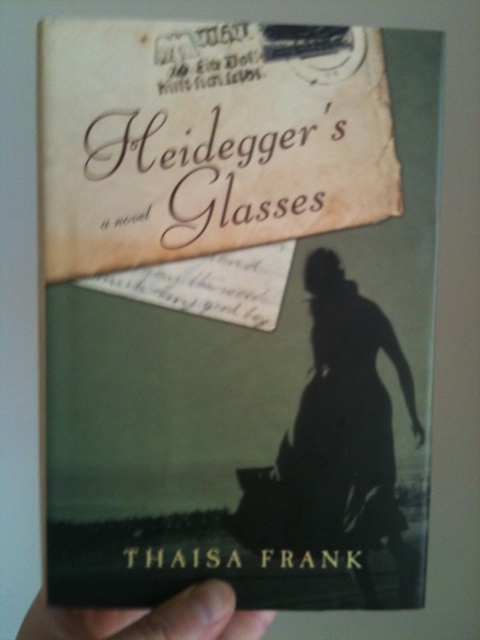
Heidegger’s Glasses is a novel by Thaisa Frank that seems promising. Description—
Magical and surreal, Heidegger’s Glasses offers a completely original vantage point on the Holocaust. The story opens during the end of World War II in a failing Germany coming apart at the seams. The Third Reich’s strong reliance on the occult and the leading officials’ obsession with the astral plane has led to the formation of a secret Compound of Scribes–multilingual translators that have been spared from deportation to answer returned letters written to the dead in the concentration camps. Ellie Schacten, the mysterious heroine of the novel, supervises the Scribes, yet secretly uses the compound to hide a steadily growing number of refugees. When a letter arrives, written by eminent German philosopher Martin Heidegger to his friend and optometrist––a man who is now lost in the dying thralls of Auschwitz––a series of events unfold that turn the Reich’s attention to the compound and threaten Ellie’s operation and the lives of the Scribes.
Based on the real Third Reich procedure, Operation Mail, which forced concentration camp prisoners to send letters to loved ones extolling conditions in the camps, Heidegger’s Glasses explores a dark, absurd world in which fear and death are a constant companion, and yet, Frank’s characters show how that when stripped of their freedom and virtually all material possessions, the human spirit perseveres and thrives.
 Biblioklept