Osvaldo Lamborghini/Mihail Sebastian (Books acquired, 10 Nov. 2020)

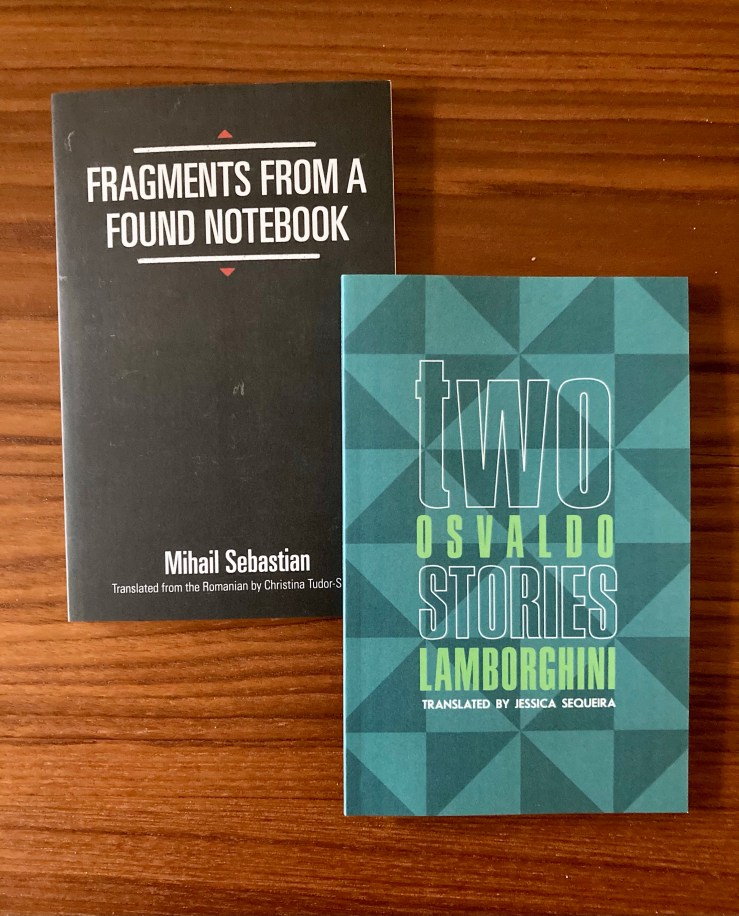
Two new “objects” in translation from strangish newish indie Sublunary Editions arrived at Biblioklept World Headquarters the other day: Two Stories by Osvaldo Lamborghini (translated by Jessica Sequeira) and Fragments from a Found Notebook by Mihail Sebastian (translated by Christina Tudor-Sideri).

Intrigued by the three-word blurb from Roberto Bolaño (“It scares me”) on its back cover, I read the two stories in Lamborghini’s Two Stories. I skipped César Aira’s introduction—I always skip introductions—and then after a few baffling pages, I went back to the introduction. Aira’s introduction didn’t exactly explicate the text for me. It did, however, read like a few pages from a Bolaño novel, describing a strange heroic exotic Argentine writer, a poet-artist romantically disposed to self-exiles. (I actually did a basic internet search just to make sure it wasn’t like, an elaborate fake. It’s not. Lamborghini was real, although he could have been a Bolaño invention.)

The texts of Two Stories are not exactly surrealist, not exactly automatic writing…Sublunary publisher Joshua Rothes described Lamborghini as “…a surrealist white hole… like de Sade and Lautréamont were sucked in by the surrealists, and Lamborghini’s what came out the other side.” Sublunary’s blurb describes the stories collected here as “an accurate sample of his work in much the same way that a bucket of seawater is an accurate sample of the ocean.”

I also started in on Mihail Sebastian’s Fragments from a Forgotten Notebook. Again, the whole affair has that romantic-Bolañoesque tinge to it. Sebastian presents the Notebook as a literal found object. Is it? Or is it invention? Here’s Sublunary’s verb, which begins with Sebastian’s introduction:

“One November evening (in circumstances that would take too long to narrate here) I found in Paris, on the Mirabeau Bridge, a notebook with black, glossy, oilcloth covers, like the ones in which grocers used to keep accounts. There were exactly 126 pages—commercial paper—filled with small writing, streamlined, without erasures. A curious reading, tiring in places, obscure passages, notations that appeared foreign to me, in fact even absolutely contrasting.”

Presented here for the first time in English, the late Mihail Sebastian’s debut book, seldom mentioned by scholars or even the author himself, Fragments from a Found Notebook casts an important light on a young writer—later to be known primarily as a diarist and documentarian—struggling with the identity of the I at the tip of his pen.



DeLillo has since stayed small

Michael Gorra has a thoughtful essay on Don DeLillo’s late style in the latest issue of The New York Review of Books. Ostensibly a review of DeLillo’s latest, The Silence, Gorra’s essay considers DeLillo’s body of work against some of his peers and literary forebears, arguing that DeLillo’s finest novels were composed and published in his “full middle age”:

The core of DeLillo’s oeuvre is the series of five novels that began with The Names (1982) and ended with Underworld; the intervening volumes are White NoiseLibra, and Mao II (1991). Those books look permanent, with the last of them a summa; his early books in contrast seem preparatory, though they each have their admirers. To put it another way, DeLillo was born in 1936, and what matters are the novels he wrote in full middle age, with Underworld appearing when he was sixty. Dickens was dead by that age, Balzac too, but DeLillo has had a third act in the six short books he has written in the new century. These novels rarely take age itself as their topic, as both Saul Bellow and Philip Roth did in their own late work; yet still they are the product of age.

Gorra then points out that “DeLillo’s recent books are significantly different from the great novels of his middle age, and that difference is worth thinking about.” Gorra continues:

…after Underworld his sense of novelistic form, of what he needs to make a narrative, did change. Probably there was no good way to follow that novel, with its distorting size and scope, a book that began with Frank Sinatra and ended with the disposal of nuclear waste. How could one compete with that—compete with oneself? DeLillo wisely didn’t try. There would be no new plateaus, no arc of increasing achievement. Underworld’s successor, The Body Artist (2001), was deliberately slight, a novella-length exploration of the uncanny that makes me think of “Bartleby, the Scrivener.” It was as if a composer who’d only written symphonies had suddenly switched to a tinny atonal song, and DeLillo has since stayed small. His late books have been at most a quarter of Underworld’s length, with The Silence the shortest of them, and always with fewer characters and a more sharply limited focus.

There’s a thorough and very generous review of The Silence embedded in Gorra’s essay—he’s far, far more generous than I was toward the book (at one point Gorra attests that he “can’t tell the difference between a few randomly chosen sentences from his recent work and a passage from Libra. Reader, there’s a difference). And while his phrase “DeLillo has since stayed small” is not overtly pejorative, I think it nevertheless captures the general sense that DeLillo’s late works—or late style—simply does not meet the quality of his work in the eighties and nineties. (Gorra admits that “Cosmopolis seems to me almost unreadable” — I concur.)

Others have found crystalline beauty in DeLillo’s late work, and in The Silence in particular. I found it a depressing read, not for its content necessarily—okay, maybe for its content, but also for its form, its prose. I concur with the first sentence of Gorra’s conclusion, but not with the second:

Some pages in this book verge on self-parody, and I doubt it will draw any readers who haven’t already invested themselves in DeLillo’s work, in the half-century of risks his voice has taken. But those of us who have will find something poignant and terrible in this strange unbroken silence.

Read Michael Gorra’s essay on DeLillo, “The Sense of an Ending,” here.