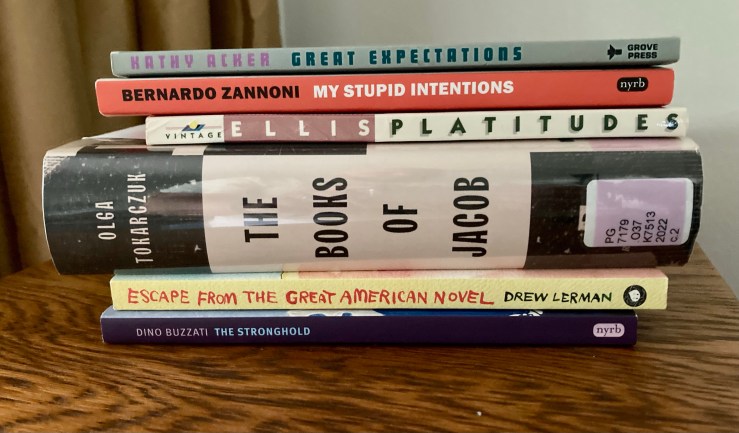
With the end of the spring term (and, frankly, a renewed commitment to weeknight sobriety), I’ve been reading a lot more and a lot faster the past few weeks. Top to bottom:
I pulled Kathy Acker’s Great Expectations out a few nights ago and ended up reading all of it over two nights and two mornings. Not the best starting point for Acker but strangely super, super readable.
Bernardo Zannoni’s My Stupid Intentions: I actually haven’t even done one of those silly “book acquired” posts for this one: I picked it up and just kept reading. Totally zapped me, fantastic stuff: a brash, sharp, sardonic animal rant against god his own self. Loved loved loved it.
I’ve got about a third left of Trey Ellis’s first 1988 novel Platitudes, and it’s really good—reminds me a lot of Ishmael Reed’s middle period stuff, Fran Ross’s Oreo, David Foster Wallace’s early fiction, and even Bret Easton Ellis. Platitudes is a send up of coming-of-age novels conveyed through linguistic channel surfing.
I finished the audiobook of Olga Tokarczuk’s novel The Books of Jacob (translated by Jennifer Croft) this afternoon. I’d been switch-hitting between the novel and audiobook, but gave over to my earplugs during a week of long commutes and longer chores—but returning to the print version for the images, maps, and, uh names. This is a novel larded with names and names and names. The Books of Jacob is a (and I don’t use this hackneyed bookworld word lightly) kaleidoscopic biopic of the 18th-c. messianic cult leader Jacob Frank. Close to 1000 pages/36 hours, The Books of Jacob is exhaustive, exhilarating, and exhaustive. Best of all, at the end of all, we don’t really know Jacob—we just get picture after perspective after point of view on the self-proclaimed savior.
I wrote about Drew Lerman’s Escape from the Great American Novel yesterday, right?
I also managed to get out a review of Lawrence Venuti’s new English translation of Dino Buzzati’s novel The Stronghold, which is strong holding the bottom of the stack above.


