
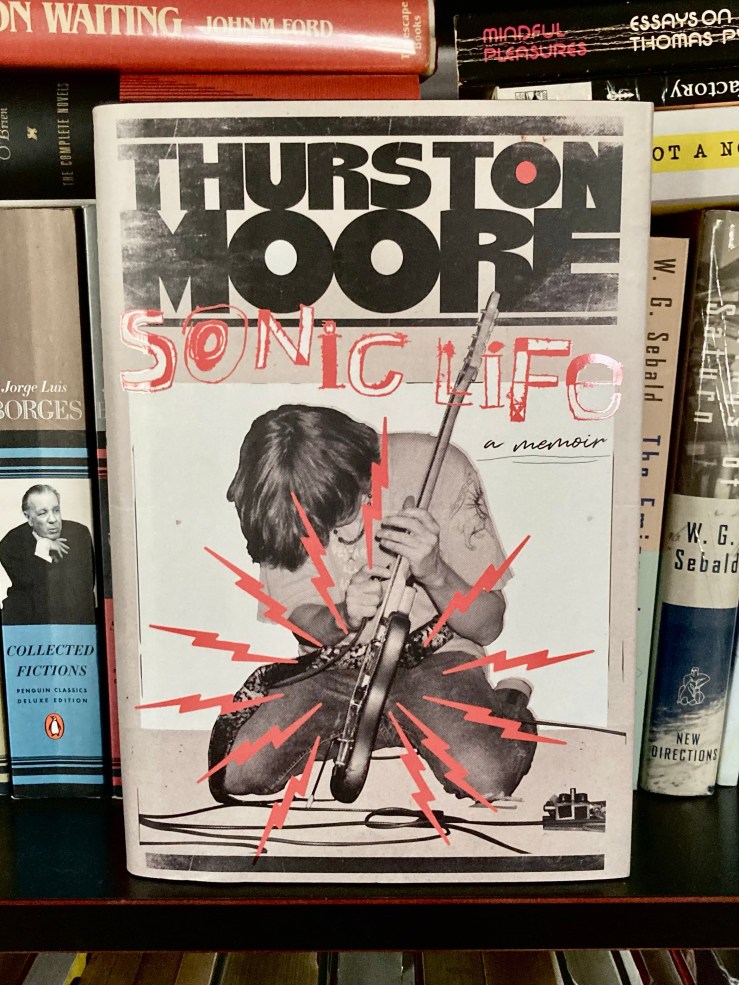
 I picked up Thurston Moore’s mammoth memoir Sonic Life yesterday afternoon, started reading it, and kept reading it. I was a huge Sonic Youth fan in my youth, introduced to the band in 1991 via a decent soundtrack to a mediocre film called Pump Up the Volume. Throughout the nineties and early 2000s, I bought all the Sonic Youth records I could get my hands on, and repeatedly watched their 1991 tour diary film The Year Punk Broke more times than I could count. Thurston Moore was a goofy avant hipster, ebullient, verbose, annoying, and endearing, the nexus of a band that were themselves a nexus of nascent bands and artists. (In his chapter on Sonic Youth in his 2001 history Our Band Could Be Your Life, Michael Azerrad repeatedly argues that DGC Records signed the band so that they would reel in the indie groups that majors wanted so badly after Nirvana et al. exploded.) When Thurston Moore and his wife and bandmate Kim Gordon separated in 2011, essentially ending Sonic Youth, I recall being strangely emotionally impacted, like my punk god parents were getting divorced. While I didn’t expect or want dishy answers from Gordon’s 2015 memoir Girl in a Band, I was still disappointed in the book, finding it cold and ultimately dull. So far, Moore’s memoir is richer, denser, sprawls more. It’s written in an electric rapid fire style loaded with phrasing that wouldn’t be out of place in the lyrics of an old SY track. I ended up reading the first 150 or so of the pages last night and this morning, soaking up Moore’s detailed account of the end of the New York punk rock scene and the subsequent birth of No Wave. Moore’s intense love of music is what comes through most strongly. Chapter titles take their names from song titles or song lyrics, and I’ve started to put together a playlist, which I’ll add to as I read:

 Biblioklept
Can’t wait to read it. I was fairly disgusted with Gordon’s multi-hundred page name-drop (after a tantalizing well written first chapter). I’ve since forgiven her, but I suspect Moore’s reporting on the events will be more my style.
LikeLike
I mean, he drops names left and right in here, but it seems to come from a place of admiration and even humility, if that makes sense, whereas in Gordon’s book it struck me as insecurity. Maybe he’s not really “name dropping” but he certainly crams the chapters with all of the infamous folks he encounters. A lot of times, at least early on, he paints himself as an insecure cad or just plain juvenile (which of course, he literally is), as when he decides to insult Dee Snider or when he writes a bad review of one of the Seeger singers.
LikeLiked by 1 person