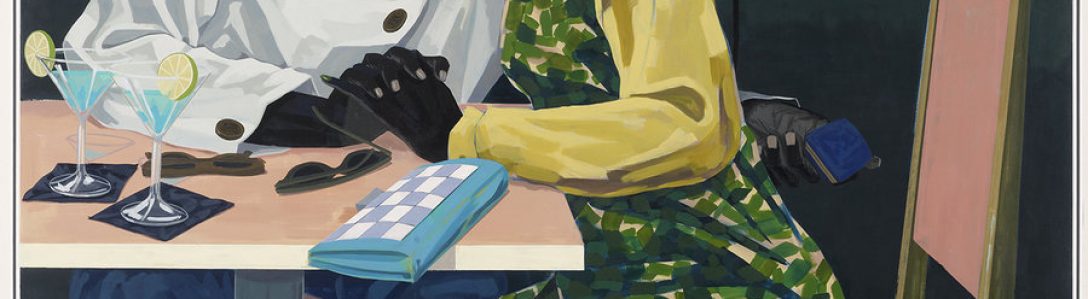
“Red Rubber Gloves”
by
Christine Brooke-Rose
From this position on my high balcony, the semi-detached beyond the garden looks more squat than it ought to in such a prosperous suburb, forming with its Siamese twin a square inverted U that faces me and boxes a wide inverted T of a back-yard, neatly divided by a hedge of roses and hydrangeas. On the left of the hedge there is a bit of lawn. On the right, only a small paved yard. The house on the left seems devoid of life, devoid, that is, of the kind of life liable to catch the eye and stop it in its casual round, mutating its idle curiosity through momentary fascination and hence, inexorably, by the mere process of reiteration, to a mild but fixed obsessiveness. As does the right-hand house.
In the angle of the square U, outside the french windows of the right-hand house, the girl sits on the edge of the red canvas bed in a pale pink bikini, carefully oiling inch after inch of her thin white body. She looks, from up here, totally naked, the pink bikini being so pale, and she sits on the edge of the red canvas bed which is set obliquely in the paved yard to face the morning sun. She has oiled the arms, the shoulders, the chest and the long midriff. Now she is doing the right leg, starting with the foot, the ankle, then the shin, as if to meet her upper oily self half way. She is oiling the right thigh. Inside the thigh. The left foot. If the heat-wave holds out she will perhaps become brown enough to contrast with the pink and so look less totally naked on the red canvas bed. The inside of the left thigh. She lies now framed in the red canvas bed, chin up, eyes closed to face the hot June sun. Round the corner from her naked body, at the square end of the inverted U, the red rubber gloves lie quiet on the kitchen window-sill.
In the morning the large rectangular windows of the house tend to reflect the sun in some at least of their thirty-two small black squares framed in cream-painted wood. And in the afternoon they are quite cast into the shade as the sun moves round to face me on my high balcony, immobilised in convalescence. I cannot therefore see much further than the beginning of the pink wash-basin in the bathroom or, in the kitchen below it, the long and gleaming double-sink unit. And the red rubber gloves, moving swiftly apart and together, vanishing and reappearing, moving apart and down. All the windows of both houses, those of the kitchen and of the bathroom above it, at each end of the square inverted U, and those of each bedroom inside the U above the french windows, are rectangular and divided into four panels, each of eight black squares, two over two over two over two, all in cream-painted frames.
The thin girl has melted away into the sun, the red canvas bed is empty.
At least, that is presumably also the lay-out of the bathroom and kitchen in the left-hand house, for the windows are mostly hidden by the apple-tree. The houses are almost identical, except for the lawn on the left of the hedge. In the back-yard of the right-hand house, a clothes-line stretches from the high wooden fence to one end of the kitchen window, and another from the same spot in the high wooden fence to the other end, forming a V with the first clothes line.
The girl, the daughter of the house, is perhaps aware that I am watching it, for the bathroom curtains have been hastily drawn. On closer scrutiny I can see that the bathroom in fact occupies only two of the framed panels in the upper window, the right-hand two, the curtains of which have been hastily drawn and are lined in white. The other two must belong to a small bedroom, the girl’s bedroom perhaps. Its curtains, pulled back on either side, have a buff lining. It is midday and the cool sun of a cold July tries to pierce through the greyness to warm me in my convalescence. I call it convalescence because the doctor does and the sun is trying to shine, but I know that the paralysis will not retreat, rather will it creep up, slowly perhaps but inexorably over the years, decades even, until it reaches the vital organs.
In the kitchen window of the right-hand house, one of the panels of two squares over two over two is open to reveal a black rectangle and the beginning of the gleaming sink. Inside the sink is a red plastic bowl and on the window-sill are the red rubber gloves, now at rest.
The morning sunlight slants on all the windows, reflecting gold in some of the black squares but not in others, making each rectangular window, with its eight squares across and four squares down, look like half a chess board gone berserk to confuse the queen and all her knights. The bathroom window and the kitchen window below it form two halves of a chessboard, more or less.
In the black rectangle of the open kitchen window the sunlight gleams on the stainless steel double-sink unit, just beyond the cream-painted frame. Above the gleaming sink the red rubber gloves move swiftly, rise from the silver greyness lifting a yellow mass, plunging it into greyness, lifting it again, twisting its tail, shifting it to the right-hand sink, moving back left, vanishing into greyness, rising and moving swiftly, in and out, together and apart.
On closer scrutiny I can see that in the left-hand house the wooden frames of the thirty-two black squares, eight by four in each of the rectangular windows, are painted white. It is only the right-hand house which has cream-painted windows. They all looked the same behind the trees against the strong August sun that faces me on my high balcony. The left-hand house seems quite devoid of life. Possibly the two rectangular windows one above the other in the left-hand house, are not the windows of the bathroom and kitchen at all. It is difficult to see them through the apple-tree, and of course the goldening elm in the garden at the back of my block of flats. In the right-hand house, however, the lower room is definitely the kitchen, in the black rectangle of which the red rubber gloves move swiftly apart, shake hands, vanish into greyness, lift up a foam-white mass, vanish and reappear, move to the right, move back, plunge into greyness, rise and move swiftly right. Beyond the red rubber gloves is a pale grey shape, then blackness.
Despite so much washing activity and two clothes-lines in the back-yard I have not seen the woman yet, the mother of the girl. Surely, she must come out one day to hang out the washing on the line. I have not seen the woman yet, or the girl again, only the red rubber gloves, although the woman has been washing ceaselessly day after day since I first began to watch the house. She must have a large family, which likewise I have not seen, except for the girl sunbathing in that June heat-wave, oiling her body inch by inch, lying it seemed quite naked on the red canvas bed. But as I stare at the empty clothes-line, I know with a mild pang that I have seen shirts hanging from it, and slips, and nightdresses, many a time, without then registering the image, which only now recurs very precisely in the back of my memory. Yet I have never seen the woman herself come out to hang the washing. She must do it while I am having physiotherapy, or seeing the doctor, or eating a meal. Perhaps she waits for a moment when I am not on the balcony, to come out and hang her washing.
On the stainless steel draining board just inside the black rectangle of the open kitchen window is a red mass on a white plate. One of the red rubber gloves unfolds the mass, the other holds a carving knife, almost invisible in the redness of the glove, and cuts the meat into small square pieces on a pale blue chopping board, carefully removing the gristle. In red rubber gloves. A bit much, really. The left red rubber glove sweeps the gristle into the gleaming sink, and then moves up and down, quickly pushing, presumably, the gristle down the waste-disposal unit. One of the red rubber gloves holds the edge of the stainless steel sink, the other moves quickly all around it.
There is no doubt about it, now that the strong September sun has dimmed and gone behind a cloud, the window frames and the frames of all the small black squares inside the windows of the left-hand house are painted white. And the window frames and the frames of the small black squares in the windows of the right-hand house are painted cream.
The red rubber gloves are upstairs now, in the white washstand just beyond the cream-painted squares of the right-hand house. It is very exciting when they are upstairs. They move apart and vanish, rise and come together, shake hands, vanish and reappear. They look larger in the small wash-basin. The shape behind is white in the rosy darkness and the arms above the gloves are clearly visible. It is a rosy darkness due to the walls being probably painted pink. Inside it must be quite light. The arms are thin and white. The red rubber gloves have been removed, the wrists dip naked into the pink washbasin, one hand soaps the other arm, under the arm, the neck, the other hand soaps the first arm, under the arm, the neck.
The stainless steel is dull today, the bright reflecting squares have become black squares, removing the uneven permutations of sunlight on the two halves of the chessboard. The red rubber gloves move swiftly apart, rise from the greyness lifting a red mass, vanish and reappear. The arms above the gloves are thin and white. Despite so much washing activity I have not seen the woman yet. But then I have not been out on the balcony for quite some time, it is too cold, even with rugs. So I wheel my chair by the dining-room window and watch. Surely the woman must one day emerge to hang out all that tremendous wash. But no, the cold November drizzle is too cold and drizzly. Unless perhaps she has a spin-dryer.
The woman steps out into the paved back-yard holding in her thin white embrace the red plastic bowl full of wet clothes. She wears a black jumper and a short grey skirt, and the red rubber gloves. She is thin and has short hair. She puts down the basin and picks from it a shirt which she smooths out and hangs upon the line, upside down by the tails. And then another shirt. Then a pyjama top, with stripes. She and the girl who seemed totally naked on the red canvas bed are one and the same person.
Nobody moves at all in the house on the left. And yet the window corresponding to the bathroom and small bedroom window has one of its panels open. Through the denuded elm, books are visible on the extreme left wall.
The red rubber gloves move swiftly apart behind the cream-painted frames of the kitchen in the right-hand house. One of the squares reflects a pale December sun but otherwise all the squares are dark on the lower half of the chessboard. The red rubber gloves move swiftly apart, shake hands, vanish into a foam-grey mass, rise, vanish and reappear, move swiftly apart, vanish, rise, move apart, vanish, rise, move swiftly. In the blackness beyond the gloves the shape is emerald green.
The woman has no daughter, and no washing-machine. She is the daughter, she is the washing-machine. She is probably the spin-dryer too. Whoever she washes for so continually is never to be seen, from this position at my high dining-room window in the immobility of my convalescence. The two houses have separate roofs, high and deeply sloping in a late Edwardian style with neat little, tight little tiles of darkened red.
The red rubber gloves are also worn to chop up meat on the pale blue chopping board. A bit much, really. The meat must taste of stale detergent. The left red rubber glove sweeps the gristle into the gleaming sink, and then moves up and down pushing the gristle down the presumably waste-disposal unit. One of the red rubber gloves holds the edge of the stainless steel sink, the other moves swiftly around it.
It is three o’clock in the afternoon and the wintry sun accuses my impotence with blank undazzling orange in a dull white sky. The thin white shape appears at the bedroom window, draws the buff-lined curtains with swift brusquery. This is the first time I have seen the woman relaxing. At least, I assume she is relaxing since she has drawn the curtains. It was so jerkily done. Staring at the drawn buff curtains I know that I have seen them drawn before, without registering the image. No doubt in June already, during the heat-wave, she went up to the bedroom at three o’clock in the afternoon and drew the curtains swiftly, jerkily, in a great hurry to relax while I was dozing off. Perhaps she is not relaxing. All I saw was a quick white shape, a slip maybe, unless it was an overall, although her arms were bare. In the kitchen she sometimes wears a white overall, which makes her stand out better against the darkness of the rectangle. And of course the red rubber gloves. They lie at rest now on the kitchen window-sill just inside the small black squares, while she relaxes, thinking of black velvet or of restful landscapes as she isolates her head, and then dismisses it as she isolates her neck, and then dismisses it as she isolates her left shoulder, her left arm, flowing, flowing, out, her right arm, and then dismisses it as she isolates her left leg, and her left foot, and then dismisses it as she isolates her right leg, her right foot. That is what the physiotherapist tells me to do when I am in pain. Normal people have to do it all the way down, isolating the left leg, then the right, but I feel no pain down there at all, my legs have isolated themselves, so there’s no point. It is the neck and shoulders, and the back especially, that ache. Perhaps she isolates the inside of her thigh.
The curtains are drawn open swiftly and a white shape moves away. A quick relaxation, that, merely counting to a hundred maybe, with a hundred deep breaths.
The thin white shape appears behind the cream-framed squares of the bathroom window. Briefly, for the white lined curtains are drawn with a brusque movement.
On closer scrutiny the bathroom curtains are not lined in white, but are made of plastic, the reverse side of which is white. Unless perhaps they have replaced, quite recently, the earlier bathroom curtains with the white cotton lining. It is now impossible to tell. There is a faint pink and blue pattern, ducks, possibly, or boats, brighter no doubt on the inside. Six out of thirty-two black squares reflect the pale December morning sun, Castle top left, Bishop left, White Queen on her colour, pawn one advanced two paces, pawn two advanced one pace, pawn four immobilised in dire paralysis.
The lower half of the chessboard reflects no sun. In the black rectangle of the kitchen window the red rubber gloves move swiftly apart. One of the gloves holds the edge of the stainless steel sink, the other moves swiftly around it. Three shirts are hanging on the line, upside down, and a pyjama top, male underpants, one nightie, two slips, three panties and a pale green blouse. There are no pyjama trousers.
Snow covers the two steep roofs, and all the trees and gardens. The narrow bricks of the Siamese twin houses seem unnaturally dark. The back yards look alike, no lawn now on the left, only the apple-tree, bare branched in black and white. The snow piles high on the window-sills of the left-hand house. But on the right-hand house the window sills have been swept clean and stand out dark and grey. The light is on in the kitchen, the woman clearly visible, in a blue smock over a red polo-neck. The red rubber gloves move swiftly apart, plunge into greyness and bring out a plate, a cup, another plate, another, and a saucepan, after scouring.
The snow makes map-like patterns on the dark red and steeply sloping roofs.
The red rubber gloves move swiftly apart above the gleaming sink in the dark rectangle of the open kitchen window. The April sun slants on the small black squares, whitening a few and leaving others blank, like half a chessboard gone berserk in order to confuse the queen and all her knights.
During my relapse I have thought a lot about the woman. I was unable to sit by the window but I saw her clearly in my mind’s eye. Busy, always busy in her red rubber gloves. But I know. Clearly she has a lover. She receives him at three o’clock in the afternoon and swiftly draws the curtains. There is so little time.
At three o’clock in the afternoon I sit by the dining-room window now and watch the house. The lover is there, behind the curtains, caressing her face, and then her neck, her breasts, her belly and the inside of her thigh as she lies totally naked on the red counter-pane. Her belly is enormous for she is eight and a half months pregnant by him. She must have been getting bigger and bigger during my relapse, and of course before, although at that time it wouldn’t have been so noticeable from this position at my dining-room window. Therefore he cannot make love to her but he caresses her. She loves me manually and I am content.
The tiny baby lies dead on the pale blue chopping board by the stainless steel sink. She cuts him up with the big carving knife and drops the small bits one by one into the waste-disposal unit which growls and grinds them into white liquid pulp.
The red rubber gloves move swiftly apart, half lost in all the blood. One hand holds the edge of the stainless steel sink, the other moves quickly around it.
The heat-wave is tremendous for late May. The woman sits on the edge of the red canvas bed in her pale pink bikini, carefully oiling her body inch by inch, the arms, the shoulders, the chest and the long midriff. Now she is doing the right leg, the shin, the thigh, the inside of the thigh. She lies on the red canvas bed, thin, white and totally naked in her invisible bikini, chin up, eyes closed to face the morning sun that pours down melting her and my left side on my high balcony. In the black rectangle of the open kitchen window the yellow rubber gloves lie on the sill, at rest.

 Biblioklept