
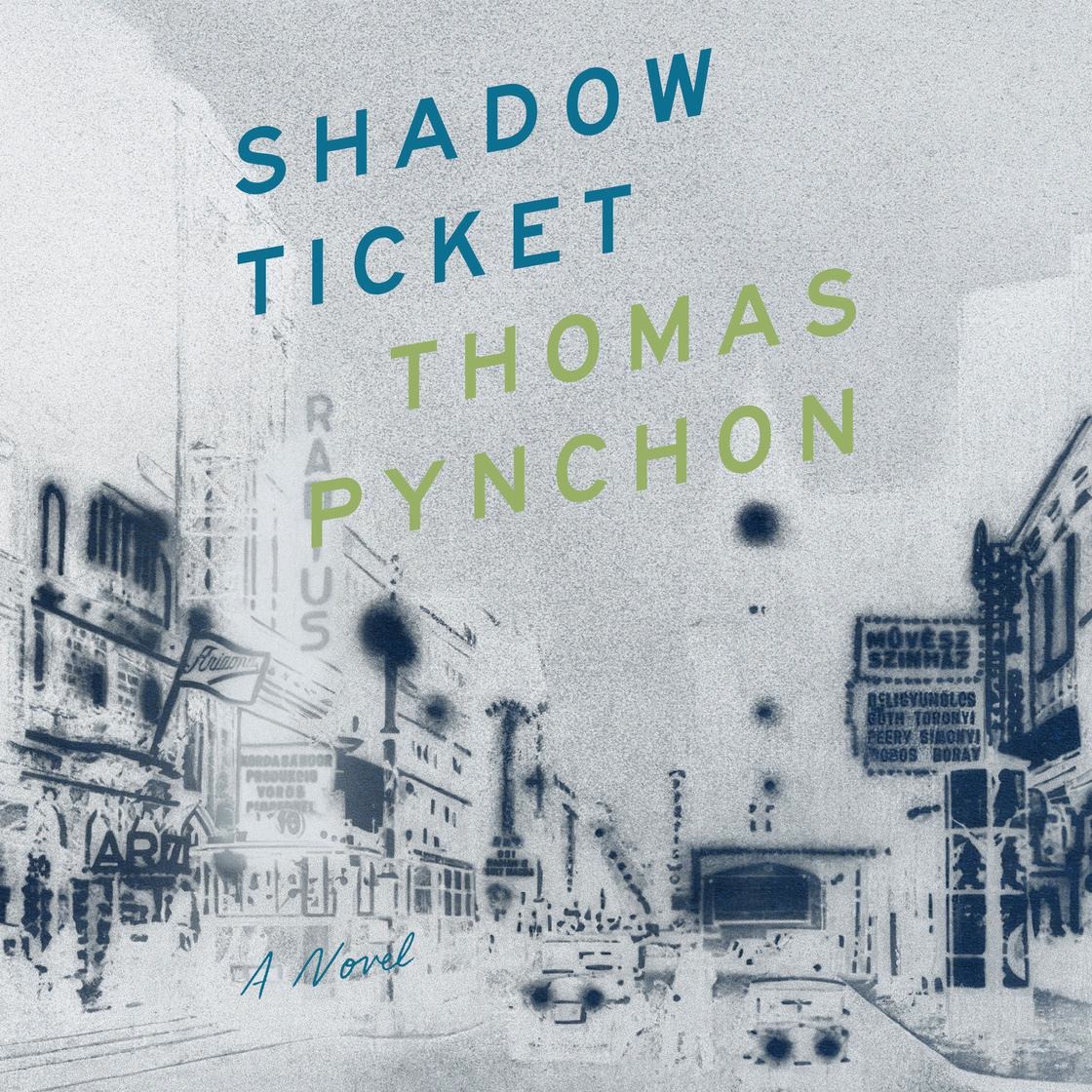
Notes on Chapters 1-7 | Glows in the dark.
Notes on Chapters 8-14 | Halloween all the time.
Notes on Chapters 15-18 | Ghostly crawl.
Chapter 19:
Last time we checked on hero Hicks McTaggart, our P.I. was in NYC, unwillingly sent there by his intelligence agency, U-Ops. A “a needle full of something in the chloral hydrate family” sends Hicks out on the Atlantic, on the “ocean liner Stupendica.“ The Stupendica is presumably the same ship, or a version of the ship, from Pynchon’s opus Against the Day. In the “Bilocations” section, the Stupendica bifurcates (or doubles?), engendering a second ship, the Emperor Maximilian, which departs on its own timeline to other bellicose adventures.
Aboard this particularStupendica, Shanghaied Hicks revives to a “seagoing-type tomato” named “Glow Tripforth del Vasto…here on assignment for Hep Debutante magazine, sending in a series of articles on how to be a Jazz Age adventuress on a Depression budget.”
Glow’s name immediately recalls Shadow Ticket’s motif of “glow in the dark” images and monster movie irradiation. The name “Glow Tripforth” (she married into the del Vasto name) also echoes “Geli Tripping,” the beautiful young witch who takes up with Tyrone Slothrop in Gravity’s Rainbow.
Indeed, much in seafaring Chapter 19 seems to echo some of Gravity’s Rainbow’s nautical (and casino) episodes. The Stupendica isn’t the Anubis of GR, but, with its “grinning stewards, uniformed juveniles years corrupted, American sorority girls, [and] exiled royalty” it offers another version of Pynchon’s ship of foolish fun.
And just as Pynchon delighted in Gravity’s Rainbow giving his totem Slothrop costume changes, so too does Hicks get a new suit, a garish “‘Midnight aubergine and electric kumquat…not perhaps as understated a look as one might wish.’ Though in fact, as the Gumshoe’s Manual points out, quite useful if you want eyewitnesses to be focused more on the suit than the mug happens to be in it.” Glamour, as in magic, is a recurring theme in Shadow Ticket, and this theme only intensifies as Hicks heads east to Ole Europe, where we meet more characters who disguise themselves via peacocking distractions.
Pynchon renders the Stupendica as a drunken anarchic playground where “different classes of passenger all … shuffle together” fueled by “Champagne Cocktails, Sidecars, French 75s, Jack Roses, and Ward Eights [that] flow without interruption.” Lotta spirits on this ship!
In this carnivalesque atmosphere, Hicks is approached by Alf and Philippa Quarrender; he claims to be a retired Lt. Commander in the British Royal Navy, but Hicks, brighter than these spies (yeah, spoiler) realize, detects “an air of international monkey business, maybe even some kind of espionage racket, hard at work” in the story they’re selling. The Quarrenders test Hicks a bit on his susceptibility to fascist/Nazi tendencies, and in one of the novel’s least subtle gags, Alf feigns shock to learn from Hicks that U.S. political operatives have ties to the mob in America: “But Al Capone, I say— Republicans and gangsters? How can such things be?” (Pynchon’s stand-in “Hicks blinks once, maybe twice” at this reaction.)
The chapter ends with some more monkey business with people who may not be what they seem, sweet Glow and her “ex- or possibly current husband, Porfirio del Vasto,” an autogyro dealer who may or may not have a murderous streak and who may or may not be a jewel thief. But he does share with Hicks that the word on the street is that folks believe Hicks is “an American gangster, being deported to somewhere in Eastern Europe. Traveling in the custody of Lieutenant-Commander and Mrs. Quarrender, of the British Intelligence, currently under contract to forces unnamed.”
Chapter 20:
So Hicks confronts the Quarrenders: “Seems Alf and Pips have been out on a worldwide scouting expedition to find recruits for the Secret Intelligence” and have likely picked up a “number of code breakers [who] have recently found themselves at loose ends after the Black Chamber was shut down, on Halloween of 1929, just after the stock market crashed.”
There’s a lot I could riff on here — the reference to cryptoanalytics; the will to mill meaning from chaos, finding the visible in the invisible; the rise of national intelligence agencies — but it’s really Pynchon’s reference to Halloween I most want to foreground here. Shadow Ticket is a stealth Gothic novel. Or not really a Gothic novel, per se, but maybe a novel about Gothicism in relation to technology, or, more specifically, communication technology — ways of knowing, ways of sending, ways of communicating. Pynchon chooses to highlight a Gothic aesthetic in the lines above, pinning them to the economic-political historicity of the U.S. at the end of the 1920s. This Gothicism intensifies over the next few chapters, as our hero P.I. heads East into Old Europe. Is Hicks a U.S. Modern? A hayseed hick? Something else?
Either way, the sophisticated, aristocratic Quarrenders do condescend to Hicks’s midwestern naivete. Our P.I. hopes aloud that things will get back to “normal” soon, to which Pips replies: “Things will never go back to the way they were, it’ll all just keep getting more, what the Chinese call, ‘interesting.’” Alf is even more frank: “Take up shooting.” Later in the chapter, Alf delivers one of several theses dispersed in Shadow Ticket:
“It’s a strange time we’re in just now…one of those queer little passageways behind the scenery, where popes make arrangements with Fascists and the needs of cold capitalist reality and those of adjoining ghost worlds come into rude contact…many have been quick to blame it on the War, on the insupportable weight of so many dead, so many wrongs still unresolved.'”
The next war is coming.
Again, I want to situate Shadow Ticket as a bridge novel between two of Pynchon’s masterpieces. Read it after Against the Day and before Gravity’s Rainbow. (Or read it however you like.)
Alf’s concern with “so many wrongs still unresolved” finds psychical manifestation on the decadent Stupendica, where “Passageways long after hours clamor with what sounds like an immense unsleeping crowd, not to be explained away by corridor acoustics or the unceasing friction of the sea.” It’s a ghost ship, baby: “‘Not too many of them exactly visible,’ Alf speculates, ‘yet still wandering the ship at will, in and out of spaces both authorized and forbidden.'” Alf suggests these spirits haunt from “a hope no longer quite sure and certain that injustices would be addressed and all come right in the end.”
The seagoing chapters of Shadow Ticket continue to echo Gravity’s Rainbow; prompted by Alf’s ghost talk, Hicks remembers “séances and so forth going on all the time” at a “spiritualist camp” he visited in summers at his “mother’s side of the family…Hicks and his friends used to hang around…hoping to see ghosts or other supernatural visitors.” The immediate recall here is to the séance scene early in Gravity’s Rainbow, but the bigger pull is to Pynchon’s overall concern with how we know what we know and how we don’t know what we don’t know — a concern that can fit neatly into a term like “paranoia,” but also manifests in attention to the paranormal or supernatural or the metaphysical.
Or, in terms Pynchon repeats in his novels, the visible and the invisible—what glows in the dark? Consider the epigraph to Shadow Ticket (from Bela Lugosi’s character in The Black Cat): “Supernatural, perhaps. Baloney…perhaps not.” Now compare it to the epigraph Pynchon gives for Against the Day (attributed to Thelonious Monk: “It’s always night, or we wouldn’t need light.” And then, far messier in its layered levels of irony, Pynchon’s epigraph to Gravity’s Rainbow, from Nazi-to-NASA rocketmensch Wernher von Braun: “Nature does not know extinction; all it knows is transformation. Everything science has taught me, and continues to teach me, strengthens my belief in the continuity of our spiritual existence after death.” But how can you know?
Pip is skeptical of all of Alf’s intuitions — “a sighting of uncertain luminosity, or a wordless voice that might be more than wind strumming the guy wires of the radio masts,” for example. The skepticism is doubled in the crew and passengers of the Stupendica, some of whom give over to “paranoid suspicions the liner is being tracked by a mysterious submarine.” Like Alf’s ghosts, “Some see it, some don’t.”
Hicks doesn’t ever see the submarine — presumably the same U-13 he didn’t see back in Chapter 8, when it picked up Stuffy Keegan. Hicks does, however, communicate with Stuffy, or someone claiming to be Stuffy (“Don’t sound like you”) over the radio. Throughout the novel, different characters warn Hicks about a variety of wonderful dangers: bombs and guns and dames and gangsters and an impending world war — but Stuffy gives the gumshoe a warning that he feels in his flat feet:
“‘…back in Milwaukee, freedom, nobody thought much about it, we just figured hey, a free country ain’t it and left it at that. But—’ this being about the point Hicks begins to feel warning signs from his feet—’the real thing, what if that’s only when they’re comin after you for somethin? But they haven’t caught you yet. So for a while, as long as you can stay on the run, that’s the only time you’re really free?'”
Is that freedom though?

 Biblioklept
Great notes for someone who’s not familiar with the US slang.
LikeLike