
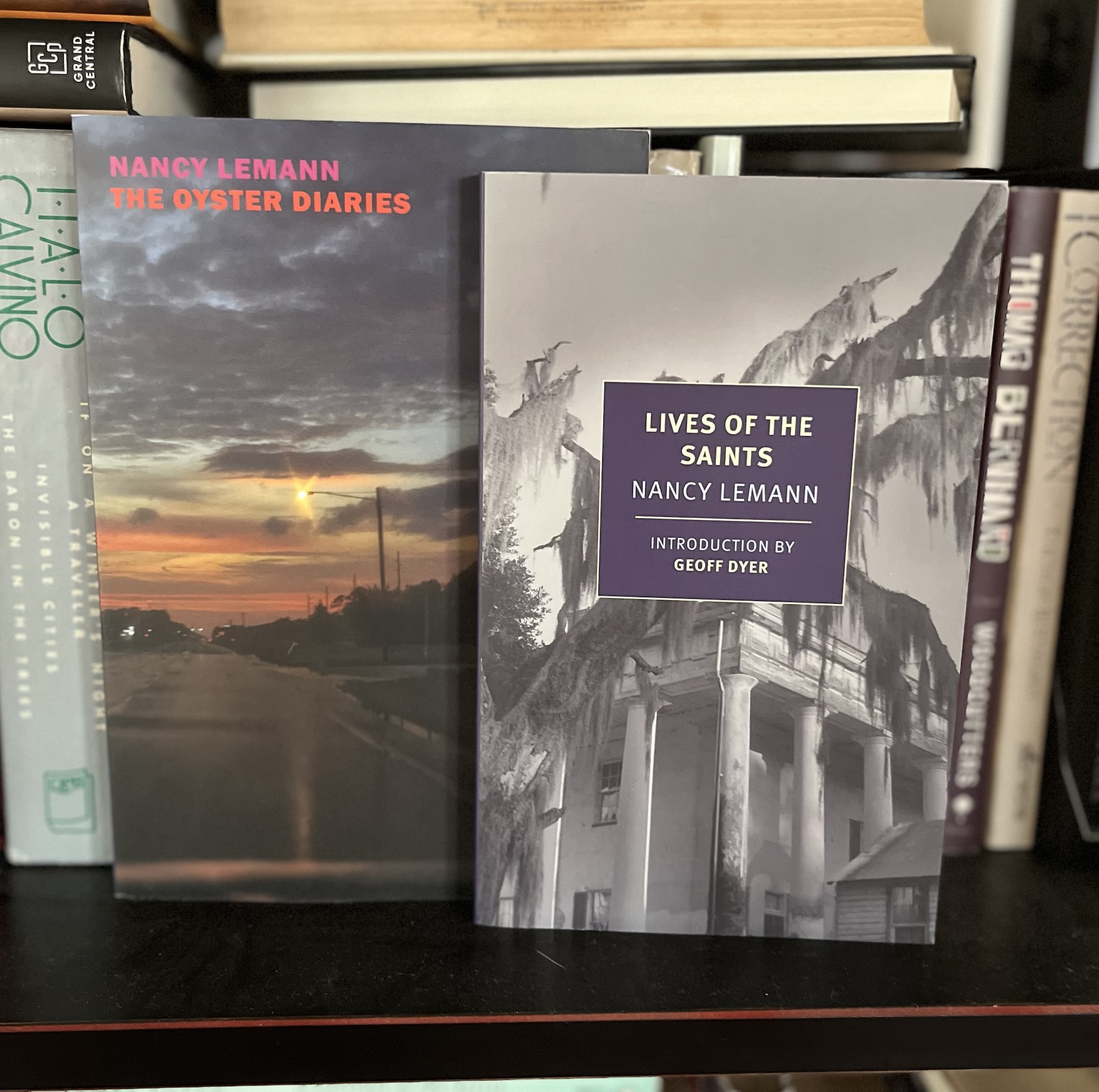
NYRB is reissuing Nancy Lemann’s 1985 novel Lives of the Saints next month. Her most recent novel, The Oyster Diaries is a sort of sequel to that early cult novel. From Geoff Dyer’s introduction to Lives of the Saints:
I want to believe that there is always a trail, however faint, leading readers back to a book that, like a hiker lost in the wilderness, is on the brink of perishing. But where does the trail start? In 2020, one of my undergrads at the University of Southern California told me that her mum was a writer. Good for her, I thought. The following week, my student said I’d really like her mum’s writing and offered to bring in a book by her. Um, okay. At the end of the semester, she gave me a harmless-looking paperback called Lives of the Saints, published in 1985 by Louisiana State University Press. I put this little book on a shelf in my office and forgot about it.
In 2023, the writer Heather McGowan texted to tell me about a “bonkers” novel by someone called Nancy Lemann that she was sure I’d like. I ordered it online. Didn’t look very promising: a print-on-demand book published by Louisiana State University Press. But, after the book arrived, I started reading and within half a dozen pages was as besotted as the narrator, Louise, is by Claude, one of the family of “saints” (the Colliers by name) whose lives—and a death—swim around her in a cocktail- and heat-soaked New Orleans. She adores Claude for his generosity, kindness, and wisdom (the three are synonymous in her view), and also because he’s on the brink of dereliction and collapse—as are many people in the book. She hangs on his every word, but these words, delivered in the family’s “curious deadpan” and often unfolding in the midst of binges or their hungover aftermath, are nonsensical, “idiotic.” She can’t stop listening to them, and I couldn’t stop reading them, or those of Claude’s little brother, a boy actually called Saint who, out of nowhere, announces, “There’s a certain meteorite in the sky, and it’s all made up of plasma.” Oh, and let’s not forget Mrs. Stewart, “an intelligent woman” who tells Louise that the thing she remembers most vividly from her youth is either “that little red hat which I wore in the summer of . . . 1912” or the “shoe sizes her friends wore in 1910.” Mrs. Stewart gets on with her daughter-in-law Julia because they happily spend “many hours talking about details of girlhood attire, and other lame-brained elements of clothing through the decades.”

 Biblioklept
Many moons ago I was introduced to the two NL novels by a great friend – sadly now dead. His life arc was somewhat Claudian (including a ‘Breaking Bad Period’ ) that did not reflect well on him.
I was so happy when I read of her new book – and given how the world wags happiness has been in short supply.
Thank you for encouraging others to find Nancy Lemann. A good act is it’s own reward.
Sheridan Swinson Aardvark Books, Brampton Bryan Shropshire
LikeLiked by 1 person
The day I heard she was back in print I bought a derby hat to celebrate. Made me feel like an o.g. I remember Nancy from a bout of college, as an unusually interesting and compassionate classmate in a music class, who turned me on to Randy Newman when Randy Newman was still quite niche. Real cause for celebration here.
LikeLiked by 1 person
I loved loved loved Lives of the Saints…very cool!
LikeLike