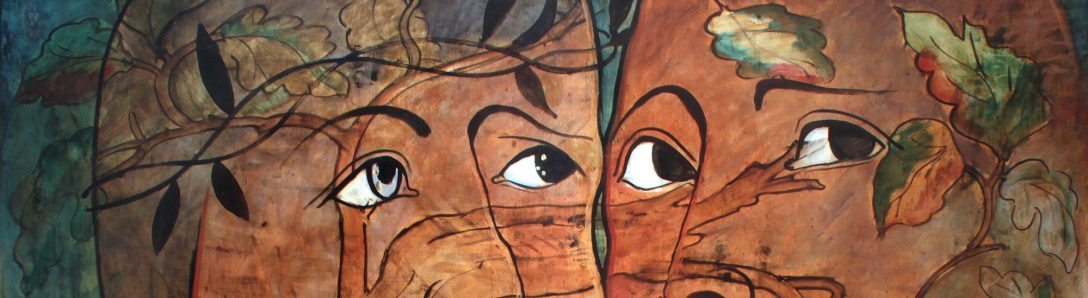
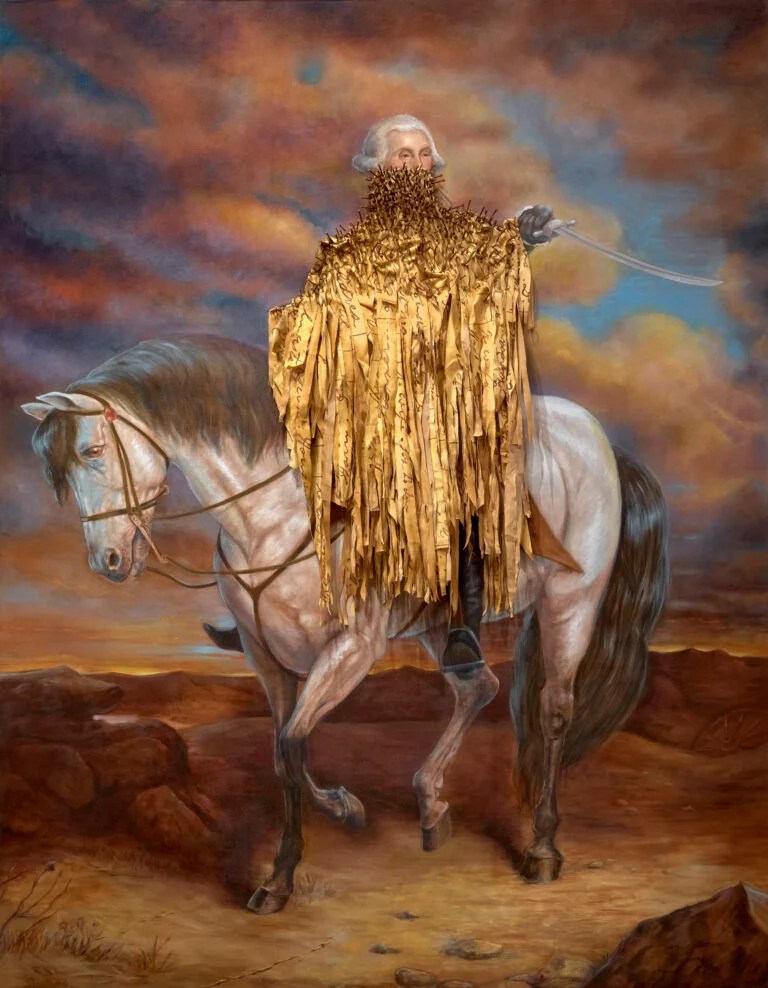
William T. Vollmann has published a long essay, “American Ephemera,” in the latest issue of Harper’s. The essay is larded with citations, illustrations, and other “ephemera.” Here are the opening paragraphs of Vollmann’s preamble to the essay, “An Explanation”:
What dimensions has our America? I propose to offer you this antique measuring stick, with a few of my own prejudices rudely gashed in.
Just because the Founders said it hardly makes it so. Moreover, just because I have read some of them here and there hardly proves that I understand them. Fifty years after the signing of the Declaration of Independence, the Supreme Court’s longest-serving chief justice expressed sour expectations of my abilities: “Those who follow us,” wrote John Marshall, “will know very little of the real transactions of our day, and will have very untrue impressions respecting men and things. Such is the lot of humanity.” Indeed it is. Picking through his relics, I uncover one such disarticulated “real transaction,” dated 1788: “He told us that the principal danger arose from a government which, if adopted, would give away the Mississippi.” Tucking that item back into its coffin of irrelevance, I rake through kindred ephemera, hoping for something to serve our day—for although Marshall could hardly foresee my real transactions, maybe it will suffice that he loved the Constitution, hoped it would endure while fearing it wouldn’t, and did his best to operate its checks and balances with impartial fairness and benevolence: “a government of laws, and not of men.”
By “men” he meant white men who ideally would be Christian property owners. He owned slaves, whose humanity he acknowledged without opening his eyes to their rights. He married his Polly, loved her until the end, trusted her advice, but never thought her fit to vote. Well, the world changes; what else can it do? “It is not for the dead to give laws to the living,” remarked John Quincy Adams. “Prospective legislation upon the most uncertain of contingencies . . . is the broken column and mutilated inscription of Eternal Rome.” But since an array of brave, well-meaning, and often divergent minds (consider the bad blood between Marshall and Thomas Jefferson, with whom John Adams also feuded) could construct a triple-walled fortress of coherence in which our freedoms could dwell, and since, in this two-hundred-fiftieth year since 1776, the house still stands, improved by amendments and, thanks to its separation of powers, only partially corrupted, then I say the Founders built awfully well, at least for me. If I were black, or a woman, I might feel less grateful. All the same, they introduced the notions of equal rights and equal representation, leaving to us, as ancestors will, the task of making their house less imperfect. They knew “the lot of humanity,” the slime within us, for it was in them also.


