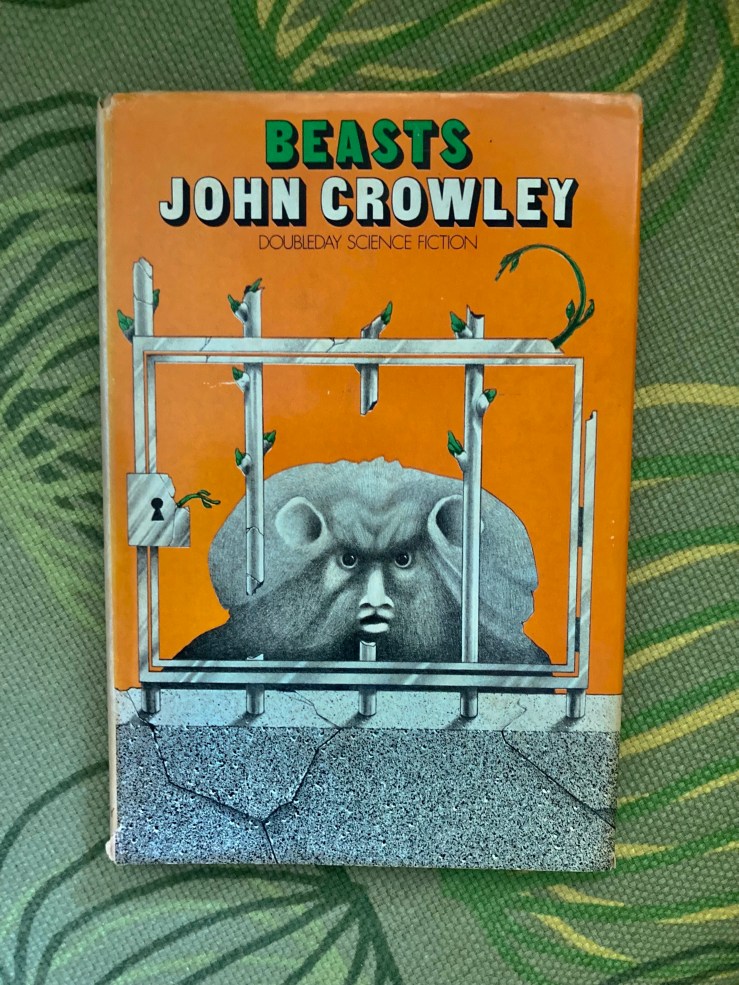
Blog about John Crowley’s novel Beasts

I finished John Crowley’s 1976 novel Beasts this morning. Loved it.

Beasts is not quite 200 pages, each of its nine chapters centering on a different character’s perspective. Crowley’s writing is rich and poetic here, as readers of his 1981 opus Little, Big might expect. In that novel, likely his most famous, Crowley conjures a vast, deep, detailed world; Little, Big is big big.

Beasts is little big: each of its nine chapters might be read as a short story in which we get a glimpse from one perspective at a balkanized, dystopian post-USA. A species of genetic hybrid called leos are corralled on reservations or outright hunted by the militant Union for Social Engineering; what remains of the Federal Government vies for control with various Autonomous zones; utopian cultists try to hide from the world; slavery has returned under the guise of contractual indentured servitude. A mutant fox, the trickster Reynard, plays kingmaker behind the scenes. The nine chapters refuse to explicitly connect the pieces of the world the present; that is the job of the reader. As Joachim Boaz puts it in his excellent, thorough review of the novel,

Beasts embodies a fascinating dialogue between nature and civilization, man and animal…  Do not expect a straightforward narrative for many chapters function more as mood pieces.  Each is part of a mosaic of images, characters, and philosophies that struggle to survive, or are altogether snuffed out, in a rapidly collapsing Old Order.

That imminent collapse is where Beasts leaves us, its final line a utopian promise: Shall we begin?

“The She-Wolf” — Saki

“The She-Wolf” by Saki

Leonard Bilsiter was one of those people who have failed to find this world attractive or interesting, and who have sought compensation in an “unseen world” of their own experience or imagination—or invention.  Children do that sort of thing successfully, but children are content to convince themselves, and do not vulgarise their beliefs by trying to convince other people.  Leonard Bilsiter’s beliefs were for “the few,” that is to say, anyone who would listen to him.

His dabblings in the unseen might not have carried him beyond the customary platitudes of the drawing-room visionary if accident had not reinforced his stock-in-trade of mystical lore.  In company with a friend, who was interested in a Ural mining concern, he had made a trip across Eastern Europe at a moment when the great Russian railway strike was developing from a threat to a reality; its outbreak caught him on the return journey, somewhere on the further side of Perm, and it was while waiting for a couple of days at a wayside station in a state of suspended locomotion that he made the acquaintance of a dealer in harness and metalware, who profitably whiled away the tedium of the long halt by initiating his English travelling companion in a fragmentary system of folk-lore that he had picked up from Trans-Baikal traders and natives.  Leonard returned to his home circle garrulous about his Russian strike experiences, but oppressively reticent about certain dark mysteries, which he alluded to under the resounding title of Siberian Magic.  The reticence wore off in a week or two under the influence of an entire lack of general curiosity, and Leonard began to make more detailed allusions to the enormous powers which this new esoteric force, to use his own description of it, conferred on the initiated few who knew how to wield it.  His aunt, Cecilia Hoops, who loved sensation perhaps rather better than she loved the truth, gave him as clamorous an advertisement as anyone could wish for by retailing an account of how he had turned a vegetable marrow into a wood pigeon before her very eyes.  As a manifestation of the possession of supernatural powers, the story was discounted in some quarters by the respect accorded to Mrs. Hoops’ powers of imagination.

However divided opinion might be on the question of Leonard’s status as a wonderworker or a charlatan, he certainly arrived at Mary Hampton’s house-party with a reputation for pre-eminence in one or other of those professions, and he was not disposed to shun such publicity as might fall to his share.  Esoteric forces and unusual powers figured largely in whatever conversation he or his aunt had a share in, and his own performances, past and potential, were the subject of mysterious hints and dark avowals.

“I wish you would turn me into a wolf, Mr. Bilsiter,” said his hostess at luncheon the day after his arrival. Continue reading ““The She-Wolf” — Saki”