2025 was in several ways one of the more fucked up and challenging years of my life. (This sentiment might be familiar to you and yours and many others.) But it was the year I finally learned to take a nap, thanks in part to an anecdote shared by the late novelist Philip Roth.
I have always been jealous of folks who can sleep on planes, in cars, on buses and far more jealous of people who can, like, choose to take a nap. I have envied people like my wife or my daughter or son or brother, who can just, like, conk out for twenty minutes and arise revived. It’s hard enough for me to fall asleep for six or seven or eight hours. As a child I remember reading that Napoleon Bonaparte was very good at taking cat naps, particularly before battles. I don’t know why but this factoid, true or false, made a huge impression on me as a kid. Napping has always seemed like a hidden key to focusing one’s energies.
I couldn’t nap but I was great at staying up for days at a time, particularly in my twenties. I also learned how to make my mind stop, to shut the whole thing down, but that wasn’t napping; it was passing out. None of this was or is healthy behavior.
Late last year a good friend of mine told me he’d picked up most of Philip Roth’s novels at an estate sale or a garage sale or some such. He’d been zipping through them and What do you think of Roth? he asked and I replied something like, I tried — it was Portnoy’s Complaint which I lifted from the Barnes & Noble when I was fifteen and then a few years later the first fifty pages of American Pastoral and all of The Human Stain and then giving up on The Plot Against America. And that was more or less it.
But maybe a year or two before this friend recommended my trying Roth, I’d read on the goddamned website Twitter an excerpt from a Philip Roth interview that stuck with me, primarily because of my desire to become a napper. It was a little screenshot, an excerpt from a 2013 puff piece with NPR celebrating Roth’s becoming an octogenarian. Here is the nap nugget:
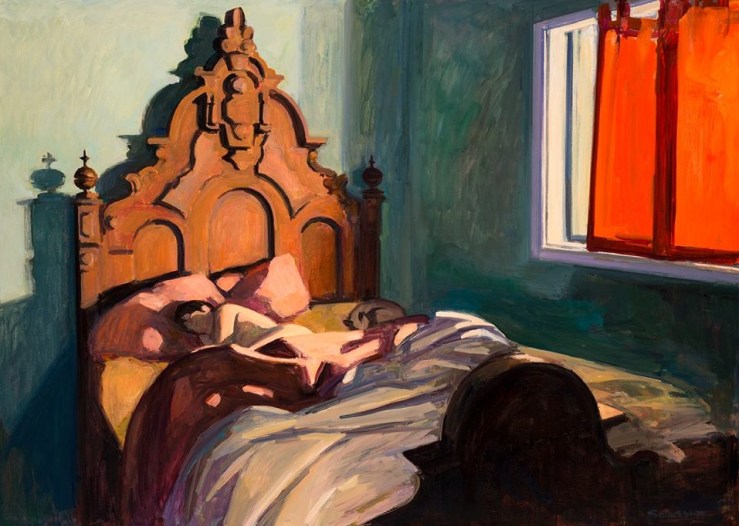
Now that he’s not working every day, though, Roth says he’s savoring a gentler pleasure: naps. “Let me tell you about the nap,” he laughs. “It’s absolutely fantastic. When I was a kid, my father was always trying to tell me how to be a man, and he said to me, I was maybe 9, and he said to me, ‘Philip, whenever you take a nap, take your clothes off, put a blanket on you, and you’re going to sleep better.’ Well, as with everything, he was right. … Then the best part of it is that when you wake up, for the first 15 seconds, you have no idea where you are. You’re just alive. That’s all you know. And it’s bliss, it’s absolute bliss.”
My friend’s recommendation to return to Roth recalled this bit of advice and I started to practice it this year, now in my late forties. It has worked for me (or maybe my body has just gotten so old that all the cells and systems and such have agreed to allow consciousness to pause for twenty minutes on a Thursday afternoon). I think Roth’s dad’s advice works because it involves a commitment to the nap. Natural nappers like my lovely wife can shut it down on a couch with the second half of Gillian Armstrong’s 1994 adaptation of Little Women on the teevee, or drift off for a postprandial half-time siesta like an uncle after some ham and turkey and Pinot noir. Natural nappers are blessed; some of us have to work for it though.
I’ve added a few moves to Roth’s simple repertoire — shutting the door, closing the blinds, putting my phone in a different room. The hardest bit though, at first, was consciousness itself, some parcel of images and words and sounds intervening in blips in my mind’s eye when I tried to shut it all down. I remember as a kid being told to count sheep, or count numbers, to visualize the sheep or the numbers.
This bad count the sheep advice led me to realize that my mind stacks images on each other; or, not really stacks images so much as holds images — that when I’m not focused on external sensory input, like, when I’m supposed to be turning off, going to sleep, my mind’s eye (for lack of a better metaphor) has decided to rustle through my imagination and memory to layer visual (and to a much lesser extent, auditory) sensations in thick bundles. My trick this year has been to relax into the image bundle without attempting to make it cohere; I try to feel the blanket on my skin. I think I’ve gotten better at breathing, too.
I like napping. I have taken it up as a midlife hobby. It has made my life better in exactly the kind of way I had hoped it would — a small, minor, gift I thought would never be mine. Maybe I’ll even reach that bliss Roth mentions. But I’m fine without it.
 Biblioklept