
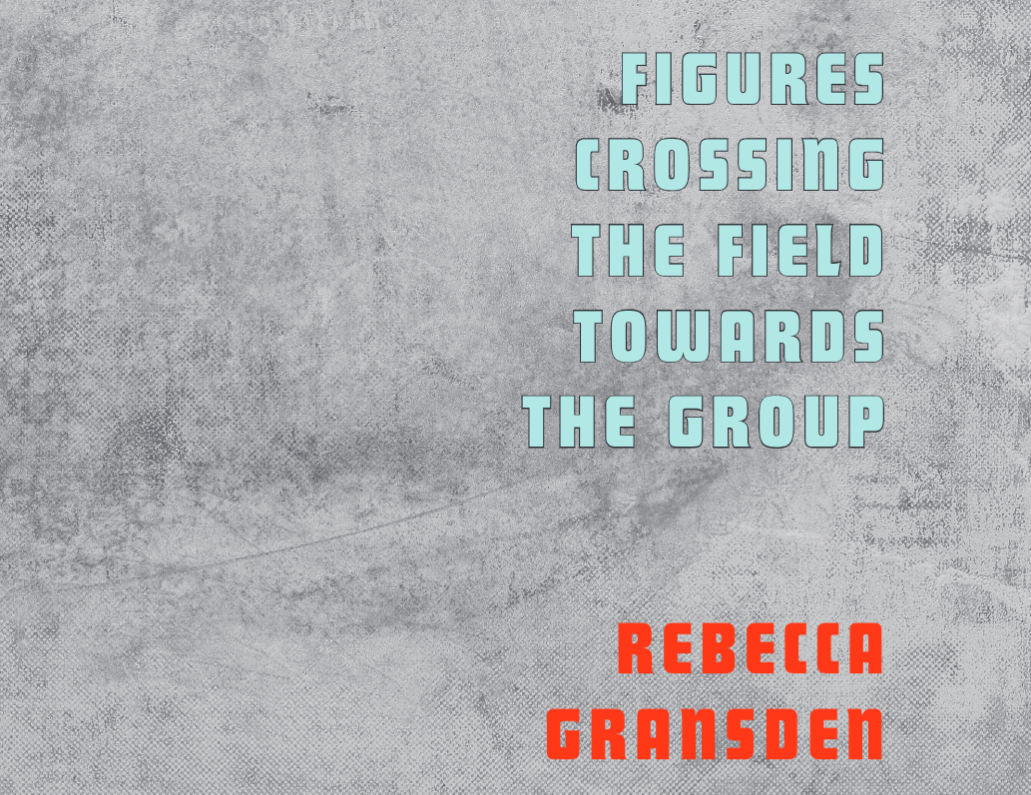
In Rebecca Gransden’s novella Figures Crossing the Field Towards the Group, an unidentified blight spreads from the south of England, driving refugees northward. Our hero, a girl named Flo, walks north through this ruined England on a quest to find her lost twin brother. In her strange journey, Flo encounters scattered figures who spill fragmented stories in broken voices. This England is barren, etiolated, and foul. Gransden conjures this apocalyptic barrenness in oblique and elliptical language. Most of the narration in Figures Crossing the Field Towards the Group slips out in clipped single-syllable beats, as if the world itself has been pared down to bone. The book’s end-times aren’t explosions or spectacle but the exhausted rhythms of a world already gone, the voice itself a survivor stumbling forward, blunt and breathless. What remains is not plot so much as the scraping of words against ruin.
And yet, within that scraped-down ruin, Gransden finds a strange fullness: stark fields and broken voices bloom with uncanny images, fleeting surges of feeling, flashes of lyric intensity that make the blasted landscape thrum with life even as it crumbles. Consider this passage, in which our hero Flo encounters a band of freed apes:
Howls eke out through branch and twig, and bods slink down the fell trunks, climb in shift shads on the broke build roof, a mess of swol leaves and wet spikes. Lab apes crawl and tick, their mugs stretch flesh, their heads bolt. Freed by the flee, and left to lone, their house fell in and they, shy and of wound nerve, did peek to the wood, and then run out and claim the trees. They stay near to where they know, fear keeps them so. One ape chomps on a bat, its legs kick as it dies. Most of the lab apes have one eye, a square patch of bald skin, a rash and some scabs.
Figures propels forward with a loose, picaresque energy, its moody, elliptical atmosphere stretched across an almost shapeless structure. It’s best not to look for causality here; things just happen. This isn’t post-apocalyptic fiction. The apocalypse is underway. And Gransden’s language drifts on the fumes of that apocalypse. I often found myself reading lines aloud, even repeatedly, in gnarly little loops: “Town rats puff with nits in their ruffs” is a simultaneously abject and beautiful image. Or consider this lovely little passage:
A shock of white moth wings sings from the shrubs, makes Flo step back and near fall. White flies round her like a snow storm, and moth dust fills the small grove. A film forms on dark leaves and the air smells of old nests. Moths brush her,just close to push a soft stroke on her face. Small round white moths, small white moth round.
The monosyllabic narrative style that dominates Figures may challenge or, more frankly, irritate some readers. I found it hypnotic. Gransden’s characters are not bound to single syllables though. When Flo talks to someone she encounters (an insane royalist, say, or a man sacrificing his body as food to tiny furry beasts), they speak in normal, multi-syllabic dialogue. More fascinating is a solitary chapter that divides the novella in halves. “Public Information Dreams” reads almost like its own Ballardian short story. Told in a clinical, detached style, the chapter gives an incomplete picture of observations made from afar on two children, Kid P and Kid Q. A taste:
Observer: 35
Day: 163
10:37:45 am — Kid Q exits property by back door (3b) and moves to end of garden. Weather is bright sunshine, occasional cloud shadows. No occlusion. Kid Q walks back and forth between end of garden and house, carrying objects. Objects observed to be recording equipment as previously noted (ID476). Kid Q collects the objects together on an empty patch of lawn behind the garden shed. The patch of lawn is square and is mostly unseen from the house. It ends at an overgrown fence, approx. 6ft tall that marks the perimeter boundary of the property’s rear. Beyond the rear fence are fields but the garden is not visible from this location due to the density of the foliage (full description and photographs of the layout of the property and garden are included in additional notes, at this time in the process of compilation). Kid Q assembles the recording equipment. Video camera on tripod is situated in the corner behind the shed and arranged to point across the lawn square diagonally, taking in as much of the space as possible.
10:52:13 am — Kid P exits house by the open back door (3b). Observed to have a listless demeanour. Kid P joins Kid Q. Kid Q and Kid P engage in long conversation (see transcript).
Are Kid Q and Kid P Flo and her brother? If you care, this book probably isn’t for you.
Too, Gransden refuses to settle Flo’s quest—or the apocalypse itself—into any final meaning. The ruined England she describes is not a backdrop but a language, one that stutters, doubles back, and opens fissures rather than closing them. Flo walks north, chasing the shadow of her brother, but whether she finds him, or whether there is anything left to find, hardly matters. What matters is the walking, the scraping of words across ruin, the pulse of strange life inside the waste. Figures Crossing the Field Towards the Group dwells in that space where endings blur into continuations, where survival is indistinguishable from loss, and where language itself flickers like the last light left to see by. Strange, gnarly, alive–great stuff.
 Biblioklept