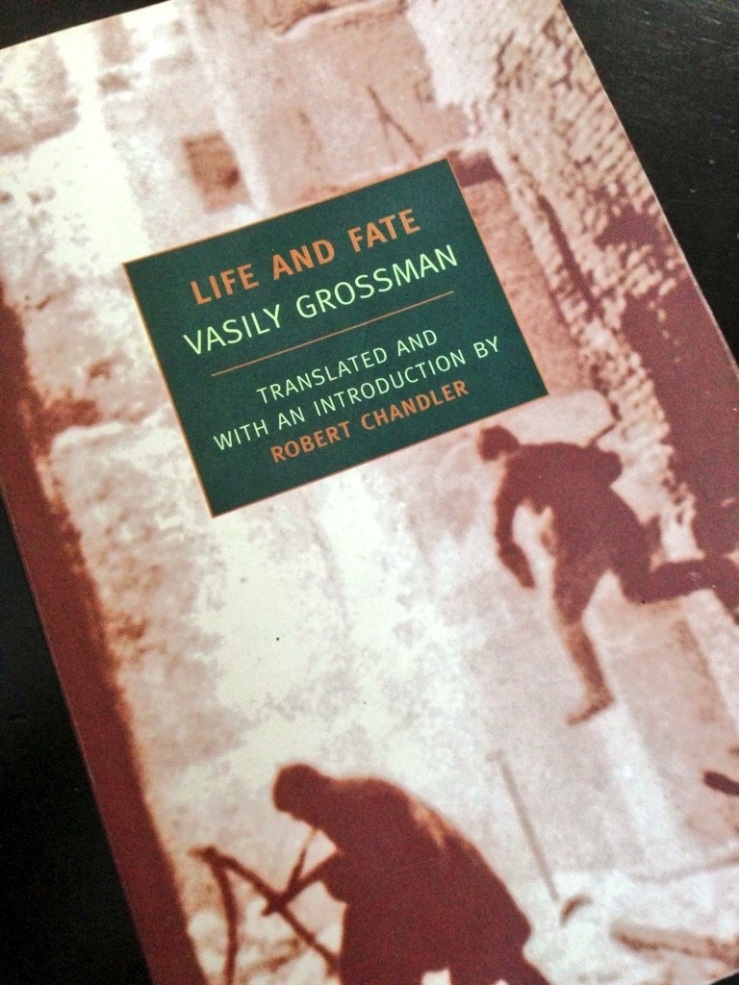
Vasily Grossman’s Life and Fate (Book Acquired, 6.14.2013)

20130617-133539.jpg

Big thanks to Mr. BLCKDGRD for sending me this copy of Vasily Grossman’s enormous novel Life and Fate. Over the past few years I’ve come to admire and trust BLCKDGRD’s taste, and I generally love these types of novels, so I’m looking forward to getting into this later in the year.

Here’s publisher NYRB’s blurb:

A book judged so dangerous in the Soviet Union that not only the manuscript but the ribbons on which it had been typed were confiscated by the state, Life and Fate is an epic tale of World War II and a profound reckoning with the dark forces that dominated the twentieth century. Interweaving a transfixing account of the battle of Stalingrad with the story of a single middle-class family, the Shaposhnikovs, scattered by fortune from Germany to Siberia, Vasily Grossman fashions an immense, intricately detailed tapestry depicting a time of almost unimaginable horror and even stranger hope. Life and Fate juxtaposes bedrooms and snipers’ nests, scientific laboratories and the Gulag, taking us deep into the hearts and minds of characters ranging from a boy on his way to the gas chambers to Hitler and Stalin themselves. This novel of unsparing realism and visionary moral intensity is one of the supreme achievements of modern Russian literature.

Read our review of Grossman’s novel The Road.


Book Acquired, 1.19.2012 — The Future of Ice

20120124-220452.jpg

Big thanks to Biblioklept reader (and frequent commenter) ccllyyddee, who sent me his copy of Gretel Ehrlich’s The Future of Ice. I dipped into it a bit this weekend; Ehrlich seems to be walking that strange line between the physical and metaphysical. A description from her website–

In this gripping circumnavigation of the Arctic Circle, Gretel Ehrlich paints a vivid portrait of the indigenous cultures that inhabit the starkly beautiful boreal landscape surrounding the Arctic Ocean, an ice-bound wilderness that includes northern Siberia, northwestern Greenland, Canada’s vast Nunavut, and northern Alaska. Ehrlich’s expedition, supported by the National Geographic Society, documents what remains of these cultures, specifically the similarities and differences among them, including hunting traditions, shamanic and ceremonial practices, languages and legends—the ways in which they have survived, or have been assimilated, and how they are adapting to the impact of climate change on their ice-age cultures.

Ehrlich is fascinated by what she calls the ecology of culture—the ways in which the human presence of indigenous Arctic people is intricately interwoven with land, rock, river, sea, and ice. Depicting human-caused climate change as only the latest and most destructive of the ills and abuses first peoples have been suffering for 250 years, Ehrlich’s haunting and lovely prose portrays ancient tribes and traditions on the edge of extinction and captures the austere beauty of their various lifeways in the frozen dreamscape of the world they have always known.