
Cheat Code

Motoko Rich’s article “The Future of Reading,” published in today’s New York Times, discusses the emerging trend in publishing and education of reaching out to young readers via video games. According to the article–

Increasingly, authors, teachers, librarians and publishers are embracing this fast-paced, image-laden world in the hope that the games will draw children to reading. Spurred by arguments that video games also may teach a kind of digital literacy that is becoming as important as proficiency in print, libraries are hosting gaming tournaments, while schools are exploring how to incorporate video games in the classroom. In New York, the John D. and Catherine T. MacArthur Foundation is supporting efforts to create a proposed public school that will use principles of game design like instant feedback and graphic imagery to promote learning.

Loyal readers will recall that last year I wrote quite positively about the MacArthur grant to promote gaming literacy. However, the trend detailed in today’s article seems like a big step in the wrong direction. While graphic design and computer programming are vital skill sets we should be teaching our kids, trying to hook them on reading through video games is altogether different. It smacks of cheap gimmickry that dismisses outright that reading might be a pleasure unto itself. In an age when the majority of college students can’t handle complex but necessary reading tasks and high school illiteracy rates are woefully underreported, trying to hook kids on books with Dance Dance Revolution just doesn’t seem like a great plan. If anything, it’s yet another step in the dumbing-down of America, a land increasingly hostile to anything with a hint of intellectualism–reading included. No wonder the Nobel Committee are such dicks to the U.S. Buried at the end of the article, luckily, is a voice of reason–

“I actually think reading is pretty great and can compete with video games easily,” said Mark S. Seidenberg, a professor at the University of Wisconsin in Madison who specializes in reading research. “So rather than say, ‘Oh, books are irrelevant in the modern era because there are all these other media available,’ I would ask shouldn’t we be doing a better job of teaching kids how to read?”

Professor Seidenberg seems like a wise and reasonable man. Let’s hope that we can get this country back on track and realize that the skill sets needed to survive and compete in a technological world do not replace but rather augment traditional literacy. Video games are great entertainment but it’s hard to imagine that they could ever trump the depth and breadth of philosophy and cultural currency contained in literature. Let’s not cheat our children out of that heritage by mistakenly believing that they cannot be taught to access it.
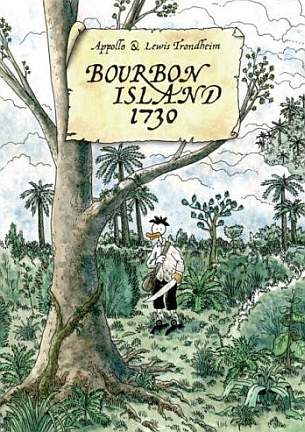
Bourbon Island 1730 — Olivier Appollodorus and Lewis Trondheim

Bourbon Island 1730, part funny animal graphic novel, part historical literature, recounts the story of Raphael Pommeroy who travels from France to Bourbon Island with his ornithology professor in search of a living dodo. On the journey to the French colony, Raphael becomes entranced by pirate tales, and when he arrives to Bourbon Island, he immediately tries to join up with some ex-pirates–unsuccessfully, of course. The French government has offered an amnesty to all pirates, and many have become successful plantation owners. However, their new wealth comes at the expense of the large population of slaves brought to Bourbon Island from Madagascar and Mozambique. The most interesting subplot of Bourbon Island 1730 involves a network of maroons, runaway slaves who have colonized their own villages at the top of the island’s treacherous terrain. When the notorious pirate Captain Buzzard is captured, some of the maroons plan to set him free and lead a revolt against the French colonials. In the meantime, the colonial authorities, including the scheming governor and the greedy priest, are trying to get Buzzard to reveal where he’s hidden a large cache of treasure.

Lewis Trondheim’s art strikes a nice balance between vivid detail and the classic funny animal style, and the book’s measured pacing delivers the story at a nice clip. Appollodorus and Trondheim never rush, taking the time to convey the cultural complexity of Bourbon Island–quite a feat, really, when you consider how much is going on here: the end of a pirate age, the horrors of slavery, and the problematics of colonization. Appollodorus and Trondheim envision Bourbon Island as a strange nexus of slavery and freedom, piracy and central authority, of the meeting of the cultures of Africa, India, and Europe. Leading man Raphael is a hopeless romantic who pines wistfully for the absolute freedom he sees as the life of a pirate and the natural right of all men. And yet, as the book makes clear, idealism can rarely stand up to the corrosive complexity of the real world.

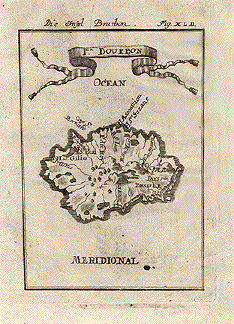
Allain Mallet's 1719 Map of Bourbon Island

With twelve pages of endnotes, Bourbon Island 1730 is just the kind of well-researched historical fiction that would fit neatly into any post-colonial studies course. There’s only one major fault with the book: it ends too quickly. Appollodorus and Trondheim have too many fascinating subplots that they don’t bother to resolve. While we have no problem with ambiguous conclusions, Bourbon feels simply rushed at the end, as it sprints to a virtual non-conclusion. We would’ve been much happier with a cliff-hanger and a promise of a part two. Nonetheless, anyone interested in colonialism and post-colonial studies should check out this book.

Bourbon Island 1730 is available October 28th, 2008 from First Second.