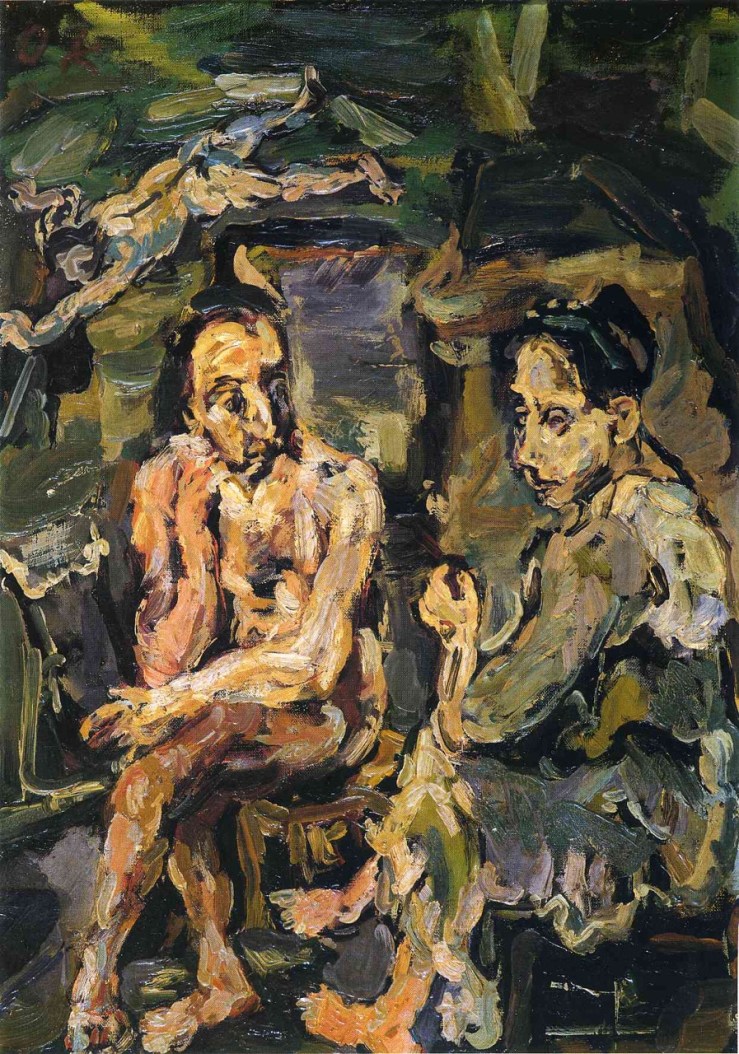
Orpheus and Eurydice — Oskar Kokoschka

ok

A daily diet of morning mist – from Bruce Chatwin’s The Songlines


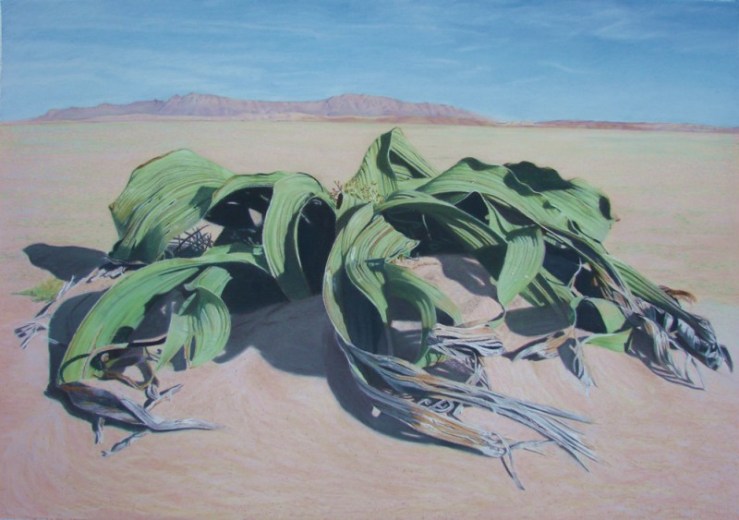
Welwitchia-Louise Nienaber.jpg

It was nonsense, Dr Vrba continued, to study the emergence of man in a vacuum, without pondering the fate of other species over the same time-scale. The fact was that around 2.5 million, just as man took his spectacular ‘jump’, there was a ‘tremendous churning over of species’.

‘All hell’, she said, ‘broke loose among the antelopes.’

Everywhere in eastern Africa, the more sedentary browsers gave way to ‘brainier’ migratory grazers.  The basis for a sedentary existence was simply no longer there.

‘And sedentary species,’ she said, ‘like sedentary genes, are terribly successful for a while, but in the end they are self-destructive.’

In arid country, resources are never stable from one year to the next. A stray thunderstorm may make a temporary oasis of green, while only a few miles off the land remains parched and bare. To survive in drought, therefore, any species must adopt one of two stratagems: to allow for the worst and dig in; to open itself to the world and move.

Some desert seeds lie dormant for decades. Some desert rodents only stir from their burrows at night. The weltwitchia, a spectacular, strap-leaved plant of the Namib Desert, lives for thousands of years on its daily diet of morning mist. But migratory animals must move – or be ready to move.

Elizabeth Vrba said, at some point in the conversation, that antelopes are stimulated to migrate by lightning.

‘So’, I said, ‘are the Kalahari Bushmen. They also “follow” the lightning. For where the lightning has been, there will be water, greenery and game.’
From Bruce Chatwin’s novel/memoir/travelogue The Songlines. The image is Welwitschia by Louise Nienaber.

The possibility of mislocation of the self (Donald Barthelme)

It was suggested that what was admired about the balloon was finally this: that it was not limited, or defined.  Sometimes a bulge, blister, or subsection would carry all the way east to the river on its own initiative, in the manner of an army’s movements on a map, as seen in a headquarters remote from the fighting.  Then that part would be, as it were, thrown back again, or would withdraw into new dispositions; the next morning, that part would have made another sortie, or disappeared altogether.  This ability of the balloon to shift its shape, to change, was very pleasing, especially to people whose lives were rather rigidly patterned, persons to whom change, although desired, was not available.  The balloon, for the twenty-two days of its existence, offered the possibility, in its randomness, of mislocation of the self, in contradistinctions to the grid of precise, rectangular pathways under our feet.  The amount of specialized training currently needed, and the consequent desirability of long-term commitments, has been occasioned by the steadily growing importance of complex machinery, in virtually all kinds of operations; as this tendency increases, more and more people will turn, in bewildered inadequacy, to solutions for which the balloon many stand as a prototype, or “rough draft.”

From Donald Barthelme’s short story “The Balloon.”