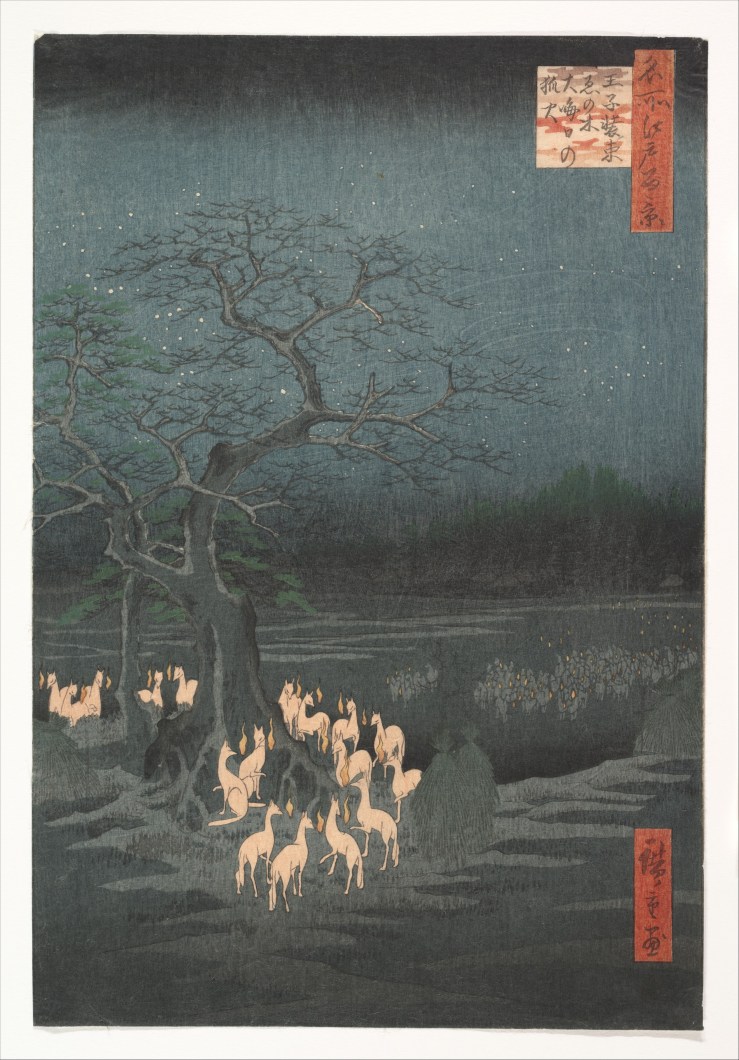
New Year’s Eve Fox-fires at the Changing Tree, Ōji — Utagawa Hiroshige

dp151598

Three Books (or, My three favorite reading experiences in 2016)

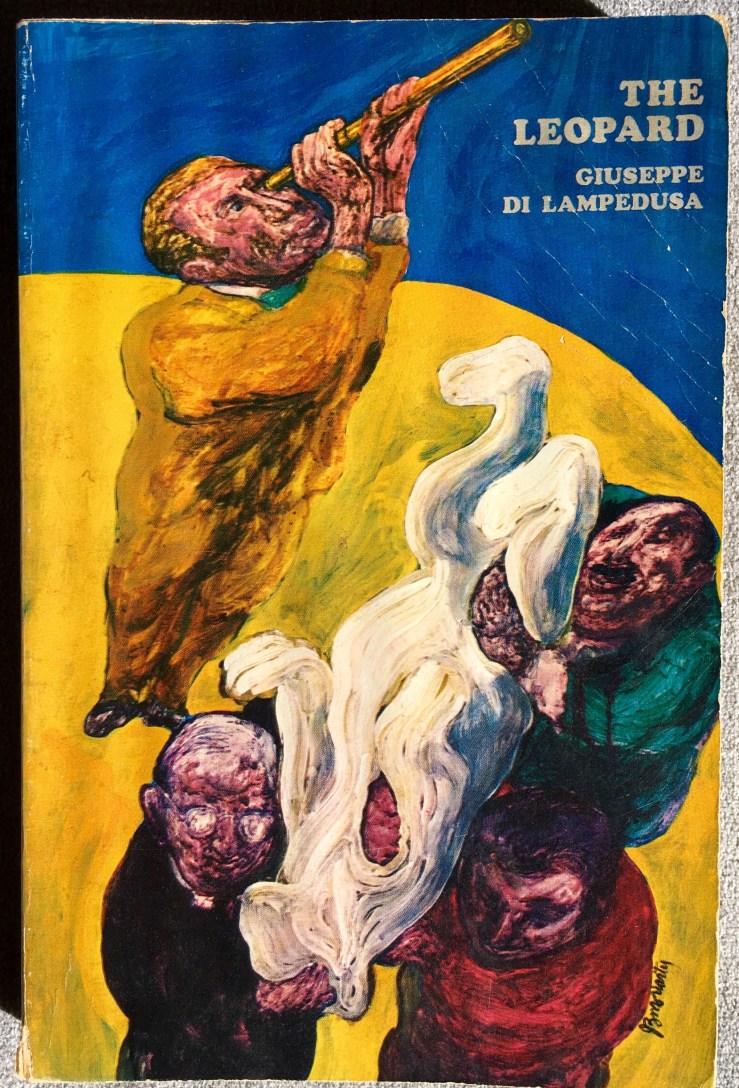
After years of false starts, I finally read Giuseppe Tomasi di Lampedusa’s 1958 novel The Leopard this August. Then I read it again, immediately. (It’s one of only two novels I can recall rereading right away—the other two were Blood Meridian and Gravity’s Rainbow). The Leopard tells the story of Prince Fabrizio of Sicily, who witnesses the end of his era during the Risorgimento, the Italian reunification. Fabrizio is an enchanting character, by turns fiery and lascivious, intellectual and stoic, and The Leopard takes us through his mind and through his times. He’s thoroughly complex, unknown even to himself, perhaps. The novel is impossibly rich, sad, electric, a meditation on death, sex, sensuality—pleasure and loss. More mood than plot, The Leopard glides on vibe, its action framed in rich set pieces: fancy balls and sumptuous dinners and games of pleasure in summer estates. But of course there is a plot—several strong plots, indeed (marriage plots and death plots, religious plots and political plots). Yet the narrative’s viewpoint characters keep the plots at bay, or mediate them, rather than propel them forward. Simply one of the better novels I’ve read in years, its final devastating images inked into my memory for as long as I have memory. (English translation by Archibald Colquhoun, by the way).

img_3290

The 43 stories that comprise Lucia Berlin’s excellent collection A Manual for Cleaning Women braid together to reveal a rich, dirty, sad, joyous world—a world of emergency rooms and laundromats, fancy hotels and detox centers, jails and Catholic schools. Berlin’s stories jaunt through space and time: rough mining towns in Idaho; country clubs and cotillions in Santiago, Chile; heartbreak in New Mexico and New York; weirdness in Oakland and Berkeley; weirdness in Juarez and El Paso. (Full Biblioklept review).

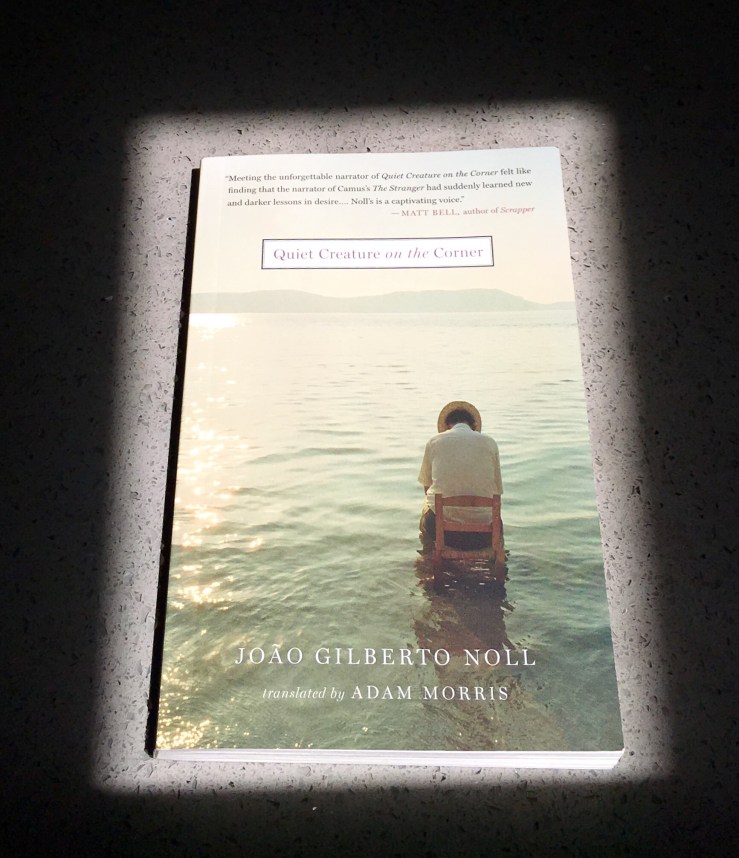
Brazilian writer João Gilberto Noll’s 1991 novella Quiet Creature on the Corner (English translation by Adam Morris; Two Lines Press) is probably best read without any kind of foregrounding or forewarning. The book is a nightmarish, abject, kinetic, surreal, picaresque read, a mysterious prose-poem that resists allegorical interpretation.  Quiet Creature on the Corner is like a puzzle, but a puzzle without a reference picture, a puzzle with pieces missing. The publishers have compared the novella to the films of David Lynch, and the connection is not inaccurate. Too, Quiet Creature evokes other sinister Lynchian puzzlers, like Roberto Bolaño’s 2666 (or Nazi Literature in the Americas, which it is perhaps a twin text to). It’s easy to compare much of postmodern literature to Kafka, but Quiet Creature is truly Kafkaesque. It also recalled to me another Kafkaesque novel, Alasdair Gray’s Lanark—both are soaked in a dark dream logic. Other reference points abound—the paintings of Francis Bacon, Leon Golub, Hieronymus Bosch, Goya’s etchings, etc. But Noll’s narrative is its own thing, wholly. (Full Biblioklept review).

A (probably incomplete) list of books I read in 2016

The Telling, Ursula K. Le Guin

Four Ways to Forgiveness, Ursula K. Le Guin

J R, William Gaddis*

The Inheritors, William Golding

American Candide, Mahendra Singh

Crossing the Sea with Syrians on the Exodus to Europe, William Bauer

Collected Stories, William Faulkner

A Temple of Texts, William H. Gass

Cow Country, Adrian Jones Pearson

Ancillary Justice, Ann Leckie

Ancillary Sword, Ann Leckie

Ancillary Mercy, Ann Leckie

Extinction, Ashley Dawson

My Brilliant Friend, Elena Ferrante

The Story of a New Name, Elena Ferrante

Those Who Leave and Those Who Stay, Elena Ferrante

The Story of the Lost Child, Elena Ferrante

Quiet Creature on the Corner, João Gilberto Noll

The Last Gas Station and Other Stories, Tom Clark

The Weight of Things, Marianne Fritz

The Transmigration of Bodies, Yuri Herrera

Miserable Miracle, Henri Michaux

The Franchiser, Stanley Elkin

Hell, Henri Barbusse

White Mythology, W.D. Clarke

The Dick Gibson Show, Stanley Elkin

The Charterhouse of Parma, Stendhal

Marketa Lazarova, Vladislav Vančura

A Manual for Cleaning Women, Lucia Berlin

Hildafolk series, Luke Pearson

The Leopard, Giuseppe di Lampedusa

There Is a Tree More Ancient Than Eden, Leon Forrest

Bear, Marian Engel

Jacob Bladders and the State of the Art, Roman Muradov

Gravity’s Rainbow, Thomas Pynchon*

The Absolute GravediggerVítězslav Nezval

Beyond the Blurb, Daniel Green

Last Evenings on Earth, Roberto Bolaño*

The Missing Books, Scott Esposito

Woodcutters, Thomas Bernhard

Flow My Tears, The Policeman Said, Philip K. Dick

* indicates a reread