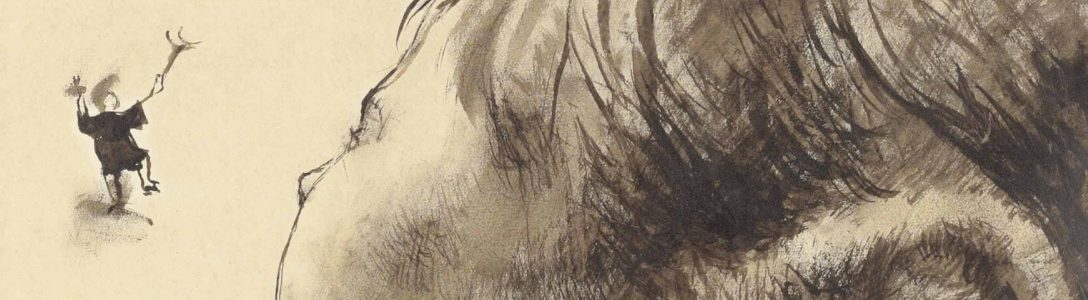
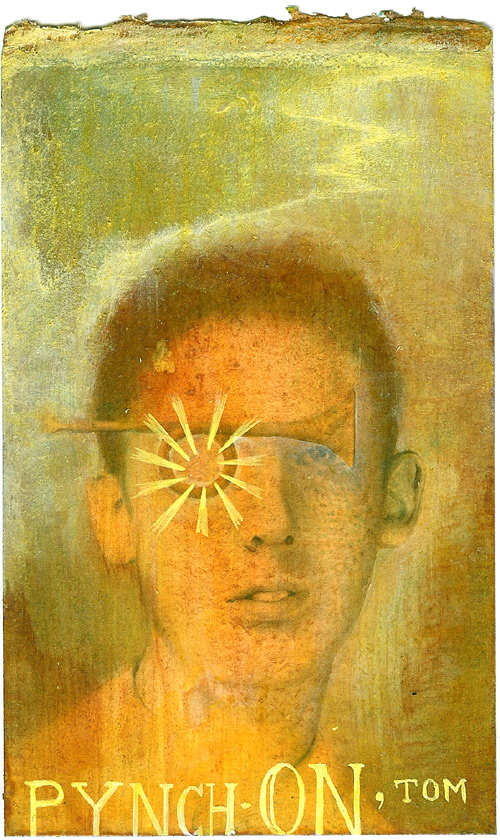
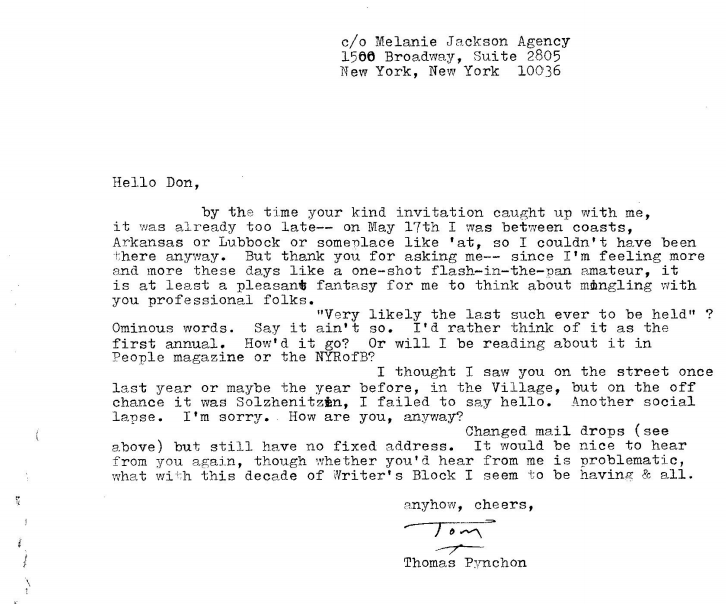
 To date, Thomas Ruggles Pynchon (American, b. 1937), has published eight novels and one collection of short stories. These books were published between 1963 and 2013. On this day, Thomas Ruggles Pynchon’s 81st birthday, I present my ranking of his novels. My ranking is completely subjective, essentially incomplete (in that I haven’t read two of Pynchon’s novels all the way through), and thoroughly unnecessary. My ranking should be disregarded, but I do not think it should be treated with any malice. You are most welcome to make your own ranking in the comments section of this post, or perhaps elsewhere online, or on a scrap of your own paper, or in personal remarks to a friend or loved one, etc. I have not included the short story collection Slow Learner (1984) in this ranking because it is not a novel.
Here is the list, ranked from not-greatest to greatest:
8. Bleeding Edge (2013)
I have never made it past the first thirty pages of Bleeding Edge, despite two attempts. I don’t even own it. I will probably read it in ten years and see something there that I didn’t see in 2013 or 2015 but for now, I’m not sure.
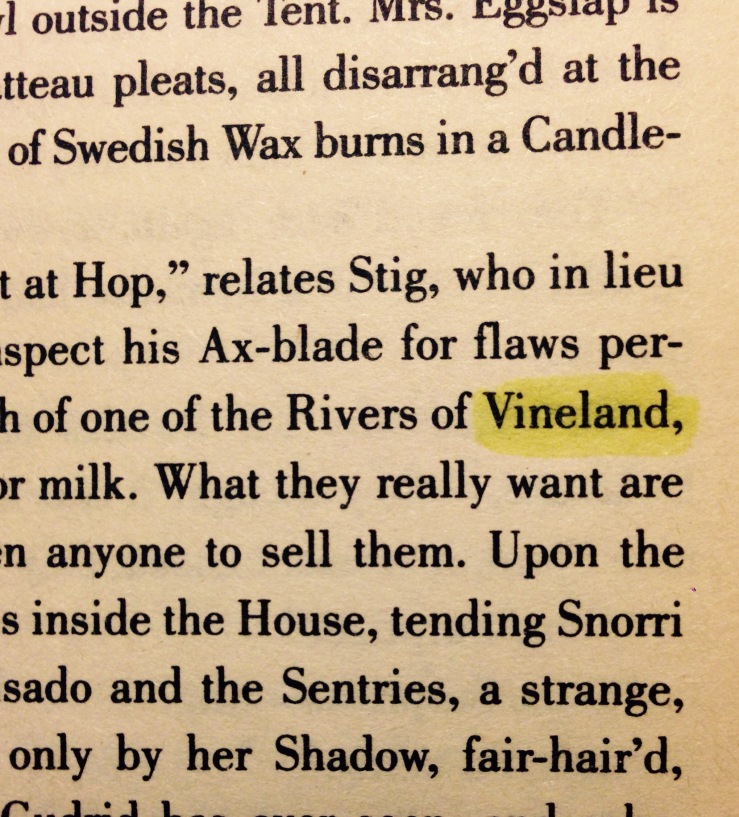
7. Vineland (1990)
Vineland is the other Pynchon novel I haven’t managed to finish. I’ve tried three times, including a semi-serious shot last year where I stalled after the fourth chapter (around 90 pages in). Vineland seems to have a strange status for Pynchon cultists—its a cult novel in an oeuvre of cult novels, I guess. Perhaps Vineland has a sturdier core to it than I can sense, but even though I dig the goofy humor, I haven’t yet found something to grab onto.
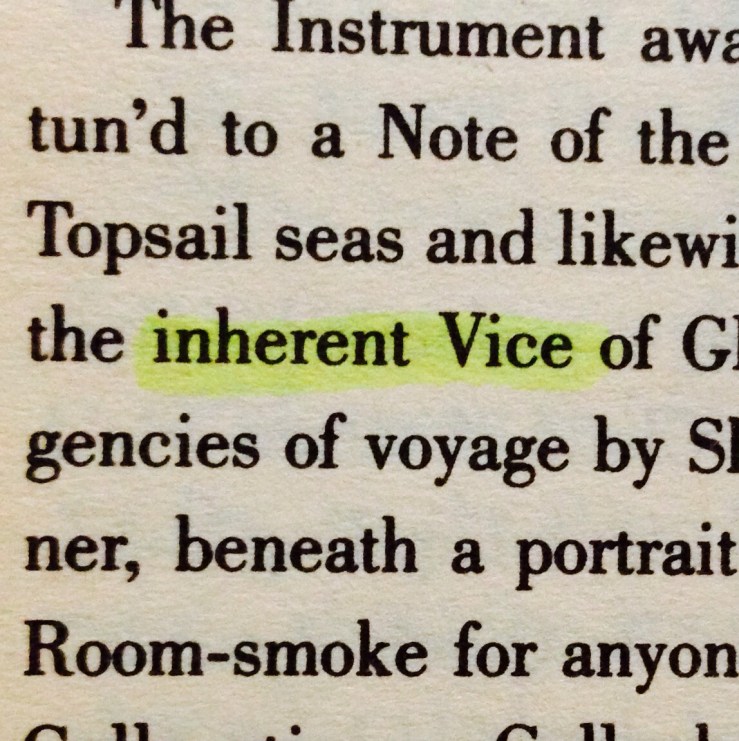
6. Inherent Vice (2009)
I love Inherent Vice. It has a bit of a reputation of being “Pynchon lite,” whatever that means, but I think it’s a much denser book than a first reading might suggest—its shaggy baggy breeziness coheres into something stronger on a second or third read. Inherent Vice is both a diagnosis of the sixties and a prognosis of a future to come.
5. V. (1963)
V. makes a good starting place for anyone new to Pynchon. Even though it’s his first novel, V. already stages Pynchon’s major themes (paranoia, technology, entropy, globalism) in an elastic and discursive narrative style and a zany (and sometimes sinister) tone. These elements continued throughout the next half century in Pynchon’s writing. V. shares a few characters with Gravity’s Rainbow, and in many ways it feels like a dress rehearsal for that bigger, grander, fuller novel—but it reverberates with its own richness. The ninth chapter, the story of of Kurt Mondaugen, is a particularly dark and decadent bit of writing.
4. The Crying of Lot 49 (1966)
The Crying of Lot 49 doesn’t so much convert paranoia into hope as it shows that the two are part and parcel of the same impulse of a consciousness that has to know that it cannot know. Pynchon’s dualities here feel new—paranoia/hope is wrapped into zaniness/horror. He sends us to escape into the labyrinth. I wrote new in the previous sentence, but Pynchon’s ambiguities resonate with American literature’s dark romantic traditions—Melville, Hawthorne, O’Connor, et al.
3. Against the Day (2006)
Against the Day glides into its sprawl, billowing out into genre trajectories that transcend the boundaries of the plot’s dates (1893-1918). Pynchon’s longest novel to date earns its 1,085-page run, pivoting between comic fantasy, high adventure, flânerie escapade, scientific treatise, and a byzantine global mystery—all weighed down by the ballast of rising modernism. Pynchon merges these styles, both “high” and “low,” into something thoroughly Pynchonian. Despite its length, Against the Day is perhaps Pynchon’s clearest indictment of sinister power, neatly figured in the oligarch Scarsdale Vibe. Just writing about it here makes me want to revisit it again and check in on The Chums of Chance and their marvelous airship The Inconvenience.
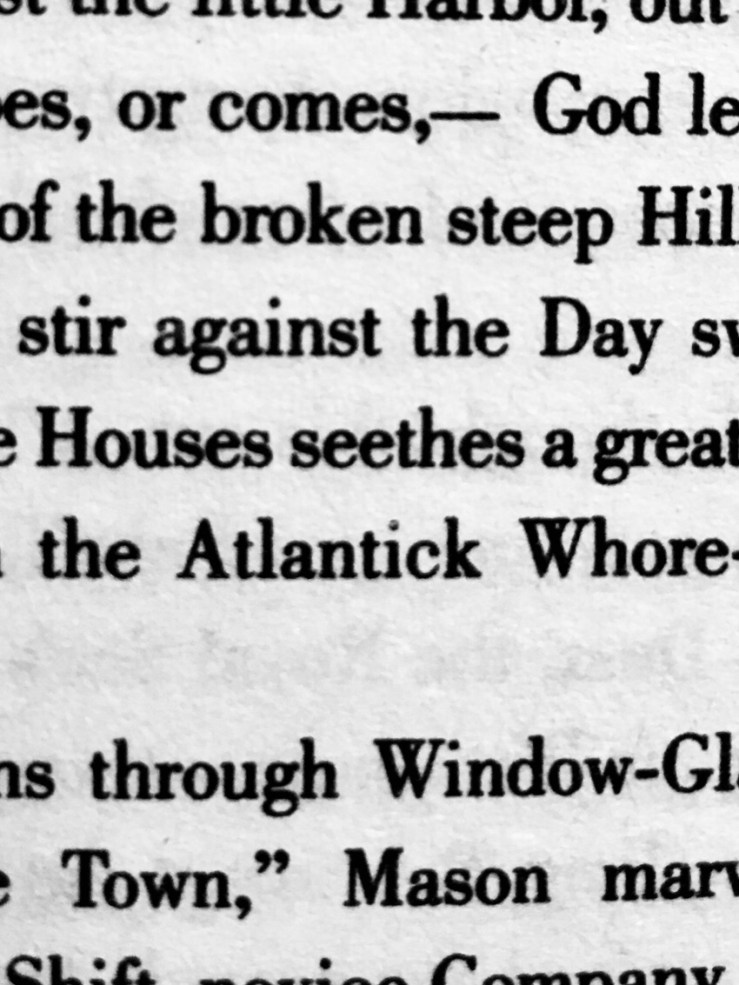
2. Mason & Dixon (1997)
Pynchon’s zany/sinister tonal axis, comic bravado, and genre-shifting modes rarely result in what folks narrowly think of as literary realism. His characters can be elastic, cartoonish even—allegorical sometimes (and even grotesque). Mason & Dixon takes two historically real (and historically famous) characters as its subject, and, in a wonderfully hyperbolic 18th-century style, takes the duo on a fantastic journey to measure the world. How does one measure the world though? Pynchon takes on seemingly every subject under the sun in Mason & Dixon, and the novel is very much about the problems and limitations of measuring (and describing, and knowing) itself. But what comes through most strongly in all of Pynchon’s fantasia is the weight of Mason and Dixon’s friendship. It’s the most real thing in a wonderfully unreal novel.
1. Gravity’s Rainbow (1973)
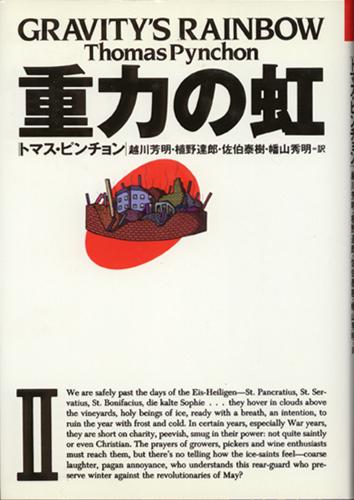
Gravity’s Rainbow is probably the best American postmodern novel ever produced. In any case, I haven’t read another novel that so acutely dissects postwar America. Pynchon extends Eisenhower’s warning of the “military-industrial complex” by adding another element: entertainment. The intuition here surpasses prescience. The problem with Gravity’s Rainbow is that it cannot be read—it has to be reread. Its themes, motifs, and symbols are easy to miss on a first pass through, when you’re likely bugeyed and bewildered. Rereading Gravity’s Rainbow is like reading it for the first time. You have to let the book teach you how to read it. Let it teach you.




 Biblioklept