A review of Olga Tokarczuk’s novel Flights

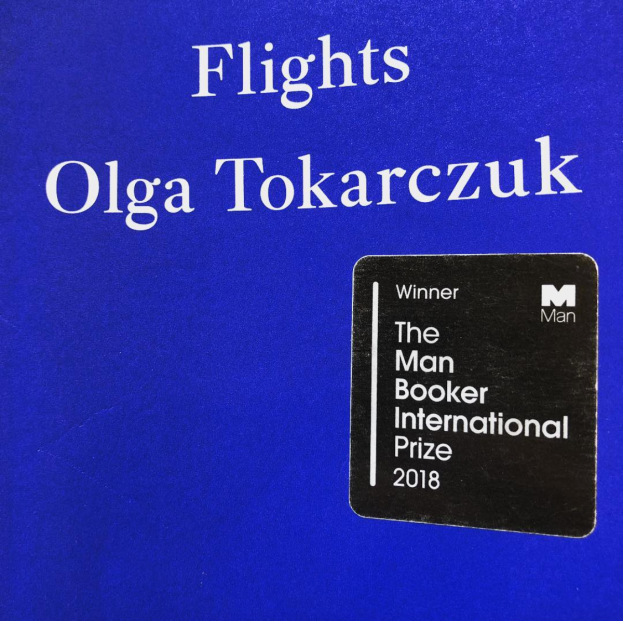
Olga Tokarczuk’s Flights,
being a book of diversions, of anything but the straight and narrow; a book bound by water, in that it is fluid, unfixed, and preoccupied with the very stuff, and the whales within; an interminable book, in which numerous stories never finish (for what is an ending but a wall to be destroyed or circumnavigated by time and other stories), but also a terminal book, in that it is “situated at the extremity of something” (New Oxford American Dictionary), like a book set on the eve of an important day, the day we leave, the day we make our move, the day we attack; and speaking of extremities, it is a book obsessed with fingers and toes and the blood vessels within, and all of the body’s parts, muscles in particular, and their preservation, long after the soul has left the body, submerged in anything from booze to Kaiserling III and held in a jar, transported across the world via horse and buggy or Russian galleon, to be placed on full display before students, kings, curious onlookers, and a grieving daughter, whose letters challenge the dubious practice of plastination; a book in which letters cross paths with lists, travelogues, tall tales, myths, ruminations on plastic bags and sanitary pads, dark matter and swastikas, stories that traverse the ruins of Athens, a boiler room in Moscow, the olive groves of Croatia, not to mention places without names, impossible to find on a map, without coordinates, all of it jumping from past to present and back again, if linear time is to be believed; a book of wandering women, who disappear and reappear on their own accord, slipping into the divine rhythms of circular time; a book about the temptation to make meaning out of any assortment of objects; a book made of 116 sections in all, which is the number of years the Hundred Years’ War actually lasted, and is the prefix for several European telephone helplines such as 116000, the hotline for missing children, or 116123, the emotional support helpline, according to Wikipedia, a site which may be, says Tokarczuk, “mankind’s most honest cognitive project,” except that it cannot index “its inverse, its inner lining, everything we don’t know”; a book populated by characters who either do not know, can’t figure it out, are lost, are trying to figure out what happened in that span of time that slipped their grasp, or those who know it all, who know the map like the back of their hand, or so they think; a book that anticipates the sovereignty of airports, those modern portals that make us time travelers, where you and I might collide, and if we do, will we talk to each other, tell our stories, move beyond the Three Travel Questions (where are you from, where are you coming from, where are you going) and into our ideas, those dangerous, viscous things, or will we simply utter apologies and head to our gates; a book that floods, that breaks at the seams and spills out into the world, so that fact and fiction get scrambled and mix in the deluge, becoming indistinguishable; a book with no answers, only arrows pointing in other directions, toward books yet to be written, histories to be retold, cities at the ends of the earth, or to the person nearest you; a book oriented, most importantly, toward other pilgrims…

…is masterfully translated from the Polish by Jennifer Croft, available from your English publisher of choice, and a magnificent read, one that travelled with me across Poland, Ireland, and the UK, and has convinced me, once and for all, that it is a crime never to read Moby-Dick.

(Image above, a map of Novaya Zemlya, via. Read an excerpt over at Asymptotein their January 2016 issue.)

“Quite an original” (From Herman Melville’s novel The Confidence-Man)

“Quite an original:” A phrase, we fancy, rather oftener used by the young, or the unlearned, or the untraveled, than by the old, or the well-read, or the man who has made the grand tour. Certainly, the sense of originality exists at its highest in an infant, and probably at its lowest in him who has completed the circle of the sciences.

As for original characters in fiction, a grateful reader will, on meeting with one, keep the anniversary of that day. True, we sometimes hear of an author who, at one creation, produces some two or three score such characters; it may be possible. But they can hardly be original in the sense that Hamlet is, or Don Quixote, or Milton’s Satan. That is to say, they are not, in a thorough sense, original at all. They are novel, or singular, or striking, or captivating, or all four at once.

More likely, they are what are called odd characters; but for that, are no more original, than what is called an odd genius, in his way, is. But, if original, whence came they? Or where did the novelist pick them up?

Where does any novelist pick up any character? For the most part, in town, to be sure. Every great town is a kind of man-show, where the novelist goes for his stock, just as the agriculturist goes to the cattle-show for his. But in the one fair, new species of quadrupeds are hardly more rare, than in the other are new species of characters—that is, original ones. Their rarity may still the more appear from this, that, while characters, merely singular, imply but singular forms so to speak, original ones, truly so, imply original instincts.

In short, a due conception of what is to be held for this sort of personage in fiction would make him almost as much of a prodigy there, as in real history is a new law-giver, a revolutionizing philosopher, or the founder of a new religion.

In nearly all the original characters, loosely accounted such in works of invention, there is discernible something prevailingly local, or of the age; which circumstance, of itself, would seem to invalidate the claim, judged by the principles here suggested.

Furthermore, if we consider, what is popularly held to entitle characters in fiction to being deemed original, is but something personal—confined to itself. The character sheds not its characteristic on its surroundings, whereas, the original character, essentially such, is like a revolving Drummond light, raying away from itself all round it—everything is lit by it, everything starts up to it (mark how it is with Hamlet), so that, in certain minds, there follows upon the adequate conception of such a character, an effect, in its way, akin to that which in Genesis attends upon the beginning of things.

For much the same reason that there is but one planet to one orbit, so can there be but one such original character to one work of invention. Two would conflict to chaos. In this view, to say that there are more than one to a book, is good presumption there is none at all. But for new, singular, striking, odd, eccentric, and all sorts of entertaining and instructive characters, a good fiction may be full of them. To produce such characters, an author, beside other things, must have seen much, and seen through much: to produce but one original character, he must have had much luck.

There would seem but one point in common between this sort of phenomenon in fiction and all other sorts: it cannot be born in the author’s imagination—it being as true in literature as in zoology, that all life is from the egg.

From Herman Melville’s novel The Confidence-Man.

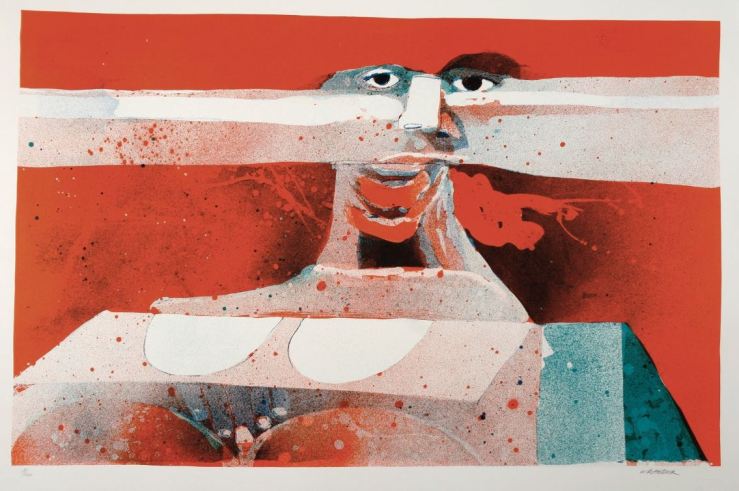
Sorrow — Hans Graeder

sorrow

Sorrow, by Hans Graeder (1919-1999)