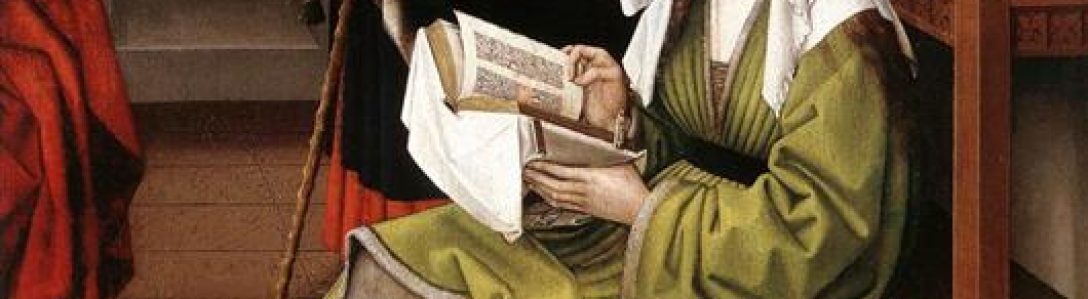
The First Thanksgiving — Warrington Colescott

w1siziisijixndkzmijdlfsiccisimnvbnzlcnqilcitcmvzaxplidiwmdb4mjawmfx1mdazzsjdxq The First Thanksgiving, 1973 by Warrington Colescott (1921 – 2018) Screenshot 2018-11-19 at 3.38.36 PMScreenshot 2018-11-19 at 3.38.55 PMScreenshot 2018-11-19 at 3.39.56 PMScreenshot 2018-11-19 at 3.38.08 PM
A grave and dark-clad company!” quoth Goodman Brown. In truth, they were such. Among them, quivering to-and-fro, between gloom and splendor, appeared faces that would be seen, next day, at the council-board of the province, and others which, Sabbath after Sabbath, looked devoutly heavenward, and benignantly over the crowded pews, from the holiest pulpits in the land. Some affirm, that the lady of the governor was there. At least, there were high dames well known to her, and wives of honored husbands, and widows, a great multitude, and ancient maidens, all of excellent repute, and fair young girls, who trembled lest their mothers should espy them. Either the sudden gleams of light, flashing over the obscure field, bedazzled Goodman Brown, or he recognized a score of the church-members of Salem village, famous for their especial sanctity. Good old Deacon Gookin had arrived, and waited at the skirts of that venerable saint, his reverend pastor. But, irreverently consorting with these grave, reputable, and pious people, these elders of the church, these chaste dames and dewy virgins, there were men of dissolute lives and women of spotted fame, wretches given over to all mean and filthy vice, and suspected even of horrid crimes. It was strange to see, that the good shrank not from the wicked, nor were the sinners abashed by the saints. Scattered, also, among their pale-faced enemies, were the Indian priests, or powows, who had often scared their native forest with more hideous incantations than any known to English witchcraft.
–From “Young Goodman Brown,” Nathaniel Hawthorne (1835)

Then there you lie like the one warm spark in the heart of an arctic crystal | Moby-Dick

Yes, we became very wakeful; so much so that our recumbent position began to grow wearisome, and by little and little we found ourselves sitting up; the clothes well tucked around us, leaning against the head-board with our four knees drawn up close together, and our two noses bending over them, as if our kneepans were warming-pans. We felt very nice and snug, the more so since it was so chilly out of doors; indeed out of bed-clothes too, seeing that there was no fire in the room. The more so, I say, because truly to enjoy bodily warmth, some small part of you must be cold, for there is no quality in this world that is not what it is merely by contrast. Nothing exists in itself. If you flatter yourself that you are all over comfortable, and have been so a long time, then you cannot be said to be comfortable any more. But if, like Queequeg and me in the bed, the tip of your nose or the crown of your head be slightly chilled, why then, indeed, in the general consciousness you feel most delightfully and unmistakably warm. For this reason a sleeping apartment should never be furnished with a fire, which is one of the luxurious discomforts of the rich. For the height of this sort of deliciousness is to have nothing but the blanket between you and your snugness and the cold of the outer air. Then there you lie like the one warm spark in the heart of an arctic crystal.

From Chapter 11 of Herman Melville’s Moby-Dick.

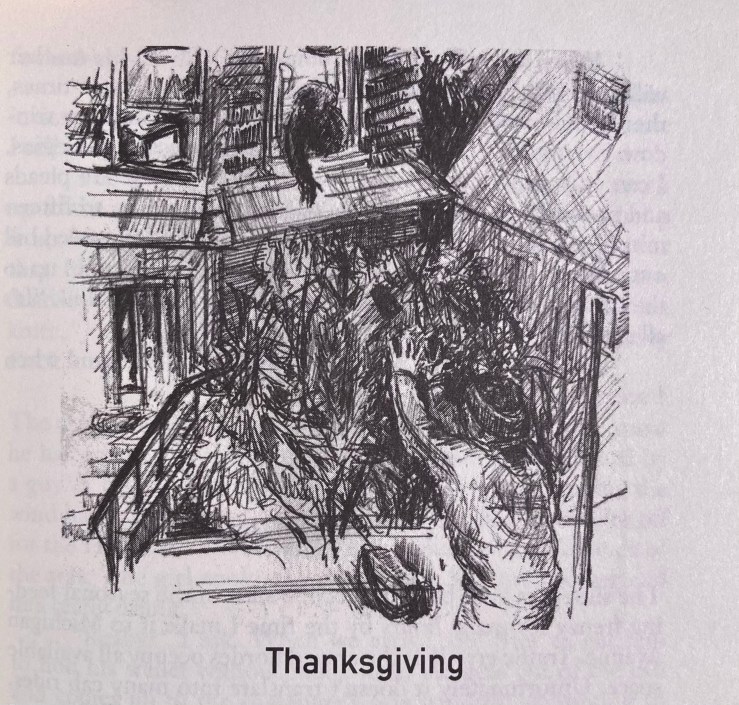
“Thanksgiving,” an excerpt from Dmitry Samarov’s cab memoir Hack

I’m on way to a traditional Thanksgiving meal of pot-stickers and spicy pan-fried pork at Lao Sze Chuan when flags me down. A young guy in a tracksuit and expensive basketball shoes. He says his car broke down, which typically a scam. But it’s Thanksgiving, so I give him the benefit of the doubt and he directs to an address on the South Side.

He tells me about going to an event with Chicago Bulls players, proudly showing the autographs he collected. He is excited like a kid would be, which makes me think the broken-down car might actually exist. He asks if I’d had my Thanksgiving meal.

When we pull up to his house, he tells me his mother will have the $25 for the cab. He has me honk a few times then goes into the yard and hollers up the second-floor window. Eventually a dark form appears and a negotiation begins. I can only make out what my passenger is saying. He pleads and promises to pay it all back. It goes on for close to fifteen minutes. Then the figure in the window tosses a crumpled bill out past the overgrown shrubbery of the yard. He comes up to the driver’s side, sheepishly offering a twenty-dollar bill. “It’s all sh has.”

He says his name is Dwayne and shakes my hand when I accept it.

From Dmitry Samarov’s illustrated cab memoir All Hack.

“Thanksgiving” — Kenneth Koch

“Thanksgiving”

by

Kenneth Koch


What’s sweeter than at the end of a summer’s day
To suddenly drift away
From the green match-wrappers in an opened pocketbook
And be part of the boards in a tavern?

A tavern made of new wood.
There’s an orange-red sun in the sky
And a redskin is hunting for you underneath ladders of timber.
I will buy this tavern. Will you buy this tavern? I do.

In the Indian camp there’s an awful dismay.
Do they know us as we know they
Know us or will know us, I mean a—
I mean a hostile force, the month of May.

How whitely the springtime is blossoming,
Ugh! all around us!
It is the brilliant Indian time of year
When the sweetest Indians mate with the sweetest others.

But I fear the white men, I fear
The rent apple blossom and discarded feathers
And the scalp lying secretly on the ground
Like an unoffending nose!

But we’ve destroyed all that. With shocking guns.
Peter Stuyvesant, Johnny Appleseed, Aaron Copeland.
We’ve destroyed all that. Come,
Do you believe right was on either side?

How would you like to be living in an Indian America,
With feathers dressing every head? We’d eat buffalo hump
For Thanksgiving dinner. Everyone is in a tribe.
A girl from the Bep Tribe can’t marry a brave from the Bap tribe. Is that democracy?
And then those dreary evenings around the campfires
Listening to the Chief! If there were a New York
It would be a city of tents, and what do you suppose
Our art and poetry would be like? For the community! the tribe!
No beautiful modern abstract pictures, no mad incomprehensible
Free lovable poems! And our moral sense! tribal.
If you would like to be living in an Indian America
Why not subscribe to the newspaper, Indian America?

In Wisconsin, Ben, I stand, I walk up and down and try to decide.

Is this country getting any better or has it gotten?
If the Indian New York is bad, what about our white New York?
Dirty, unwholesome, the filthy appendage to a vast ammunition works, I hate it!
Disgusting rectangular garbage dump sending its fumes up to suffocate the sky—
Foo, what fumes! and the scaly white complexion of her citizens.
There’s hell in every firm handshake, and stifled rage in every look.
If you do find somewhere to lie down, it’s a dirty inspected corner,
And there are newspapers and forums and the stinking breath of Broadway
To investigate what it feels like to be a source of stench
And nothing else. And if one does go away,
It is always here, waiting, for one to come back. And one does come back,
As one does come back to the bathroom, and to a fine suffering.

Where else would I find such ardent and grateful spirits
Inspired and wasted and using and used by this horrible city,
New York, New York? Can the Pilgrims’ Thanksgiving dinner really compare to it?
And the Puritans? And the single-minded ankle-divided Indians?
No, nothing can compare to it! So it’s here we speak from the heart
And it’s rotting so fast that what we say
Fades like the last of a summer’s day.
Rot which makes us as prolific as the sun on white unfastened clouds.