
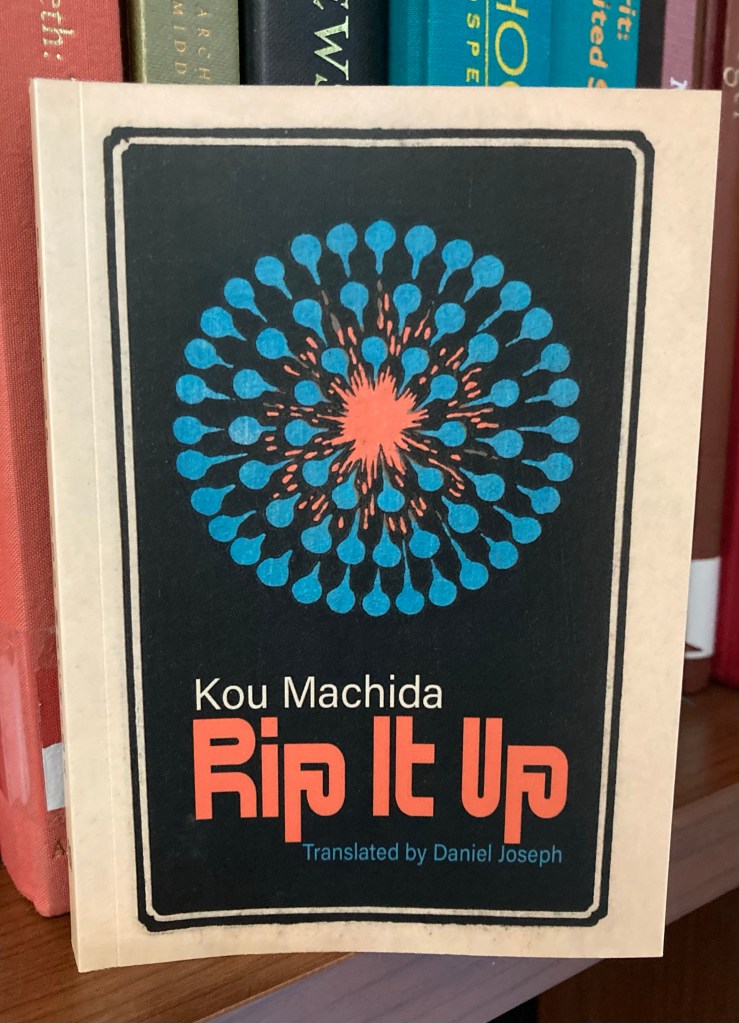
Kou Machida’s Rip It Up (Book acquired, 15 April 2022)

So I got into Kou Machida’s short novel Rip It Up last night. This Japanese novel (original title, きれぎれ [Kiregire]) gets its first English translation, via Daniel Joseph and Mercurial Editions, a new translation imprint from Inpatient Press. This is how the publisher describes Rip It Up:

Set in a kaleidoscopic hyperreal Japan circa Y2K, Rip It Up catalogues the misdeeds and misgivings of a down-and-out wannabe debonair who ekes out a meager living at the fringes of the art world, wracked by jealousy at his friend’s success and despondency of his own creative (and moral) bankruptcy. In turn hilarious and also horrifying, Machida’s pyrotechnic prose plumbs the discursive depths of the creative spirit, a head-spinning survey of degeneration and self-sabotage.

Machida’s psychedelic punk prose takes a few pages to tune into. The (as-yet?) unnamed narrator’s voice is tinged with madness and soaked with vitriol for the conformist society he can’t seem to get out of. He’s a rich kid, a lout, and a bum, obsessed with Satoe the horse-headed girl. Her head isn’t really a horse’s head; rather, it’s a mask she’s wearing when he first runs into her at a drunken Setsubun party at the “panty bar” where she works. He’s stumbled in after getting drunk at his friend’s funeral. The scene Machida conjures is simultaneously vile, hallucinatory, and hilarious, with salarymen and “little people gotten up to look like Fukusuke dolls” crashing about the place in a bizarre karaoke showdown. The narrator takes the mic, belting out malapropisms that synthesize and parody the lyrics of Western pop songs:

It’s not unusual to hi-de hi-de hi-de-hi

You’re as chaste as ice

And baby we were born to nun

Rollin’, rollin’, rollin’ on Moon River

Any way the lunch grows, doesn’t really matter

A few pages later, the narrator still pines for the horse-headed girl, spending all his money at the panty bar. He has to go visit his rich mother for a “loan,” but she makes him embark on a stolid omiai, a marriage interview, which he torpedoes by declaring to the prospective partner and her dour mother “exactly what kind of person I am”:

That I spend all my free time at the panty bar. That I dropped out of high school. That I’m a spendthrift. That I’ve got my head in the clouds and I’ve never done an honest days work in my life because I despise hard work. That’s all.

I’m digging Rip It Up so far; it’s alienating, self-indulgent stuff. Daniel Joseph’s translation conveys a desperate, stuffy world, and shows how linguistic resistance might puncture stifling conformity. More thoughts to come. Check out Kou Machida’s seminal punk band Inu,


Life is an entanglement of lies to hide its basic mechanisms | William S. Burroughs

From The Place of Dead Roads

by

William S. Burroughs


Kim is a slimy, morbid youth of unwholesome proclivities with an insatiable appetite for the extreme and the sensational. His mother had been into table-tapping and Kim adores ectoplasms, crystal balls, spirit guides and auras. He wallows in abominations, unspeakable rites, diseased demon lovers, loathsome secrets imparted in a thick slimy whisper, ancient ruined cities under a purple sky, the smell of unknown excrements, the musky sweet rotten reek of the terrible Red Fever, erogenous sores suppurating in the idiot giggling flesh. In short, Kim is everything a normal American boy is taught to detest. He is evil and slimy and insidious. Perhaps his vices could be forgiven him, but he was also given to the subversive practice of thinking. He was in fact incurably intelligent.

Later, when he becomes an important player, he will learn that people are not bribed to shut up about what they know. They are bribed not to find it out. And if you are as intelligent as Kim, it’s hard not to find things out. Now, American boys are told they should think. But just wait until your thinking is basically different from the thinking of a boss or a teacher…You will find out that you aren’t supposed to think.

Life is an entanglement of lies to hide its basic mechanisms.

Kim remembers a teacher who quoted to the class: “If a thing is worth doing at all it is worth doing well…”

“Well sir, I mean the contrary is certainly true. If a thing is worth doing at all, it is worth doing, even badly,” said Kim pertly, hoping to impress the teacher with his agile intelligence. “I mean, we can’t all become Annie Oakleys doesn’t mean we can’t get some fun and benefit from shooting…”

The teacher didn’t like that at all, and for the rest of the school year singled Kim out for heavy-handed sarcasm, addressing him as “our esteemed woodsman and scout.” When Kim couldn’t answer a history question, the teacher asked, “Are you one of these strong, silent men?” And he wrote snippy little comments in the margins of Kim’s compositions: “Not quite as badly as that,” viciously underlining the offending passage. At the end of the term the teacher gave him a Β — for the course, though Kim knew fucking well he deserved an A.

To be sure, Kim was rotten clear through and he looked like a sheep-killing dog and smelled like a polecat, but he was also the most ingenious, curious, resourceful, inventive little snot that ever rose from the pages of Boy’s Life, thinking up ways of doing things better than other folks. Kim would get to the basic root of what a device is designed to do and ask himself, Is it doing it in the simplest and most efficient way possible? He knew that once an article goes into mass production, the last thing a manufacturer wants to hear about is a better and simpler article that is basically different. And they are not interested in a more efficient, simpler or better product. They are interested in making money.

When Kim was fifteen his father allowed him to withdraw from the school because he was so unhappy there and so much disliked by the other boys and their parents.

“I don’t want that boy in the house again,” said Colonel Greenfield. “He looks like a sheep-killing dog.”

“It is a walking corpse,” said a Saint Louis matron poisonously.

“The boy is rotten clear through and he stinks like a polecat,” Judge Farris pontificated.

This was true. When angered or aroused or excited Kim flushed bright red and steamed off a rank ruttish animal smell.

And sometimes he lost control over his natural functions. He took comfort from learning that partially domesticated wolves suffer from the same difficulty.

“The child in not wholesome,” said Mr. Kindhart, with his usual restraint. Kim was the most unpopular boy in the school, if not in the town of Saint Louis.

“They have nothing to teach you anyway,” his father said. “Why, the headmaster is a fucking priest.”