

“Long, Too Long America” — Walt Whitman

“The Coahoma County Wind Cults” — David Berman

“The Coahoma County Wind Cults”

by

David Berman


My dream walked on four legs
toward the remote source
of a pale yellow letter

only to circle around the cabin
when it got there.

A black and white cave rainbow
arched between two old shoes.

Oxygen bounced off the face of a doll,
looking for the slow dazzling guts
of a life form.

There was a moment of sudden clarity
when the pages of burned in opera glasses,

like a herd crossing zip codes

or an exhausted idea pressing
at the limits of the marquee bulbs,

my dream pushes air.

“Occurrence on Washburn Avenue” — Regan Huff

“Occurrence on Washburn Avenue”

by

Regan Huff


Alice’s first strike gets a pat on the back,
her second a cheer from Betty Woszinski
who’s just back from knee surgery. Her third—
“A turkey!” Molly calls out—raises everyone’s eyes.
They clap. Teresa looks up from the bar.
At the fourth the girls stop seeing their own pins wobble.
They watch the little X’s fill the row on Alice’s screen—
That’s five. That’s six. There’s a holy space
around her like a saint come down to bowl
with the Tuesday Ladies in Thorp, Wisconsin.
Teresa runs to get Al, and Fran calls Billy
at the Exxon. The bar crowds with silent men.
No one’s cheering. No one’s bowling now
except Alice’s team, rolling their balls
to advance the screen around to Alice, who’s stopped
even her nervous laugh, her face blank and smooth
with concentration. It can’t go on
and then it does go on, the white bar
reading “Silver Dollar Chicken” lowering and clearing
nothing, then lowering and clearing nothing again.

Cruelest month

“Arrested Saturday Night” — Stephen Dobyns

“Primer” — Rita Dove

“Primer”
by
Rita Dove

In the sixth grade I was chased home by
the Gatlin kids, three skinny sisters
in rolled-down bobby socks. Hissing
Brainiac! and Mrs. Stringbean!, they trod my heel.
I knew my body was no big deal
but never thought to retort: who’s
calling who skinny? (Besides, I knew
they’d beat me up.) I survived
their shoves across the schoolyard
because my five-foot-zero mother drove up
in her Caddie to shake them down to size.
Nothing could get me into that car.
I took the long way home, swore
I’d show them all: I would grow up.

“Armor” — Sharon Olds

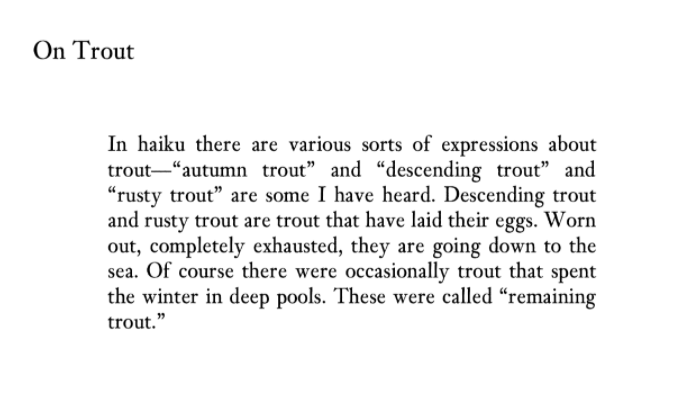
“On Trout” — Anne Carson

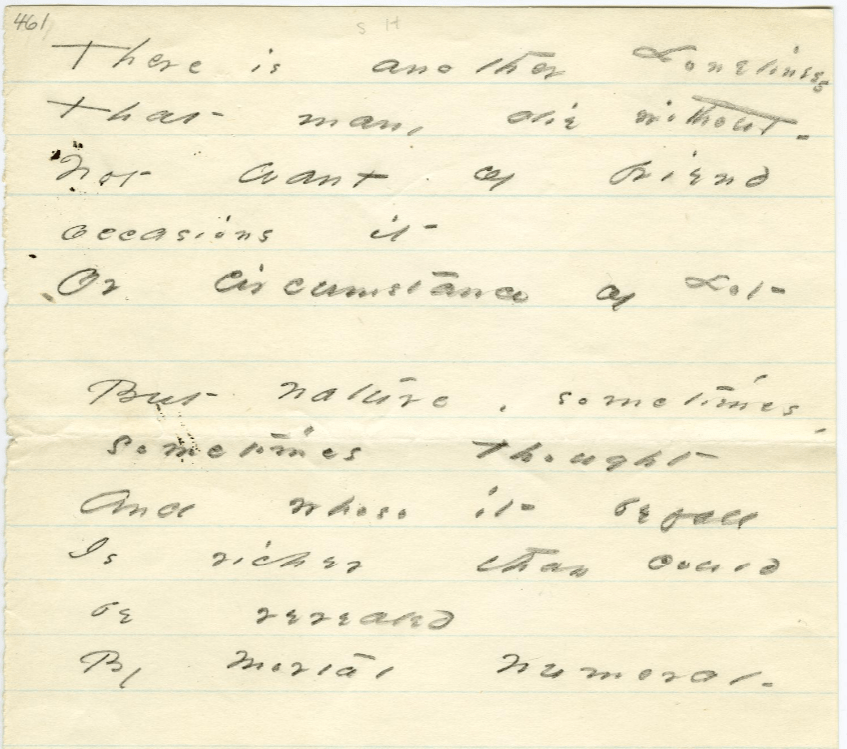
“There is another Loneliness” — Emily Dickinson

There is another Loneliness
That many die without —
Not want of friend occasions it
Or circumstances of Lot

But nature, sometimes, sometimes thought
And whoso it befall
Is richer than could be revealed
By mortal numeral —

Look at the boy and apologize | Claudia Rankine

“Fox” — Rita Dove

“Fox”

by

Rita Dove


She knew what
she was and so
was capable
of anything
anyone
could imagine.
She loved what
she was, there
for the taking,
imagine.

She imagined
nothing.
She loved
nothing more
than what she had,
which was enough
for her,
which was more
than any man
could handle.

“News” — Grace Paley

“The Unexplorer” — Edna St. Vincent Millay

esvm

Grandfather — Michael S. Harper

“Grandfather”

by

Michael S. Harper


In 1915 my grandfather’s
neighbors surrounded his house
near the dayline he ran
on the Hudson
in Catskill, NY
and thought they’d burn
his family out
in a movie they’d just seen
and be rid of his kind:
the death of a lone black
family is the Birth
of a Nation,
or so they thought.
His 5’4” waiter gait
quenched the white jacket smile
he’d brought back from watered
polish of my father
on the turning seats,
and he asked his neighbors
up on his thatched porch
for the first blossom of fire
that would bring him down.
They went away, his nation,
spittooning their torched necks
in the shadows of the riverboat
they’d seen, posse decomposing;
and I see him on Sutter
with white bag from your
restaurant, challenged by his first
grandson to a foot-race
he will win in white clothes.

I see him as he buys galoshes
for his railed yard near Mineo’s
metal shop, where roses jump
as the el circles his house
toward Brooklyn, where his rain fell;
and I see cigar smoke in his eyes,
chocolate Madison Square Garden chews
he breaks on his set teeth,
stitched up after cancer,
the great white nation immovable
as his weight wilts
and he is on a porch
that won’t hold my arms,
or the legs of the race run
forwards, or the film
played backwards on his grandson’s eyes.

“Abraham Lincoln of Rock Spring Farm” — Melvin B. Tolson

“Abraham Lincoln of Rock Spring Farm”

by

Melvin B. Tolson


I

Along the Wilderness Road, through Cumberland Gap,
The black ox hours limped toward Sunday’s sun,
Across a buff clay belt with scrawls of stone,
Where bird and beast quailed in the bosom brush
From February’s fang and claw; the stars,
Blue white, like sheer icicles, spired aglow
As if the three wise men barged in the East
Or priests in sackcloth balked the Scourge of God.

Foursquare by the rite of arm and heart and law,
The scrubby log cabin dared the compass points
Of Rock Spring farm, man’s world, God’s universe,
The babel of the circumstance and era.
The frozen socket of its window stared
Beyond the spayed crabapple trees, to where
The skulls of hills, the skeletons of barrens,
Lay quiet as time without the watch’s tick.

Not knowing muck and star would vie for him,
The man Tom sank upon ax-split stool,
Hands fisted, feet set wide to brace the spirit,
Big shoulders shoved, dark hazel eyes glazed by
Grotesqueries of flame that yawled and danced
Up, up, the stick-clay chimney. While fire imps combed
The black and bristling hair, the acids of thoughts
Made of the orby face an etching-plate.

II

Near pyrotechnic logs, the purling kettle,
Aunt Peggy puffed her pipe on God’s rich time:
A granny at a childbed on the border,
Where head and backbone answered the tomahawk
Her wise old eyes had seen a hundred Nancys
In travail tread the dark winepress alone;
Her wise old hands had plucked a stubborn breed
Into the outer world of pitch and toss.

The cabin that her myth and mission entered
Became a castle in which Aunt Peggy throned
A dynasty of grunts and nods and glances.
The nest, the barn, the hovel had schooled her in
The ABC of motherhood, and somehow
She’d lost her ego in the commonweal:
She sensed so accurately a coming child
That rakes dubbed her the St. Bernard of Sex!

And now her keyhole look explored Tom Lincoln
Beneath the patched homespun, the hue and cry
Of malice, until she touched his loneliness,
The taproot that his fiber gave no tongue.
Then, lulling the wife, troubled in flesh and mind,
She eased the sack quilts higher and mused the while:
There’s but one way of coming into the world,
And seven times seventy ways of leaving it!

III

The woman Nancy, like a voyager sucked
Into the sea’s whale belly by a wreck,
Buoyed to the surface air of consciousness
And clutched the solace of her corn-husk bed.
Her dark face, sharped in forehead, cheekbone, chin,
Cuddled in dark brown hair; her eyes waxed grayer
With wonder of the interlude: her beauty
And courage choked Aunt Peggy’s hyperbole!

Out of the fog of pain, the bog of bygones,
The bag of cabin cant and tavern tattle,
She picked the squares to piece tomorrow’s quilt:
She puzzled now, as then, about her father
Who let wild Lucy Hanks bundle and carry
Flesh of his flesh beyond the Cumberland Gap;
A strange roof is no roof when imps of fear
Pilfer the fatherless in blossom time.

Year in, year out, the daughter tinkered with
The riddle of her birth; the mother chided
The woman Nancy as she had the child,
“Hush thee, hush thee, thy father’s a gentleman.”
The butt of bawd, grand jury, Sunday bonnet,
Lucy, driven, taught her daughter the Word,
And Nancy, driven, taught her son the Word,
And Abraham, driven, taught his people the Word!

IV

The man Tom bit his fingernails, then rammed
His pockets with the hector hands that gave
Raw timber the shape of cabinet and coffin,
And in his lame speech said: “Aunt Peggy, listen,
Now that our Nancy’s time is come, I’m haunted
By my own nothingness. Why breed nobodies?”
He tapped the dirt floor with the iron-capped boot
That aided fist and skull in border fights.

Aunt Peggy counseled: “Tom, you say the say
Poor Joseph probably said in that low stable
Ere Jesus came into this mishmash world.”
She paused, then boxed the ears of cynicism:
“It’s true, down in the barnyard, blood speaks loud,
Among the hogs, the chickens, the cows, the horses;
But, when it comes to Man, who knows, who knows
What greatness feeds down in the lowliest mother?”

The man Tom turned and spat: his naked surmise
Ranged out and out. Aunt Peggy’s innermost said:
“Your father Abraham, bred like Daniel Boone,
Conquered a land with gun and ax and plow,
Baptized it in his blood! I say, I’ve said,
What’s in a baby is God Almighty’s business;
How the elders wring it out is worry enough!
The best, the worst—it’s all, all human nature.”

V

The tavern, Tom remembered, the New Year’s Eve,
The clubfoot scholar bagged in Old World clothes,
With arrowy eyes and a hoary mushroom beard.
An Oxford don, he hymned the Bastille’s fall
In spite of the hair-hung sword; his betters set
Him free to hail new truths in new lands, where
He seined with slave and master, knave and priest,
And out of all fished up the rights of man:

“As Citizen Lincoln asks, ‘What’s human nature?’
His full mug says a clear mind puts the question
Which ties the fogey scholar in a knot!
My new idea fed to his new baby
Would fetch the New World and the New Year peace!
The sum of anything unriddles the riddle:
The child whose wet nurse is the mother-of-all
Grows like a pine unmarked by rock or wind.

“To make a New World and a New Year, Plato
And Jesus begged the boon of little children!
Now Citizen Lincoln asks, ‘What’s human nature?’
It’s what we elders have: no baby has it.
It’s what our good and bad graft on the neutral.
It’s what our rulers feed the boy and girl.
It’s what society garbs nature in.
It’s a misnomer: call it human nurture!”

VI

Aunt Peggy hovered closer, with flawless rites
Grown lyrical from habit: muffled pain sounds
Dragged from the bed of cleated poles; she hawed
Tom Lincoln, as one turns a nag aside,
Then swooped her way, even as a setting hen
Carves a dictatorship from yard to nest.
And Tom again was squeezed into a cell
Whose inmates were the ghosts of unsuccess.

Later his memories climbed a gala peak,
His Nancy’s infare that ran riotous:
The bear meat, venison, wild turkey, duck,
The maple sugar hanging for the whiskey,
The red ham, gourds of syrup, bowls of honey,
The wood coal pit with brown and juicy sheep,
The guzzling, fiddling, guttling, monkeyshining:
A continent sprawled between that day and this!

A havenot on the frontier is no havenot;
A Crusoe without Friday has no conscience:
Yet Tom’s grub living gnawed him like the teeth
Of slavery, land titles, melancholy.
He, like his forebears, visioned a Promised Land
And tidied ways and means to fly the barrens
That doomed the flesh to peck, to patch, to pinch,
And wrung the soul of joy and beauty dry.

VII

The black ox hours limped by, and day crawled after.
White prongs of ice, like dinosaur fangs, gleamed in
The cavernous mouth of Rock Spring; snowbirds shivered
And chirped rebellion; a cow with jags and gaps
Chewed emptily; hogs squealed in hunger fits;
And scrags of dogs huddled against the chimney,
Which shoveled smoke dust into the throats and noses
Of ragged winds kicking up snow in the desert.

Nancy lay white, serene, like virgin milk
After the udder’s fury in the pail.
Beneath the sack quilts and the bearskin robe,
In yellow petticoat and linsey shirt,
The baby snuggled at her breast and gurgled—
An anonymity of soft red wrinkles.
Aunt Peggy, hovering, grinned, “He’s Sabbath-born.
Remember …Sunday—it’s red-letter day!”

Like ax and helve, like scythe and snath, the bond
Held Tom and Nancy; she smiled at his halt smile,
His titan’s muss in picking up the baby.
Tom frowned and spat, then gulped, “He’s legs! All legs!”
Aunt Peggy beamed, “Long legs can eat up miles.”
Tom gloomed, “The hands—look at the axman’s hands!”
And Nancy mused, “The Hankses’ dream, the Lincolns’,
Needs such a man to hew and blaze the way.”

Behind God’s back | On Thulani Davis’s poetry collection Nothing but the Music

Here are the first lines of Thulani Davis’s 1978 poem “Mecca Flats 1907”:

On this landscape

Like a thin air

Hard to breathe

Behind God’s back

I see the doors

I wanted to underline the line Behind God’s back—such an image! But the book itself is so pretty, lithe, lovely. Better to leave it unmarked?

The book is Nothing but the Music, a new collection of Thulani Davis’s poems. Its subtitle Documentaries from Nightclubs, Dance Halls, & a Tailor’s Shop in Dakar: 1974-1992 is a somewhat accurate description of the content here. These are poems about music—about Cecil Taylor and The Commodores and Thelonious Monk and Henry Threadgill and Bad Brains and more. “About” is not really the right word, and of course these poems are their own music; reading them aloud reveals a complexity of rhyme and rhythm that might be lost to the eye on the page.

But where was I—I wanted to underline the line Behind God’s back, but I didn’t. I didn’t even dogear the page. Instead, I went back to read Davis’s acknowledgements, a foreword by Jessica Hagedorn, and an introduction by Tobi Haslett. The material sets the stage and provides context for the poems that follow. Davis’s acknowledgments begin:

I have heard this music in a lot of clubs that no longer exist, opera houses in Italy that will stand another hundred years parks in Manhattan, Brooklyn, L.A., San Francisco, and Washington, DC as well as on Goree Island and in Harare, Zimbabwe. Some of it was in lofts in lower Manhattan now inhabited by millionaires, crowded bistros in Paris that are close, and legendary sites like Mandel Hall and the Apollo, radio studios, recording studios, and my many homes.

Acknowledging the weird times that have persisted (behind God’s back or otherwise), Davis touches on the COVID-19 lockdown that took the joy of live music from her—and then returned it in the strange form of “masked protesters massed in the streets singing ‘Lean on Me'” during the protests following the murder of George Floyd.

Poems in Nothing but the Music resonate with the protests against police violence and injustice we’ve seen this year. The speaker of “Back Stage Drama (For Miami)” (surely Davis herself?) repeats throughout the poem that “I was gonna talk about a race riot,” but the folks around her are absorbed in other, perhaps more minute affairs:

They all like to hang out

Thinking is rather grim to them.

Composed in 1980, the poem documents an attempt to attempt to address the riots in May of the same year in Miami, Florida, after several police officers were acquitted in the murder of Arthur McDuffie, a black man.

The speaker of the poem embeds a poetic plea, a poem-within-a-poem:

I said, ‘they’re mad, they’re on the the bottom going down/

stung by white justice in a white town

and then there’s other colored people

who don’t necessarily think they’re colored people

taking up the middle/leaving them the ground.’

But her would-be audience is weary:

I am still trying to talk about this race riot.

Minnie looked up and said, ‘We don’t have anywhere

to put any more dead.’

Snake put on his coat to leave, ‘We never did,

we never did.’

1992’s “It’s Time for the Rhythm Revue” takes for its erstwhile subject the riots that ensued after the acquittal of the LAPD officers who beat Rodney King. The subject is far more complex though—the speaker of the poem desires joy of course, not violence:

did they acquit somebody in LA?

will we burn it down on Saturday

or dance to the Rhythm Revue

the not too distant past

when we thought we’d live on?

Is God’s back turned—or do the protagonists just live behind it?:

…I clean my house

listening to songs from the past

times when no one asked anyone

if they’d seen a town burn

cause baby everybody had.

In Nothing but the Music, music is part and parcel of the world, entangled in the violence and injustice of it all, not a mere balm or solace but lifeforce itself, a point of resistance against it all. In “Side A (Sir Simpleton/Celebration), the first of two poems on Henry Threadgill’s 1979 album X-75, Vol. I, Davis’s narrator evokes

at the turning of the day

in these winters/in the city’s bottomless streets

it seems sometimes we live behind god’s back

we/the life blood

of forgotten places/unhallowed ground

sometimes in these valleys

turning the corner of canyons now filled with blinding light streams caught between this rock & a known hard place

sometimes in utter solitude

a chorale/a sweetness/makes us whole & never lost

And again there that line, a note from a previous jam—it seems sometimes we live behind god’s back—I’ll dogear it here, digitally, underline it in my little blog scrapbook.

I think seems is the right verb though, above. Does the star of “Lawn Chair on the Sidewalk” not remain in God’s gaze?

there’s a junkie sunning himself

under my front tree

that tree had to fight for life

on this Brooklyn street

disease got to its limbs

while still young

Typing the lines out, I wonder who I meant by star above.

Nothing but the Music is filled with stars. Here’s avant-piano great Cecil Taylor in “C.T. at the Five Spot”:

this is not about romance & dream

it’s about a terrible command performance of the facts

of time & space & air

In a synesthestic moment, the speaker merges her art with its subject:

the player plays/Mr. Taylor plays

delicate separate licks of poems

brushes in tones lighter & tighter/closer in space

In the end it’s one art:

I have heard this music

ever since I can remember/I have heard this music

There are plenty more famous musicians, of course, but more often than not minor players emerge with the greatest force. There’s the unknown hornplayer whose ecstatic playing inspired 1975’s “He Didn’t Give Up/He Was Taken.” In “Leaving Goree” there are the “two Bambara women…gold teeth gleaming” who “sit like mountains” and then explode in song.

Davis crafts here characters with deft economy. Here’s the aforementioned couple of “Back Stage Drama (For Miami)”:

Snake & Minnie

who love each other dearly

drink in different bars,

ride home in separate cars.

They like to kiss goodnight

with unexplored lips.

They go out of town

to see each other open.

Or the hero of 1982’s “Bad Brains, A Band”—

the idea that they think must scare people to death

the only person I ever met from southeast DC

was a genius who stabbed her boyfriend for sneaking up on her in the kitchen

she was tone deaf and had no ear for French

she once burned her partner in bid whist

for making a mistake

At the core of it all is Davis’s strong gliding voice, pure and clean, channeling miracle music and synthesizing it into new sounds. The speaker of “C.T. at the Five Spot” assessed Taylor’s performance as a work of physics, a transcendence beyond “romance & dream,” but the speaker of 1982’s “Zoom (The Commodores)” gets caught up in the aural romance of The Commodore’s pop magic:

zoom I love you

cause you won’t say no/cause you don’t want to go

cause it’s so cruel without love

give me the tacky grandeur of Atlantic City

on the Fourth of July

the corny promises of Motown

give me the romance & the Zoom.

I love those corny promises too. The romance and the zoom are not, at least in my estimation, behind God’s back, but rather, if you believe in that sort of thing, might be God’s special dream. Nothing but the Music cooks raw joy and raw pain into something sublime. I like poems best when they tell stories, and Davis is a storyteller. The poems here capture place and time, but most of all sound, sound, rhythm, and sound. Lovely stuff.

Nothing but the Music is available from Blank Forms Editions.

[Ed. note–Biblioklept first published this review in Nov. 2020.]

“Landscape” — Larry Fagin