“Reading is thinking with someone else’s head” (Schopenhauer)

Reading is thinking with someone else’s head instead of one’s own. To think with one’s own head is always to aim at developing a coherent whole—a system, even though it be not a strictly complete one; and nothing hinders this so much as too strong a current of others’ thoughts, such as comes of continual reading. These thoughts, springing every one of them from different minds, belonging to different systems, and tinged with different colors, never of themselves flow together into an intellectual whole; they never form a unity of knowledge, or insight, or conviction; but, rather, fill the head with a Babylonian confusion of tongues. The mind that is over-loaded with alien thought is thus deprived of all clear insight, and is well-nigh disorganized. This is a state of things observable in many men of learning; and it makes them inferior in sound sense, correct judgment and practical tact, to many illiterate persons, who, after obtaining a little knowledge from without, by means of experience, intercourse with others, and a small amount of reading, have always subordinated it to, and embodied it with, their own thought.

From The Art of Literature by Arthur Schopenhauer.

Pain and boredom (Schopenhauer)

The most general survey shows us that the two foes of human happiness are pain and boredom. We may go further, and say that in the degree in which we are fortunate enough to get away from the one, we approach the other. Life presents, in fact, a more or less violent oscillation between the two. The reason of this is that each of these two poles stands in a double antagonism to the other, external or objective, and inner or subjective. Needy surroundings and poverty produce pain; while, if a man is more than well off, he is bored. Accordingly, while the lower classes are engaged in a ceaseless struggle with need, in other words, with pain, the upper carry on a constant and often desperate battle with boredom. The inner or subjective antagonism arises from the fact that, in the individual, susceptibility to pain varies inversely with susceptibility to boredom, because susceptibility is directly proportionate to mental power. Let me explain. A dull mind is, as a rule, associated with dull sensibilities, nerves which no stimulus can affect, a temperament, in short, which does not feel pain or anxiety very much, however great or terrible it may be. Now, intellectual dullness is at the bottom of that vacuity of soul which is stamped on so many faces, a state of mind which betrays itself by a constant and lively attention to all the trivial circumstances in the external world. This is the true source of boredom—a continual panting after excitement, in order to have a pretext for giving the mind and spirits something to occupy them. The kind of things people choose for this purpose shows that they are not very particular, as witness the miserable pastimes they have recourse to, and their ideas of social pleasure and conversation: or again, the number of people who gossip on the doorstep or gape out of the window. It is mainly because of this inner vacuity of soul that people go in quest of society, diversion, amusement, luxury of every sort, which lead many to extravagance and misery. Nothing is so good a protection against such misery as inward wealth, the wealth of the mind, because the greater it grows, the less room it leaves for boredom. The inexhaustible activity of thought! Finding ever new material to work upon in the multifarious phenomena of self and nature, and able and ready to form new combinations of them,—there you have something that invigorates the mind, and apart from moments of relaxation, sets it far above the reach of boredom.

From Arthur Schopenhauer’s The Wisdom of Life (trans. T. Bailey Saunders).

If he does not love solitude, he will not love freedom (Schopenhauer)

All society necessarily involves, as the first condition of its existence, mutual accommodation and restraint upon the part of its members. This means that the larger it is, the more insipid will be its tone. A man can be himself only so long as he is alone; and if he does not love solitude, he will not love freedom; for it is only when he is alone that he is really free. Constraint is always present in society, like a companion of whom there is no riddance; and in proportion to the greatness of a man’s individuality, it will be hard for him to bear the sacrifices which all intercourse with others demands, Solitude will be welcomed or endured or avoided, according as a man’s personal value is large or small,—the wretch feeling, when he is alone, the whole burden of his misery; the great intellect delighting in its greatness; and everyone, in short, being just what he is.

From Schopenhauer’s Counsels and Maxims, translated by T. Bailey Saunders.


“Genius and Virtue” — Arthur Schopenhauer

“Genius and Virtue” by Arthur Schopenhauer

When I think, it is the spirit of the world which is striving to express its thought; it is nature which is trying to know and fathom itself. It is not the thoughts of some other mind, which I am endeavouring to trace; but it is I who transform that which exists into something which is known and thought, and would otherwise neither come into being nor continue in it.

In the realm of physics it was held for thousands of years to be a fact beyond question that water was a simple and consequently an original element. In the same way in the realm of metaphysics it was held for a still longer period that the ego was a simple and consequently an indestructible entity. I have shown, however, that it is composed of two heterogeneous parts, namely, the Will, which is metaphysical in its character, a thing in itself, and the knowing subject, which is physical and a mere phenomenon.

Let me illustrate what I mean. Take any large, massive, heavy building: this hard, ponderous body that fills so much space exists, I tell you, only in the soft pulp of the brain. There alone, in the human brain, has it any being. Unless you understand this, you can go no further.

Truly it is the world itself that is a miracle; the world of material bodies. I looked at two of them. Both were heavy, symmetrical, and beautiful. One was a jasper vase with golden rim and golden handles; the other was an organism, an animal, a man. When I had sufficiently admired their exterior, I asked my attendant genius to allow me to examine the inside of them; and I did so. In the vase I found nothing but the force of gravity and a certain obscure desire, which took the form of chemical affinity. But when I entered into the other—how shall I express my astonishment at what I saw? It is more incredible than all the fairy tales and fables that were ever conceived. Nevertheless, I shall try to describe it, even at the risk of finding no credence for my tale.

In this second thing, or rather in the upper end of it, called the head, which on its exterior side looks like anything else—a body in space, heavy, and so on—I found no less an object than the whole world itself, together with the whole of the space in which all of it exists, and the whole of the time in which all of it moves, and finally everything that fills both time and space in all its variegated and infinite character; nay, strangest sight of all, I found myself walking about in it! It was no picture that I saw; it was no peep-show, but reality itself. This it is that is really and truly to be found in a thing which is no bigger than a cabbage, and which, on occasion, an executioner might strike off at a blow, and suddenly smother that world in darkness and night. The world, I say, would vanish, did not heads grow like mushrooms, and were there not always plenty of them ready to snatch it up as it is sinking down into nothing, and keep it going like a ball. This world is an idea which they all have in common, and they express the community of their thought by the word “objectivity.”

In the face of this vision I felt as if I were Ardschuna when Krishna appeared to him in his true majesty, with his hundred thousand arms and eyes and mouths. Continue reading ““Genius and Virtue” — Arthur Schopenhauer”

“On Noise” — Arthur Schopenhauer

Kant has written a treatise on The Vital Powers; but I should like to write a dirge on them, since their lavish use in the form of knocking, hammering, and tumbling things about has made the whole of my life a daily torment. Certainly there are people, nay, very many, who will smile at this, because they are not sensitive to noise; it is precisely these people, however, who are not sensitive to argument, thought, poetry or art, in short, to any kind of intellectual impression: a fact to be assigned to the coarse quality and strong texture of their brain tissues. On the other hand, in the biographies or in other records of the personal utterances of almost all great writers, I find complaints of the pain that noise has occasioned to intellectual men. For example, in the case of Kant, Goethe, Lichtenberg, Jean Paul; and indeed when no mention is made of the matter it is merely because the context did not lead up to it. I should explain the subject we are treating in this way: If a big diamond is cut up into pieces, it immediately loses its value as a whole; or if an army is scattered or divided into small bodies, it loses all its power; and in the same way a great intellect has no more power than an ordinary one as soon as it is interrupted, disturbed, distracted, or diverted; for its superiority entails that it concentrates all its strength on one point and object, just as a concave mirror concentrates all the rays of light thrown upon it. Noisy interruption prevents this concentration. This is why the most eminent intellects have always been strongly averse to any kind of disturbance, interruption and distraction, and above everything to that violent interruption which is caused by noise; other people do not take any particular notice of this sort of thing. The most intelligent of all the European nations has called “Never interrupt” the eleventh commandment. But noise is the most impertinent of all interruptions, for it not only interrupts our own thoughts but disperses them. Where, however, there is nothing to interrupt, noise naturally will not be felt particularly. Sometimes a trifling but incessant noise torments and disturbs me for a time, and before I become distinctly conscious of it I feel it merely as the effort of thinking becomes more difficult, just as I should feel a weight on my foot; then I realise what it is. Continue reading ““On Noise” — Arthur Schopenhauer”

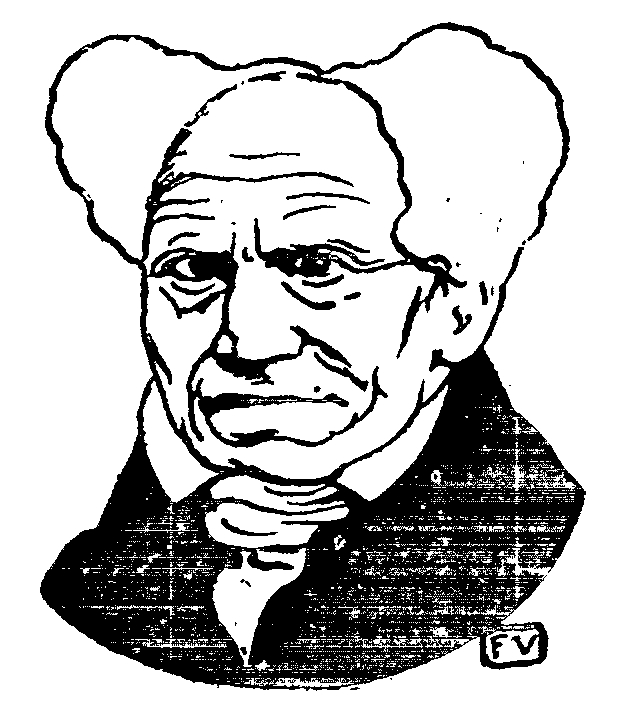
Schopenhauer — Felix Vallotton

german-philosopher-arthur-schopenhauer-1896