
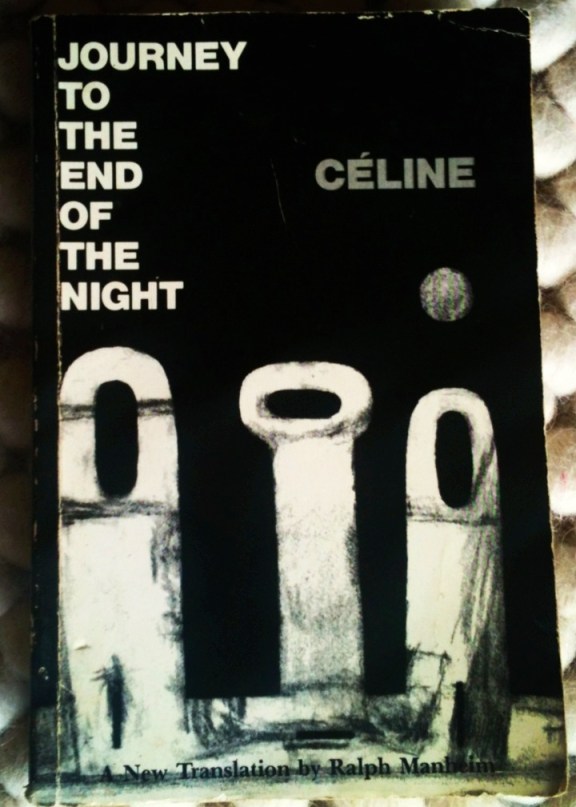
This expedition to see Céline was organized in 1958 by Allen Ginsberg who had got his address from someone. It is in Meudon, across the river from Paris proper. We finally found a bus that let us off in a shower of French transit directions: “Tout droit, Messieurs …” Walked for half a mile in this rundown suburban neighborhood, shabby villas with flaking stucco—it looked sort of like the outskirts of Los Angeles—and suddenly there’s this great cacophony of barking dogs. Big dogs, you could tell by the bark. “This must be it,” Allen said. Here’s Céline shouting at the dogs, and then he stepped into the driveway and motioned to us to come in. He seemed glad to see us and clearly we were expected. We sat down at a table in a paved courtyard behind a two-story building and his wife, who taught dancing—she had a dancing studio—brought coffee.
Céline looked exactly as you would expect him to look. He had on a dark suit, scarves and shawls wrapped around him, and the dogs, confined in a fenced-in area behind the villa, could be heard from time to time barking and howling. Allen asked if they ever killed anyone and Céline said, “Nooo. I just keep them for the noise.” Allen gave him some books, Howl and some poems by Gregory Corso and my book Junky. Céline glanced at the books without interest and laid them sort of definitively aside. Clearly he had no intention of wasting his time. He was sitting out there in Meudon. Céline thinks of himself as the greatest French writer, and no one’s paying any attention to him. So, you know, there’s somebody who wanted to come and see him. He had no conception of who we were.
Allen asked him what he thought of Beckett, Genet, Sartre, Simone de Beauvoir, Henri Michaux, just everybody he could think of. He waved this thin, blue-veined hand in dismissal: “Every year there is a new fish in the literary pond.
“It is nothing. It is nothing. It is nothing,” he said about all of them.
“Are you a good doctor?” Allen asked.
And he said: “Well … I am reasonable.”
Was he on good terms with the neighbors? Of course not.
“I take my dogs to the village because of the Jeeews. The postmaster destroys my letters. The druggist won’t fill my prescriptions.…” The barking dogs punctuated his words.
We walked right into a Céline novel. And he’s telling us what shits the Danes were. Then a story about being shipped out during the war: the ship was torpedoed and the passengers are hysterical so Céline lines them all up and gives each of them a big shot of morphine, and they all got sick and vomited all over the boat.
He waved goodbye from the driveway and the dogs were raging and jumping against the fence.
From With William Burroughs, by Victor Bockris. The speaker is, of course, Burroughs, prompted by a question from Bockris. It’s from the chapter entitled “Dinner with Nicolas Roeg, Lou Reed, Bockris-Wylie, and Gerard Malanga: New York 1978.” Roeg and Reed come off as total pricks.


 Biblioklept