
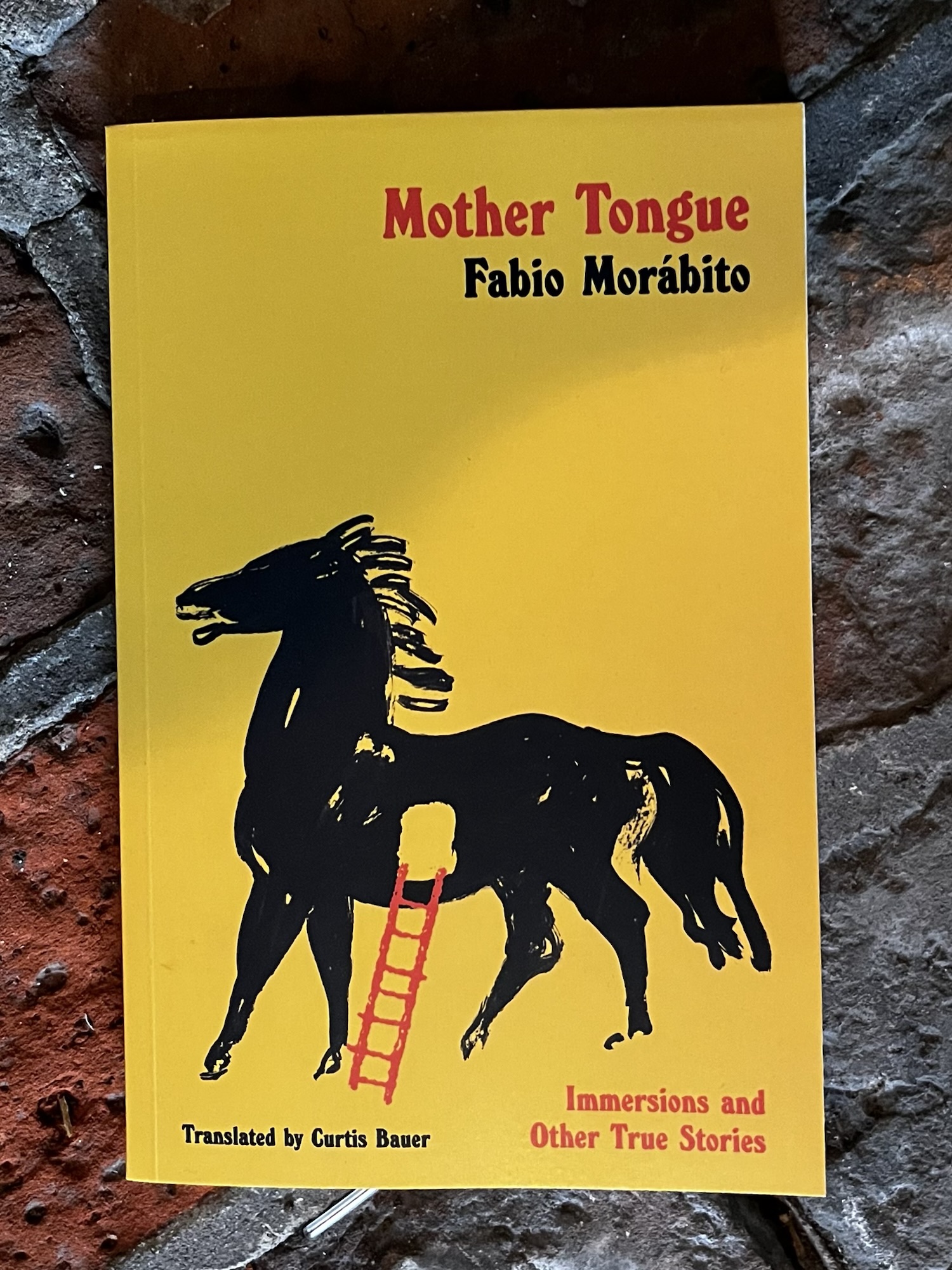
Fabio Morábito’s collection of microfictions, Mother Tongue, is new this month from Other Press (and translator Curtis Bauer!).
Here’s “To Steal”:
WHEN I WAS THIRTEEN I WOULD STEAL MONEY FROM my parents. Every day I’d remove just enough coins to go the movies, which I’d always go to by myself, running away from the oppressive climate of my house. I’d go to the first afternoon show, when the theater was nearly empty. I don’t remember a single movie, not one title, not one image that passed in front of my eyes. I think the vague sense of being a thief kept me from enjoying the movie and I tried not to look the ticket lady in the eye, as I was certain she knew where the money that paid for the ticket came from. I hardly had any friends at that time, my performance at school had plummeted, and movies were my only comfort. I would always steal at the same time, after lunch, taking advantage of the brief nap my parents took. My hands trembled as I dug through the pockets of my father’s bag and my mother’s coin purse. I recognized by touch each coin I needed to remove and I’d take only the exact amount necessary for the ticket, not one coin more. I don’t know what impact those thefts had on my life, and I have asked myself if they might have influenced my literary inclinations; if writing has been an extension of them, because they granted me, as well as embarrassment and remorse, a tendency toward introspection that later led me to read countless books and write a few of my own. I don’t regret these thefts and I even think that in writing workshops one should be taught to steal small quantities of money, because when one writes intensely one is in fact stealing, extracting from language’s pockets the words necessary to say what one wants to say: exactly those words, and no more. Even today, after so many years, I tend to wake very early to write, while everyone else is still asleep. I don’t conceive of writing as something illustrious but as something clandestine. I look for just enough coins to escape the stifling atmosphere of the mundane. Since I get up so early, my friends admire me for my discipline.
And Other Press’s blurb:
In 84 brief, brilliant texts that combine fiction and essay, an acclaimed Mexican author examines the role of language in our lives with insight and humor.
Forced to work with used notebooks, students learn to get creative and fill the limited space.
A man makes his way through Anna Karenina in fits and starts, telling himself that he’s laying the foundation for the day he’ll read it properly.
A woman feels isolated with a husband and daughter who don’t speak her native language, and he begins to question how well he actually knows his wife.
Touching on a host of celebrated authors who shaped his life and writing—from Homer to Kafka, Camus, and Beckett—Fabio Morábito offers a delightful, multifaceted meditation on expressing ourselves through words. What do our libraries say about us? What differentiates poetry from prose? Why do interpreters forget what they translate so quickly? How can reading change us and how others see us?

